“All that separates, whether of race, class, creed, or sex, is inhuman, and must be overcome.” –Kate Sheppard
Catherine Wilson Malcolm was born on this day in Liverpool, England in 1847. Today is the 166th anniversary of her birth.
Although christened Catherine she preferred Kate. She lived in London, Nairn (Scotland) and Dublin. She was well-educated and excelled in science, the arts and law. She shared her father’s love of music and her mother’s faith in the Free church of Scotland (her uncle was a minister in the church.) She lived in the UK until 1869. After her father passed away her mother, brother and sister moved to Christchurch, New Zealand. At 24 she married Walter Allen Sheppard, and they had a son, Douglas.
In New Zealand she got involved in the temperance movement.
Women’s Christian Temperance Union, which advocated women’s suffrage as a means to fight for liquor prohibition. For Kate, suffrage quickly became an end in itself. Speaking for a new generation, she argued, ‘We are tired of having a “sphere” doled out to us, and of being told that anything outside that sphere is “unwomanly”.’ [New Zealand History Time Line]
She quickly became the leading voice for the movement and deployed her organizational, writing and speech making skills to rally other women to the cause. The women refused to follow the advice of critics such as ” Wellington resident Henry Wright” who wrote…
…women were ‘recommended to go home, look after their children, cook their husbands’ dinners, empty the slops, and generally attend to the domestic affairs for which Nature designed them’; they should give up ‘meddling in masculine concerns of which they are profoundly ignorant’. [Ibid]
New Zealand became the first country to pass a Woman’s suffrage bill, granting woman the right to vote, in 1893. A a 766-foot-long petition containing 32,000 signature was unrolled in front of the country’s Parliament to get the job done.
National Council of Women at the inaugural meeting in Christchurch in 1896 (Photo credit: Wikipedia)
Sheppard continued to work for women’s rights and freedoms. She traveled the world to promote the women’s right to vote, and became president of the National Council of Women of New Zealand as well as the editor of The White Ribbon, a New Zealand newspaper owned, managed and published by women.
She died on 13 July 1934, a year after the first woman MP, Labour’s Elizabeth McCombs, entered Parliament. In recent years Sheppard’s contribution to New Zealand’s identity has been acknowledged on the $10 note and a commemorative stamp. [Ibid]
“I think my being such a nomad let me into acting. I was always having to create a new image whenever we moved.” — Aidan Quinn
Legends of the Fall [Image courtesy: Tristar films]
Aidan Quinn was born on this day in Chicago, Illinois, USA in 1959. He is 54.
Born to an Irish American family, he grew up in Illinois ( in Chicago and Rockford) and in Ireland. His mother, Teresa, was a bookkeeper, his father, Michael, was a literature professor. Brothers Robert, Paul, and Declan and sister Marian round out the Quinn brood. He studied acting at the Piven Theatre Workshop in Evanston, Illinois and has a BFA in acting from DePaul University in Chicago, IL.
Quinn in Desperately Seeking Susan.
After working on the stage in Chicago he made the jump to film in 1984 with the drama Reckless, but broke through with the comedy Desperately Seeking Susan in the role of Dezin 1985. The Television drama An Early Frost, in which Quinn plays a young man with AIDS, earned him his first Emmy nomination. The next year he played a small role in [one of my favorite movies of all time] The Mission. “…Quinn found a niche playing sensitive, intelligent male characters, often in supporting roles. Notable films includeAvalon, Benny & Joon, Michael CollinsandPractical Magic.” [Biography.com]
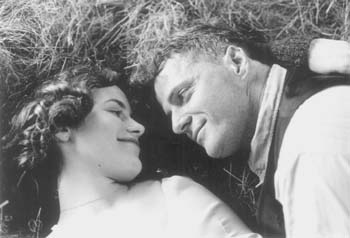
One film that was close to his heart was also a family affair. He plays Kieran O’Day in 1998’s This is My Father.
He plays a poor Irish farm hand in love with Moya Farrelly’s Fionna in This Is My Father
The film was written and directed by his brother Paul, brother Declan was the cinematographer, and sister Marian had a cameo.
Although having starred alongside “big names …and in some “big” films such as Legends of the Fall, Mary Shelley’s Frankenstein… and Michael Collins he has managed to keep a fairly low profile. This is not something he’s unhappy about, since he likes to keep his private life private. [Aidan Quinn — The Biography]
“Celebrity” he says ” is not a thing to seek.” That’s not to say he doesn’t keep busy. Between films, television and the stage Quinn has performed regularly (averaging 3 or 4 projects a year) since he entered the business.
Recently he’s been in the movie Sarah’s Key and the US version of Prime Suspect. You can currently catch him in Elementary.
Aidan Quinn 2 by David Shankbone (Photo credit: david_shankbone)
“I don’t think you can ever do your best. Doing your best is a process of trying to do your best.” — Townes Van Zandt
Van Zandt in the film Heartworn Highways (Photo credit: Wikipedia)
Townes Van Zandt was born on this day in Fort Worth, Texas, in 1944. Today is the 69th anniversary of his birth.
He was born into East Texas Oil royalty. His great-great-great grandfather was a prominent leader of the Republic of Texas and his great-great grandfather was a founder of Forth Worth. His father, a corporate lawyer traveled extensively for his job, and the family moved frequently when Townes, his brother Bill and sister Donna were growing up.
When he was 12 he got a guitar for Christmas and he taught himself to play. He wanted to be like Elvis, who he saw on Ed Sullivan, because Presley had “all the money in the world, all the Cadillacs and all the girls, and all he did was play the guitar and sing.” [Townes Van Zandt] He did well in school and scored very high on standardized test. He went to the University of Colorado at Boulder for a while, but his parents pulled him out because of his depression and binge drinking. They had him hospitalized for manic depression. The treatment he received left him with out much of his long-term memory. He tried going back to school for pre-law and tried to join the Air Force, but neither panned out.
So he turned to music. By 1965 Van Zandt was playing regularly in local Huston venues. He was influenced largely by folk (Dylan) and Blues. At first he performed mostly covers, but then he started to write his own songs.
Singer-Songwriter Townes Van Zandt in Concert at “Kult” Niederstetten, Germany (Photo credit: Wikipedia)
He never hit the big time (though other artist had #1 hits with his songs). He was on the constant grind of touring, writing and recording. There was a lot of drinking a substance abuse interspersed amongst the touring, writing and recording. Still he put out some pretty awesome music in the 30 years he performed, and he was a big influence on performers to come… and his voice — one part gravel, one part yodel, one part whiskey — breaks your heart.
By 1996 years of hard living had caught up with him. He fell down a flight of concrete steps and hurt his neck and hip on December 19 or 20th, but he refused medical treatment until December 31st. X-rays revealed a fractured hip. Faced with detoxing and a series of operations Van Zandt left the hospital with his ex-wife. He died the next day, on January 1, 1997. He was 52 years old.
The Late Great Townes Van Zandt (Photo credit: Wikipedia)
For the Sake of the Song – 1968
Our Mother the Mountain – 1969
Townes Van Zandt – 1969 Delta Momma Blues – 1971 High, Low and in Between – 1972
The Late Great Townes Van Zandt – 1972
Flyin’ Shoes – 1978
At My Window – 1987
The Nashville Sessions – 1993 (recordings from the aborted Seven Come Eleven album, recorded 1972)
No Deeper Blue – 1994
Cover of No Deeper Blue
The art of Townes Van Zandt reveals itself a little at a time. Every hearing brings forth something you can’t believe you missed all the other times, or something that rings even truer today than back. [Townes Van Zandt Central]
“I live and love in God’s peculiar light.” — Michelangelo
Michelangelo Buonarroti (Photo credit: Wikipedia)
———————————————————
Some days are deserts I struggle to find some one to profile on this blog…and some days are overwhelming. Today, besides Dame Kiri (who got the official Thought of the Day birthday nod) Michelangelo, Cyrano De Bergerac, Gabriel Garcia Marquez, Elizabeth Barrett Browning, Willie Mays, and astronaut Gordo Cooper were on the A List for a possible birthday nod. I think it came down to the fact that I wanted to listen to some opera today, so Kiri won.
But I just can’t ignore Michelangelo.
Especially given what is happening RIGHT NOW in what is arguably his most famous “installation” the Sistine Chapel.
The family soon moved to Florence, when Michelangelo was still a baby. His mother was ill, so little Michelangelo was sent to a wet-nurse who was part of a family of stone cutters.
Michelangelo’s father realized early on that his son had no interest in the family financial business, so agreed to apprentice him, at the age of 13, to the fashionable Florentine painter’s workshop. There, Michelangelo was exposed to the technique of fresco. Michelangelo had spent only a year at the workshop when an extraordinary opportunity opened to him: At the recommendation of Ghirlandaio, he moved into the palace of Florentine ruler Lorenzo the Magnificent, of the powerful Medici family, to study classical sculpture in the Medici gardens. [Biography.com]
“Faith in oneself is the best and safest course.” — Michelangelo
He went back to Florence in 1495 and worked as a sculptor. Three years later he moved to Rome where he met Cardinal Jean Bilhères de Lagraulas.
Michelangelo sculpted his Pieta, a sculpture of Mary holding the dead Jesus across her lap, for the Cardinal’s tomb.
Carved from a single piece of Carrara marble, the fluidity of the fabric, positions of the subjects, and “movement” of the skin of the Pieta—meaning “pity” or “compassion”—created awe for its early spectators. [Ibid]
His next major work was David.
front (Photo credit: Wikipedia)
He “turned the 17-foot piece of marble into a dominating figure.” [Ibid]
“A man paints with his brains and not with his hands.”— Michelangelo
The project fueled Michelangelo’s imagination, and the original plan for 12 apostles morphed into more than 300 figures on the ceiling of the sacred space. … Michelangelo fired all of his assistants, whom he deemed inept, and completed the 65-foot ceiling alone, spending endless hours on his back and guarding the project jealously until revealing the finished work, on October 31, 1512…. The resulting masterpiece is a transcendent example of High Renaissance art incorporating the Christian symbology, prophecy and humanist principles that Michelangelo had absorbed during his youth. The vivid vignettes of Michelangelo’s Sistine ceiling produce a kaleidoscope effect, with the most iconic image being theCreation of Adam… [Ibid]
michelangelo (Photo credit: 熊͘)
The ceiling of the Sistine Chapel (Photo credit: Wikipedia)
After the Sistine Chapel his work moved more toward architecture. He designed the tomb for Pope Julius II, the Laurentian Library in Florence, and the Medici Chapel. In 1546 he was appointed as the new architect for St. Peters Basilica in Rome. He designed the famous dome that crowns the church and work was well underway on it when Michelangelo died on Feb 18, 1564.
Robert MacPherson (1811-1872) – Rome – St. Peter’s Dome in the Vatican. (Photo credit: Wikipedia)
Last Judgment of Michelangelo Buonarroti (Photo credit: Wikipedia) The Last Judgement is a massive painting that takes up the alter wall of the Sistine Chapel. It took 4 years to complete.
“When I perform Strauss, it is as if the music fits me like a glove. My voice seems to lie in a happy area in this music, which is lyrical and passionate at the same time.”–Kiri te Kanawa
Claire Mary Teresa Rawstron was born on this day in Gisborne, on the North Island of New Zealand in 1944. She is 69 years old.
She was adopted by Thomas and Nell Te Kanawa as an infant. She went to school at Saint Mary’s College in Auckland where she was trained to sing. In her teens and 20’s she was a popular singer in New Zealand. “She enrolled in the London Opera Center in 1966, and had her Covent Garden debut 1 December 1971.” [IMDb — Kiri Te Kanawa] Her first performance on stage was as the Second Lady in Mozart’s The Magic Flute.
She “was granted a three-year contract as a junior principal at Covent Garden.” [Bach Contatas.com] and soon came to…
international attention singing the role of Xenia in Boris Godunov and the Countess in Le Nozze di Figaro….after her successes at Covent Garden, Kiri Te Kanawa performed her Metropolitan Opera debut as Desdemona in Otello (replacing an ill Theresa Stratas). Her other performances include Fiordiligi in Cosi fan tutte, Arabella in Arabella, Rosalinde in Die Fledermaus, Violetta in La Traviata, Tosca in Tosca, Pamina in Die Zauberflöte and, most notably, her numerous performances as Donna Elvira in Mozart’s Don Giovanni.[Ibid]
Te Kanawa sang “Let the Bright Seraphim” at Prince Charles and Lady Diana’s wedding. Her “O Mio Babbino Caro,” and “Ch’il bel sogno di Doretta,” by Puccini, were featured in 1986’s “A Room With A View.”
She was made a Companion of the Order of Australia in 1990, awarded the Order of New Zealand in the 1995, made an Officer of the Order of the British Empire in 1973, and made “Dame Commander of the Order of the British Empire in 1982 for her services to music.” [IMDb — Kiri Te Kanawa]
But why am I TALKING about her when I could be letting you HEAR her sing ?
Here’s O Mio Babbino Caro by Puchinni
And how about a little Mozart on a snowy afternoon? Here’s Porgi amor from Le nozze di Figaro
When word reached Henry that Becket was hiring armed men to protect him he said “What miserable drones and traitors have I nourished and brought up in my household, who let their lord be treated with such shameful contempt by a low-born cleric?” [History of Britain, Schama, pg 142] It was said in a moment of frustration and anger, and probably not given as command, but it was all the anti- Becket faction needed. Four knights set out to murder the Archbishop while he was at Vespers in Canterbury Cathedral. “Almost overnight Becket became a saint. Henry reconciled himself with the church.” [BBC.co.uk] He was genuinely grief-stricken over the loss of his former friend. He did penance at Beckett’s tomb and reversed the Constitution of Clarendon.
Family
English: Henry II and his wife Eleonora (Photo credit: Wikipedia)
Henry had trust issues. Those extended to his family. Eleanor, 10 years Henry’s senior, was very much in love with him when they first married. She was a dutiful wife and bore him seven children, five of whom were boys. She traveled with him when she could. But he preferred to have Becket entertain visiting royalty — usually the Queen’s job — and he was a restless busy man who gave her titles but not power. She put up with it for 14 years before returning to Aquitaine to “assume personal control of the lands. Henry was left to his own affairs (of every sort) back in England.” [About.com]
Henry now had problems within his own family. His sons – Henry, Geoffrey, Richard and John – mistrusted each other and resented their father’s policy of dividing land among them. There were serious family disputes in 1173, 1181 and 1184. The king’s attempt to find an inheritance for John led to opposition from Richard and Philip II of France. Henry was forced to give way. [BBC.co.uk]
[James Goldman’s excellent play The Lion in Winter portrays a fictionalized Christmas between the imbittered royal family in 1183.]
Henry and Richard were at war in France when Henry took seriously ill. After so many years of refusing to name Richard his heir he was forced to do so at Ballan. He died on the 6th of July, 1189.
———————————————-
Links:
We saw The Lion in Winter at the American Shakespeare Center in Staunton, Virginia last summer. It was an amazing theatre and an awesome Shakespeare (and historical) experience. Click on the link and check them out.
James Keegan as King Henry in The Lion in Winter, 2012. Photo by Michael Bailey. [At the American Shakespeare Center.]
Henry II of England was born on this day in Le Mans, France in 1133. Today is the 880th anniversary of his birth.
Henry, Count of Anjou, Count of Maine, Duke of Normandy, Duke of Aquitaine, Count of Nantes, Lord of Ireland, and eventually King of England (1154–89) was the oldest child of Empress Matilda and Geoffrey the Fair. Matilda was the eldest daughter of England’s Henry I who died unexpectedly in 1135 without naming an heir. She had a strong claim that her baby boy, a direct male descendant should be next in line for the throne, but her cousin Stephen, Count of Blois, (aka Stephen the Usurper), got there first. Matilda, aided by her half-brother Robert of Gloucester, raised an army and a 17 year civil war ensued.
Stephen and Henry discuss across the River Thames how to settle the succession of the English throne. (Photo credit: Wikipedia)
Henry’s early years were spent in the Court of Anjou with his father, but beginning in 1142 the boy traveled to England to join the campaign. The years he spent living in a Spartan manner followed him the rest of his life and Henry eschewed the opulence and soft pleasures of other monarchs.
1151, Henry became ruler of Normandy and Anjou, after the death of his father. In 1152, he married Eleanor of Aquitaine, the greatest heiress in western Europe. In 1153, he crossed to England to pursue his claim to the throne, reaching an agreement that he would succeed Stephen on his death, which occurred in 1154. [BBC.co.uk]
Henry and Becket
The next order of business was to restore peace and order in England. To do that Henry turned to Thomas Becket. Together they rid the country of the robber barons, disloyal knights and criminals who were lapping up the offal of 17 years of war. As a reward for a job well done (and to strengthen his own power over the church) Henry named Becket Archbishop of Canterbury when the old Archbishop died. The church hierarchy was stunned and dismayed, Becket was the King’s man. He wasn’t even a priest. He was ordained on June 2nd, 1162, and consecrated Archbishop on June 3rd. But Becket surprised everyone, especially Henry. He undertook a religious transformation, and where he had been loyal wholly to the King he was now loyal only to God. He began to work to restore the powers of the Archbishop and the Church, especially in matters of Law.
English: King Henry II and Thomas Archbishop Česky: Jindřich II. a Thomas Beckett From the Liber Legum Antiquorum Regum, a 12th century work (Photo credit: Wikipedia)
Henry thought the Law of the Land superseded the Law of the Church. Becket disagreed. Henry called and assembly of clergy to Clarendon Palace in January 1164 where he demanded that Becket sign the Constitution of Clarendon which “established procedures of criminal justice, establishing courts and prisons for those awaiting trial. In addition, the assizes gave fast and clear verdicts, enriched the treasury and extended royal control.” [BBC.co.uk] In other words it gave Henry power over the church. After much heated debate Becket pledged an oath to the idea of the Constitution, but he refused to sign. Henry was satisfied. But later when Becket refused to say mass until the oath was overturned. Henry was outraged and had the Archbishop put on trail for treason. Becket fled for exile in France. A battle of wills ensued between two of Europe’s most stubborn men and neither Queen Elinor nor the Pope Alexander III could bring the parties together. Becket used the last most powerful arrow in his quiver. He tried to excommunicate Henry. Henry countered by threatening to arrest any one who supported Becket with treason. Becket’s support dwindled. He agreed to meet Henry in July of 1170. Becket accepted Henry’s legal supremacy in England. He was allowed to return to England. But he wasn’t willing to leave well enough alone.
Henry II with Thomas Becket, from a 13th-century illuminated manuscript (Photo credit: Wikipedia)
“If you do things out of time you’re weird.” — Robyn Hitchcock
[Image courtesy: TurnTableInterview.com]
Robyn Rowan Hitchcock was born on this day in London, England in 1953. He is 60 years old.
[I couldn’t find anything about Hitchcock’s upbringing or family. Nada. Zip. Really… I looked. If you can find something send a reply.]
He started his music career as a singer songwriter in the 1970’s. He listened to the Beatles, Dylan, the Velvet Underground and absorbed it all. He says he developed a kind of song writing muscle that takes hold every summer and starts producing with out his taking any notice of it. He genre hopped from Folk to Punk with his band, the proto-punk group The Soft Boys.
The Soft Boys (Photo credit: Wikipedia)
The group, “a punk-era band specializing in melodic, chiming jangle pop and clever lyrics” [All Music] mixed the psychedelic with the weird, but they kept away from the “aggressive, simplistic approach of most punk bands.” [About.com] Their “masterpiece” [Ibid] album Underwater Moonlight, released in 1980. Soon after Underwater Moonlight was released the group broke up and Hitchcock made his solo debut with Black Snake Diamond Role.
Black Snake Diamond Role represented a subtle but clear shift away from the more aggressive tone of The Soft Boys toward a more pop-oriented sound. “The Man Who Invented Himself” is user-friendly… and the production, while mostly straightforward, is …polished and professional. …the surrealism of the lyrics and the trippy undertow of the melodies are in the same league as Hitchcock’s earlier work…. Black Snake Diamond Role staked out a distinct sonic territory for Hitchcock’s solo career [All Music — Black Snake Diamond Role review]
Here’s I’m the Man with the Lightbulb Head:
The 80’s progressed with Groovy Decay and the all-acoustic I Often Dream of Trains. Then he formed Robyn Hitchcock and the Egyptians and produced the album that usually tops the Best of Robyn Hitchcock list, Fegmania!
Featuring layered, intertwining guitars and keyboards that created lush and thick sonic textures. … Fegmania! was Hitchcock’s most consistent work to date, featuring such highlights as the Eastern-tinged “Egyptian Cream,” and the creepy “My Wife & My Dead Wife,” and the relatively straightforward “The Man with the Lightbulb Head.” [All Music review of Fegmania!]
In 1988 he signed with A&M Records, thus widening his reach to an American audience. He put out Globe of Frogs in ’88 and (my favorite Hitchcock record) Queen Elvis ’89.
Here’s a live version of Lost Madonna of the Wasp:
and a very MTV version of the brilliant One Long Pair of Eyes:
Perspex Island and Respect followed in 2 year intervals for A&M. Then he switch to Warner for Moss Elixir for which he…
returned to the spare singer/songwriter format for his best set of songs in more than ten years. Everything is here: the quirky on “Man with a Woman’s Shadow,” and the elegant on “Beautiful Queen,” and the straight-ahead Beatlessque music in which Hitchcock excels in the perfect pop of “Alright, Yeah.” [All Music review of Moss Elixir]
He did a few more “solo” LPS — Jewels for Sophia, 1999, Luxor, 2003, and Spooked, 2004 — before teaming up various rockers to form the Venus 3 project in 2006. With Venus 3 he put out Olé! Tarantula, 2006, Goodnight Oslo, 2009 and Propellor Time, 2010. In 2011 he released Tromsø, Kaptein, on Hype City Records, a Norwegian label.
He has a new album, “Love from London,” coming out on Tuesday. He’ll be touring the UK and the US shortly to celebrate the album.
“Forty years ago, when I first got hold of an electric guitar, if someone had told me that at 60 I’d be playing amplified beat music, I would have just said, ‘Get out of here! … It’s like Mr. Rogers is playing guitar; that’s gross!’ But you know, rock ‘n’ roll is an old man’s game now.” [NPR: Weekend Edition]
English: Musician Robyn Hitchcock on stage at Iron Horse in Northampton, Massachusetts, 13 March 2005 (Photo credit: Wikipedia)
—————————–
This blog goes out to my buddy Sam who reminded me that today is Robin Hitchcock’s birthday. Sam, who is a freshman in college, learned about Hitchcock through his dad, Chip. He says “I think what I like most about Robyn’s style is his dreamy weirdness, but also the ability his songs have to be interpreted many different ways.” Some of Sam’s favorite Hitchcock songs are
Queen Elvis,
So You Think You’re In Love,
Victorian Squid,
Balloon Man,
The Man Who Invented Himself, and
The Man With The Lightbulb Head.
“One of the great things about being a director as a life choice is that it can never be mastered. Every story is its own kind of expedition, with its own set of challenges.”– Ron Howard
Gallery ~ Opie Taylor (Photo credit: erjkprunczýk)
Ronald William Howard was born on this day in Duncan, Oklahoma, USA in 1954. He is 59 years old.
He was born into a theater family. His mother was an actress, and his father both acted and directed. He was in his first film at 18 months and on stage at 2. He appeared on television frequently as a child and had reoccurring gigs on CBS’s Playhouse 90, Dennis the Menace, and The Many Loves of Dobie Gillis before landing the roll of Opie Taylor in the Andy Griffith Show.
He played Opie from 1960 to 1968. The show ran for 268 episodes and was ranked as the #9 best show in American Television History by TV Guide.
Howard kept busy while the show was in summer hiatus with family films like The Music Manand The Courtship of Eddie’s Father.
In the early 70’s the worked on The Smith Family, a sitcom about a police detective and his family starring Henry Fonda. (It lasted two seasons) In 1973 he starred in George Lucas’ American Graffitti. Then hit with another sitcom as the star of Happy Days.
Photo of Richie (Ron Howard) dressed as a girl dancing with Fonzie (Henry Winkler) from the television program Happy Days. In this episode, Richie must dress as a girl and attend a Jefferson High School dance as part of an initiation. (Photo credit: Wikipedia)
His second act came as a producer / director / producer. He’d been behind the camera before Happy Days was a wrap, but it was Night Shiftwith Michael Keaton, Shelly Long, and Happy Days alum Henry Winkler that made his as a Director. Other comedies include Splash, Gung Ho, Cocoon, How the Grinch Stole Christmas, and The Dilemma.
Adult Opie in the 1986 reunion telemovie, “Return to Mayberry”. (Photo credit: Wikipedia)
Dramas and Dramedies include: Parenthood, Backdraft, Far and Away, The Paper, Apollo 13, Ransom, A Beautiful Mind,The Missing, Cinderella Man, The Da Vinci Code, Frost / Nixon and Angels & Demons. He won an Academy award for A Beautiful Mind,and the Directors Guild of America Award for A Beautiful Mind and Apollo 13.
Next up is a biopic about formula one race car drivers in RUSH due out in September of this year.
Ron Howard during filming of Angles and Demons in Rome. (Photo credit: Wikipedia)