Steven Vincent Buscemi was born on this day in Brooklyn, New York, USA in 1957. He is 55 years old.
Buscemi is part Irish and part Italian, he’s one of four boys born to John Buscemi, a sanitation worker, and Dorthy Buscemi a hostess. He went to Valley Stream Central High School where he wrestled and acted. After graduating in 1975 he attended Nassau Community College then moved Manhattan to attend the Lee Strasberg Institute. He worked on FDNY Engine #55 as a fire fighter. He has worked as a bartender, a stand-up comedian, an ice-cream truck driver before breaking into acting. One of his brothers, Michael, is also an actor.
He made his film debut with a short called Tommy’s (in which he played Tommy), in 1985. He took on the odd ball, character actor roles — often the mafia types and worked in dozens of TV shows and movies. When he hooked up with the Coen Brother’s his off beat sensibilities found a home.
He played Mr. Pink in Quentin Tarntino’s Reservoir Dogs. Then paired up with the director again for a bit part in Pulp Fiction.
English: Photo of a young Steve Buscemi (American actor). Taken in Silverlake / Los Angeles. (Photo credit: Wikipedia)
Buscemi was brilliant as Carl Showalter, the can’t-catch-a-break smal-time crook in Fargo.
His movie and tv CV is impressive, and he’s the kind of actor where you see a movie title and you think “Oh, yeah, he WAS in that.” From Templeton the Rat (in 2006’s Charlotte’s Web) to Donny (in 1998’s The Big Lebowski) to Lenny Wosniak (his recurring guest spot on 30 Rock) Buscemi is wonderful to watch — even when you want to turn away.
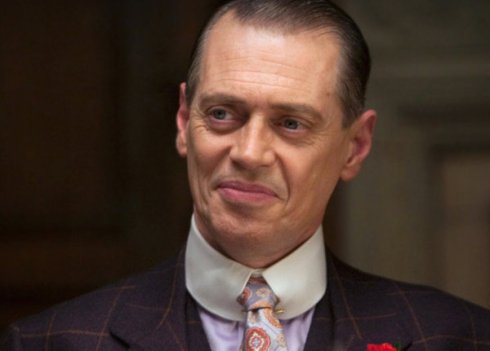
Most recently he’s been the star of HBO’s Boardwalk Empire. As amoral Nucky Thompson he manages to hang on to a thread of inner humanity to keep his character viable. And , oh, yeah, he’s a hoot. (When he’s not killing people.)
Francis Albert Sinatra was born on this day in Hoboken, New Jersey, USA in 1915. Today is the 97th anniversary of his birth.
Frank was the only child of Marty and Dolly Sinatra. As a kid he stood on top of the bar at a local nightclub and sang for tips. He dropped (or was kicked) out of high school, and help make ends meet at home by delivering the local paper, the Jersey Observer. He also worked as a riveter at a local shipyard. Although he couldn’t read music he began singing professionally by the mid 1930s when he joined the Three Flashes (they changed their name to the Hoboken Four.)
He worked as a singing waiter in Englewood Cliffs for $15 a week for almost 4 years. Then Henry James signed him for a one year contract at $75 a week. On July 13th, 1939, as the US was emerging from a decade of Depression and the world was on the advent of another great War, 23-year-old Frank Sinatra recorded his first record, From the Bottom of my Heart, with the Harry James Orchestra.
He released 10 songs with James (none of which charted particularly high in their original pressing.) Sinatra switched to the more popular Tommy Dorsey’s band (with James’ blessing) in November. He recorded over 40 songs on Dorsey. One of his biggest hits with Dorsey was I’ll Never Smile Again.
By 1941 he was at the top of both the Billboard and Down Beat magazine polls. Not only did he sell records, he opened up an entirely new audience — the bobby soxers (aka teenagers.) [It seems odd today — when so much of a company’s advertising budget goes toward capturing the 12-20 year old’s pocketbook — but prior to 1940 most consumers were adults. Sinatra appealed to both adult women and bobby sox wearing girls.]
He went solo in 1943 and in the next three years he charted 17 times. Sinatra was classified 4-F for military service because of a perforated eardrum, so he did not serve in the military.
He started making films as part of the Dorsey Band with Las Vegas Nights and Ship Ahoy, he had a walk on / singing part in the wonderfully named Reveille with Beverlybut then had his first real role inHigher and Higher. He teamed with Gene Kelly for the hugely successful Anchors Aweigh in 1945. It was the first of three Sinatra/Kelly films with Take Me Out to the Ball Gameand On the Towncoming out in 1949. He won a special academy award for his work on the (dated) short film The House I Live In. (1945)
At the beginning of the 1950’s Sinatra saw his popularity wane somewhat. The bobby soxers who had screamed out deafening choruses of “FRANKIE” for the thin, blue-eyed singer had found new idols to adore.
He came back with a bang with his next movie, 1953’s From Here to Eternity. He won an Oscar as bad boy Angelo Maggio.
Cover of From Here to Eternity
The same year he signed with Capitol Records. In 1954 his album Swing Easy! was named Album of the Year by Billboard and the single Young At Heart was picked for Song of the year. Swing Easy was arranged by Nelson Riddle. Sinatra and Riddle worked together again for Songs for Swingin’ Lovers!which included I’ve Got You Under My Skin.
He poked fun at his mobster image in the movie version of Guys and Dolls. in 1955 as Nathan Detroit. In 1956 he played Mike Connor to Grace Kelly’s Tracy Lord in High Society. The next year he was Joey in Pal Joey.
He started his own record label in 1960, Reprise Records.
In 1962 he starred in his most dramatic movie the classic political thriller, The Manchurian Candidate. [For my money The Manchurian Candidate is the best movie of the bunch.]
He was a founding member of the Rat Pack and worked alongside Dean Martin, Peter Lawford, Sammy Davis Jr., and Joey Bishop in several movies and countless nightclub acts.
Here he is having a ton of fun singing Lady Is a Tramp with the incomparable Ella Fitzgerald
Sinatra was a sucker for charities. He raised over a billion dollars in the course of his life for charities all over the world.
His generosity touched the worlds of education, medicine, science, and children’s needs, his favorite cause. … Sometimes it was a late-night phone call that moved him; sometimes he just caught wind of a hard-luck story on the news or in the paper and did what he could to fix it. [Sinatra.com]
In 1962 he led a 12 country World Tour for Children that raised over a million dollars for children’s charities worldwide. He paid for the entire cost of the tour himself, and recruited other musical luminaries to join him.
He also worked against segregation , taking a major role in the desegregation of Nevada entertainment and hospitality industry in the 1960s. He boycotted venues and hotels where black performers and guest were banned. And he played benefits for Martin Luther King, Jr. and the Equal Right Movement.
Sinatra received the Presidential medal of Freedom from Ronal Reagan in 1985.
Ole’ Blue Eyes faced his final curtain on May 14, 1998. He was 82 years old.
“He looked like something that had gotten loose from Macy’s Thanksgiving Day Parade.”
–Harpo Marx
Adolph Marx was born on this day in New York City, New York, USA in 1888. Today is the 124th anniversary of his birth.
The second of five brothers in the Marx family, Adolph didn’t make it past second grade in school. He was small for his age and he was picked on by the bigger boys because he was Jewish. Two boys literally threw him out of the (first floor) classroom window on several occasions before he gave up and left school. He joined his brother Chico in doing odd jobs to help the family.
His uncle Al Schoenberg (stage name Al Shean) was in a Vaudeville act. His older brother Chico played piano, and his younger bother Julius (Groucho) was a boy soprano. Adolph joined Julius and Milton (Gummo) to form “the Three Nightingales” in 1910. Lou Levy joined them to make the group “The Four Nightingales.” When their mother, Minnie, and Aunt Hannah joined the act they changed the name to “The Six Mascots.”
The five Marx brothers with their parents in New York City, 1915. From left to right; Groucho, Gummo, Minnie (mother), Zeppo, Frenchy (father), Chico, and Harpo. (Photo credit: Wikipedia)
In 1911 he changed his name to Arthur because he didn’t like the sound of Adolph. He adopted the stage name of Harpo when his mother sent him a harp. He didn’t know how to tune it or play it. He didn’t even know how to hold it until he found an image of an angel holding a harp at the 5&10 store. He tuned it the best he could and taught himself to play.
At that point Harpo’s two-fold schtick — he “couldn’t talk” so he blew his horn or whistled to communicate; and he played the harp — was in place. (He could, in fact, talk. And he did so — a lot — off stage/scene. His “speaking career” stopped after he received a bad review for a largely ad-libbed performance in the play Home Again.)
A critic in the local newspaper described the show by saying, in part, “Adolph Marx performed beautiful pantomime which was ruined whenever he spoke.” Harpo then decided he could do a better job of stealing focus by not speaking. [The Marx Brothers; Harpo Marx from an article in Theatre Arts Monthly, October 1939]
The four Marx Brothers stowing away on an ocean vessel by hiding in barrels in this promotional still for Monkey Business. Left to right: Harpo, Zeppo, Chico, Groucho. (Photo credit: Wikipedia)
From the Vaudeville stage the Marx Brothers moved on to Hollywood. They made the short, Humor Risk, in 1921. (The film has since been lost.) Harpo was then in Too Many Kissesas the character “The Village Peter Pan.” He actually has a line in this movie, but, as it’s a silent film, you don’t actually hear him speak it. His brothers did not appear in the film.
In 1929 the brothers put out The Cocoanuts.The film was based on their Broadway play of the same name. In it…
the Marx Brothers run a hotel, auction off some land, thwart a jewel robbery, and generally act like themselves. [IMDB]
They shot during the day and performed in the stage show of Animal Crackers at night. It was an exhausting schedule and the Brothers were not happy with the result. They were “so appalled … that they offered to buy the negative from Paramount so that they could burn it.” [Ibid]
Marx Brothers, head-and-shoulders portrait, facing front. Top to bottom: Chico, Harpo, Groucho and Zeppo. (Photo credit: Wikipedia)
The Brothers made Animal Crackers,Horse Feathers , Duck Soup, A Night at the Opera, A Day at the Races, Room Service, At the Circus, Go West, The Big Store, A Night in Casablanca, and Love Happy in quick succession.
Starting in 1952 Harpo started doing guest spots on Television, most notably on the I Love Lucy Show.
His last film was The Story of Mankindin 1957. He played Sir Isaac Newton.
Off screen Harpo, the elementary school drop out, rubbed shoulders with some pretty high level literary types. In the 1920’s he held his own at the Algonquin Round Table with writers such as George S. Kaufman and Dorothy Parker. In 1928 he spent the summer on the French Riviera with George Bernard Shaw.
He attributes his welcome hanging out with the fast literary crowd at the Algonquin Round Table in New York in the 1920s to his ability to listen — in fact, to being the one real listener in that set. [Robert Wilfred Franson’s review of Harpo Speaks]
In 1933 Harpo did a 6-week goodwill mission in the Soviet Union. He was the “first American to perform in the Soviet Union after the United States government officially recognized it.” [Harpo’s Place] According to his autobiography, Harpo Speaks, the trip was part performance and part spy caper. He smuggled papers out of the USSR by taping them to his leg.
Marx died while having open-heart surgery on September 28, 1964.
Here’s a clip of Harpo actually speaking (and honking):
English: U.S. actor Steve Zahn (Photo credit: Wikipedia)
Steven James Zahn was born on this day in Marshall, Minnesota in 1967. He is 45 years old.
He started acting in high school when he discovered improv. After a year at Gustavus-Adolphus College and two years at the American Repertory Theatre he moved to New Jersey. Based in Hoboken he acted in New York and did odd jobs to pay the rent. He did a national tour of Bye, Bye Birdie directed by Tommy Tune. The gig last 13 months and Zahn met his future wife Robyn Peterman.
Cover via Amazon
Zahn co-starred with Ethan Hawke in the play Sophistry and Hawke recommended him for a part in the 1994 film Reality Bites. It was a break out role for Zahn and he followed it up with Crimson Tide and That Thing You Do!
He has made “an art out of portraying dysfunctional losers and likable freaks,” [AMG All Movie Guide: Steve Zahn] and he always made it look fun. From his turn as Rosencrantz in Michael Almereyda’s 2000 version of Hamlet to Wayne Wayne Wayne Jr. in Happy Texas it is hard to take your eyes off him when he is on-screen.
Cover of Rescue Dawn
There are some dramatic roles in his CV, to be sure. For his part as Duane inRescue Dawn. Zahn lost 40lbs.
He currently plays Jazz loving Davis McAlary on HBO’s Treme. He taps into his musical side for the show and sings and plays on screen.
Zahn lives on a farm in Kentucky with his wife and kids. He raises hay on the farm because it is easy, it allows him time away from the farm to work, and it is just funny to say.
“Hollywood amuses me. Holier-than-thou for the public and unholier-than-the-devil in reality.” –Grace Kelly
English: Studio publicity portrait for film High Society (Photo credit: Wikipedia)
Grace Patricia Kelly was born on this day in Philadelphia, Pennsylvania, USA in 1924. Today is the 88th anniversary of her birth.
Third of four children, Grace was born into a wealthy family of Irish and German background. The Kellys were athletic, her father, Jack, won three gold medals in the Olympics and her mother, Margaret, was the first female head of the University of Pennsylvania’s Physical Education Department. Her brother, John, also competed in the Olympics.
But Grace was drawn to acting. She modeled and acted in school plays starting at age 12.
At a young age, Grace decided she wanted to become an actress, and studied acting (primarily theater) at New York City’s American Academy of Dramatic Art and worked as a stage actress and model before moving to Hollywood. When in New York, Grace promoted Old Gold cigarettes and appeared on the covers of magazines such as Cosmopolitan and Redbook. [Grace Kelly Online — Biography]
She worked her way through the American Academy of Dramatic Arts by working as a model on the side. At 19 she starred as Tracy Lord in the school’s performance of The Philadelphia Story (She reprised the role in High Society, her final film in 1956)
Television and stage gigs followed. Kelly played 39 roles on high brow television theatre shows such as the Kraft Television Theatre, the Philco-Goodyear Television Playhouse, and the Armstrong Circle Theatre. The shows were a hybrid of stage performances and scripted radio drama filmed live in front of a studio audience.
English: Screenshot of Grace Kelly and Clark Gable from the trailer of the film en:Mogambo (Photo credit: Wikipedia)
After a small role in Fourteen Hours her film career took off when she played the “mousey” Quaker bride” [Ibid] in High Noon in 1952. The following year she went to Africa to shoot Mogambo with Clark Gable and Ava Gardner. Kelly was nominated for a best supporting actress Academy Award for the film.
1954 brought the first of three movies that Kelly did with director Alfred Hitchcock, Dial M for Murder. Here’s THE clip from the movie. [I think it proves what a great actress she is… not just any actress can get this much drama out of one word and a pair of scissors.]
Her next movie with Hitch was Rear Window with Jimmy Stewart. There’s plenty of tension and murder here too, but there is also a huge helping of likeability too. There is a lot of chemistry between Steward and Kelly. It’s dark, but it’s funny and romantic too. And Kelly’s Lisa Carol Fremont is soooo sophisticated and, well, graceful. [Rear Window is my favorite Grace Kelly movie and probably my favorite Hitchcock movie as well.]
Cropped screenshot from the trailer for the film Rear Window (Photo credit: Wikipedia)
That same year, 1954, she also co-starred with [the always wonderful] William Holden in a Korean War drama, The Bridges at Toko-Ri; the South American emerald mining adventure, Green Fire; and as Bing Crosby’s wife in The Country Girl. Holden was the third leg of a romantic triangle in The Country Girl. Kelly’s performance as a woman torn between a verbally abusive, alcoholic, washed up husband and a charming, kind man who looks like WILLIAM HOLDEN won her an Academy Award.
English: Screenshot of Grace Kelly and Cary Grant from the trailer of the film en:To Catch a Thief (film) (Photo credit: Wikipedia)
In 1955 her last Hitchcock movie came out. In To Catch a Thief she co-starred with Cary Grant.
When a reformed jewel thief is suspected of returning to his former occupation, he must ferret out the real thief in order to prove his innocence. [IMDb]
Again Kelly’s onscreen chemistry with her co-star elevates a good movie to a great one. To Catch a Thief won the Academy Award for best picture that year.
Her next movie was The Swan with Alec Guinness and Louis Jourdan. She plays Princess Alexandra who needs to win the heart of Crown Prince Albert (Guinness) so her family can re enter the inner circle of court life. In real life Kelly was being courted by Prince Rainier III of Monaco whom she had met while attending the Cannes Festival. The engagement ring she wears in the movie is her real ring from Rainier. The studio timed the release of the film to corresponded with the date of the royal wedding.
Kelly’s last feature film was High Society, a musical reboot of The Philadelphia Story. In it Kelly and Crosby sing True Love, a song that went platinum — selling over a million records and and earning a best song Academy Award nod.
Later that year, she married Prince Rainier Grimaldi III of Monaco to become Her Serene Highness Princess Grace of Monaco. As a princess, she gave up her successful acting career, in which she had made eleven films. She had three children: Princess Caroline, Prince Albert, and Princess Stéphanie. [Grace Kelly Online — Biography]
Wedding dress of Grace Kelly (Photo credit: Wikipedia)
Kelly had a stroke while driving with her daughter Stephanie along the windy mountainside roads of Monaco. The car went off the road and Kelly suffered fatal injuries. She died on September 14th, 1982.
“People wear shorts to the Broadway theater. There should be a law against that.” –Stanley Tucci
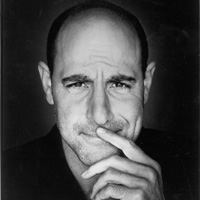
Stanley Tucci was born on this day in Peekskill, New York in 1960. He is 52 years old.
His mom, Joan, was a writer and secretary and his father, Stanly, Sr., was an art teacher. His grandparents immigrated from Calabria Italy. He enjoyed playing soccer and baseball in school, and he acted in school plays. He went to SUNY Purchase where he got his BFA from the school’s Conservatory of Theatre Arts.
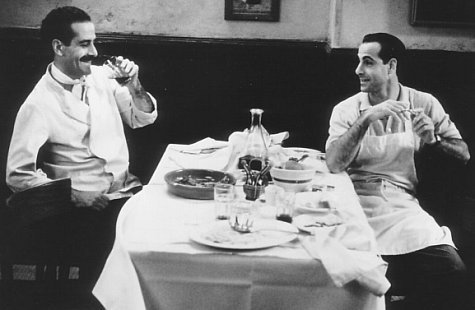
Tucci’s twin loves are acting and food — something he indulged in Big Nightand Julie & Julia. [My personal favorite pair of Tucci films.]
He’s made 93 movies and television shows in his career thus far. [For a complete breakdown of his film credits go to his IMDb page HERE] Starting 1985 with a bit part in Prizzi’s Honor and spanning nearly three decades to his role as Caeser Flickerman in the upcoming the Hunger Games: Catching Fire, Tucci has been a very busy man.
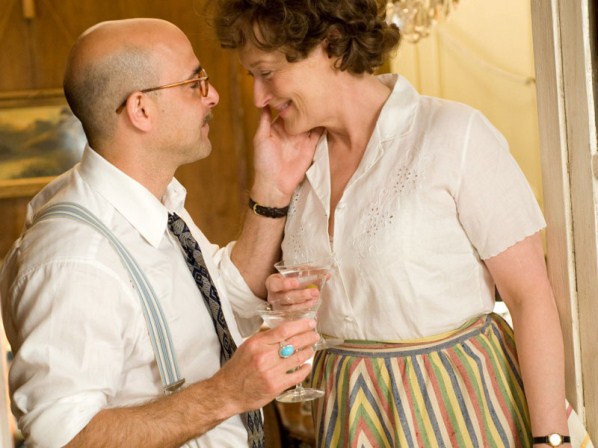
He’s a terrific collaborative actor and has been the backbone of many a movie. Think the Devil Wears Prada, orJulie and Juliafor that matter, in both he plays second fiddle to Meryl Streep. He never tries to out shine his co-star, but his performance is a little gem of acting goodness.
Movie still from Conspiracy[Image courtesy HBO]
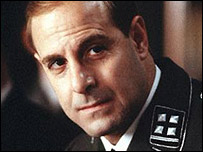
Tucci also has the ability to take a one-dimensional character and breath so much life into it that he steals the picture. He’s done it with plenty of villains — most chillingly as Adolf Eichmann in Conspiracy and George Harvey in The Lovely Bones.
Still from Big Night.
When filming Big Night –which Tucci co-wrote, co-directed and starred in — he and his mother produced a short cook book called Cucina & Famiglia. He worked with her again to put out The Tucci Cookbook ‘“The Tucci Cookbook,” a paean to Italian cooking — and to Italian-American families…” [nytimes.com] was published in October. It’s a tribute to Tucci’s Italian grandmother who taught him his kitchen skills.
“The Tucci Cookbook,” in which the recipes are interlaced with reminiscences from two generations of Tuccis, suggests the meaty, saucy ways in which a love of food can bind and govern a family. That love has certainly shaped Stanley Tucci’s life and career, in which cooking and eating seem to be the glues for every relationship, the sidebars to every adventure, the grace notes of every achievement. [Ibid]
Still from Julie & Julia
When he was cast as Paul Child in Julie & Julia he called up Meryl Streep and encouraged her to research their roles by cooking together.
Mr. Tucci… is a proud and avid cook, and at his home in northern Westchester County, … his arsenal of equipment trumps what many restaurants have on hand. In addition to the six burners and acres of counter space in his kitchen, there’s a mammoth stone pizza oven, made in Italy, on the patio outside, along with a gas grill as large as a Fiat, a free-standing paella pan the size of a wading pool, and a coffinlike wood-and-aluminum roasting box, called a Caja China, that can accommodate up to 100 pounds of meat. He likes his dinner parties populous and his friends carnivorous.[Ibid]
You can also find him on Vine Talk reruns on PBS where he host a team of experts and celebrities as they talk casually (but knowledgeably) about everything from Cabernet to Chardonnay.
“I don’t understand why I do what I do. I don’t understand why I act anymore. But I do know that I love it, and that I find it really interesting and satisfying to enter into other worlds and explore different ways of thinking.”
—Toni Collette
Toni Collette (United States of Tara) (Photo credit: Capital M)
Antonia Collette was born on this day in Blacktown, Sydney, Australia in 1972. She is 40 years old today.
Toni is the oldest of three, and only girl, to Judy and Bob Collette. The family lived about an hour away from Sydney where Bob was a truck driver and Judy was a customer-service rep. When she was six the family moved to the Sydney suburbs. She had a number of pets as a child, including cats, dogs, birds and rabbits. Toni was always a tom-boy and athletic.
Collette at 15 at the Blackstown Girls High School [Image courtesy: Toni Collette Online]
At 14 she caught the acting bug when she performed in her school’s production of Godspell. By 16, with her parents permission, she dropped out of school and enrolled in NIDA (the National Institute of Dramatic Arts, ) It was a three-year acting course, but she left after 18 months to take a role in her first film Spotswood with Anthony Hopkins and Russell Crowe. She was nominated for Best Supporting Actress by the Australian Film Institutefor her role as Wendy in the movie.
She moved to the Theatre, playing Petra in A Little Night Music , Meg in Away .
Her break out film was Muriel’s Wedding. Her hefty Muriel (she gained 40 pounds for the role) is a misfit. She has no direction in life. Her one hazy ambition is to get married, (even though she’s never had a boy friend).
A very special actress was needed, someone who could reveal the terrible torment and turmoil inside the outwardly cheery Muriel, someone who could really enjoy the extravagant highs of Muriel’s holiday – including a storming rendition of Abba’s Waterloo with Rachel Griffiths. [Ibid]
Collette is wonderful in the film about a “girl who didn’t fit in, but learns to stand out.” [from the dvd cover]. [If you are planning a Quirky Australian Film Night — and why wouldn’t you be? — throw this one in with Strictly Ballroom]
She made her Broadway in 1999 debut in Michael John LaChiusa’s The Wild Party. She nominated for a Toni Award, a Drama Desk Award and a Theatre World Award (Collette won the latter.)
She was offered the role of Bridget Jones, but had to turn it down because of her Broadway commitment. No worries, that left her free to take the role in M. Night Shyamalan’s The Sixth Sense. [Click Here to read the Thought of the Day on M. Night Shyamalan] Collette earned an Oscar nomination as the harried mother who glued her troubled son to reality in this thriller. She turned in a fantastic performance among a cast full of fantastic performances and her turn from smiling, singing Muriel or bland, sweet Harriet to intense, worried Lynn Sear let the world know that she was an actress to look out for.
She had a supporting role in Nick Hornby’s About a Boy as Fiona, and in The Hours, as Kitty in 2002. Collette received a slew of awards and nominations for both.
Cover of Little Miss Sunshine [Blu-ray]
Collette played mom Sheryl Hoover in the sleeper hit of 2006, Little Miss Sunshine. Sunshine was an ensemble piece with quirky characters all around.
…Meet the Hoovers, an Albuquerque clan riddled with depression, hostility, and the tattered remnants of the American Dream; despite their flakiness, they manage to pile into a VW van for a weekend trek to L.A. in order to get moppet daughter Olive (Abigail Breslin) into the Little Miss Sunshine beauty pageant. Much of the pleasure of this journey comes from watching some skillful comic actors doing their thing…[From Robert Horton’s review of Little Miss Sunshine on Amazon.com]
Again Collette plays a mom just trying to keep her family together (although to a lot more laughs here than she did in Sixth Sense.)
HBO and the BBC joined forces to produceTsunami: The Aftermath in which Collette plays an Australian aid worker named Kathy Graham. Tim Roth, Hugh Bonneville & Chiwetel Ejiofor also star in the film that dramatized events around the devastating the 2004 tsunami that hit Thailand.
United States of Tara (Photo credit: Wikipedia)
She won an Emmy, a Golden Globe and an Australian Film Institute Award for her work on the United States of Tara. In it she plays a housewife with dissociative identity disorder. When stressed one of her multiple personalities come out. The show ran for three seasons on Showtime.
Collette re-teamed with her Muriel director PJ Hogan for the quirky Aussie film Mental. It was release Down Under on October 4th. Other indie films out (or coming out) include the comedy Jesus Henry Christ— a comedy about a ten-year old, “petri-dish”, boy genius who goes in search of his biological father and Hitchcock— about the making of Psycho.
Collette and husband Dave Galafassi headline the group Toni Collette and the Finish. Their cd, “Beautiful Awkward Pictures” came out in 2006 features 11 of Collette’s original songs.
Your words are my food, your breath my wine. You are everything to me.
–Sarah Bernhardt
English: Sarah Bernhardt, portrait by Nadar (d. 1910) Português: Sarah Bernhardt, fotografia de Nadar (d. 1910) (Photo credit: Wikipedia)
Henriette-Rosine Bernard was born on this day in Paris, France in 1844. Today is the 168th anniversary of her birth.
The illegitimate daughter of a Julie Bernardt, a Dutch courtesan working in Paris. She was sent to Grandchamp, a Augustine convent school. She was greatly influenced by her time at the religious school and showed a desire to become a nun herself. Her first role was as the Angel Raphael in Tobais Regains His Sight, a show performed for the Archbishop of Paris when he visited the convent.
When one of her mother’s lovers, the Duke of Monry (Napoleon III’s half-brother) took an interest in young Sarah’s acting abilities, he arranged for her to go to the Paris Conservatoire at age 16 in 1862. She was forced to forget her dreams of becoming a Bride of Christ and took up a life on stage instead.
With the Duke as her patron she moved from the Conservatoire to France’s national theatre company, Comedie-Francaise where she starred in Iphigene. She left Comedie-Francaise after she slapped another actress and had a two year run at Theatre du gymnase-Dramatique.
English: Sarah Bernhardt as Joan of Arc holding banner (Photo credit: Wikipedia)
At about that time she had an affair with Charles-Joseph Eugène Henri Georges Lamoral de Ligne (Belgium) and gave birth to her son Maurice in 1864. Although the prince proposed the royal family rejected the idea of his marrying an illegitimate actress. They forbade the union and Bernhardt was left to raise Maurine on her own. [See side bar below]
In 1866 she got a contract with Theatre de L’Odeon. During her six year run at the L’Odeon she had her first big success in the French version of King Lear as Cordelia and as the Queen in Ruy Blas by Victor Hugo. Perhaps her most memorable star making role was Zanetto in Le Passant (The Passerby), a role she played in a command performance for Napoleon III.
In 1870, in the midst of the Franco-German War, Bernhardt organized a military hospital in the Odéon, and by the late 1870s, when the war was over, she resumed acting and had reached the heights of her acting career, propelled in part by her quirky behavior both on and off the stage.” [biography.com]
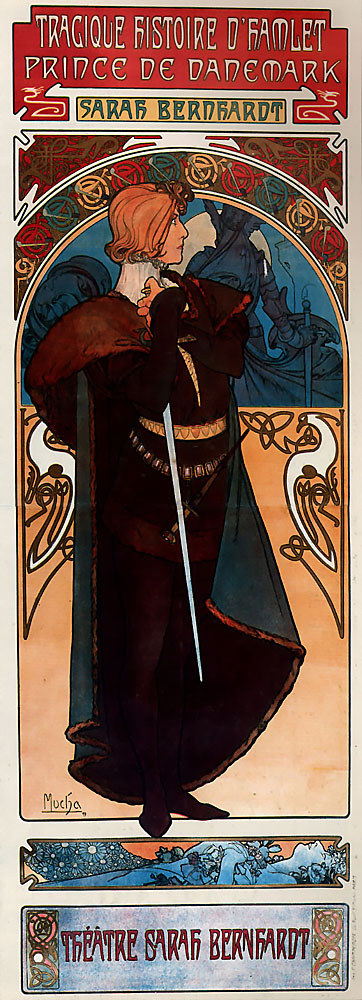
In 1899 she took over the Theatre de Nations and renamed it the Theatre Sarah-Bernhardt. In May she premiered a prose adaptation of Hamlet in which she played the great Dane.
At 61 the actress was in Rio de Janeiro starring in La Tosca.
She… injured herself in a leap off the parapet at the end of … the stage play that later became a Puccini opera, and she was in constant pain. [Sarah Bernhardt’s leg, 02.02.09 NYTimes.com]
a decade later she take the pain no longer and she ordered doctors at Bordeaux University to amputate it above the knee. She was wheelchair bound for a while, but eventually she retuned to acting (with or with out the wooden leg which she found cumbersome.) Her last three movies were filmed after the leg was amputated.
English: Portrait of Sarah Bernhardt as Hamlet. (Photo credit: Wikipedia)
With the advent of film Bernhardt became the first classical actress to lend her talents to the new medium. She filmed her version of Hamlet (Le Duel d’Hamlet — which she thought was abysmal); La Tosca; La Dame aux Camelias; Adrienne Lecouvreur; Elisabeth Reine d’Angleterre; Meres Francaise; Jeanne Dore and La Voyante.
She’s alleged to have had over 1,000 lovers. When she was 15 she bought a rosewood coffin. She some times slept in it — allegedly it helped her prepare for her dramatic roles. The coffin was lined with letters from her lovers.
Bernhardt died of kidney failure in 1923.
Side Bar — The Importance of Being Sarah:
[Prince Henri was not completely out of the picture. When Maurice was about to be married Henri offered to “officially recognize him and offered him his name and a substantial fortune.” [IMDB.com] Maruice refused saying his mother had sacrificed so much to raise him that he would remain a Bernhardt. Later when the two were traveling by train Henri was frustrated at having to wait in a long line. He went to the man in charge and demanded to be let in front saying “I am the Prince de Ligne” The man had never heard of him and told him to take his place in the back. So Maurice came forward and said he was the son of Sarah Bernhardt. They were immediately brought through. [ibid]
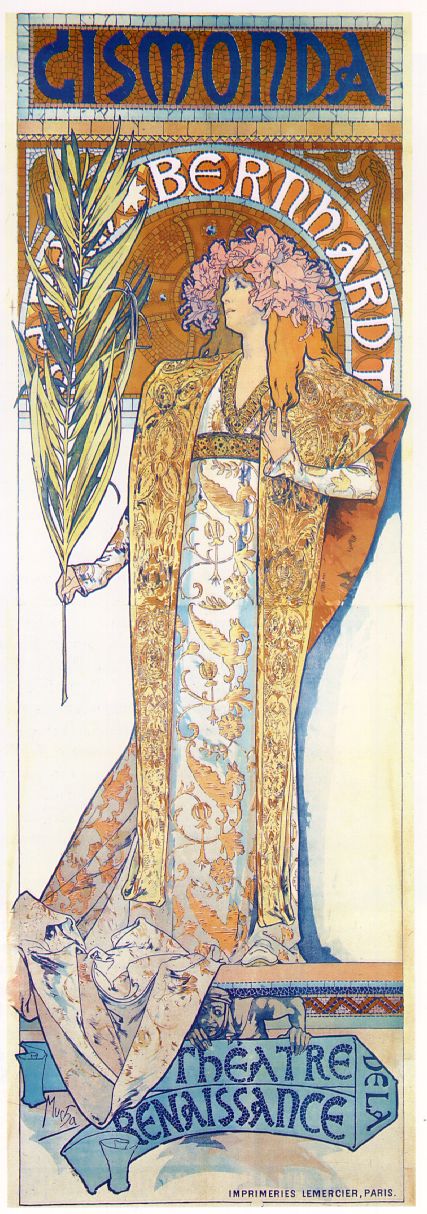
Alphonse Mucha’s poster for Bernhardt in as Gismonda [Image courtesy: Art Dish]
Mucha’s poster for Bernhardt’s Hamlet [Image Courtesy: Art Renewal]
Director Ian Gallanar chose to pick the characters up from the 15th century and time warp them to something resembling War War One. Clever, especially considering the Patapsco Female Institute was used as a war hospital during the Great War. In his director’s notes he says:
“The production really uses the visual palate and the historic technology of the World War One era as a way to clarify the relationships of the characters….[The audience] might also recognize the futility and wastefulness of a war that, much like the English “Wars of the Roses,” seemed more about resolving who would inherit power rather than who ought to inherit power.” [Chesapeake Shakespeare Company, Richard III: Program Notes]
So on a cold October night we got to see one of Shakespeare’s bloodiest plays in and around the shell of a burned out 19th Century building that some people claim is haunted. The occasional gas-masked actors quietly playing cards in a dimly lit corner or typing away orders on an antique typewriter upped the creep factor. As did the lighting effects, the period music and wonderful costumes.
Vince Eisenson as Richard III. Photo by Teresa Castracane. [Image courtesy: Chesapeake Shakespeare Company]
This version of Richard really worked. I really liked the “Moveable” aspect too. It added to the length of the play (instead of quick scene changes the audience literally did a scene change by moving to a new part of the building or grounds, and that took a while.) My only problem was that there was a scene or two where I couldn’t see the action because I had the bad luck of standing behind some one tall.) Still, I liked that we kept moving through the building, and “discovering” new rooms. It really put the audience DEAD center into the action of the play (and moving about kept us warm.)
Richard III runs for one more weekend at Chesapeake Shakespeare. So if you are local to Maryland jump on their website and grab some tickets before they sell out. http://chesapeakeshakespeare.com/
————————————
Scrap for a Shakespeare character card: Richard III., c. 1890; Printer: Siegmund Hildesheimer & Co. Victoria and Albert Museum, London, Museum number: S.63-2008, Link (Photo credit: Wikipedia)
Of course they didn’t have instant fact checkers in Shakespeare’s day, and history, as they say is written by the winners. So it comes as no surprise that the Richard the Third we met last night was a real piece of work. Shakespeare was writing for an Elizabethan audience. Elizabeth, a Tudor, was the granddaughter of the man who finally brought about Richard’s undoing on Bosworth Field in Leicestershire, Henry VII. It was in his interest to make Richard as loathsome as possible.
Henry VII’s claim to the thrown was weak at best. So he took…
“every opportunity of enhancing his own reputation at the expense of his predecessor. Richard’s actions and behaviour were the subject of attention and scrutiny and were presented, in the weeks and years after his death, as those of a wicked and unscrupulous tyrant.” [The Richard III Society]
While he was alive Richard was well thought of.
He was loyal to his brother Edward.
He was effective in his administration of the North.
He defended the country against the Scots.
He handled the premature death of Edward with out plunging the country into crisis.
Shakespeare wasn’t the first writer to take up the thread of anti- Richard-ism. (Yes, I just made that up.)
By the time the Elizabethan playwright William Shakespeare penned what was to become one of his most popular and frequently performed plays, The Tragedy of King Richard III, the works of the anonymous Croyland Chronicler, John Rous, Bernard André, Polydore Vergil, Sir Thomas More, Edward Hall, Richard Grafton and Raphael Holinshed had been written. [Ibid]
So, as Chesapeake Shakespeare Managing Director and Richard III Dramaturge says in her note… The Bard’s “fictitious villainous Richard has triumphed over the historic Richard for centuries now.” [CSC Program]
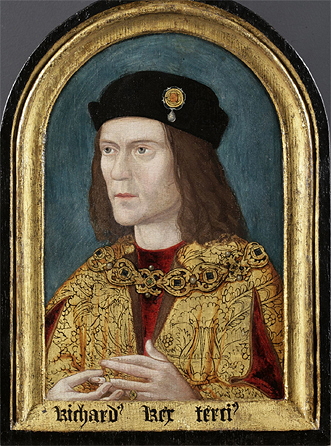
Richard III earliest surviving portrait. [Image courtesy: Wikipedia]
In a timely twist of history archeologists digging up a parking lot in Leicester have found the remains of the Greyfriars Church that might be those of Richard, the last King of England to die on the battlefield. They have found a skeleton in the choir area (Richard was buried in the choir of Friars Minor at Leicester), that had a skull injury caused by a bladed implement, an arrowhead was found between its vertebrae and upper back, and it had spinal abnormalities.
“the individual would have had severe scoliosis – which is a form of spinal curvature. This would have made his right shoulder appear visibly higher than the left shoulder.” [University of Leicester Press Release : The Leicester Greyfriars Dig]
——————————————————————————-
Bonus Material:
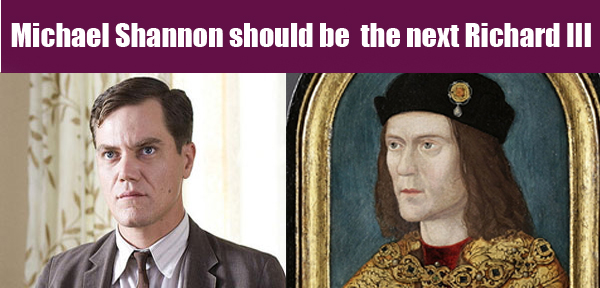
Not sure how many of you watch HBO’s Boardwalk Empire… but I couldn’t stop thinking how much Michael Shannon (who plays messed up Treasury agent turned iron salesman Nelson Van Alden) looks like our boy Richard. I think they ought to do a new film version of Richard cubed with Shannon in the lead. He certainly has the intensity to play the role.










![Cover of "Emma [Region 2]"](https://i0.wp.com/ecx.images-amazon.com/images/I/41W8FnMyyTL._SL300_.jpg "Cover of \"Emma [Region 2]\"")
![Cover of "Little Miss Sunshine [Blu-ray]&...](https://i0.wp.com/ecx.images-amazon.com/images/I/51UZdHaxwKL._SL300_.jpg "Cover of \"Little Miss Sunshine [Blu-ray]&...")







 ritaLOVEStoWRITE