Category Archives: postaday

Thought of the Day 7.22.12

“Give me your tired, your poor,
Your huddled masses yearning to breathe free,
The wretched refuse of your teeming shore.
Send these, the homeless, tempest-tost to me,
I lift my lamp beside the golden door!”

Emma Lazarus

Engraving

Engraving (Photo credit: Wikipedia)

Emma Lazarus was born in New York City in 1849. Today is the 163 anniversary of her birth.

She was the middle of seven children born to Moses and Ester Lazarus. The family lived very comfortably in the Union Square neighborhood of the city. They had ties to some of the earliest Jewish American families and were part of the Jewish upper class. She received a classical education and excelled in German and French, she loved to write and translate poems.

As antisemitism began to rise in Europe and America, Lazarus became more and more involved in the fight against it. As the Russian Pogroms caused large numbers of Jews to immigrate to the US she became more outspoken on refugee issues.

She wrote “The New Colossus”  for an auction to help pay for the pedestal for the Statue of Liberty. (France had donated the statue, the US had to come up with the money for the pedestal.) The sonnet perfectly exemplified the Mother of Exiles in the the New York Harbor. The poem was engraved into the Statue of Liberty’s base after Lazarus’ death.


She was an accomplished writer, publishing books of poetry, a novel, a play, and several translations for the American market. She sought out Emerson as her mentor, and the two shared a long friendship.

"I lift my lamp. . .

“I lift my lamp. . . (Photo credit: ckaiserca)


Thought of the Day 7.21.12

“Life is like a movie-since there aren’t any commercial breaks, you have to get up and go to the bathroom in the middle of it.”

–Garry Trudeau

English: Garry Trudeau. I took this photo on N...

English: Garry Trudeau. November 9, 1999 at Tufts University  (Photo credit: Wikipedia)

Garry Trudeau was born in New York City on this day in 1948. He is 64 years old.

He grew up near Saranac Lake in upstate New York. He went to Yale where he earned a BA and MFA in Graphic Design in 1973. (YEAH Graphic Design.) He drew a comic strip, Bull Tales,  for Yale Daily News. He later became the editor and chief of the school newspaper.

His most famous work Doonesbury was syndicated in 1970. Today over 1400 outlets, both in print and online carry the strip. In 1975 Doonesbury won a Pulitzer, the first comic strip to do so.

The first Doonesbury cartoon, from October 26,...

The first Doonesbury cartoon, from October 26, 1970. (Photo credit: Wikipedia)

The Doonesbury was made into a short film that was nominated for an Oscar, an animated TV special and a Broadway musical (Trudeau wrote the book and lyrics, Elizabeth Swados composed the music). Rap Master Ronnie brought Trudeau and Swados together again, this time in 1984 to satirize the Reagan White House years. The show was filmed and broadcast on Cinemax in 1988. That same year Trudeau worked with Robert Altman to satirize the election campaign with Tanner ’88 for HBO. Tanner ’88 won an Emmy Award.

Illustration from The Sandbox blog on Slate.com

He  established The Sandbox, a …

forum for service members currently deployed to Iraq and Afghanistan (and serving elsewhere in the GWOT), returned vets, spouses and caregivers. …The unclassified details of deployment — the everyday, the extraordinary, the wonderful, the messed-up, the absurd.

In 2005 B.D. one of his main characters in Doonesbury was seriously injured in the Battle for Fallujah the  Pentagon invited Trudeau to Walter Reed Medical Center to visit the troops. Trudeau accepted and has been working with the wounded warriors since.  His book “The Long Road Home: One Step at a Time” chronicles  B.D.’s slow convalescence.

Trudeau lives with his wife Jane Pauley in New York City.

Interested in more Garry Trudeau quotes? Try BrainyQuote or Thinkexist.com. Those sites, along with my trusty Bartlett’s Famous Quotes, are my go-to sources for “THOUGHT” fodder.


Thought of the Day 7.20.12

“People do not decide to become extraordinary. They decide to accomplish extraordinary things.”

–Sir Edmund Hillary

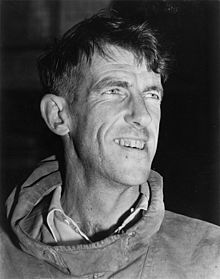
Edmund Hillary circa 1953 taken by an unidentified photographer. (Photo: Courtesy Wikimedia)http://upload.wikimedia.org/wikipedia/en/4/4a/Commons-logo.svg

Edmund Hillary was born in Auckland, New Zealand on this day in 1919. He would have turned 93 today.

Hillary’s interest in mountain climbing was sparked on a field trip at 16 to Mount Ruapehu.  The first mountain he climbed was Mount Ollivier in the Sealy Range on the country’s South Island in 1939. He became a beekeeper with his brother Rex, an occupation that left ample time for mountain climbing in the off season.

During WWII he joined the RNZAF (Royal New Zealand Air Force)  as a navigator.

Aoraki/Mount Cook in Winter. (Photo: Wikimedia Commons) http://en.wikipedia.org/wiki/File:Commons-logo.svg

After the War he continued to climb his own country’s mountains, concurring Aorki/Mount Cook (New Zealand’s highest peak) in January of 1948. Next he travelled to Europe and tackled the Alps.

In 1951 Hillary went to the Himalayas. He joined expeditions in 1951 and 1952 to recon Everest. In 1952 He was part of a team that attempted (but didn’t reach) the summit of Cho Oyu from the South side.

And in 1953 he was part of team to attempt 29,035ft summit of Everest. The group established 9 camps on the mountain (some of which are still in use today.) On May 26 the first team, Tom Bourdillon and Charles Evans tried for the peak. They got to about 300 ft from the summit but had to turn back. Problems with their oxygen tanks, bad weather and a fall had worked against them.

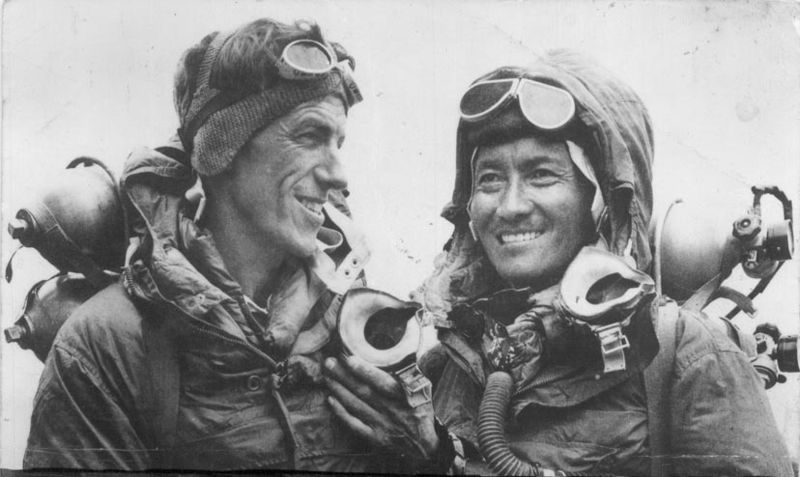
Edmund Hillary and Tenzing Norgay on their return from the summit.

So, the second team, Hillary and Tenzin Norgay made preparations for the ultimate climb. They woke early, but Hillary’s frozen boots  caused a 2 hour delay before they set off to forge the summit. They left camp at 6:30 pm. Almost at the top of the mountain they encountered a nearly vertical  40ft rock face. Hillary found a way to climb it by wedging his way up a crack. (The rock formation is now called the “Hillary Step.”) at 11:30 on May 29th, 1953 the two men stood at the top of the world.

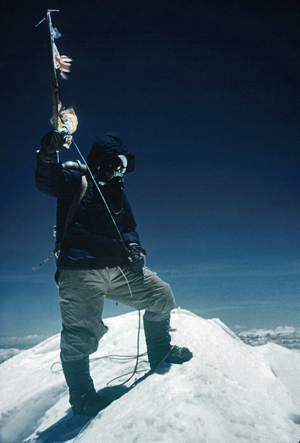
Tenzing Norgay on the summit of Mt. Everest as photographed by Edmund Hillary on May 29, 1953. Norgay offered to take a photograph of Hillary, but the later declined. They spent 15 minutes at the top of the World. They documented the event (to confirm that the ascent was not a fake); looking for any evidence that a previous team who had disappeared on the mountain might have made the summit (they didn’t find any); and leaving offerings of thanksgiving (Tenzing left chocolates, Hillary left a cross. (Photo courtesy of Wikimedia.)

Hillary‘s itch to explore turned to the Antarctic and in 1955-1958 he led the New Zealand party of  the Commonwealth Tran-Antarctic expedition  and participated in the first mechanized expedition tot he South Pole.

In 1985 he joined with another famous explorer, Neil Armstrong,  for a flight over the Arctic Ocean. The two landed at the North Pole, and Hillary became the first person to reach the northern most, southern most and highest point on Earth. (Armstrong, of course had gone a bit further.)

In 1992 New Zealand honored Hillary by putting his image on a $5 note. Since He was still alive this was a break with convention. (He is the only person to be awarded such an honor during his lifetime other than a head of state.) (Photo: Courtesy Wikimedia)

He returned to Nepal in the 1960s on several philanthropic missions to help the people. There he helped build clinics, hospitals and schools for the Nepalese people.  He enlisted the help of the New Zealand government to provide aid and technical support to Nepal in setting up the agencies needed to establish and run Everest National Park and the tourist industry that grew around climbing the peak. He spent the rest of his life working to help the Nepalese people.

Mount Everest (Photo: Courtesy Wikimedia)


Thought of the Day 7.19.12

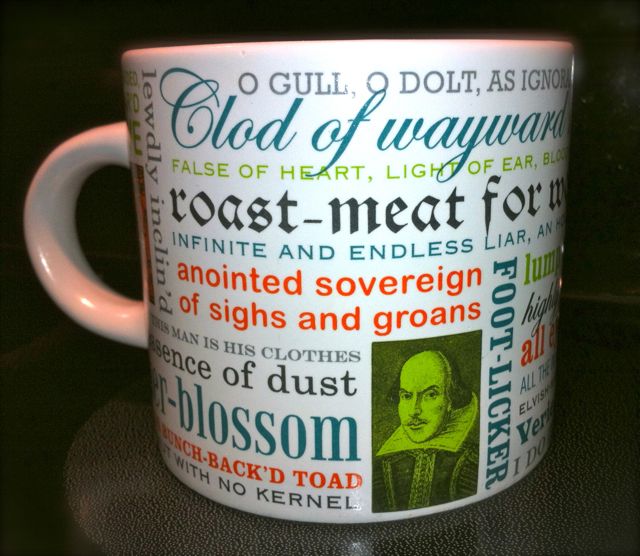
‘Tis the Shakespeare insult mug from our cupboard. Because sometimes inspiration IS as close as your morning cup of coffee.

Well, today I’m thinking that you, my clever, well read, blog followers must be in wont of a few additional Shakespearian insults to heap upon mankind. The response to yesterday’s list was pretty amazing (thank you!) And whilst I was compiling that list I kept finding quotes from/to/about this Falstaff guy…So, dear reader, I give you…

The Henry IV collection

You starvelling, you eel-skin, you dried neat’s-tongue, you bull’s-pizzle, you stock-fish–O for breath to utter what is like thee!-you tailor’s-yard, you sheath, you bow-case, you vile standing tuck! (Henry IV, Part 1) [ wow that’s all one curse! You might want to break it down and use a bit of moderation, lest some one thing you a bow-case.]

Peace, ye fat guts! (Henry IV, Part 1)

Falstaff sweats to death,
And lards the lean earth as he walks along. (Henry IV, Part 1)

Thou art as fat as butter (Henry IV, Part 1)

Thou clay-brained guts, thou knotty-pated fool, thou whoreson obscene greasy tallow-catch! (Henry IV, Part 1)

You are as a candle, the better burnt out. (Henry IV, Part 1)

That trunk of humours, that bolting-hutch of beastliness, that swollen parcel of dropsies, that huge bombard of sack, that stuffed cloak-bag of guts, that roasted Manningtree ox with pudding in his belly, that reverend vice, that grey Iniquity, that father ruffian, that vanity in years?  (Henry IV, Part 1)

You scullion! You rampallian! You fustilarian! I’ll tickle your catastrophe! (Henry V, Part 2)

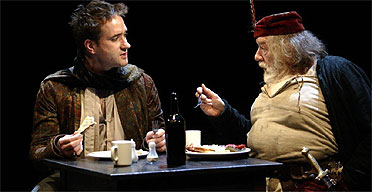
Matthew MacFadyen as Prince Hal and Michael Gambon as Falstaff in a scene from the National Theatre’s presentation of Henry IV in 2005. (Photo credit: Catherine Ashmore)

My secret Shakespearian wish… If you had a million dollars and could endow a classical theatre company what would your wish be?

My wish?  I’d  endow my two favorite Shakespearian troupes — the Baltimore Shakespeare Factory and the Chesapeake Shakespeare Company — for a Summer of Hal. Since they generally put on two shows a piece …they could do Henry  IV Parts 1 and 2 and go once more into the breach Henry V in rep. [For the fourth show I’d love to see another Jane Austen adaptation, maybe Persuasion?] …Oh, We few we happy few who could witness such a summer as that!  (Now if only I had a million dollars!)

[Discuss]


Thought of the Day 7.18.12

Today I’m thinking about Shakespeare. Why? because I got to see Baltimore Shakespeare Factory’s Love’s Labour’s Lost last Friday and I’m going to see Chesapeake Shakespeare Company’s Romeo and Juliet this Sunday. Two very different plays and two very different approaches. How lucky am I to live in a city that offers two ways to experience the Bard?

So instead of the regular birthday tribute (Shakespeare’s birthday is April 23rd for any one who is keeping track) I give you… Shakespearian insults. Because you never know when you might need a really tell some one that they are “a flesh-monger, a fool and a coward.” (Measure for Measure).

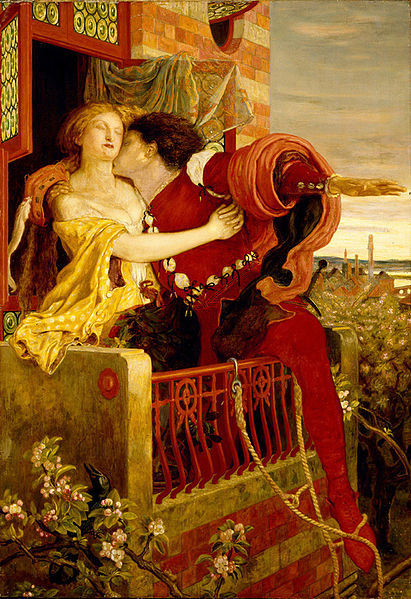
An 1870 oil painting by Ford Madox Brown depicting Romeo and Juliet’s famous balcony scene.

Here are a few from Romeo and Juliet:

… He’s a man of wax
You kiss by the book
He heareth not, he stirreth not, he moveth not, the ape is dead
She speaks yet she says nothing
He is not the flower of courtesy
You rat catcher
A dog, a cat, a mouse, a rat to scratch a man to death
A plague on both your houses
Thou detestable maw
Thou womb of death

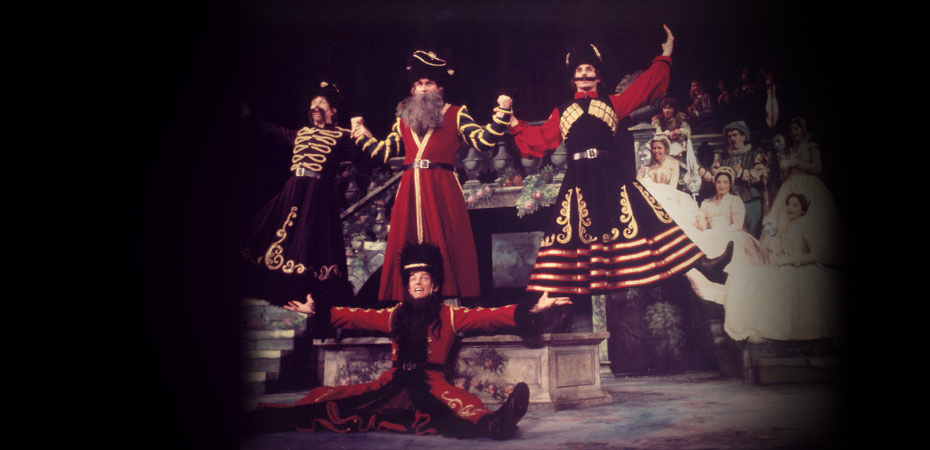
A scene from Love’s Labour’s Lost as put on by the Acting Co. of New York in 1974. Here the boys try to fool the girls into thinking they are a bunch of visiting Russians.

Here are a few from LLL:

Taffeta phrases, silken terms precise,
Three-piled hyperboles, spruce affectation,
Figures pedantical; these summer flies
Have blown me full of maggot ostentation:
I do forswear them.

They have been at a great feast of languages, and stolen the scraps.

From other Plays:

A most notable coward, an infinite and endless liar, an hourly promise breaker, the owner of no one good quality. (Alls Well That Ends Well.)

Thine face is not worth sunburning. (Henry V)

There’s no more faith in thee than in a stewed prune. (Henry V)

Thou art as loathsome as a toad. (Troilus and Cressida)

Thou art like a toad; ugly and venemous. (As You Like It)

I must tell you friendly in your ear, sell when you can, you are not for all markets.” (As You Like It.)

Thou art a flesh-monger, a fool and a coward. (Measure for Measure)

You secret, black and midnight hags (Macbeth)

Thou subtle, perjur’d, false, disloyal man! (The Two Gentleman of Verona)

“Thou art a base, proud, shallow, beggarly, three-suited, hundred-pound, filthy worsted-stocking knave; a lily-liver’d, action-taking, whoreson, glass-gazing, superserviceable, finical rogue; one-trunk-inheriting slave; one that wouldst be a bawd in way” (King Lear)

“Thou art a boil, a plague sore, an embossed carbuncle in my corrupted blood.” (King Lear)

“I’ll beat thee, but I should infect my hands.” (Timon of Athens)


7.17.12

Vince Guaraldi 

Couldn’t really find a verbal quote for today’s birthday honoree, but, please, isn’t this musical clip better? 

Vince Anthony Guaraldi was born today in San Francisco in 1928. He he would have been 84.

Guaraldi, aka “Dr. Funk,” began playing piano gigs in college. His first record was with the Cal Tjader Trio in 1953, entitled “Vibratharpe.” in 1955 he started his own trio with guitarist Eddie Duran and bass player Dean Reilly. The trio released “The Vince Guaraldi Trio” in 56 and “A Flower is a Lonesome Thing” in ’57. Guaraldi continued to do album work with other musicians throughout the late 1950s.

He picked up on the Latin vibe with a reformed trio (Bassist Monte Budwig and drummer Colin Bailey) and  put out Jazz Impressions of Black Orpheus.” The track Cast Your Fate to the Wind became his first Gold Record and earned him a Jazz Grammy.

He was chosen by Reverend Charles Gompertz of San Francisco’s Grace Cathedral to compose a “modern setting for the choral Eucharist.” The  40 minute piece, for jazz trio and 68-voice choir,  took him a year an half to write, and includes an 11 minute instrumental “Holy Communion Blues” and a syncopated “Kyrie Eleison.” Performed in May of 1965, the recording went on critical and popular success.

He became a household name when he  pennedLinus and Lucy and other songs for  A Charlie Brown Christmas.

Heres another version of the Linus and Lucy Theme that I really liked  (it takes a bit of time to start, but it’s nice).


Thought of the Day 7.16.12

“When two people love each other, they don’t look at each other, they look in the same direction”

–Ginger Rogers

Virginia Katherine McMathwas born in Independence, Missouri on this day in 1911. She would have been 101  years old today.

Her parents divorced when she was a baby and little Virginia, Ginger, stayed with her mother, Lela. When she remarried, Ginger took the name Lela’s second husband John Rogers. Ginger was introduced to the theater when Lela became a theater critic and took the girl to the shows that she reviewed. Legend has it that Ginger would hang out backstage picking up the songs and dances from the performers as her mother sat in the audience and took notes. One night while she was backstage at a traveling vaudeville show the act needed a stand-in, Rogers was tapped for the duty and had her first gig.

She was still in high school when she won  The Texas State Charleston Championship. The prize — a tour of theaters in Texas cities — was expanded to include  a wider tour of the Western US.. Ginger’s easy banter with the master of ceremonies was such an audience hit that it became as much of a draw as the dance routine.  At 17 she married vaudeville artist Jack “Pepper” Culpepper and the two formed the act known as “Ginger and Pepper.” The marriage was short lived, but Ginger’s career continued. She made it to New York where she had her Broadway debut in Top Speed in 1929.  Shortly thereafter the Gershwin Brothers picked Ginger to star in Girl Crazy along with Ethel Merman. The musical made a star of both actresses  and introduced Ginger to Fred Astaire who was hired as a dance coach. Ginger’s amazing renditions of  Embraceable You and But Not For Me in the musical helped the tunes become part of the American Song Book.

At 19 she switched to movies. Her breakthrough role was in Warner Brother’s 42nd Street. In 1933 she made her first film with Fred Astaire, Flying Down to Rio. The duo made nine musicals together, the most famous probably being Top Hat.

Dancing was only one arrow in her quiver, she was also an acclaimed singer and actor and her career went on long after she stopped making musicals with Fred. She won an Academy Award for Kitty Foyle in 1940.

She went back to the Great White Way when roles for mature women in film became scarce. Ginger took over for Carol Channing as Dolly in Hello! Dolly in 1965 and performed to packed houses for an 18-month run. She then took Mame to London’s West End for 14-months (and a Royal command performance.)

Ginger Rogers - 1920s

Ginger Rogers – 1920s (Photo credit: danceonair1986)


Thought of the Day 7.15.12

“Choose only one master — Nature.”

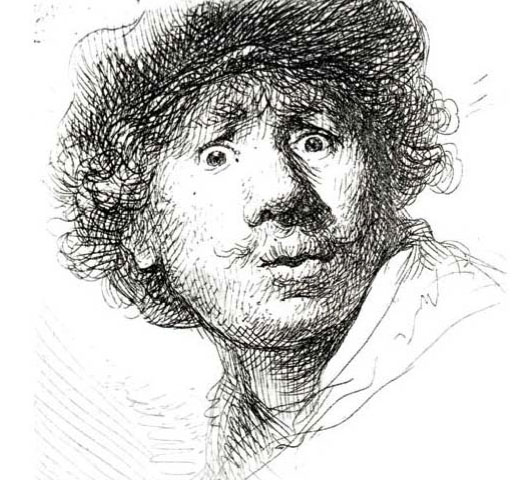
Rembrandt van Rijn

Self-portrait in cap, with eyes wide open. circa 1630.

Rembrandt van Rijn was born on this day in Leiden, the Netherlands in 1606. Today is the  406th  anniversary of his birth.

His father, a  miller, wanted his son to be an educated man and sent Rembrandt to the University of Leiden. There he learned science and anatomy, but he didn’t stay long. He wanted to paint. He  learned about light, form and composition from by studying the masters of Renaissance art like Da Vinci and Caravaggio. In 1630 he moved to Amsterdam and set up a studio painting portraits for individuals and for local guilds.

The Anatomy Lesson of Dr. Nicolas Tulp as an important early work. With its dark background and focus of light Rembrandt tells a story in the painting. It isn’t just a group of men sitting around having their picture painted. This is a narrative slice of action.

His reputation as a painter grew he established himself as in society. He married the beautiful and rich Saskia van Uylenburgh and the couple moved into an expensive house on the good side of town. Domestic bliss was not long lived however as the couple lost their first three children in infancy. The fourth child, Titus, survived, but Saskia died the next year. It seemed that life followed art for Rembrandt and every bright spot on his personal canvass had and equal patch of darkness.

In 1642 he painted The Night Watch. It  was almost 12 feet by 14.5 feet and was his masterpiece. Another guild painting, this one was commissioned by the Captain and guard of the Kloveniers (the civic guard). He was paid 1,600 guilders for the work.

Rembrandt van Rijn - Self-Portrait (1659)

Rembrandt van Rijn – Self-Portrait (1659) (Photo credit: Wikipedia)


Thought of the Day 7.14.12

“Sometimes love is stronger than a man’s convictions”

Isaac Bashevis Singer

Isaac Bashevis Singer was born on this day in Radzymin, Poland in 1904. He would have been 98 years old today.

He came from a religious family. His father was a rabbi and his mother had several rabbis in her family. He grew up surrounded in a world steeped in Hasidic traditions and even attended Rabbinical School. According to Singer’s Nobel Prize biography, it was a world:

which the reader encounters in Singer’s stories, … a very Jewish but also a very human world. It appears to include everything – pleasure and suffering, coarseness and subtlety…

But Singer wanted  a more secular life. The World was changing fast around him and he wanted to be a part of it.  The conflict of old verses new (both on a personal level and a global level as Eastern Europe churned through WWI and the build up and horrors of  WWII ) were fodder for Singer’s budding journalism and short story writing. Singer gave voice to those conflicts, mixing the tragic with the comic; breaking our hearts but warming them too, all on the same page.

He emigrated to the United States in 1935 and began to work  for Yiddish Newspapers. Because of the Holocaust the Yiddish language was nearly wiped out  in Europe, but Singer  reveled in the power of his native tongue and knew there was still an audience for it. His work often recalled a Poland before the War, but without the sugar coating of nostalgia.

He published memoirs, essays, novels, children’s books and short stories.  Singer won the Nobel Prize in Literature in 1978.

English: Isaac Bashevis Singer, Miami Book Fai...

English: Isaac Bashevis Singer, Miami Book Fair International, 1988 (Photo credit: Wikipedia)