Category Archives: History

Thought of the Day 8.14.12 Earl Weaver

“I became an optimist when I discovered that I wasn’t going to win any more games by being anything else.”
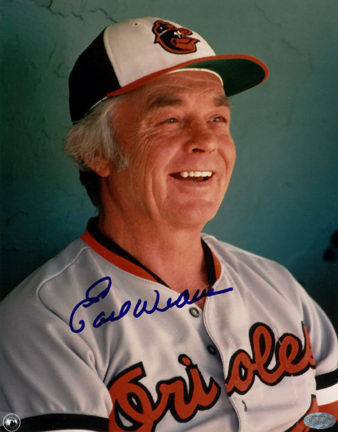
Earl Weaver

Earl Sidney Weaver was born on this day in St. Louis, Missouri in 1930. He is 82 years old.

Weaver managed the Baltimore Orioles from 1968-1982 and again from 1985-1986.  He became a Hall of Famer a decade later.

He played second base for 13 years in the minor leagues, then he managed for another dozen years in the minors before making it to the Show as a first-base coach for the Orioles in 1968. He took over as Manager in July of that season.

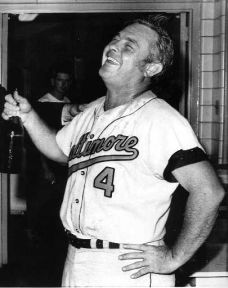
He wore #4 on his Oriole’s jersey and had a .583 winning record while managing the club. The team won 6 American League East titles, had 5 100+ win seasons, won 4 A.L. pennants, and won the 1970 World Series under his leadership.

Weaver didn’t want to bunt or sacrifice to advance a runner, according Hall of Fame player Frank Robinson, “He didn’t even have a hit and run sign…” Earl was all about the three run home run.

He pioneered the use of radar guns to track fast balls in 1975’s Spring Training season (according to the National Baseball Hall of Fame.)
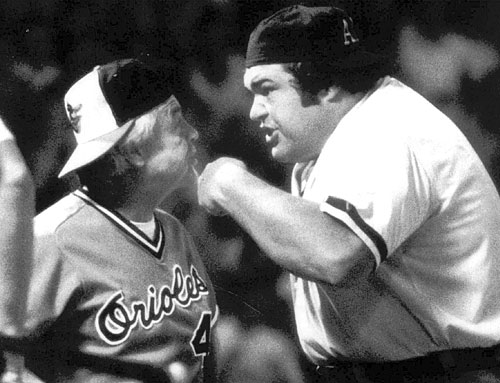
He was famous for his heated arguments with umpires that often ended with the manager kicking Memorial Stadium’s infield dirt at the official. Weaver was tossed from 91 regular season games.
Locals also remember the “Tomato Wars” he had with groundskeeper Pat Santarone. Santarone had a patch of plants in the left field foul area, Weaver grew his maters at home. The two argued (good naturedly) for 17 years over who had the best tomatoes in Baltimore.

After he left the O’s he worked as broadcaster for ABC television providing color commentary during the 1983-84 baseball seasons. He also did Manager’s Corner with Tom Marr while he was with the O’s (some times to very colorful effect.)
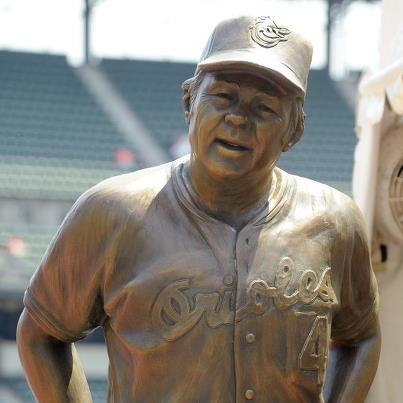
He was elected to the Baseball Hall of Fame in 1996.  A bronze statue of the manager was erected at Camden Yards (the “new” home of the Orioles) in June of this year.  At seven feet the statue towers over the real life Weaver, who is only 5’7″.  Weaver quipped “I guess there will be a lot of kids looking up at me…saying, ‘who is this?'”


Chillin’ out in GRAND CAVERNS

Who’d have thought that things that go drip in a cave could be so pretty?

On our way home from a family vacation in Staunton, VA we stopped at Grand Caverns. The cave was discovered in 1804 by a trapper and opened for tours two years later as “The Grottoes of the Shenandoah”. It is the oldest continually operating “show cave” in America and is rated 2nd best “show cave” (after Carlsbad Caverns in New Mexico) by Parade Magazine. In 1926 it was renamed “Grand Caverns” and it was declared a National Natural Landmark in 1973.

Drapery formations hang from the ceiling in the Persian  Palace  (once known as the Tannery).

During the Civil War soldiers from both sides explored the cave. 200 men signed the walls of the cave. Two of the signatures, one from a Northern soldier, one from a Confederate soldier, were left on the same day, only hours apart. A firearm accidentally discharged inside the cave, piercing one of the shield formations. The hole is still visible today.

The rock formations are always growing, albeit at an extremely slow rate. Oil from human hands block that growth, so visitors aren’t allowed to touch any of the rock formations.  However, visitors will inevitably feel a drip or two while taking a tour. Those are called “Cave Kisses” and are supposed to bring good luck.

The Cathedral Hall is the largest chamber in the caverns. An impressive stalagmite, “George Washington’s Ghost” (foreground) stands century at the center of the hall. The white spot on the ceiling is likely a spot where a shield broke off centuries ago.

Naturally occurring colors in the cave are White (from calcite/calcium carbonate), Red (from iron/iron oxide) or Grey (limestone or manganese). Another color  in the cave is Green (from cave algae which is the result of dampness of the cave combined with lint from clothing and heat and light from the light bulbs.) Colored lights enhance the cave formations in certain areas. With out artificial lights the cave would be pitch black, of course.

The Bridal Chamber has a shield formation with drapery that represents a bride’s veil. It is about 17 feet tall.

With over 200 shield formations, Grand Caverns has more cave shield formations than any other cave or cavern in the eastern United States. No one knows how these formations are made, but for some reason they form flat disks rather than columns.  Some notable shield formations in Grand Caverns are  the “Clam Shell”  formation, a triple shield formation in the Lily Room, and the “Bride’s Veil” formation that combines both a shield and drapery.

The Lily Room. A shield with drapery resembles a calla lily and takes center stage in the Lily Room

Another formation in the Lily Room.

Grand Caverns is open daily except Thanksgiving, Dec 24, 25 & Jan 1. Summer Hours (April to Oct 31) are 9-5. Winter Hours (Nov 1-March 31) are 10-4. Tours are given hourly. For pricing and directions click here.

At the lowest part of the cave (as seen on the tour) looking up to the highest part of the cave.


Thought of the Day 8.7.12 Mata Hari

“I am a woman who enjoys herself very much; sometimes I lose, sometimes I win.”

–Mata Hari

Postcard of Mata Hari in Paris

Postcard of Mata Hari in Paris (Photo credit: Wikipedia)

Gertrud Margarete “M’greet” Zelle was born on this day in Leeunwarden, Netherlands in 1876. Today is the 136 anniversary of her birth.

The second of five children, M’greet was the only girl. Her father doted on her calling her “an orchid among buttercups.” She did well in school, especially in langauge classes. She had an active imagination and a flair for the dramatic (her dark hair and eyes and olive skin already marked her as exotic amongst the pale skinned, blond haired Dutch villagers) and was popular with her classmates. She lived happily until her father lost his money, and the family status, in stock market speculations.  When her mother died M’greet and the boys were separated and shipped off to relatives willing to look after them. After a short stint training to become a kindergarten teacher she moved to The Hague and stayed with her uncle.

At 5’10” M’greet was taller than the average dutch man. And she was small chested. She also didn’t have any money. Not the most attractive qualities for a young woman in wont of a husband. But she was pretty in an exotic sort of way, she was vivacious, she had style and grace and she planned to make the most of it. She answered an ad that read “Officer on home leave from Dutch East Indies would like to meet girl of pleasant character — object matrimony.” The officer the ad referred to was 38 year old Captain Rudolph Macleod, (a friend of his placed the ad with out his knowledge, but he he agreed to meet M’greet and the two fell for each other.) Despite the 20 year difference in their ages the two got married. The marriage proved an unhappy one with Rudolph, an alcoholic, openly taking mistresses and abusing his wife. They moved to Java and Sumatra for his job in the Dutch Colonial Army.

Rudolph and Norman John Mac Leod

Rudolph and Norman John Mac Leod (Photo credit: Wikipedia)

Despite Rudolph’s orders otherwise, M’greet learned to speak Malay. She immersed herself in the culture and joined a local dance company. It was here that she took the artistic pseudonym “Mata Hari” Although the phrase “Mata Hari” has come to mean a kind of femme fatal spy, the term literally means “eye of the day” or “sun”.  They had two children, Norman John and Louise Jeanne. While the MacLeods were stationed in Sumatra the children took seriously ill (they were either poisoned or suffered from complications from the treatment of syphilis.) The little boy died.

Louise Jeanne Mac Leod (1898-1919) daughter of...

Louise Jeanne Mac Leod (1898-1919) daughter of Mata Hari (Photo credit: Wikipedia)

M’greet and Rudolf’s marriage, already on rocky ground, spiraled downward. When they returned to Amsterdam in 1902 she filed for separation. The Dutch courts, surprisingly, granted her request, gave her custody of little Louise Jeanne and ordered Rudolph to pay 100 guilders a month is support.  The support never came. and a bitter Rudolph publicly denounced his “evil” wife for deserting him. With out a  means of feeding or clothing her daughter she reluctantly turned the child over to her father. M’greet eked by relying on the kindness of her relatives.

Mata Hari

Mata Hari (Photo credit: Wikipedia)

In 1903 she decided to change her life. She moved to Paris and under the name “Lady MacLeod” she performed as a circus horse rider, a dancer and an artist’s model. The Orientalism movement in dance was sweeping Europe and her exotic/erotic style and Java inspired dancing became a hit. The website  Mata Hari.com quotes Russell Warren Howe’s book to describe the dance…

…(the) diaphanous shawls she wore as the dance began were cast away to tempt the god until finally…the sarong was abandoned and her silhouette, with her back to the audience, writhed with desire toward her supernatural lover. … All passion spent, she touched her brow to Siva’s feet; one of the attendant dancers tiptoed delicately forward and threw a gold lamé cloth across the kneeling figure, enabling her to rise and take the applause.”

He goes on to say that  her overnight success “was pivotal in elevating the striptease to an art form.” She took her act on the road and danced at all the European hot spots and capitals. She was a master of illusion in that she did a striptease without stripping all the way down. She wore a body stocking that matched her own skin color and she never took off her bejeweled bra (which she padded.) She dropped the moniker of “Lady MacLeod” and went as “Mata Hari”  reinventing herself as a daughter of Indian temple dancer, raised in the temple of Siva. She became a courtesan and developed relationships  with wealthy, powerful men.  She had always loved “a man in uniform” and now she had lovers of the highest rank.

The Netherlands remained neutral during WWI so she had access to both Germany and France. According to FirstWorldWar.com :

It was said that while in The Hague in 1916 she was offered cash by a German consul for information obtained on her next visit to France.  Indeed, Mata Hari admitted she had passed old, outdated information to a German intelligence officer when later interrogated by the French intelligence service.

Mata Hari herself claimed she had been paid to act as a French spy in Belgium (then occupied by German forces), although she had neglected to inform her French spymasters of her prior arrangement with the German consul.  She was, it seemed, a double agent, if a not very successful one.

While traveling in France she was arrested in Paris on February 13, 1917. She was held Saint-Lazare prison and interrogated on charges of espionage. She maintained her innocence.  The trail was held on July 24 & 25. She was found guilty  and sentenced to death. On October 15, 1917 she refused a blind fold and faced her execution squad. She blew them a kiss just before the fired.

The Execution of Mata Hari in 1917. http://www...

The Execution of Mata Hari in 1917. Probably a reconstruction for the movie of 1920. (Photo credit: Wikipedia)


Thought of the Day 8.5.12 Neil Armstrong

—————————————UPDATE—————————————

Sadly I have to give an update to this post.

One of America’s greatest heros, Neil Armstrong, passed away today due to complications from cardiovascular procedures. He had  heart surgery last month in Cincinnati, Ohio.

“Looking back, we were really very privileged to live in that thin slice of history where we changed how man looks at himself and what he might become and where he might go,” Armstrong said.

—————————————UPDATE—————————————

“I believe every human has a finite number of heartbeats. I don’t intend to waste any of mine”

–Neil Armstrong

Neil A. Armstrong was born on this day in Wapakoneta, Ohio, in 1930. He is 82 years old.

He grew up near the local airport and took flying lessons as a teenager. He got his pilots license before he got his driver’s license.

Armstrong was a naval aviator for three years, flying 78 combat missions during the Korean War,  prior to joining the National Advisory Committee of Aeronautics (NACA) in 1955. (The NACA was the precursor to NASA.) He  logged over 2,400 hours of air time testing experimental aircraft at Edwards Airforce Base.

According to the NASA’s Glenn Research Center web site:

He has flown over 200 different models of aircraft, including jets, rockets, helicopters and gliders.

In 1962 Armstrong became one of the “New Nine” NASA astronauts, the second group of men selected for US space flight to augment the Mercury 7. The Mercury astronauts established orbital space flight, the New Nine would fly in Gemini space capsules and would tackle docking two vehicles in space and space walks.

English: Close-up on orbiting Agena D rocket s...

English: Close-up on orbiting Agena D rocket stage Polski: Zbliżenie orbitującego członu rakietowego Agena D (Photo credit: Wikipedia)

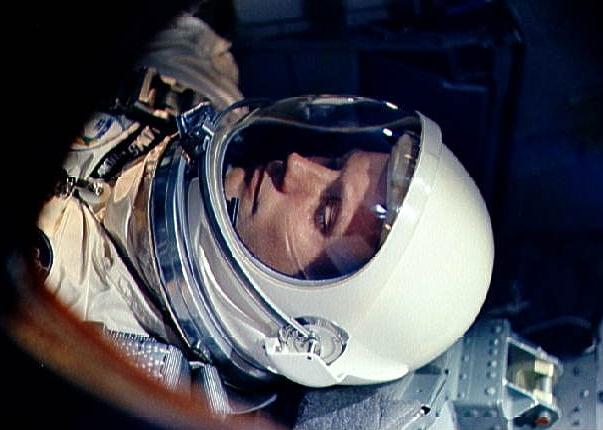
On his historic Gemini 8 mission Armstrong and Dave Scott successfully docked their ship with an unmanned Agena target vehicle. It was an essential first step  towards getting to the moon. Unfortunately about 27 minutes after docking the two ships began to roll and yaw. Assuming the problem was with the Agena, Armstrong undocked, but it was a faulty thruster on the Gemini that was making the capsule spin, and undocking only exacerbated the problem. Armstrong and Scott had to shut down Gemini’s main reaction control system and use the reentry thrusters to zero out yaw and roll on the wildly spinning craft. Armstrong’s masterful flying skills were successful, but they used up 75% of the system’s fuel and Mission Control cut short the flight.

On the Gemini 11 flight he acted as CAPCOM — the person at Ground Control who interfaces with the astronauts in space — and he was the commander of the back-up crew for Apollo 8 (the first human space flight to leave Earth’s orbit, fly to the moon — but not land — and return to Earth.)

Flag of the United States on American astronau...

Flag of the United States on American astronaut Neil Armstrong’s space suit (Photo credit: Wikipedia)

Armstrong was the Commander of Apollo 11, the first manned space craft to land on the Moon. He accompanied by Michael Collins, who stayed aloft in the Command Module, and Edwin “Buzz” Aldrin, Jr. who touched down on the Moon’s surface on July 20, 1969 with with Armstrong. Armstrong descended a lader and took the first steps on the lunar surface. Armstrong and Aldrin had about 2 hours outside the lander, the Eagle,  to take photographs, set up experiments and collect moon rocks. The Eagle blasted off from the Sea of Tranquility and  Armstrong and Aldrin rejoined Collins on the Command Module, Columbia.

The reverse of the Anthony dollar is based upo...

The reverse of the Anthony dollar is based upon the insignia of the Apollo 11 mission, which was also used on the reverse of the Eisenhower dollar that preceded it. (Photo credit: Wikipedia)

He worked for NASA as Deputy Associate Administrator for aeronautics until 1971.

Post NASA he taught and did research as a professor of aerospace engineering at University of Cincinnati and served as the chairman of the board for several privately owned aerospace/defense industries.

Buzz Aldrin walks on the moon, July 20, 1969

Buzz Aldrin walks on the moon, July 20, 1969. The photo was taken by Armstrong. (Photo credit: Wikipedia)

[Please note that I did not say Armstrong was the first man to LAND on the moon. Both Aldrin and Armstrong landed on the Moon at the same time.  … Armstrong was the first man to WALK on the Moon.]


Thought of the Day 8.3.12 Leon Uris

“Often we have no time for our friends but all the time in the world for our enemies.”

–Leon Uris

Leon Marcus Uris was born on this day in Baltimore, Maryland in 1924. This is the 88th anniversary of his birth.

Son of Polish and Russian Jewish immigrants Leon went to schools in Baltimore, Norfolk and Philadelphia. He failed English three times, but he loved History and Literature. He allegedly wrote an operetta about the death of his dog when he was only six years old.

When the Japanese attacked Pearl Harbor on December 7, 1941 Uris dropped out of high school and enlisted in the Marine Corps. He served from 1942 to 1945 in the South Pacific. He  was a radio operator  and saw combat at Guadalcanal and Tarawa. When he contracted malaria he was sent to San Francisco to recuperate. There he met his first wife Marine sergeant Betty Beck.

1st edition cover Pages: 694 pp (Mass Market P...

1st edition cover Pages: 694 pp (Mass Market Paperback) (G.P. Putnam’s Sons) (Photo credit: Wikipedia)

After his discharge from the service he worked  for the San Francisco Call-Bulletin and wrote fiction in his spare time. His first book, Battle Cry,  retold his war experiences. Published in 1953 ,and made into a movie by Warner Brothers with Uris as screen writer, the film did well at the box office.

His second novel also took place during WWII, but this time in the European Theatre. The Angry Hills is about Greek resistance fighters.  It too was made into a movie, this one starring Robert Mitchum.

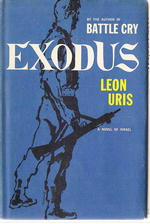
Research Uris did for The Angry Hills and his time  as a war correspondent during Arab-Israeli fighting in 1956  lead to most his most successful novel, Exodus. Published in 1958 the book is the result of  thousands of interviews. Uris traveled 12,000 miles in Israel and read hundreds of books on Jewish history. Doubleday bought the book which out sold Gone with the Wind, becoming the biggest bestseller in the United States. It was translated into 50  languages. A blockbuster movie starring Paul Newman came out in 1960.

Mila 18 is about Jewish resistance fighters during the Warsaw uprising. Armageddon: A Novel of Berlin is about the complications of the Cold War during and after and the Berlin Airlift. Topaz, a spy story, has the Cuban Missile Crisis and the Cold War in its cross hairs. Alfred Hitchcock  directed it for the big screen.  QBVII  is a courtroom drama about a doctor who was pressed into service in a Nazi concentration camp.  It was made into a mini series starring Anthony Hopkins in 1974.

In Trinity Uris tacked the troubles in Ireland, following the lives of several families from the potato famine to the Easter Uprising. Redemption, written two decades later follows up on the Irish story.

The Haj delves again into the troubled Middle East. The Milta Pass is about the Suez Crisis.

A God in Runs takes on the American political scene when Quinn Patrick O’Connell runs for president. His last novel, O’Hara’s Choice, was published posthumously, and was not well received.

Non fiction works include: Ireland: A terrible Beauty and Jerusalem: Song of Songs both include photographs by his with Jill Uris.

More on Leon Uris try this site: http://www.kirjasto.sci.fi/uris.htm


Thought of the Day 8.2.12 L’Enfant

Pierre Charles L'Enfant

Pierre Charles L’Enfant (Photo credit: Wikipedia)

Pierre Charles L’Enfant was born on this day in 1754 at Anet, Eure et Loir, France. Today is the 258th anniversary of his birth.

L’Enfant was educated at the Royal Academy in Paris as an engineer before joining Lafayette  to help the American side during the War of Independence. He arrived in 1777 at the age of 23 and fought as military engineer. He joined George Washington’s staff  after recovering from injuries at the Siege of Savannah. He attainted the rank of Major of Engineers in 1783.

He moved to New York after the war and established a civil engineering firm. In 1788 he redesigned the  New York’s city hall to be the United States’ first capitol building, Federal Hall.  The building was the site of George Washington’s inauguration and where the Bill of Rights was signed.

Federal Hall, Seat of Congress 1790
hand-colored engraving by Amos Doolittle, depicting Washington’s April 30, 1789 inauguration. [Image Courtesy Wikimedia Commons: public domain]

In 1791 the US Congress authorized the building of a capital city on the Potomac River. George Washington appointed his old friend L’Enfant  to design the new city in 1791.

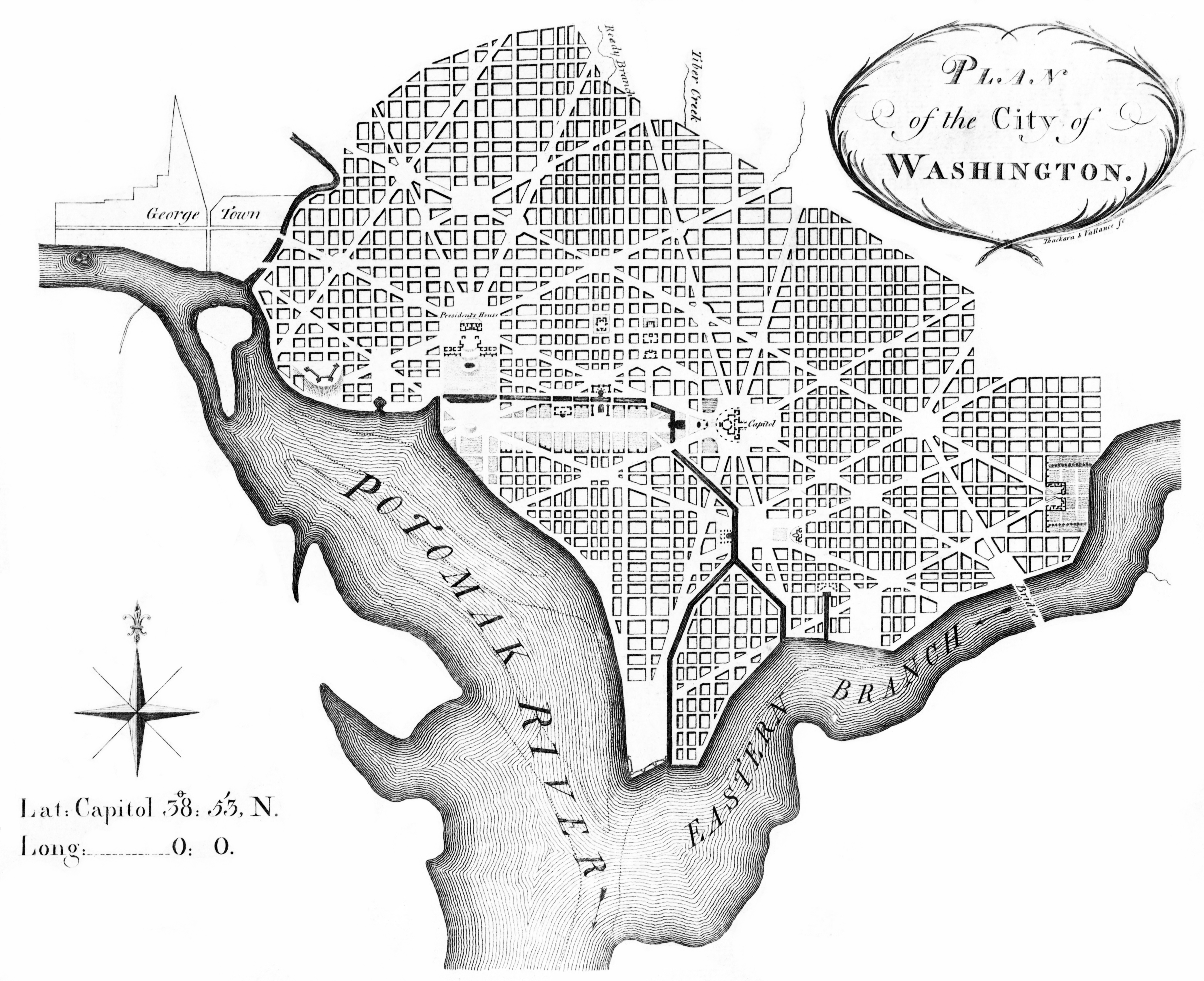
L’Enfant’s “Plan of the city of Washington” March 1792 is at the Library of Congress. [Image courtesy Wikimedia Commons. This image is in the Public Domain.]

“Congress House” (the Capitol) was to be on top a hill, a place of honor overlooking the rest of the city.  The “President’s House” (the White House) was to be a grand mansion fit for the leader of the country. His plan outlined the need for public spaces including a grand public walk (today’s National Mall) ). It would be 1 mile long and 400 feet wide and would stretch from the Capitol to an equestrian statue of Washington (the Washington Monument is now where the statue would have been).

The western front of the United States Capitol...

The western front of the United States Capitol. The Capitol serves as the seat of government for the United States Congress, the legislative branch of the U.S. federal government. It is located in Washington, D.C., on top of Capitol Hill at the east end of the National Mall. The building is marked by its central dome above a rotunda and two wings. It is an exemplar of the Neoclassical architecture style. (Photo credit: Wikipedia)

According to “A Brief History fo Pierre L’Enfant and Washington, D.C.”:

L’Enfant placed Congress on a high point with a commanding view of the Potomac, instead of reserving the grandest spot for the leader’s palace as was customary in Europe. Capitol Hill became the center of the city from which diagonal avenues named after the states radiated, cutting across a grid street system. These wide boulevards allowed for easy transportation across town and offered views of important buildings and common squares from great distances. Public squares and parks were evenly dispersed at intersections.

Wide avenues and public squares would make it “people’s city”, while monuments  and inspiring buildings would give it the stature and importance of world capital.

While he was concerned with the grand vision of the city  his bosses on the Congressional appointed committee were concerned with how much the project was going to cost . They  wanted to keep the wealthy plantation owners in the area happy. L’Enfant “delayed producing a map for the sale of city lots (fearing real estate speculators would buy up land and leave the city vacant).” And he angered the commission when he had a prominent resident’s house torn down because it was in the way of one his boulevards.  When the city’s surveyor went behind his back and produced a lot map L’Enfant resigned. He was never properly paid for the work he did on the Capital.

The city was built, but the design had been greatly altered. Gone were the arrow straight streets and parkways. The Mall between the Capitol and the White House was a tree-covered park of irregular shape. Cows grazed on it.

Visitors ridiculed the city for its idealistic pretensions in a bumpkin setting and there was even talk after the Civil War of moving the capital to Philadelphia or the Midwest.

But in 1901 the McMillan Commission resurrected L’Enfant’s ideas and updated them for a modern city. The Mall was reclaimed, cleared and lined with American Elm trees. Memorials to Lincoln and Jefferson were added, and Museums and government buildings lined the perimeter.

L’Enfant worked on commissions

after the Capital, but non were very successful. His design for Philadelphia millionaire Robert Morris’ mansion was called Morris’ Folly. His final years were spent at the home of his friend William Dudley Digges, near Bladensburg, Maryland. He was buried there, but his body was exhumed and reinterred at Arlington National Cemetery with full military honors. His tomb now overlooks the city he helped design.

Tomb of Pierre Charles L'Enfant, designer of W...

Tomb of Pierre Charles L’Enfant, designer of Washington, D.C.’s original city plan, on the grounds of Arlington House (the Robert E. Lee Memorial) at Arlington National Cemetery in Arlington, Virginia, in the United States. (Photo credit: Wikipedia)


Thought of the Day 7.29.12 Ken Burns

“Good history is a question of survival. Without any past, we will deprive ourselves of the defining impression of our being.”

–Ken Burns

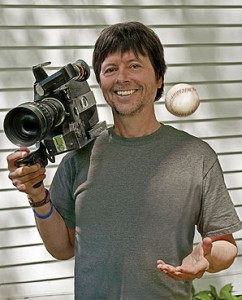
His family, including his brother Ric Burns, who is also a documentary film maker, traveled often through out Europe and the North East US. They settled in Ann Arbor.  Burns enjoyed reading, especially history. For his 17th birthday he got an 8mm movie camera and made his first documentary (it was about a factory in Ann Arbor.)  He attended Hampshire College in Amherst, MA. He Graduated in 1975 and co-founded Florentine Films in 1976 with Roger Sherman, Buddy Squires and Larry Hott.

Burns’ work as a director, writer, producer, cinematographer, and film music director began in earnest in 1977  when he started work on a documentary based on the book The Great Bridge by David McCullough.  The result, Brooklyn Bridge (1981) brought Burns an Academy Award nomination. He followed that success with 23 (and counting) award winning documentaries most of which saw their debut on PBS.

His break out series was the 11 hour  The Civil War which first ran in 1990. Burns used over 16,000 photographs  and archival images. He had first person narratives (mostly letters) read by different actors, giving each historic figure their on personality in the film. He had live interviews with noted historians. And the finishing touch was the music — a mix of Civil War era tunes and the haunting theme song, Jay Unger’s Ashokan Farewell.  The Civil War won two Emmy Awards, two Grammy Awards, a Peabody Award,  a Producers Guild of America Award, a People’s Choice Award and a slew of other accolades.


Films by Ken Burns:

  • The Shakers: Hands to Work, Hearts to God
  • The Statue of Liberty (which also received an Oscar nomination)
  • Huey Long
  • The Congress
  • Thomas Hart Benton
  • The Civil War
  • Empire of the Air: The Men Who Made Radio
  • Baseball
  • The West
  • Thomas Jefferson
  • Lewis & Clark: the Journey of the Corps of Discovery
  • Frank Lloyd Wright
  • Not for Ourselves Alone: Elizabeth Cady Stanton and Susan B. Anthony
  • Jazz
  • Mark Twain
  • Horatio’s Drive: America’s First Road Trip
  • Unforgivable Blackness: The Rise and Fall of Jack Johnson
  • The War
  • The National Parks: America’s Best Idea
  • The 10th Inning
  • Prohibition
  • The Dust Bowl

Films in production include:

  • The Central Park Five
  • The Roosevelts
  • Jackie Robinson
  • Vietnam
  • Country Music
  • Ernest Hemingway

The Baltimore Sun’s Media Critic, David Zurawik, has called Burns “… not only the greatest documentarian of the day, but also the most influential filmmaker period. ”


Thought of the Day 7.27.12

[No quote for Today’s Thought, just some interesting history and some lovely paintings.]

Ludovico Sforza, called the Moor

Ludovico Sforza, called the Moor (Photo credit: Wikipedia)

Ludovico Sforza [il Moro],  born on this day in Vigevano, Lombardy, Italy in 1452. Today is the 518 anniversary of his Birth.

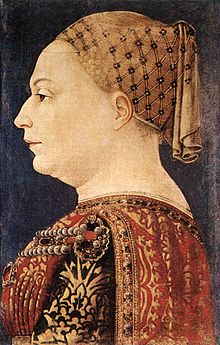
The fourth son of the powerful Sforza family Ludovico was not supposed to become Duke of Milan. But his mother, Bianca Maria Visconti Sforza insisted that he be educated in the arts, government and warfare.

Bianca Maria Visconti Sforza (Photo courtesy Wikipedia)

When Ludovico was 14 his father died and his bother Galeazzo Maria became Duke. Galeazzo, was cruel and sadistic ruler. He reigned for 10 years until he was assassinated on St. Steven’s Day (Dec 26) 1476.

Galeazzo Maria Sforza (Image courtesy Wikipedia)

The next in line was Galeazzo’s 7 year old son Gian Galeazzo Sforza.

Alleged portrait of Gian Galeazzo Maria Sforza...

Alleged portrait of Gian Galeazzo Maria Sforza as Saint Sebastian, by Giovanni Ambrogio de Predis in 1483. Portrait of a Youth as Saint Sebastian, Cleveland Museum of Art, Ohio (Photo credit: Wikipedia)

Ludovico, called the More because of his black hair and swarthy appearance, saw his chance and made a play to become Regent for young Gian, but the boy’s mother, Bona of Savoy, fended him off. Ludovico went into exile for a while but returned in 1481 and seized control of Milan.

With Bona out of the way he  became Regent and de facto ruler. He kept a tight reign on the young Duke and refused to turn over power when Gian came of age. And when Gian died from natural causes (many believed his uncle had him poisoned) Ludovico took official control of the Dukedom.

As Regent and then as Duke Ludovico  built Milan into a powerhouse among Italian city states. He invested in infrastructure, building  up the cattle and horse industries as well as the silk industry. He widened the streets,  funded the universities and supported the the continued building of the Cathedral of MIlan.

Ludovico married Beatrice d’Este, a charming and beautiful 15 year old in 1491. Ludovico was already a patron of the arts — Leonardo Da Vinci helped bring about his marriage —  but with Beatrice’s sense of style (and extravagance) Sforza castle blossomed into a center of entertainment.

Portrait of a lady

Portrait of a lady  Beatrice d’Este by Giovanni Ambrogio de Predis and Leonardo da Vinci. (Photo credit: Wikipedia)

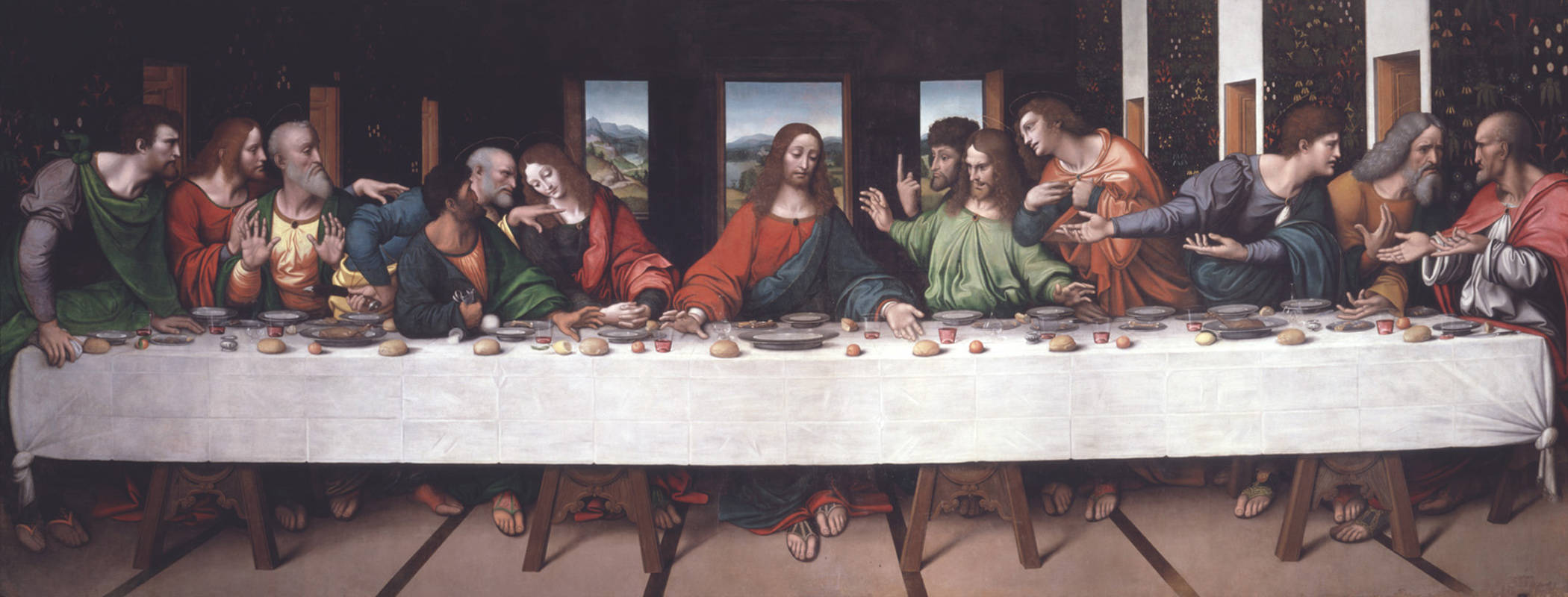
Perhaps Ludovico’s most famous contributions to history is his commissioning of The Last Supper by Leonardo da Vinci. The masterpiece, based on the Gospel of John 13:21 depicts Jesus breaking bread with his 12 disciples shortly before his death. Specifically it shows the reaction of the 12 to Jesus telling them that one of them will betray him  It measures 15 x 29 feet and graces the wall of a dining hall at the monastery of Santa Maria delle Grazie in Milan. (Ludovico’s father, Francesco is buried at Santa Maria).

The Last Supper

As the Duke of Milan he was one of many players on the game board that was Italy (Venice, Florence, Naples, and the Vatican in Rome being some others.) Ludovico played a key roll in the Italian Wars.  It was a game he ultimately lost.  He was captured and handed over to the French. He died in the dungeon at Loches on May17, 1508.


Thought of the Day 7.24.12

“Never interrupt someone doing what you said couldn’t be done.”

–Amelia Earhart

Famous aviator Amelia Earhart is thought to ha...

Famous aviator Amelia Earhart is thought to have crash landed on Nikumaroro Island when she disappeared in 1937. (Photo credit: Wikipedia)

Amelia Mary Earhart was born on this day in Atchison, Kansas in 1897. Today is the 115th anniversary of her birth.

She was unimpressed with the first plane she saw, a rickety thing of “rusty wire and wood” at the Iowa State Fair. When she was 23 pilot Frank Hawks took her up for her first ride in a plane and she was hooked. “By the time I had got two or three hundred feet off the ground, I knew I had to fly.” (– from Amelia Earhart, the Official Website.)

Earhart was a nurse’s aid at Spadina Military Hospital in Toronto, Ontario, during WWI. She was there when the Spanish Flu broke out in 1918 and she was hospitalized for pneumonia and sinusitis. She suffered from chronic sinusitis for the rest of her life.

She took her first lesson at Kinner Field in Long Beach in 1921. She had to take a bus and then walk four miles to get there. She cropped her hair and bought a leather jacket to ward off the chill morning flights (Amelia slept in the jacket for three nights straight to break it in before she dared to wear it to the field.) On Oct 22, 1922 she broke the altitude record for a female pilot  by flying over 14,000 feet, and on May 15, 1923 she became the 16th woman to earn her pilot’s license.

Family financial problems limited her time in the air as Amelia took jobs as a photographer a teacher and a social worker. But with Lucky Lindy’s solo flight over the Atlantic the hunt was on to find the first woman to fly (either solo or with a crew) over the ocean too. Amelia was chosen to join pilot Wilmer Stultz and copilot/mechanic Louis “Slim” Gordon. They took off from Newfoundland and landed in Wales about 21 hours later. Although her contribution to the flight was minimal — she kept the flight log and later said she that Stultz did all the flying and she was as useful as a “sack of potatoes” — it was a publicity smash. They returned to New York to a ticker-tape parade and were greeted at the White House with a reception by President Calvin Coolidge.

She become romantically involved with George Putnam, who had handled the publicity for the trans-Atlantic flight, and (after Putnam proposed six times) the two married in February of 1932. Amelia saw the marriage as a partnership. Their honeymoon was a lecture/promotional tour.  She also did a number of endorsements for luggage, clothing and cigarettes.  She became an associate editor for Cosmopolitan. And she and Lindbergh promoted commercial air travel, investing in Transcontinental Air Transport (which later became TWA).

In May of 1932, 5 years after Lindberg’s trip, she became the first woman to fly solo across Atlantic (she landed in Ireland.)  She also flew solo from Hawaii to California, from LA to Mexico City and from Mexico City to New York.

Amelia was one of the organizers and the first  president of The Ninety-Nines, an organization that advanced the cause of women in aviation.

In 1936 she started to plan a trip around the world. The first attempt ended in Hawaii when a blown tire (or perhaps pilot error) when the plane ground-looped. The damaged plane and the deflated crew went back to Oakland, CA.  For the second attempt Amelia and Fred Noonan  headed east, to Miami. They made several stops in South America, Africa, India and Southeast Asia. On June 29, 1937 they landed in Lae, New Guinea. The next stop would be Howland Island… but the plane never made it.

An intense air and sea rescue attempt ensued, but after searching a quarter million square miles of ocean the US Government gave up.

Amelia Earhart - GPN-2002-000211