Category Archives: History

Lucrezia Borgia 4.18.13 Thought of the Day

“If people knew the reasons for my fears, they would Be able to understand my pain.” — Lucrezia Borgia

Italiano: Lucrezia Borgia ritratta nella "...

Italiano: Lucrezia Borgia ritratta nella “Disputa di Santa Caterina” dell’Appartamento Borgia, nella Sala dei Santi in Vaticano. (Photo credit: Wikipedia)

Lucrezia Borgia  was born on this day in Subiaco, near Rome, Italy in 1480. Today is the 533rd anniversary of her birth.

Lucrezia  was the daughter of the powerful Cardinal Rodrigo Borgia and his mistress Vannozza dei Cattanei, and younger sister of Cesare and Giovanni Borgia.  When she was a toddler her father took the children away from their mother and sent them to live with his cousin, Adriana de Mila. The Cardinal took an active role in raising the children, making sure they were well-educated and properly brought up. He doted on pretty Lucrezia.

“Lucrezia was educated according to the usual curriculum of Renaissance ladies of rank, and was taught languages, music, embroidery, painting, etc…” [NNDB] She studied poetry and read the classics. She could converse in Latin, Italian, French and Greek. She was also a beauty. Her long blond hair, flawless complexion, hazel eyes and graceful stature were all the fashion in Renaissance Italy.

By eleven she was betrothed to a Spanish nobleman, Don Cherubin do Centelles, but that brokered arrangement was broken for a more advantageous one, with another Spaniard, Don Gasparo de Procida. Before the two could marry Cardinal Borgia became Pope Alexander VI, and  “he annulled the union with Procida; in February 1493 Lucrezia was betrothed to Giovanni Sforza, Lord of Pesaro.” (Ibid)

Portrait of Pope Alexander VI. Painting locate...

Portrait of Pope Alexander VI. Painting located at Corridoio Vasariano (museum) in Florence (Firenze), Italy. Measures of painting: 59 x 44 cm. (Photo credit: Wikipedia)

This time Lucrezia, at 13,  did walk down the aisle. Sforza was 15 years older than the girl and it was hardly a match made in heaven. So when the political winds shifted and the Pope wanted to annul the marriage his daughter didn’t object. But Sforza did. Alexander claimed the reason for the annulment was Sforza’s impotency, a charge the Lord of Pesaro vehemently denied — and offered to prove in front of anyone who cared to act as witness. He countered that Alexander and Lucrezia were having an incestuous relationship. He later recanted the allegations and accepted the annulment, but there were other Borgia enemies who took up the rumors.

Whispers of incest filled the streets of Rome and 14-year-old Lucrezia’s reputation was damaged beyond repair. There was also a claim that she poisoned her enemies. She allegedly had her own special formula for a an undetectable poison. She’s even supposed to have had a specially designed ring with a compartment for the poison and a tiny needle with which to administer it.

Coin of Lucrezia Borgia

Coin of Lucrezia Borgia (Photo credit: Wikipedia)

Pope Alexander married her off again, this time to Alphonso of Aragon, the 18-year-old duke of Bisceglie, to firm up his political alliances with Naples. Although it was an arranged marriage the match was a happy one. Lucrezia and Alphonso had a baby, Rodrigo and seemed to be very much in love. Alas it only lasted 2 years. “Pope Alexander and Lucrezia’s brother Cesare sought a new alliance with France, and Lucrezia’s marriage to Alfonso was a major obstacle.” [Biography] Alfonso was attacked by assassins in the streets of Rome. He was brutally stabbed in the head, arm and leg. With the help of his own guards he made it back to the papal residence, where he was nursed  by Lucrezia and others.  But, while he was recovering an assassin (almost certainly working for her brother) gained admittance to the sick room and strangled him. Lucrezia was heart broken.

After Alphonso’s death Pope Alexander went away to survey a  “new acquisition” and “left the administration of the Vatican and the Church in the hands of Lucrezia.” [trutv.com]

English: Lucrezia Borgia presiding over the Cu...

English: Lucrezia Borgia presiding over the Curia Romana in the abcense of her father Pope Alexander VI (Photo credit: Wikipedia)

But the political chess game that was Lucrezia’s life wasn’t over yet. Single again at 20 her father found her yet another husband Alfonso I d’Este. The d’Este family had heard the rumors of Lucrezia’s infamous behavior, they’d seen how her last two marriages had ended, and they knew how dangerous it was to dance with the Borgas . They bulked at the union, but when Alexander applied pressure — and upped the dowry — they gave in and the wedding took place in 1502. Lucrezia was packed up and sent to Ferrara.

At first her new life in Ferrara was very difficult. Her husband was distant and unloving, her new family was suspicious and shunned her and she was removed from everyone she had every loved — especially her baby, Rodrigo. But Alfonso d’Este and eventually his family came to realize she wasn’t the murderous adulterer she painted to be.”She won over her reluctant husband by her youthful charm (she was only twenty-two), and from that time forth she led a peaceful life, about which there was hardly a breath of scandal.” [NNDB]

Possibly portrait of Lucrezia Borgia

Possibly portrait of Lucrezia Borgia (Photo credit: Wikipedia)

In 1503 Pope Alexander died and she was finally free from her role as the family’s pawn. Two years later Alfonso’s father died making the couple the Duke and Duchess of Ferrara.

During their seventeen year marriage Alfonso and Lucrezia had 6 children, 2 of whom lived to adulthood. (Rodrigo lived to be 12-years-old. Although Lucrezia tried she never saw her son after she left Rome)

As Duchess she helped make the court of Fererra a truly Renaissance place. She…

gathered many learned men, poets and artists at her court, among whom were Ariosto, Cardinal Bembo, Aldus Manutius the printer, and the painters Titian and Dosso Dossi. She devoted herself to the education of her children and to charitable works [Ibid]

She died due to complications of child birth on June 24, 1519.

English: Lucrezia Borgia

English: Lucrezia Borgia (Photo credit: Wikipedia)


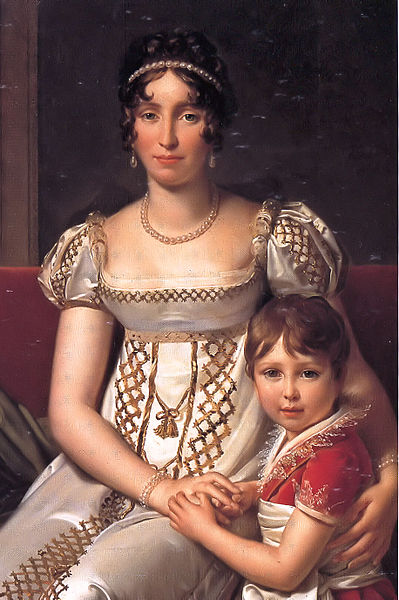
Hortense de Beauharnais 4.10.13 Thought of the Day

[Image courtesy: Wikipedia]

[Image courtesy: Wikipedia]

Hortense E de Beauharnais was born on this day in Paris, France in 1783. Today is the 230th anniversary of her birth.

She was born to French aristocrats Alexandre, Vicomte de Beauharnais and Joséphine Tascher de la Pagerie. Both her parents were arrested during the French Revolution, and her father was guillotined at the Place de la Révolution on July 23, 1794. Josephine was released in August of that year. In 1796 she married Napoleon Bonaparte.

Hortense was a pretty child. She had long blond hair and blue eyes. She attended school Napoleon’s youngest sister, Caroline.

[Image courtesy: Wikimedia Commons

[Image courtesy: Wikimedia Commons

At 19 this “Flower of the Bonapartes” was married off to Napoleon’s brother Louis. It was not a marriage of love, but, rather, it was a marriage of convenience, arranged at Napoleon’s request. The couple never got along, but they did manage to have three children together: Napoléon Louis Charles Bonaparte, Napoleon Louis Bonaparte and Charles Louis Napoléon Bonaparte. (Charles would later become Napoleon III, Emperor of France.)

The Royal Monogram of Hortense [Image Courtesy Wikipedia]

The Royal Monogram of Hortense de Beauharnais, Queen of Holland [Image Courtesy Wikipedia]

The Emperor appointed Louis King of Holland and Hortense had to leave her beloved Paris to follow her no-so-beloved husband to Holland. The Netherlands won her over and she learned to enjoy the people, customs and landscapes. But her relationship with Louis did not improve.

After the death of their first son Hortense was allowed to return to Paris because it would provide a more healthy environment for both the Queen and her remaining children. When Napoleon prepared to remarry he decided that it wouldn’t do to have the daughter of his first wife living at court, so he had her shuttled north again. Her stay in Holland was temporary and she left, again for “health” reasons, in 1810.

Now officially separated Hortense moved to Switzerland where she had a long-term affair with Colonel Charles Joseph, Comte de Flahaut. The couple had an illegitimate son together, Charles Auguste Louis Joseph.

[Image courtesy: Wikipedia]

[Image courtesy: Wikipedia]

She remained a loyal Bonapartist. When the Bourbon monarchy was restored in Paris, Hortense — like all the Bonapartes –went into exile. She, Charles Louis Napoléon Bonaparte and Charles Auguste Louis Joseph moved to Arenenberg Castle, near Lake Constance in Switzerland. While there she transformed…

The medieval castle and its gardens …. into an island of French culture amidst the rather provincial region of Lake Constance. The castle was surrounded by a 12 ha park with hermitage, fountains, waterfalls and nymphaeum, steep paths and viewpoints.  [www.bodensee-magazine]

The main house, which still stands, had living quarters and rooms for entertainment (including a theatre). She continued to expand the house and  revamp the estate, adding the latest in Parisian style almost until her death on October 5,  1837.

[Image courtesy: Kreuzlingen tourism]

Arenenberg Castle  [Image courtesy: Kreuzlingen tourism]


Andrew Jackson 3.15.13 thought of the Day

“Take time to deliberate; but when the time for action arrives, stop thinking and go in.” –Andrew Jackson

English: Andrew Jackson - 7 th President of th...

English: Andrew Jackson – 7 th President of the United States (1829–1837) (Photo credit: Wikipedia)

Andrew Jackson was born on this day in the  Waxhaws region between North and South Carolina in 1767. Today is the 246th anniversary of his birth.

He was born to Andrew and Elizabeth Hutchinson Jackson, Scots-Irish emigrants who had come over from Ireland two years before with their young sons Hugh and Robert. Andrew Jackson never met his father, who died three weeks before the baby was born.

Raised by his widowed mother, Jackson grew up with a large extended family—aunts, uncles, and cousins— who were also Irish immigrant farmers. As a youth, Jackson attended a good school and his mother had hopes of him becoming a Presbyterian minister. However, young Jackson’s propensity for pranks, cursing, and fighting quickly dashed those hopes. [The Hermitage.com]

The American Revolutionary War left the Jackson family devastated. All three boys signed up to fight the British (Andrew was just 13 and became a courier.) Older bother Hugh died of heat stroke at the Battle of Stono Ferry in 1779. In 1781 Jackson and his remaining brother Robert were taken prisoner. The boys nearly starved to death in the camp, and Jackson was slashed with a sword when he refused to polish a British officer’s boots. He carried the scars on his hand and head for the rest of his life. Both Jackson and Robert

contracted smallpox in prison and were gravely ill when Jackson’s mother arranged for their release in a prisoner exchange. Jackson survived, however, his brother died. After Jackson recovered, his mother traveled to Charleston to aid the war effort by nursing injured and sick soldiers. She contracted cholera and died leaving Jackson an orphan. [Ibid]

Growing up in the backwoods of the Carolinas, Jackson’s education was sporadic. He attended a “old-field” school in his youth. (An old-field school was a school that washeld on– either an open field or in a building built — on an exhausted corn, tobacco or cotton field.)  After the Revolutionary War he worked for a while at a saddle makers shop, but then took up law.

In 1787, after three years of studying law, Jackson received his license to practice law in several counties scattered through the North Carolina back country. To supplement his income, he also worked in small-town general stores. While living in North Carolina, Jackson gained a reputation for being charismatic, wild, and ambitious. He loved to dance, entertain, gamble, and spend his free time with friends in taverns. [Ibid]

At 21 he became public prosecutor of the Western District of North Carolina. He became the prosecutr for both Jonesborough and Nashville. It was during this time that he met Rachel Donelson Robards (who was separated — and she assumed divorced — from her first husband Lewis Robards.) Jackson married Rachel while the two were in the wilderness of the Western District only to come back to Nashville to find out that Robards had not completed the divorce proceedings. He, Robards, then used  Rachel’s ‘bigomy’ as grounds  to finalize the divorce. Jackson and Rachel remarried, but the controversy followed them for the rest of their lives, and Jackson was willing to duel with any man who  besmirched his wife’s name.

English: Portrait of Rachel Donelson Jackson, ...

English: Portrait of Rachel Donelson Jackson, wife of U.S. President Andrew Jackson, by the artist Ralph E. W. Earl. Oil on canvas, 30 in. x 20 in. Circa 1830-1832. Portrait is in the collection of The Hermitage, Nashville, Tennessee. Image courtesy of the Tennessee Portrait Project. (Photo credit: Wikipedia)

None of that stopped Jackson’s rise in the political arena. “He was the first man elected from Tennessee to the House of Representatives, and he served briefly in the Senate” [Whitehouse.gov]

During the War of 1812 President Madison “commissioned Jackson Major General of U.S. Volunteers and ordered him to lead 1,500 troops south to Natchez and eventually to defend New Orleans” [The Hermitage.com] His leadership in the Battle of New Orleans made “Old Hickory ” a national hero. In 1824 he made an unsuccessful run for President against John Quincy Adams. Four years later he ran again. This time he won the White House.

Accomplishments of his presidency:

  1. He paid off the National Debt
  2. Fought against corrupt bureaucracy with the Spoil System
  3. Enfranchisement policy

Crisis / Negatives of his presidency:

  1. Nullification Crisis
  2. Ethnic cleansing of  about 45,000 Native Americans from their ancestral lands under his “Indian Removal Act”  which lead to the Trail of Tears .

Neutral effects of his presidency:

  1. Tried to eliminate the Electorial College
  2. Opposed the National Bank

After leaving the White House he retired The Hermitage in Nashville. He died on June 8, 1845, of chronic tuberculosis, dropsy, and heart failure.

78 year old Andrew Jackson

78 year old Andrew Jackson (Photo credit: Wikipedia)


Czar Alexander II 3.13.13 Thought of the Day

Switching it up a bit on ritaLOVEStoWRITE. Instead of picking some one who was BORN on this day I picked some one who DIED on this day, Alexander II of Russia.  In grad school we did a big group project where we developed a magazine concept. My group did a history magazine based on slices of time called Epoch. Our sample magazine’s Epoch was the year 1881 and I wrote an article and designed spreads on Alexander II.

——————————————

“It is better to abolish serfdom from above than to wait for it to abolish itself from below”–Alexander II or Russia

English: Photo taken by A. A. Pasetti of Tsar ...

English: Photo taken by A. A. Pasetti of Tsar Nicholas II of Russia, near age 30, at St. Petersburg, Russia, 1898. Français : Photo de Nicolas II de Russie, prise par A. A. Pasetti en 1898, alors que Nicolas II a 30 ans. Русский: Фотография A. A. Pasetti царя Николая Второго, в возрасте 30 лет в Санкт-Петербурге, 1898 год. (Photo credit: Wikipedia)

Alexander Nikolaevich Romanov was born on April 29th, 1818 in Moscow, Russia. He died on this day in the Winter Palace, St. Petersburg, Russia in 1881.

He was the first-born son of grand duke Nikolay Pavlovich and his wife Alexandra Fyodorovna (who became Czar Nicholas II and Charlotte of Prussia in 1825). His father’s larger than life personality dominated family and palace life and Alexander was completely overshadowed by him. Alexander was schooled in a broad field of disciplines (his principal instructor was poet Vasily Zhukovsky), but he was a passive student. At 19 he did a tour of Europe and plus 20 of the Russian provinces. He was the first Romanov to visit Siberia. While he was in Europe he met his future wife Princess Marie of Hesse. The two married in 1841.

14 years later, after the death of his father, Alexander became Czar.

The country was in the throes of the bloody Crimean War. The war was both draining the country financially and costing a tremendous loss of life. Russia was clearly overpowered her British, French and Ottoman foes.  The Czar negotiated for peace. “The Treaty of Paris ended the bloodshed but Russia lost its dominance in the Balkans and its warships were banned from the Black Sea.” [Russiapedia]

Portrait by unknown of Tsar Alexander II of Ru...

Portrait by unknown of Tsar Alexander II of Russia, wearing the greatcoat and cap of the Imperial Horse-Guards Regiment, circa 1865. The portrait is the property of the Hermitage Museum of St Petersburg, Russia. (Photo credit: Wikipedia)

He embarked on a number of reforms in hopes of modernizing Russia. He:

  1. Improved the railway. When he took office there was one line from Moscow to St. Petersburg (about 600 miles). At the time of his death about 14,000 miles of track had been laid.
  2. Developed the Economy, promoting banks and join-stock companies.
  3. Freed the Serfs. Despite fierce opposition from the land owners he “took an active personal part in the arduous legislative labours that on February 19, 1861, culminated in the Emancipation Act. By a stroke of the autocrat’s pen, tens of millions of human chattels were given their personal freedom.” [Britannica.com] They were given a small amount of land. (Of course they had to pay taxes on those lands.)
  4. Modernized the judicial system
  5. Improved  the Russian military
  6. Set up elective local assemblies known as Zemstvos

Their gradual introduction extended the area of self-government, improved local welfare (education, hygiene, medical care, local crafts, agronomy), and brought the first rays of enlightenment to the benighted Russian villages. [Ibid]

Political changes included:

  1. The release of political prisoners
  2. Greater religious freedoms for “Jews and sectarians.” [Ibid]
  3. Lifting of foreign travel restrictions
  4. Relaxing Russian rule over Poland
  5. Abolishing medieval punishments

Despite all the reforms and attempts at  modernization there was great unrest in the country. The great land owners weren’t happy about loosing their free labor force. National pride was bruised over Poland — and there were riots in the streets. And anarchists and nihilists seemed to be on every street corner.

Alexander’s reforms were drawing more and more criticism. For some his extraordinary efforts to change his country were too much while others believed he didn’t go far enough. Alexander became a victim of numerous murder plots – one dramatic assassination attempt followed another. [Russiapedia]

The more people protested. The more he drew back, and the less reform minded he became.

Alexander II of Russia

Alexander II of Russia (Photo credit: Wikipedia)

There were four assignation attempts made on Alexander’s life.  April the 4th 1866, April 20th 1879, December 1879, and  February 5th  1880. Then…

In February 1880 Alexander announced that he was considering granting the Russian people a constitution. But the plan never went ahead. On March 13, 1881 the Tsar’s carriage was bombed in the streets of St. Petersburg by members of a revolutionary organisation People’s Will. He emerged shaken but unhurt and wanted to see the site of the explosion and check on the wounded Cossacks that accompanied him. As he made his way over, another terrorist threw his bomb. Fatally wounded, Alexander died an hour later. [Russiapedia]

English: The assassination of Alexander II of ...

English: The assassination of Alexander II of Russia 1881 Deutsch: Das Attentat auf den Kaiser Alexander II. in St. Petersburg (Photo credit: Wikipedia)


Kate Sheppard 3.10.13 Thought of the Day

“All that separates, whether of race, class, creed, or sex, is inhuman, and must be overcome.” –Kate Sheppard

Social reformer, suffragist, writer, and first...

Catherine Wilson Malcolm was born on this day in Liverpool, England in 1847. Today is the 166th anniversary of her birth.
Although christened Catherine she preferred Kate. She lived in London, Nairn (Scotland) and Dublin. She was well-educated and excelled in science, the arts and law.  She shared her father’s love of music and her mother’s faith in the Free church of Scotland (her uncle was a minister in the church.) She lived in the UK until 1869. After her father passed away her mother, brother and sister moved to Christchurch, New Zealand.  At 24 she married Walter Allen Sheppard, and they had a son, Douglas.
In New Zealand she got involved in the temperance movement.
Women’s Christian Temperance Union, which advocated women’s suffrage as a means to fight for liquor prohibition. For Kate, suffrage quickly became an end in itself. Speaking for a new generation, she argued, ‘We are tired of having a “sphere” doled out to us, and of being told that anything outside that sphere is “unwomanly”.’ [New Zealand History Time Line]
She quickly became the leading voice for the movement and deployed her organizational, writing and speech making skills to rally other women to the cause.  The women refused to follow the advice of critics such as ” Wellington resident Henry Wright” who wrote…
…women were ‘recommended to go home, look after their children, cook their husbands’ dinners, empty the slops, and generally attend to the domestic affairs for which Nature designed them’; they should give up ‘meddling in masculine concerns of which they are profoundly ignorant’. [Ibid]
New Zealand became the first country to pass a Woman’s suffrage bill, granting woman the right to vote, in 1893. A a 766-foot-long petition containing 32,000 signature was unrolled in front of the country’s Parliament to get the job done.
National Council of Women at the inaugural mee...

National Council of Women at the inaugural meeting in Christchurch in 1896 (Photo credit: Wikipedia)

Sheppard  continued to work for women’s rights  and freedoms. She traveled the world to promote the women’s right to vote, and  became president of the National Council of Women of New Zealand as well as the editor of The White Ribbon, a New Zealand newspaper owned, managed and published by women.
She died on 13 July 1934, a year after the first woman MP, Labour’s Elizabeth McCombs, entered Parliament. In recent years Sheppard’s contribution to New Zealand’s identity has been acknowledged on the $10 note and a commemorative stamp. [Ibid]

Related articles:


Henry II 3.5.13 Thought of the Day — Part 2

English: Henry II and Thomas Becket

English: Henry II and Thomas Becket (Photo credit: Wikipedia)

Click here for PART ONE

When word reached Henry that Becket was hiring armed men to protect him he said “What miserable drones and traitors have I nourished and brought up in my household, who let their lord be treated with such shameful contempt by a low-born cleric?” [History of Britain, Schama, pg 142] It was said in a moment of frustration and anger, and probably not given as command, but it was all the anti- Becket faction needed. Four knights set out to murder the Archbishop while he was at Vespers in Canterbury Cathedral.   “Almost overnight Becket became a saint. Henry reconciled himself with the church.” [BBC.co.uk] He was genuinely grief-stricken over the loss of his former friend. He did penance at Beckett’s tomb and reversed the Constitution of Clarendon.

Family

English: Henry II and his wife Eleonora

English: Henry II and his wife Eleonora (Photo credit: Wikipedia)

Henry had trust issues. Those extended to his family. Eleanor, 10 years Henry’s senior, was very much in love with him when they first married. She was a dutiful wife and bore him seven children, five of whom were boys. She traveled with him when she could. But he preferred to have Becket entertain visiting royalty — usually the Queen’s job — and he was a restless busy man who gave her titles but not power. She put up with it for 14 years before returning to Aquitaine to “assume personal control of the lands. Henry was left to his own affairs (of every sort) back in England.” [About.com]

Henry now had problems within his own family. His sons – Henry, Geoffrey, Richard and John – mistrusted each other and resented their father’s policy of dividing land among them. There were serious family disputes in 1173, 1181 and 1184. The king’s attempt to find an inheritance for John led to opposition from Richard and Philip II of France. Henry was forced to give way. [BBC.co.uk]

[James Goldman’s excellent play The Lion in Winter portrays a fictionalized Christmas between the imbittered royal family in 1183.]

Henry and Richard were at war in France when Henry took seriously ill. After so many years of refusing to name Richard his heir he was forced to do so at Ballan. He died  on the 6th of July, 1189.

Henry II & his children

———————————————-

Links:

We saw The Lion in Winter at the  American Shakespeare Center in Staunton, Virginia last summer. It was an amazing theatre and an awesome Shakespeare (and historical) experience. Click on the link and check them out.


Henry II 3.5.13 Thought of the Day PART ONE

“Will no one rid me of this turbulent priest?” — Henry II of England

James Keegan as King Henry in The Lion in Winter, 2012. Photo by Michael Bailey. James Keegan as Henry II in last summer's production of The Lion in Winter at the American Shakespeare Center.]

James Keegan as King Henry in The Lion in Winter, 2012. Photo by Michael Bailey. [At the American Shakespeare Center.]

Henry II of England was born on this day in Le Mans, France  in 1133. Today is the 880th anniversary of his birth.

Henry, Count of Anjou, Count of Maine, Duke of Normandy, Duke of Aquitaine, Count of Nantes, Lord of Ireland, and  eventually King of England (1154–89)  was the oldest child of Empress Matilda and Geoffrey the Fair. Matilda was the eldest daughter of England’s Henry I who died unexpectedly in 1135 without naming an heir. She had a strong claim that her baby boy, a direct male descendant should be next in line for the throne, but her cousin Stephen, Count of Blois,  (aka Stephen the Usurper), got there  first. Matilda, aided by her half-brother Robert of Gloucester, raised an army and a 17 year civil war ensued.

Stephen and Henry discuss across the River Tha...

Stephen and Henry discuss across the River Thames how to settle the succession of the English throne. (Photo credit: Wikipedia)

Henry’s early years were spent in the Court of Anjou with his father, but beginning in 1142 the boy traveled to England to join the campaign.  The years he spent living in a Spartan manner followed him the rest of his life and Henry eschewed the opulence and soft pleasures of other monarchs.

1151, Henry became ruler of Normandy and Anjou, after the death of his father. In 1152, he married Eleanor of Aquitaine, the greatest heiress in western Europe. In 1153, he crossed to England to pursue his claim to the throne, reaching an agreement that he would succeed Stephen on his death, which occurred in 1154. [BBC.co.uk]

Henry and Becket

The next order of business was to restore peace and order in England. To do that Henry turned to Thomas Becket. Together they rid the country of the robber barons, disloyal knights and criminals who were lapping up the offal of 17 years of war. As a reward for a job well done (and to strengthen his own power over the church) Henry named Becket Archbishop of Canterbury when the old Archbishop died. The church hierarchy was stunned and dismayed, Becket was the King’s man. He wasn’t even a priest. He was ordained on June 2nd, 1162, and consecrated Archbishop on June 3rd. But Becket surprised everyone, especially Henry. He undertook a religious transformation, and where he had been loyal wholly to the King he was now loyal only to God.  He began to work to restore the powers of the  Archbishop and the Church, especially in matters of Law.

English: King Henry II and Thomas Archbishop Č...

English: King Henry II and Thomas Archbishop Česky: Jindřich II. a Thomas Beckett From the Liber Legum Antiquorum Regum, a 12th century work (Photo credit: Wikipedia)

Henry thought the Law of the Land superseded the Law of the Church. Becket disagreed. Henry called and assembly of clergy to Clarendon Palace  in January 1164 where he demanded that Becket sign the Constitution of Clarendon which “established procedures of criminal justice, establishing courts and prisons for those awaiting trial. In addition, the assizes gave fast and clear verdicts, enriched the treasury and extended royal control.” [BBC.co.uk]  In other words it gave Henry power over the church. After much heated debate Becket pledged an oath to the  idea of the Constitution, but he refused to sign. Henry was satisfied. But later when Becket refused to say mass until the oath was overturned. Henry was outraged and had the Archbishop put on trail for treason. Becket fled for exile in France. A  battle of wills ensued between two of Europe’s most stubborn men and neither Queen Elinor nor the Pope Alexander III could bring the parties together. Becket used the last most powerful arrow in his quiver. He tried to excommunicate Henry. Henry countered by threatening to arrest any one who supported Becket with treason. Becket’s support dwindled. He agreed to meet Henry in July of 1170. Becket accepted Henry’s legal supremacy in England. He was allowed to return to England. But he wasn’t willing to leave well enough alone.

Henry II with Thomas Becket, from a 13th-centu...

Henry II with Thomas Becket, from a 13th-century illuminated manuscript (Photo credit: Wikipedia)

Click here for PART TWO


Michel de Montaigne 2.28.13 Thought of the Day

“Stubborn and ardent clinging to one’s opinion is the best proof of stupidity.” –Michel de Montaigne

Painting by Thomas de Leu (Franco-Flemish pain...

Painting by Thomas de Leu (Franco-Flemish painter and engraver, 1560–1612, active 1580-1610). An engraving of this painting was published in the first edition of Montaigne’s Essais, 1617. (Photo credit: Wikipedia)

Michel Eyquem de Montaigne was born on this day in Château de Montaigne,  near Bordeaux, France  in 1533. Today is the 460th anniversary of his birth.

He was born into a very wealthy French family, but as a toddler he lived with a peasant family for three years. This, his father thought, would give him an appreciation for the conditions of the poor.

The fourteenth-century château, in which Miche...

The fourteenth-century château, in which Michel de Montaigne was born and died, was burnt down in 1885. But soon after rebuilt in a similar style by the Montaign family. Michel Eyquem de Montaigne (February 28, 1533 – September 13, 1592) was an influential French Renaissance writer, generally considered to be the inventor of the personal essay. Michel de Montaigne Another view: Flickr (Photo credit: Wikipedia)

When he returned to the Chateau he was taught by a German tutor and only spoken to in Latin and (eventually) in Greek. So Latin, not French, was his first language. “So the young Montaigne grew up speaking Latin and reading Vergil, Ovid, and Horace on his own. At the age of six, he was sent to board at the Collège de Guyenne in Bordeaux, which he later praised as the best humanist college in France.” [Stanford.edu] In 1546 he went to the University of Toulouse. He studied law and became a counselor of the Court des Aides of Périgueux before being appointed counselor to Parlement and serving as a courtier to Charles IX.

Michel Eyquem de Montaigne, statue sur l'Espla...

Michel Eyquem de Montaigne, statue sur l’Esplanade des Quinconces, Bordeaux (Photo credit: Wikipedia)

While at Parlement he became close friends with the  humanist poet Etienne de La Boëtie whose early death greatly effected Montaigne. “the void left by La Botie’s death in 1563 likely led Montaigne to begin his writing career.” [Answers.com] He retired to the Château de Montaigne to study and write. Although he traveled a bit and served as Mayor of Bordeaux, but his primary office was as a writer.

He was…

one of the most influential writers of the French Renaissance. … He became famous for his effortless ability to merge serious intellectual speculation with casual anecdotes and autobiography — and his massive volume Essais (translated literally as “Attempts”) contains, to this day, some of the most widely influential essays ever written. Montaigne had a direct influence on writers the world over, from William Shakespeare to René Descartes, from Ralph Waldo Emerson to Stephan Zweig, from Friedrich Nietzsche to Jean-Jacques Rousseau. [Goodreads.com]

He died in his home in Montaigne of quinsy, a  complication of tonsillitis at the age of 59, in 1592.

Français : Essais, éd de Bordeaux.

Français : Essais, éd de Bordeaux. (Photo credit: Wikipedia)


George Washington 2.22.13 Thought of the Day

“Labor to keep alive in your breast that little spark of celestial fire, called conscience.”-George Washington

1795 - 1823

1795 – 1823 (Photo credit: Wikipedia)

George Washington was born on this day in Westmoreland County, Virginia, USA in 1732. Today is the 281st anniversary of his birth.

Did you know that if your name is George and you went to Mt. Vernon–Washington’s home south of Alexandria Virginia — today you’d get in at a reduced rate?

So much has been said and written about our first president that that (the “George” Discount) is about the only thing I can bring to the table that is new.

Therefor  I decided that for today’s blog I’d focus on images of Washington.

For an excellent biography of the surveyor, soldier, statesman, farmer and cherry-tree-chopper I refer you to the whitehouse.gov bio. Another terrific bio can be found on the Mount Vernon site at mountvernon.org. Indeed if you are anywhere near the Northern Virginia area I strongly suggest a trip to Mount Vernon where you can not only tour Washington’s house and the grounds of his estate, but can explore Ford Orientation Center and the The Donald W. Reynolds Museum and Education Center. If you have a little extra time you might want to drive over to the Washington Grist Mill and Distillery.

Washington was one of the most successful liquor distributors in the new nation. He built a state-of-the-art distillery at Mt. Vernon, where he made rye whiskey, apple brandy and peach brandy. The distillery has been restored in recent years, and is now open to visitors. [Bio.now]

George Washington dollar

George Washington dollar (Photo credit: Wikipedia)

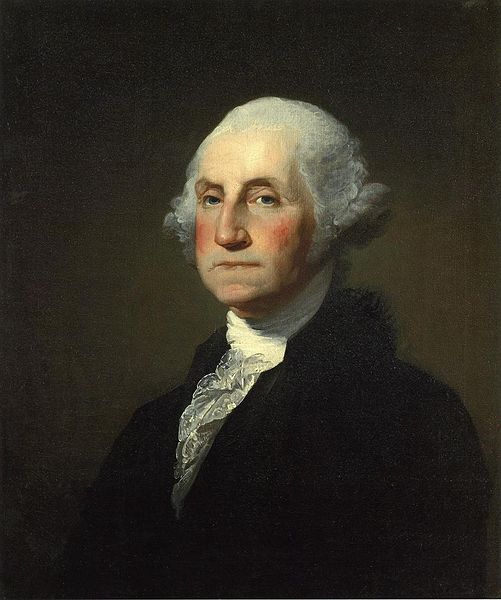
Perhaps the best known image of George Washington is this one done by Gilbert Stuart.

Perhaps the best known image of George Washington is this one done by Gilbert Stuart.

Gilbert Stuart was another artist who was inspired to paint Washington. [Image courtesy: The Library of Congress]

Stuart was inspired by Washington and painted him several times . [Image courtesy: The Library of Congress]

Tompkins H. Matteson's Washington at Valley Forge. [Image courtesy the Pocontico Hills School Washington site]

Tompkins H. Matteson’s Washington at Valley Forge. [Image courtesy the Pocontico Hills School Washington site]

General of the Armies [Image courtesy: the US Military Hall of Fame.]

General of the Armies [Image courtesy: the US Military Hall of Fame.]

A young George Washington [Image courtesy: The History Channel.]

A young George Washington [Image courtesy: The History Channel.]


An etching showing George Washington addressing the troops in 1775 [Image courtesy: The National Archives]

An etching showing George Washington addressing the troops in 1775 [Image courtesy: The National Archives]

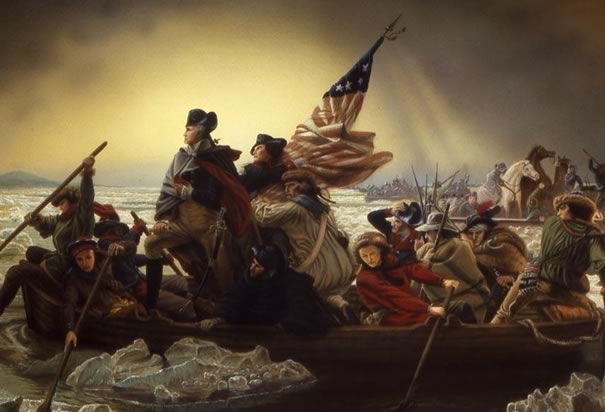
Emanuel Leutze's famous (and highly stylized) version of Washington crossing the Delaware river.

Emanuel Leutze’s famous (and highly stylized) version of Washington crossing the Delaware river.

Washington at Valley Forge. [Image courtesy: the Library of Congress]

Washington at Valley Forge. [Image courtesy: the Library of Congress]

Washington was one of artist John Trumbull's favorite subjects. Here he is  resigning as commander and chief.

Washington was one of artist John Trumbull’s favorite subjects. Here he is resigning as commander and chief.

[Image courtesy Bartleby.com]

[Image courtesy Bartleby.com]

George Washington at Mt. Vernon. George Washin...

George Washington at Mt. Vernon. George Washington seated, half-length, with Martha Washington, and two children. (cropped) (Photo credit: Wikipedia)

An older Washington [Image courtesy: The Independent]

An older Washington [Image courtesy: The Independent]

English: The equestrian sculpture of George Wa...

English: The equestrian sculpture of George Washington at the center of Washington Circle, a traffic circle and public park, located on the boundary of the Foggy Bottom and West End neighborhoods in Washington, D.C. (Photo credit: Wikipedia)

Click HERE to see a forensic model of what George Washington looked like.