Category Archives: History

July Creative Challenge, day 31: RELAX — St. Michaels

[I’m taking this challenge seriously. First I’m RELAXing a bit on this last day of the July Creative Challenges by recycling and revising an article I did for AtHomeInMaryland.com an online travel magazine that has sadly gone away. Since the article is all about RELAXing and having fun in St. Michaels I thought it fit the challenge pretty well… Here goes…]

Take a walk on the relaxing streets of St. Michaels.

Take a walk on the relaxing streets of St. Michaels.

St. Michaels is a place of history, water, crabs, but above all St. Michael’s is a place to relax.

Finding a home on the river…

The little sea fairing town was built around St. Michaels Episcopal Church which was established in 1677. It was a trading post for farmers and trappers. James Braddock, an English land agent purchased 20 acres in 1778. An early real estate developer, Braddock carved 58 plots out of the land and arranged them around a town green. Along with the houses he included churches, a market and schools. Since the town is on the water fishing and shipbuilding became natural industries. By 1812 a half-dozen firms were building schooners to sail the Chesapeake.
It became the “Town That Fooled the British” in the War of 1812. The English fleet was barreling its way up the Chesapeake Bay headed to Baltimore. St. Michaels, with its shipping industry was a clear target for destruction. But in the wee hours of August 10, 1813 as the fleet approached the town’s residents hoisted lanterns into ship’s rigging and high into the tree tops, and the British cannons overshot the town. Only one house took a direct hit. A cannonball crashed through the roof, frightening, but not harming the inhabitants as it rolled down the stairs. That house still stands on Mulberry Street, it is aptly named the “Cannonball House.”
Over the next 150 years St. Michaels became one of the major seafood processing centers on the Bay. By 1930 a single processing plant was shipping more than a million pounds of crab meat annually, and 12,000 gallons of oysters a week! But, by the mid 20th century the seemingly boundless harvest of seafood began quickly, to dry up and St. Michaels long history as the “seafood basket” of the Chesapeake was coming to an end.
With the establishment of the Chesapeake Bay Maritime Museum in 1965 the city turned full-time to tourism as a way of life. St. Michaels beautiful colonial and Victorian homes refashioned themselves as bed and breakfasts, feed stores and tack shops were converted to boutiques and restaurants, and skipjack captains turned from dredging crustaceans to hosting sunset cruises.

Interior of one of the boat barns at the Maritime Museum

Interior of one of the boat barns at the Maritime Museum

Lots to see and do around town…

The Chesapeake Bay Maritime Museum offers 12 buildings and sits on 18 acres at old Naval Point in St. Michaels Harbor.
The Hooper Strait Lighthouse is the iconic center piece of the museum.  Built in 1879 the hexagonal lighthouse guarded the wicked shoals near Deals Island. It was accessible only by rowboat then, and the keepers spent months alone on the water tending the 4th level Fresnel lense and keeping weather and vessel records at the “screw pile” lighthouse. But by 1954 the lighthouse was fully automated and the Coast Guard began dismantling the old style lighthouses.. The Hooper Straight house was on the list for demo! Luckily the fledgling Chesapeake Bay Maritime Museum was able to purchase it for $1,000 and barge is North to St. Michaels. Today it sits safely on the tip of Naval Point, one of four screw pile designed lighthouses left on the Bay. Visitors can climb into the lighthouse and take a self paced tour of the interior, including the keeper’s quarters and the light, and get a birds eye view of the harbor from the catwalk.  The Museum offers a Lighthouse Overnight program for small groups of kids 8-12.
At the “Oystering on the Chesapeake” building visitors board the E.C. Collier and listen in as her long time crew brings in the harvest. Dozens of hands-on, kid friendly displays take you through the history and conflicts of the oystering industry and lets you see how Maryland’s favorite mollusk went from the Bay’s bottom to a restaurant’s table top.
At the museum’s boat yard you can watch as skipjacks and crab dredgers are restored to new life. If you are itching to get out on the water you can take a tour on the Mister Jim. If you want a more hands on approach, the Museum’s Apprentice For A Day program is a unique opportunity to help build traditional wooden skiffs. The museum is open daily year-round (except Christmas, Thanksgiving, and New Year’s day).
PENTAX Image

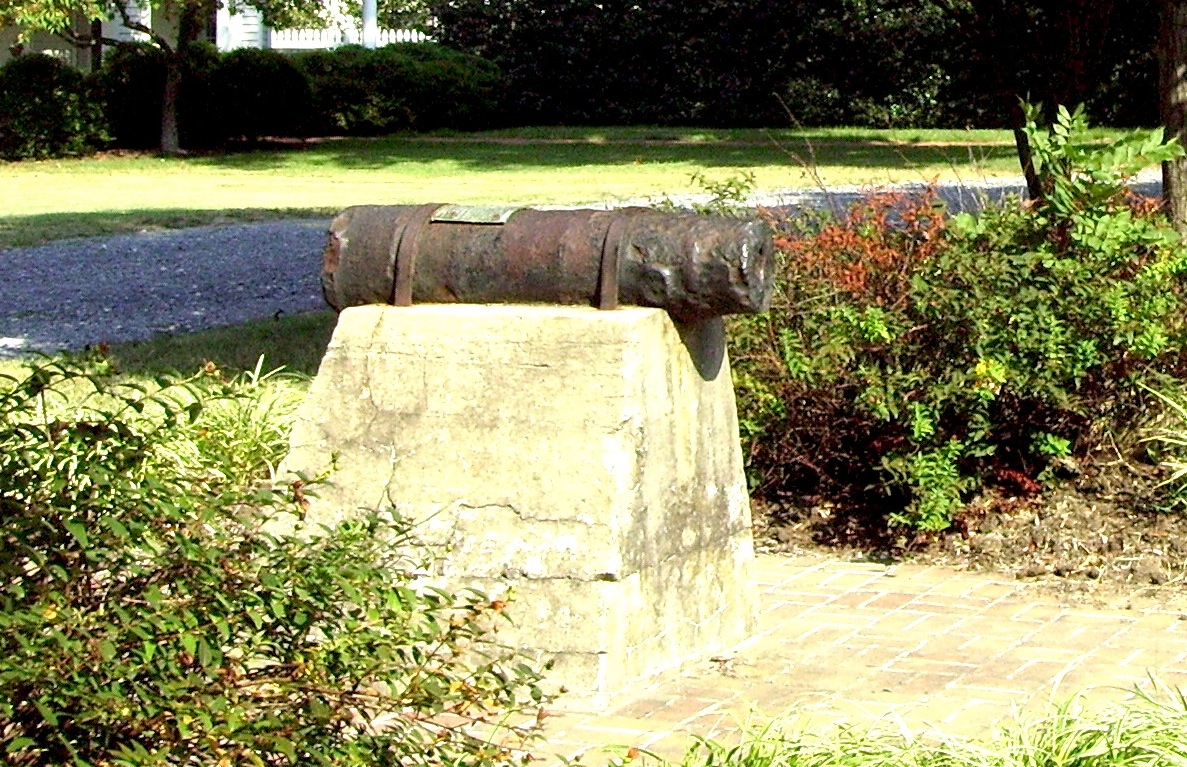
Canon at St. Mary’s Square

St. Mary’s Square lies just to the south of St. Michaels Harbor. See cannons, one of which defended the city in during the War of 1812, and the Mechanic’s Bell that ruled the shipbuilder’s day by ringing at 7am, noon and 5 pm. St. Mary’s Square Museum host historic exhibits centered on the town of St. Michaels. The Museum is open weekends from May to October, Guided walking tours are available at the corner of Chestnut street and St. Mary’s Square on Saturdays beginning at 10:30 am. The tours alternate between “Young Frederick Douglas in St. Michaels” and “Historic St. Michaels Waterfront”. Reservations are required for a docent tour, call 410-745-0530. A Self-Guided walking tour map is also available at the St. Mary’s Museum.

Get out on the water! Go down to St. Michaels’ dock or drive over to nearby Tilghman Island for some water action.  Get up close and personal with some wild life, including osprey and bald eagles, with Peake Paddle Tours. Tours range from freshwater streams, to tidal rivers, to salt marshes all over the Eastern Shore, and skill levels start at beginner. Chesapeake Lights offers a variety of Lighthouse tours on the Bay.  Captain Mike Richards sales the motorized M/V Sharps Island out of Tilghman Island. A 10 hour, 10 lighthouse tour is scheduled for July 24th. The skipjack Rebecca T. Ruark, a National Historic Landmark, also sales out of Tilghman’s.  Captain Wade Murphy, Jr. is a 5th generation Chesapeake Bay waterman, and along with a beautiful ride you’ll get a history and science lesson on the Bay. The beautiful canoe-sterned ketch the Lady Patty is berthed in front of the Bay Hundred Restaurant in Tilghman Island and sets sail three times a day for 2 hour cruises including a romantic Champagne Sunset Cruise at 6:30.  The Salina II, a vintage catboat hosts private sailing lessons and 2 hr cruises for six. You can also take a Wine or Beer Tasting cruise or even an Overnight Excursion on the Selina II which docks at St. Michaels.
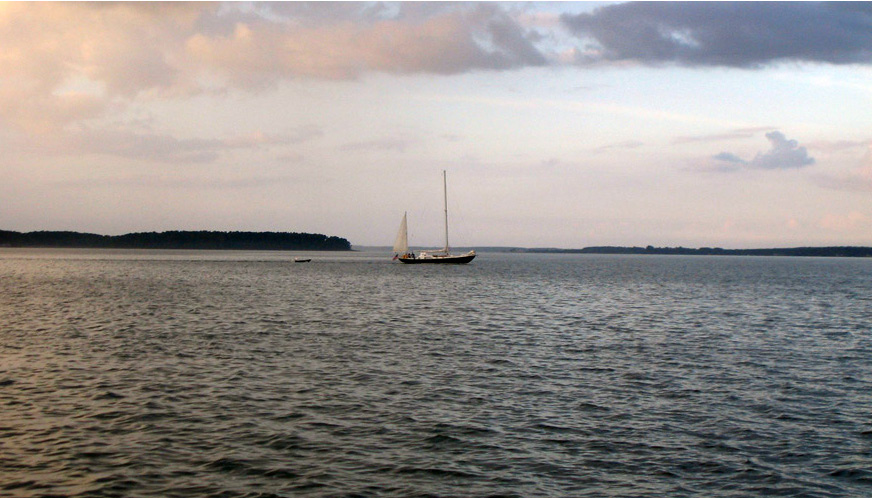
Sailing on the Bay

Sailing on the Bay. We took a twi-light cruise on the Rebecca T. Ruark which I found both educational and relaxing. This shot if of another vessel as the sun set to the left.

Spending the night…

There are over 25 Bed and Breakfast establishments in the St. Michaels area, so there’s plenty of variety in cost, location and luxury.

Dr. Dodson’s House at 200 Cherry Street began life as a tavern and the town’s first post office in 1799. Fredrick Douglas visited the house after the Civil War to meet with his former master, Captain Thomas Auld. Much of the house still maintains a historic flavor with original fireplaces, woodwork and glass. The house, which is on the St. Mary’s Square Museum walking tour, remains one of the finest examples of Federal architecture in town. It was brought to new life as a Bed and Breakfast after a bit of modernization (read: Air Conditioning and WiFi). The full breakfast is an “Event” from the eggs benedict, to the fresh tomato tarts, to the banana pecan waffles. You won’t leave the table hungry.

For Victorian charm try the Cherry Street Inn. This 1880’s house built by a steamboat captain has been lovingly maintained. The Inn is an easy walk to the harbor, The Chesapeake Maritime Museum and the shops and eateries on Main Street (Talbot Street).

Five Gables Inn and Spa offers a number of packages for the ultimate escape to the Bay. The signature Spa and Sail package includes two nights at one of their charming Main Street locations, two massages at the on site Aveda Spa, crab dinner for two at the Crab Claw Restaurant, and a two-hour cruise on the Rebecca T. Ruark. Other packages range from a one night champagne and chocolate get away to a four night “Learn to Sail” program that includes three private sailing lessons followed by massages. Five Gables is in the heart of St. Michaels, it is nestled among the Main Street Antique shops and is an easy walk to the harbor and the Maritime Museum. The Five Gables offers 12 rooms and 8 suites and an extended continental breakfast.
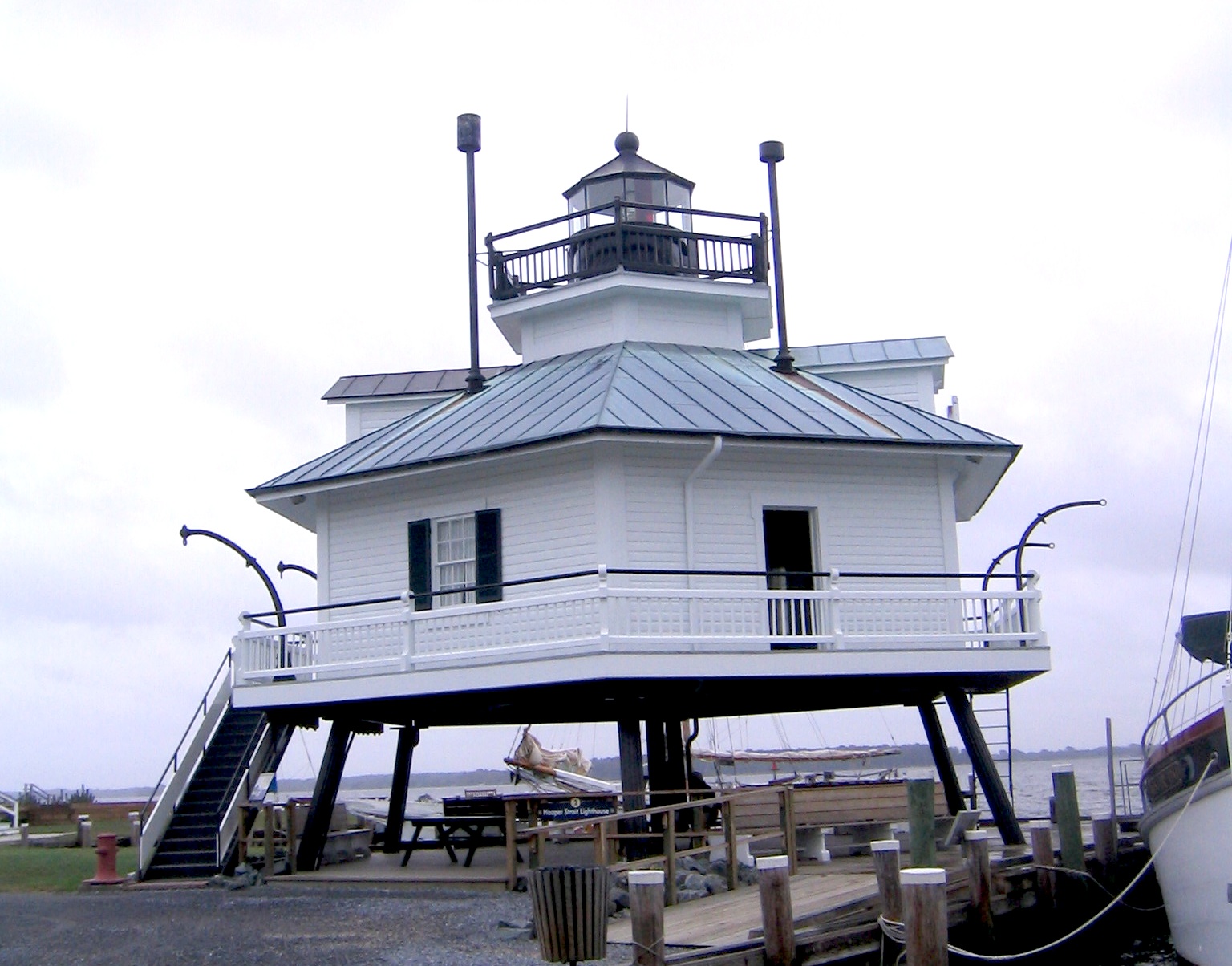
The iconic Hooper Light House at St. Michaels.

The iconic Hooper Light House at St. Michaels.

  • re-enactments,
  • boat rides,
  • cannon firings,
  • a Talbot Street parade,
  • horse-drawn carriage rides,
  • an Art show
  • and more.

If you stay an extra day you can enjoy the 4 th Annual Watermen’s Appreciation Day and Crab Feast.

_____________________________________________________________


July Creative Challenge Day 4: PRIDE

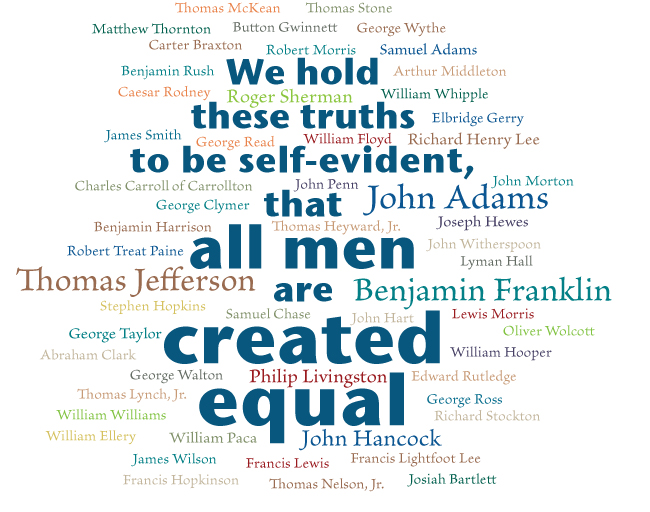
Well, it’s the Fourth of July and here in America that elicits a lot of PRIDE in our Founding Fathers. So for today’s challenge I did a word collage based on the Declaration of Independence  and the original signers.

My Declaration word collage.

My Declaration word collage.

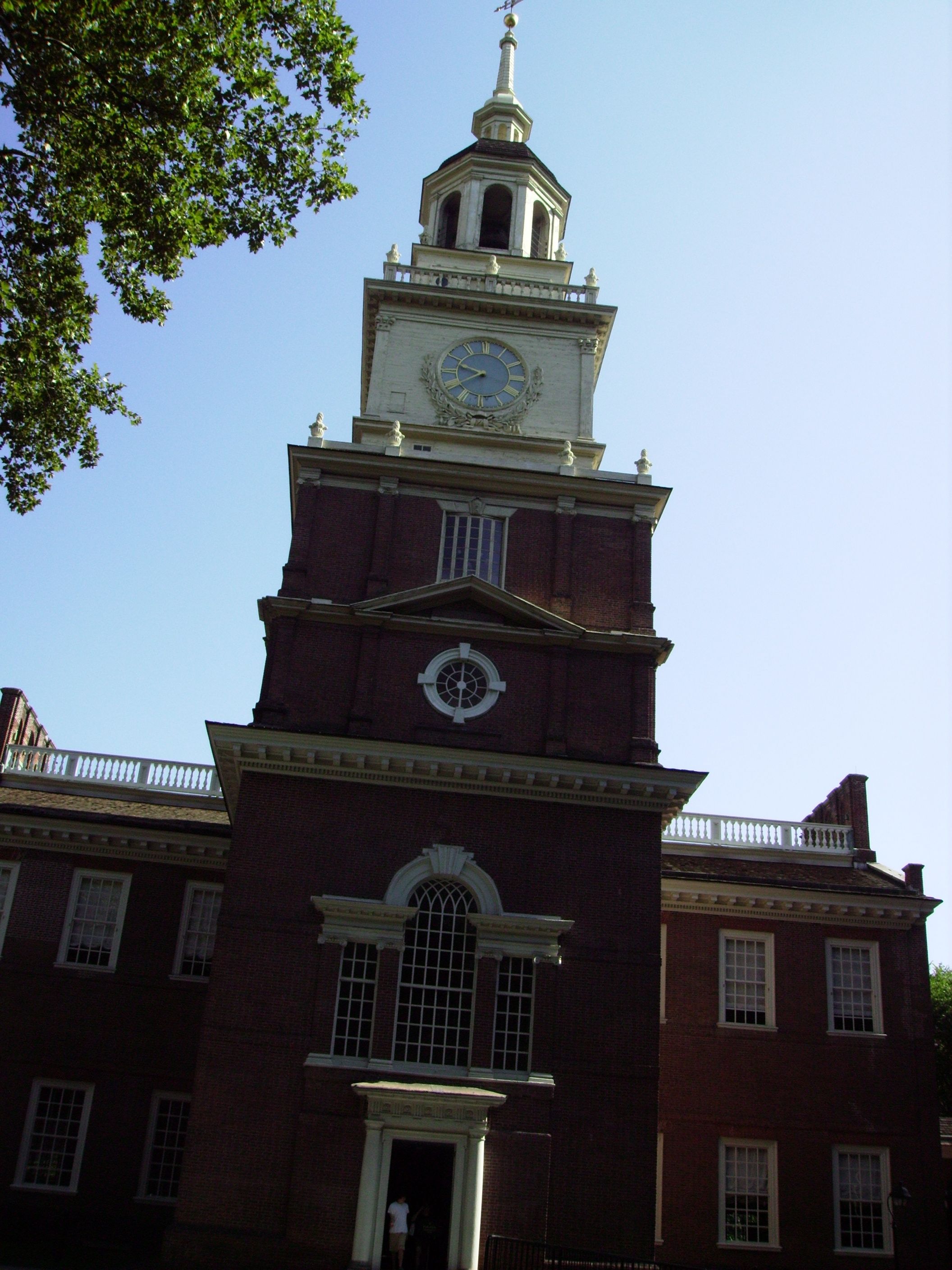
The Declaration is an amazing document and it is worth a trip to the National Archives in Washington DC to see it in person (along with the Constitution, the Bill of Rights and the 1217 Magna Carta. I’d also strongly suggest a trip to Independence Hall in Philadelphia, PA where the Declaration was debated and adopted.

Independence Hall in Philadelphia.

Independence Hall in Philadelphia.

Like the Bible and the Constitution people read the Declaration in different ways, often to fit their specific needs. Indeed, when Jefferson, Adams, Franklin, Livingston and Sherman put their heads together to come up with the document they had their disagreements, and before the Second Continental Congress finally adopted it copious compromises had to be accommodated. Alas, certain races and sexes had been edited out of the “all men” altogether (not that women were ever really in the mix to begin with.) Yet, despite it’s flaws and the flaws of the men who signed it, the Declaration remains one of the best treatises on the rights of individual man and of independent states ever written.

I encourage you to read it in its entirety. Here’s a full transcript of the Declaration. Or to listen to it HERE from NPR.

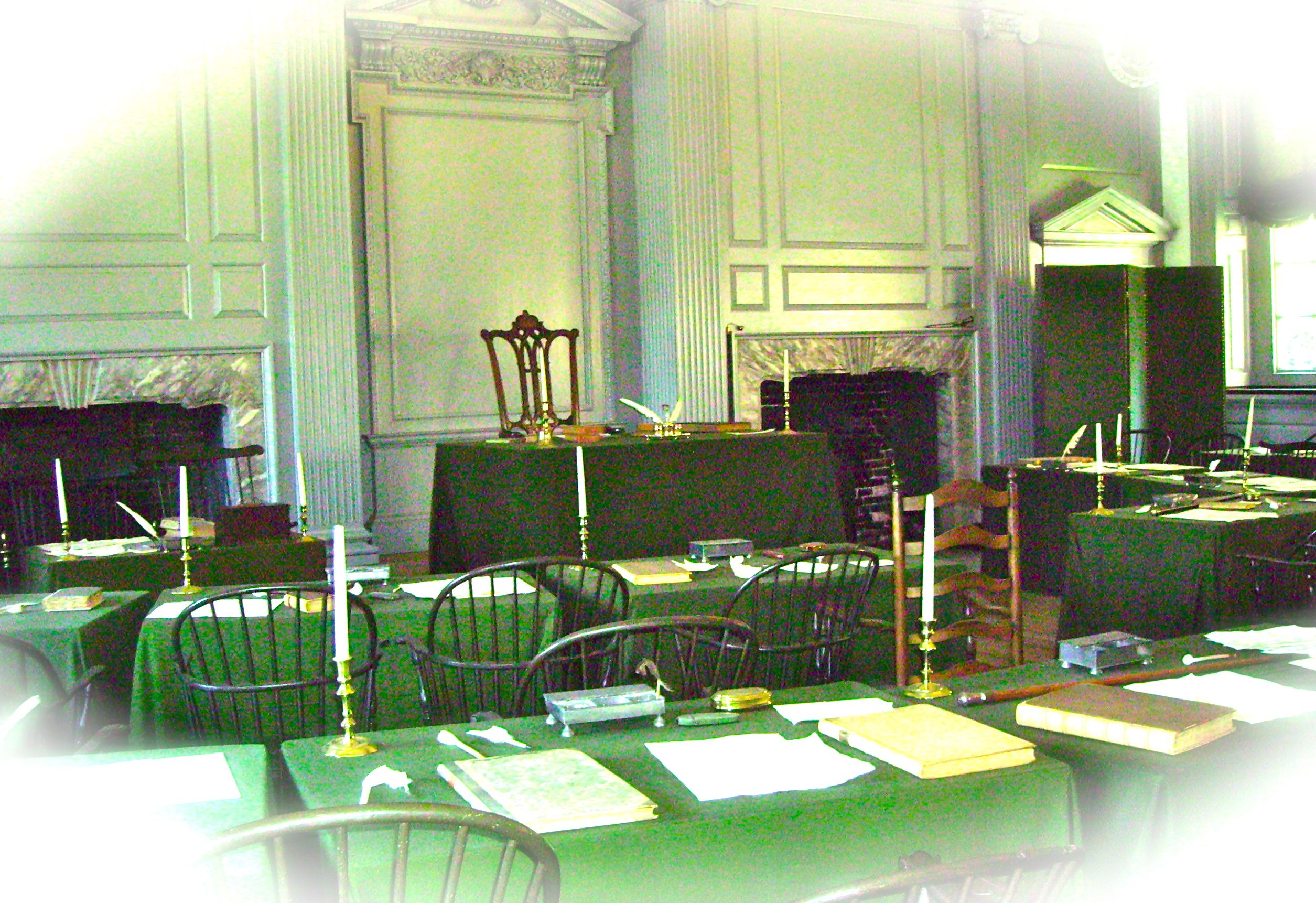
The Assembly Room inside Independence Hall, where the Declaration of Independence was signed.

The Assembly Room inside Independence Hall, where the Declaration of Independence was adopted.

For more information on the signers I suggest delving into the profiles posted on The Society of The Descendants of the Signers of the declaration of Independence.   Click HERE to read about John Penn from North Carolina (who I picked at random). John Penn was instrumental in organizing the North Carolina delegates to vote for Independence. He:

  • He served in the Continental Congress for six years
  • He signed the Declaration of Independence
  • He signed the Articles of Confederation
  • He signed the Halifax Resolves (the North Carolina Constitution)
  • He was virtual dictator of North Carolina at what arguably was the turning point of the American Revolution in 1781-1782 [DSDI1776.com]
John Penn (Continental Congress)

John Penn (Continental Congress) (Photo credit: Wikipedia)


July Challenge Day 2: TUDOR

Here’s my post followed by some early entries to the Creative Challenge, day two…

[Background image: Pembroke Castle; courtesy: Wikimedia]

[My contribution to the Creative Challenge… a logo for a BBC style documentary on the family. Background image: Pembroke Castle; courtesy: Wikimedia]

I’m not a Tudor expert. Other people with a lot more knowledge of British History have written volumes and volumes on Henry VIII and Elizabeth I and the rest. Today’s blog doesn’t come close to telling the whole story of that family. But it is the birthday of Elizabeth Tudor, Henry the VIII’s little sister, so I thought I’d tell you a little bit about her.

English: Portrait of the Royal Tudors. At left...

English: Portrait of the Royal Tudors. At left, Henry VII, with Prince Arthur behind him, then Prince Henry (later Henry VIII), and Prince Edmund, who did not survive early childhood. To the right is Elizabeth of York, with Princess Margaret, then Princess Elizabeth who didn’t survive childhood, Princess Mary, and Princess Katherine, who died shortly after her birth. (Photo credit: Wikipedia)

She was born in 1492, one year after Henry. Although she was just three years old when she died she was already a pawn in the marriage game the Tudors were so very “good” at playing. She was to be wed to Prince Francis. Had she lived she would have become Queen of France to his King Francis I. Alas the little girl died of atrophy in 1495.

Elizabeth spent much of her short life at the royal nursery of Eltham Palace, Kent, with her brother Prince Henry (the future King Henry VIII) and her sister Princess Margaret (later Queen of Scotland) under the guidance of a Lady Mistress, presided over by her mother. Elizabeth’s oldest brother, Prince Arthur, as heir to the throne, was brought up separately in his own household. [Find a Grave.com]

Her death, she was the first of the children to die young –Edmund and Katherine would also die in infancy — effected the family greatly. Her parents spent a lavish amount of money on her funeral and tomb. And Margaret and Henry were devastated by the loss of their little sister and play mate. (He was only 4 at the time.)

A decade later Arthur, the eldest and heir, would die too. Here is Henry with his surviving sisters Margaret and Mary.

English: Erasmus of Rotterdam visiting the chi...

English: Erasmus of Rotterdam visiting the children of Henry VII at Eltham Palace in 1499 and presenting Prince Henry (the future Henry VIII.) with a written tribute. Detail of oil painting in the Prince’s chamber in Westminster Hall. (Photo credit: Wikipedia)

When the Court was sure that Arthur’s widow, Katherine of Aragon, was not with child,  Henry was made Prince of Wales and the heir apparent.  He also became betrothed to Arthur’s widow Katherine of Aragon to maintain the political alliance of the marriage brought with Spain. (He was 15, she was 21).

Here's my chart showing the marriages and offspring of the Tudors

Here’s my chart showing the marriages and offspring of the Tudors.

Henry VIII is, of course the central figure in this chart — I supposed that happens when you have six wives and change the church of a nation — but there are eight other heads of states on there (not including poor Jane Grey). That’s a lot of power in one family.

His older sister, Margaret, was married off to James IV of Scotland. She was the grandmother of  Mary Queen of Scots.

English: A picture of Margaret Tudor from &quo...

English: A picture of Margaret Tudor from “Memoirs of the Court of Queen Elizabeth” Deutsch: Ein Porträt Margaret Tudors aus “Memoirs of the Court of Queen Elizabeth” (Photo credit: Wikipedia)

His younger sister, Mary, was married first to Louis XII of France, a man 30 years her senior. He died two months later and Mary married Charles Brandon, 1st Duke of Suffolk, in a secret ceremony, and with out Henry’s consent.  She was the grandmother of Lady Jane Grey.

Mary Tudor, Queen of France and subsequently w...

Mary Tudor, Queen of France and subsequently wife of Charles Brandon. (Photo credit: Wikipedia)

———————————————————————————————————-

Thanks to Bill and KL for playing along on the Creative challenge today… I like the way you think!

Please feel free to join them by commenting with your creative take on TUDOR or sending me an email.

Bill suggests a VW Beetle as our Tudor (or is it two door)…

[Image Courtesy: diecast.com]

[Image Courtesy: TheSamba.com]

KL sent in this gif for us. You have  to look closely at it to see why…

elizabethan

Liisa thought of a Tudor Rose — the rose that has red on the outside and a white center, the colors of the petals representing the joining of the York and Lancaster houses after the War of the Roses.

Tudor rose badge from the Pelican Portrait of ...

Tudor rose badge from the Pelican Portrait of Elizabeth I of England (Photo credit: Wikipedia)


Mary Katherine Goddard 6.16.13 Thought of the Day

“He carries every point, who blends the useful with the agreeable, amusing the reader while he instructs him.”
the English translation of the Goddard family motto.

[Image courtesy: The Baltimore Sun]

[Image courtesy: The Baltimore Sun]

Mary Katherine Goddard was born on this day n Groton, Connecticut, USA, in 1738. Today is the 275th anniversary of her birth.

She was elder of two children born to Sarah Updike Goddard and Dr. Giles Goddard. Mary Katherine and her brother William learned to read and write at their New London, Connecticut home. Their mother also taught them “Latin, French, and the literary classics.” [WHMN.org] Shakespeare, Pope and Swift  were favorite reading assignments.

When Mary Katherine was 19 her father passed away. The family stayed in Connecticut for a few years while William was apprenticed to a local printer, but in 1762 they moved to Providence, Rhode Island, and  Sarah Goddard lent William the money to start his own printing business. All three members of the family pitched in to help establish the business.

William was ostensibly in charge, (but) he traveled a great deal, and it was Sarah Updike Goddard who was the true publisher of the Providence Gazette and Country Journal.  Mary Katherine took a great interest in the business and forewent many of the usual activities for young ladies to work as a typesetter, printer, and journalist.  The mother/daughter team made their print shop a hub of activity at a time when newspapers exerted great political influence.  They added a bookbindery, and in addition to the Gazette, printed almanacs, pamphlets, and occasionally books.[WHMN.org]

In 1765 William left Rhode Island for the more metropolitan Philadelphia.  Mary Katherine took over the printing operation in Providence.

…Left with a burden upon her shoulders, Mary Katherine acquired the skills she needed to print a successful publication. “It was probably during the years of [William’s] absence… that his sister… learned the practical side of typography and journalism… ” Lawrence C. Wroth wrote.[University of Rhode Island web site URI.edu]

Three years later William asked the two women to sell the Providence business (They sold the Gazette,  press and building for $550) and move to Pennsylvania to help him with the Philadelphia Chronicle.

Upon their arrival they ran the newspaper and press and William headed to Baltimore, Maryland  on a new venture.  Mary Katherine followed him again in 1774 when she took over her brother’s weekly publications the Maryland Journal and Baltimore Advertiser as he continued to travel.

With her mother dead and her brother prioritizing his political inclinations, Mary Katherine Goddard finally assumed the title of publisher of the Maryland Journal and the Baltimore Advertiser.  She put “Published by M.K. Goddard” on the masthead on May 10, 1775 — and it remained there even when William returned from his New Hampshire-to-Georgia travels in 1776.  [WHMN.org]

She also became a postmaster in 1775 — the first woman in the colonies to do so. As postmaster she was at the  “center of the information exchange.”  [Ibid] and was privy to the news before her competitors. The Journal broke important news stories  (like the skirmishes at Lexington and Concord).

[Image courtesy the Library of Congress]

[Image courtesy the Library of Congress]

Mary Katherine kept the tone of the Journal professional. Other newspapers — and William — editorialized and included op eds that advanced political agendas. “Mary Katherine Goddard used a more objective, impersonal, and professional tone.” [Ibid]

She was a shrewd business woman who accepted alternate forms of payment when the taxes or the War made cash subscription payments difficult.

These included beef, pork, animal food, butter, hog’s lard, tallow, beeswax, flour, wheat, rye, Indian corn, beans and other goods she could sell in her shop. [University of Rhode Island web site URI.edu]

She ran a stationary and printing press where fine printing was produced. She also had a local paper mill.

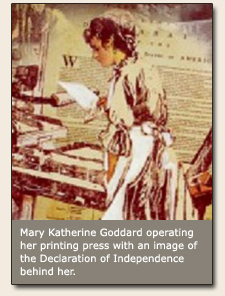
Mary Katherine biggest scoop as a newspaper woman came in January of 1777 when her press printed the first official copy of the Declaration of  Independence to include the names of the signers.

Goddard's published copy of the Declaration of Independence with all the signers identified. [Image courtesy McHenry Country Turning Point.org]

Goddard’s published copy of the Declaration of Independence with all the signers identified. [Image courtesy McHenry Country Turning Point.org]

She successfully ran both the publication and the related printing and paper companies AND served as postmaster through out the long Revolutionary War. But things changed in 1784. She had a falling out with William and he forced her off the paper’s staff. Then in 1789 Mary Katherine was forced to give up her postmaster position. As a woman — it was as argued — she could not handle the traveling the job would demand. Her appeals — backed by a petition of endorsement signed by over 200 Baltimore businessmen — went to President Washington and Congress but got nowhere. She resigned her self to running her bookstore.

Mary Katherine Goddard died att he age of 78 on April 12, 1816. “A copy of the Declaration of Independence printed by her is at the Maryland Hall of Records.”[WHMN.org]


George III 6.4.13 Thought of the Day

“Born and educated in this country, I glory in the name of Britain.”–George III

King George III (in coronation robes)

King George III (in coronation robes) (Photo credit: Wikipedia)

George William Frederick was born on this date in Norfolk House, St. James’s Square, London, England in 1738 . Today is the 275th anniversary of his birth.

The eldest of two sons born to Frederick, Prince of Wales and August of Saxe-Gotha, George was born two months early. The Royal family feared he wouldn’t survive infancy and he was quickly baptized. A month later he was presented publicly and formally baptized into the Anglican Church.

He was educated along with his brother, Prince Edward, Duke of York and Albany, by tutors. The boys learned to read and write English and German as well as the Romance Languages, Science, Math, History, Geography, Economics, Law, Music,  Dancing, Fencing, Riding and Sports.

 On his father’s death in 1751, the 12-year-old George became Prince of Wales. He was cared for in relative isolation by his mother and tutored by the Scottish nobleman Lord Bute. [History.com]

Nine years later he followed his grandfather to the Throne. Crowned in 1761 he reigned for 59 until his death in 1820. George III had the third longest reign of a British monarch (surpassed only by his granddaughter Victoria — 63 years — and the current queen — 61 years).

English: George III of the United Kingdom whil...

English: George III of the United Kingdom while Prince of Wales (Photo credit: Wikipedia)

Positive things that happened while he was king…

  •  Ended the Seven Year’s War
  •  Democracy increased during his reign
  •  Britain Defeated Napoleon
  •  Enhanced the Royal Academy of Arts
  •  Opened the King’s Library to researchers and academics.

Neutral things that happened while he was king…

  • Survived an assassination attempt by James Hadfield
  • Had a planet named after him (It was later renamed Uranus)

Negative things related to his reign…

  • Suffered from madness as early at 1788 and spent much of the last decade of his reign in a fog.

“certainly as early as 1788. By 1810 his madness—now thought perhaps to be the result of a congenital disease called porphyria—had completely taken over his mind, and he was judged unfit to rule during the final decade of his reign” [Home At Fist.com]

’’’Coat of arms of the Hanoverian Princes of W...

’’’Coat of arms of the Hanoverian Princes of Wales’’’ used by George II, Frederick and George III. (Photo credit: Wikipedia)


Xin QiJi 5.28.13 Thought of the Day

Precious hairpin, broken, halved
At the Peach-Leaf Ferry where
We parted; darkening mist and willow shroud the place.
I dread to climb the tower-top stair;
Nine days out of ten wind raves, rain torrents race:
It breaks my heart to see the scarlet petals scatter one by one.
All this with nobody to care
Above it – who is there
Will bid the oriole’s singing cease?
Xin QiJi

[Image courtesy: OnePlaceTravel.com]

[Image courtesy: OnePieceTravel.com]

Xin QiJi was born on this day in Licheng (now Jinan) in the Shandong Province  of China in  1140. Today is the 873rd anniversary of his birth.

He was born to an age of conflict. Northern China was occupied by a nomadic “horde” from north-east China called the Jin or Jurchen.

In his childhood his grandfather told him about the time when the Han Chinese ruled the north and told him to be an honorable man and seek revenge against the barbarian for the nation. It was then when he developed his patriotic feelings. [Cultural China.com]

At 22 he began his military career with a group of fifty men under his command. He fought along side Geng Jing with his 10,000 strong army. After some success in 1161 Xin QiJi convinced Geng Jing to …

 …Join forces with the Southern Song army in order to fight the Jurchen more effectively. … but just as Xin finished a meeting with the Southern Song Emperor… Xin learned that Geng Jing had been assassinated by their former friend-turned-traitor, Zhang Anguo (张安国). With merely fifty men, Xin fought his way through the Jurchen camp and captured Zhang Anguo. Xin then led his men safely back across the border and had Zhang Anguo decapitated by the emperor. [Ibid]

His bravery, military prowless, and loyality to Geng Jing, his men and the Emperor “gained him a place in the Southern Song court.” [Ibid]

He was frustrated by the courts appeasement policy toward the invaders, and kept from a position of influence by being given “a series of minor posts” [Ibid] in the court.

[Image courtesy: ibid]

[Image courtesy: Cultural China.com]

Although he was an effective ruler on the district level (where he improved the irrigation system, helped poverty-struck peasants and maintained  well trained troops) it is through the  poetry that he began to write when he moved to the South that is known for today.

Xin Qiji’s Song poems are “powerful and sonorous , embracing the world and history”. As a patriotic lyricist , he sang of the sorrows and joys of the time , and the indignation and hope of the nation , pushing the Song poems up a new peak . [Ibid]

When young, I knew not the taste of sorrow,
But loved to mount the high towers;
I loved to mount the hight towers
To compose a new song,urging myself to talk about sorrow.
Now that I have known all the taste of sorrow,
I would like to talk about it, but refrain;
I would like to talk about it, but refrain,

And say merely: “It is chilly; what a fine autumn!” [Ibid]

-Xin QiJi

[Image courtesy: Cultural China.com]

[Image courtesy: Cultural China.com]


Harry S. Truman 5.8.13 Thought of the Day

“If you can’t convince them, confuse them.”” Harry Truman

Harry S. Truman (1884 – 1972), 1945 – 1953 the...

Harry S. Truman (1884 – 1972), 1945 – 1953 the thirty-third President of the United States Deutsch: Harry S. Truman (1884–1972), 1945 bis 1953 33. Präsident der Vereinigten Staaten (Photo credit: Wikipedia)

Harry S. Truman was born on this day in Lamar, Missouri, in 1884. today is the 129th anniversary of his birth.

He was the eldest of three children born to John Anderson Truman and Martha Ellen Young Truman. Father was a farmer and his family was of modest means. The family moved to Independence Missouri when Harry was six.

When he was eight he began his formal schooling. He liked music and took piano lessons. He also loved to read and enjoyed history. Truman was always interested in politics, and was a page for the Democratic National Convention in 1900. He graduated from Independence High School in 1901.

The Trumans didn’t have the money to send their children to College — Harry Truman is the only US President in the 20th Century with out a college degree — so Harry worked after graduating from high school.

“He worked a variety of jobs after high school, first as a timekeeper for a railroad construction company, and then as a clerk and a bookkeeper at two separate banks in Kansas City. After five years, he returned to farming and joined the National Guard.” [Biography.com]

In 1905 he joined the Missouri Army National Guard. He served in the Guard until 1911. After a few years break he rejoined the Guard to fight in World War One. He served as an Captain in the 129th Field Artillery.

At the end of the War Truman came home to Independence, and married Elizabeth (Bess) Virginia Wallace and opened a haberdashery with his fellow soldier, Edward Jacobson. Although the clothing shop failed his relationship with Jacobson lasted for decades.

“Active in the Democratic Party, Truman was elected a judge of the Jackson County Court (an administrative position) in 1922. He became a Senator in 1934. During World War II he headed the Senate war investigating committee, checking into waste and corruption and saving perhaps as much as 15 billion dollars.” [White House.org]

Franklin Roosevelt choose Truman as his running mate in 1944. Truman served as Vice President less than 12 weeks before Roosevelt died of a massive stroke. Roosevelt had kept him largely in the dark. He didn’t even know about the Manhattan Project.

Presidential portrait of Harry Truman. Officia...

Presidential portrait of Harry Truman. Official Presidential Portrait painted by Greta Kempton. (Photo credit: Wikipedia)

He said when he assumed office “I felt like the moon, the stars and all the planets had fallen on me.”

While the war in Europe was winding down — he proclaimed “V-E Day” on his 61st birthday — there seemed no end in sight with the war with Japan.

“An urgent plea to Japan to surrender was rejected. Truman… ordered atomic bombs dropped on cities devoted to war work. Two were Hiroshima and Nagasaki. Japanese surrender quickly followed.” [White House.org]

Post war accomplishments included:

  • Witnessing the signing of the charter of the United Nations
  • Expanding the Social Security system (the Fair Deal),
  • The Truman Doctrine  (aimed at thwarting Soviet aggression)
  • The Marshall Plan (helping to rebuild the European economy)
  • The Berlin Airlift
  • NATO
  • Recognition of Israel
  • Integration of the Armed Forces

Challenges included:

  • Demobilizing the military while maintaining a healthy economy
  • The cold War
  • Labor disputes, especially with the Steel industry
  • Korean War
  • McCarthyism

Truman survived an assassination attempt on November 1, 1950. The first family was staying in Blair House — the White House was undergoing major renovations — when two Puerto Rican nationals attempted to enter the house and shoot him. There was gun battle outside Blair House, resulting in the death of a White House police man and one of the conspirators.

In 1952 he decided not to run for a second term (He has served most of Roosevelt’s’ final term and one full term of his own.) He supported Democrat Adlai Stevenson against Dwight Eisenhower.

He wrote his memoirs back in Independence. He worked to establish a presidential library. He toured the country with Bess in his Chrysler New Yorker.

Harry Truman died at the age of 88 the day after Christmas, 1972.

“My choice early in life was either to be a piano-player in a whorehouse or a politician. And to tell the truth, there’s hardly any difference.”

English: US Postage stamp: Harry. S. Truman, I...

English: US Postage stamp: Harry. S. Truman, Issue of 1973, 8c (Photo credit: Wikipedia)


James Buchanan

“What is right and what is practicable are two different things.”– James Buchanan

English: I took photo of James Buchanan in Nat...
English: I took photo of James Buchanan in National Portrait Gallery with Canon camera. Public domain. (Photo credit: Wikipedia)

James Buchanan was born on this day in Cove Gap, Pennsylvania, USA in 1791. Today is the 222nd anniversary of his birth.

James Buchanan Log House

Although he was born in a log cabin Buchanan’s family was well to do. His father was a prosperous businessman. His father, James Buchanan, Sr. was a farmer, businessman and merchant, his mother, Elizabeth Speer, was intelligent and well-respected. James was the second of 11 children, 8 of whom lived to adulthood.

Young James attended school in the Mercersberg area, but his father’s business triumphs and his mother’s interest in education dictated better opportunities for the boy. At age sixteen, he entered Dickinson College in Carlisle, seventy miles from home. [the Miller Center.org]

After graduation in 1809 he went to Lancaster, PA, to study Law. He passed the bar in 1812.

Although he was against the War of 1812 (he thought it was unnecessary) He joined the light dragoon unit when the British invaded Maryland and helped defend the city of Baltimore. Although the Battle of Baltimore would later become famous because of Francis Scott Key’s poem The Star Spangled Banner, Buchanan’s unit didn’t see any action.

He returned to Lancaster after the war. At 23 he ran for Pennsylvania House of Representatives and won a seat as a Federalist.

Toward the end of his time in the legislature, Buchanan fell in love with Ann Caroline Coleman. … The young woman’s family opposed the match with Buchanan, however. … Ann Coleman sent him a letter breaking off the engagement. A few days later she died. The Coleman family turned its grief and guilt on the young lawyer and forbade him to attend the funeral. The experience severely shook Buchanan; he vowed he would not marry another, and he never became seriously involved with any other woman for the rest of his life, though he carried on many flirtations. He would be the nation’s first and only bachelor President. [the Miller Center.org]

He threw himself into his work and was elected to the U.S. House of Representatives in 1820.

He was elected five times to the House of Representatives; then, after an interlude as Minister to Russia, served for a decade in the Senate. He became Polk’s Secretary of State and Pierce’s Minister to Great Britain. [White House.gov]

Being out of the country during a contentious primary season helped Buchanan side step the bloody Slavery debate. “The overseas post enabled Buchanan to be unblemished by the political bloodshed that resulted from the disastrous Kansas-Nebraska Act of 1854.” [the Miller Center.org]  He became the Democratic Party’s nominee for President in 1856. He beat Republican John C. Frémont and took the White House on March 4, 1857 as the 15th president of the United States.

James Buchanan: Fifteenth President of the Uni...
James Buchanan: Fifteenth President of the United States (Photo credit: Wikipedia)

The first crisis of his presidency happened when the Supreme Court handed down the Dread Scott Decision…

Asserting that Congress had no constitutional power to deprive persons of their property rights in slaves in the territories. Southerners were delighted, but the decision created a furor in the North. [White House.gov]

More slavery woes were in store in the territory of Kansas. The choice in Bleeding Kansas was between two rival state constitutions, the Free-Soil (anti-slavery settlers) took Topeka as their capital, those who were pro-slavery picked Lecompton as the seat of government. The Free-Soil party was in the majority but the Lecomptons managed (through a number of shady means) to get their platform passed.

Buchanan decided to end the troubles in Kansas by urging the admission of the territory as a slave state. Although he directed his Presidential authority to this goal, he further angered the Republicans and alienated members of his own party. Kansas remained a territory. [Ibid]

By the mid-term elections Buchanan’s political star had fallen and the Republican took the House and Senate. He was the lamest of lame ducks and the government was at a stalemate. In the presidential election of 1860 the Democrats split with Buchanan taking the Southern states and Douglas taking the Northern states.

Consequently, when the Republicans nominated Abraham Lincoln, it was a foregone conclusion that he would be elected even though his name appeared on no southern ballot. Rather than accept a Republican administration, the southern “fire-eaters” advocated secession…President Buchanan, dismayed and hesitant, denied the legal right of states to secede but held that the Federal Government legally could not prevent them. He hoped for compromise, but secessionist leaders did not want compromise. [White House.gov]

South Carolina was first to secede (on December 20, 1860.) Six other states joined South Carolina and formed the Confederate States of America. “When Buchanan left office on March 3, 1861, to retire to his estate outside of Lancaster, Pennsylvania, he left the nation on the brink of civil war.” [Biography.com ]

James Buchanan
James Buchanan (Photo credit: Wikipedia)

He lived out the war at his home, Wheatland, in Lancaster, PA.

Rightly or wrongly, considerable blame for the Civil War fell upon him. His portrait had to be removed from the Capitol to keep vandals from damaging it, and posters captioned “Judas” depicted him with his neck in a hangman’s noose. A wave of second-guessing condemned Buchanan’s actions with regard to Fort Sumter. The Republican press attacked him while absolving the Republican Party and Lincoln from all responsibility for the conflict. Although Buchanan vocally supported the Union cause, many branded him an appeaser of the South and a lover of slavery.  [the Miller Center.org]

He died of respiratory failure in 1868. He 77.


The Samuel Mudd House

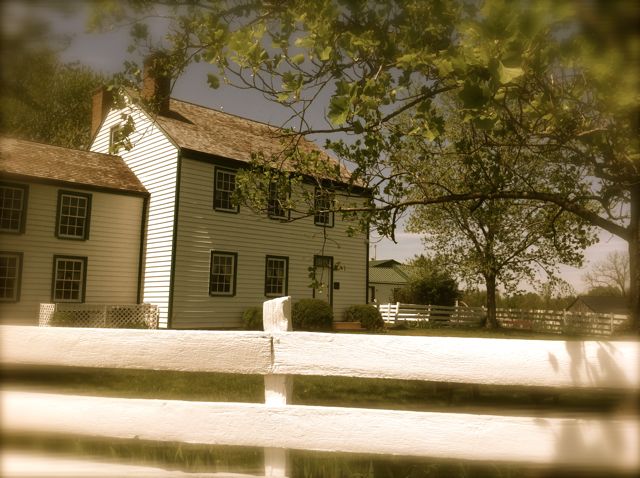
Home of Dr Samuel Mudd

Home of Dr Samuel Mudd (Photo credit: crazysanman.history)

A trip to Southern Maryland brought us to the door step of history today when we stopped by the Samuel Mudd House. You may remember that I profiled Mudd as a Thought of the Day bioBLOG on his birthday back in December (click HERE to read the bio) so when we saw the brown historical marker indicating that Mudd’s house was a few mile off Maryland’s Route 5 we had to make a side trip and explore.

Approaching the Mudd House.

Approaching the Mudd House.

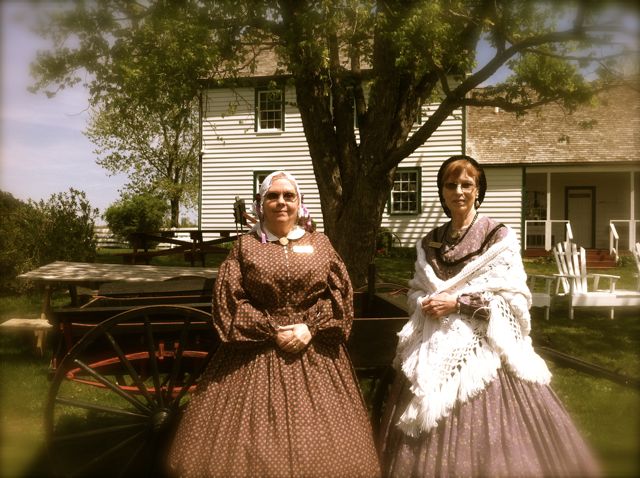
You enter the Dr. Samuel Mudd House at the back of the house, at the gift shop. There a docent will greet you and take you on a tour of the house. Our docent, Russet Hodgkins, took us through the events of early April 16th when…

Docents Russet Hodgkins and Lynn Bounviri pose behind the Mudd House.

Docents Russet Hodgkins and Lynn Bounviri pose behind the Mudd House.

A knock at the door work the 31-year-old doctor and his wife “Frankie”  at 4:00 am.

Two men stood in the doorway, one in need of medical attention for a badly broken leg. It was David Herold and John Wilkes Booth. News of the previous night’s assassination had not reached sleepy Charles Country.  Mudd couldn’t have known that Booth had shot Lincoln. The doctor didn’t even recognize the men, who were traveling under aliases — though there was something familiar about the injured man. He had actually met Booth before (when the actor was looking to buy a horse and property in the area) but that night he was in disguise, and the poor light and a false beard fooled the doctor.

English: Broadside advertising reward for capt...

English: Broadside advertising reward for capture of Lincoln assassination conspirators, illustrated with photographic prints of John H. Surratt, John Wilkes Booth, and David E. Herold. Français : Avis de recherche avec prime de 100.000 $ pour la capture de John Wilkes Booth, le meurtrier du président Abraham Lincoln, et deux de ses complices, David Edgar Herold et John Harrison Surratt. (Photo credit: Wikipedia)

He examined the stranger’s leg on a red couch that still sits in the House’s parlor, and had him taken upstairs where he set the leg.  The next day the two men acted suspiciously, turning their faces to the wall when Mudd’s wife brought them food.  After a few hours rest they left, headed toward Virginia where they were eventually found at the Garrett Farm.

Investigators followed Booth’s trail to Mudd’s house and the doctor was implicated in the Lincoln assignation.Mudd was convicted by a Military Commission and sentenced to life in prison. He was sent to the military prison at the Dry Tortugas, west of Key West, Florida. When a yellow fever outbreak hit the Dry Tortugas and the  prison doctor died of the disease Mudd took over. For his efforts during the epidemic President Andrew Johnson pardoned him.

Dr. Mudd as he appeared when working in the ca...

Dr. Mudd as he appeared when working in the carpenter’s shop in the prison at Fort Jefferson. (Photo credit: Wikipedia)

He went back to his wife and children and the Maryland farm. Mudd died of pneumonia in 1883.  He was 49 years old.

The house is decorated with furniture from several generations of Mudds, and it is interesting to see how this working farm passed down from generation to generation.

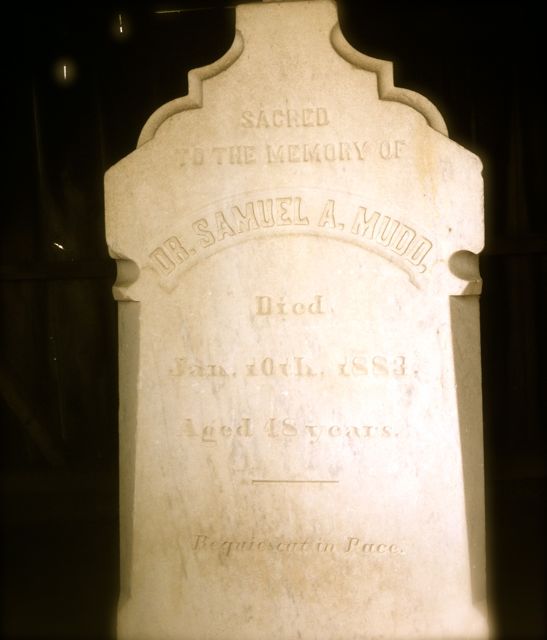
The mistake tombstone

The mistake tombstone

Don’t miss the outbuildings, especially the gravestone building (they made a mistake on his grave marker, and this “mistake” is housed at the museum.) Other outbuildings house period farm equipment, a tobacco barn, a Civil War display and more.

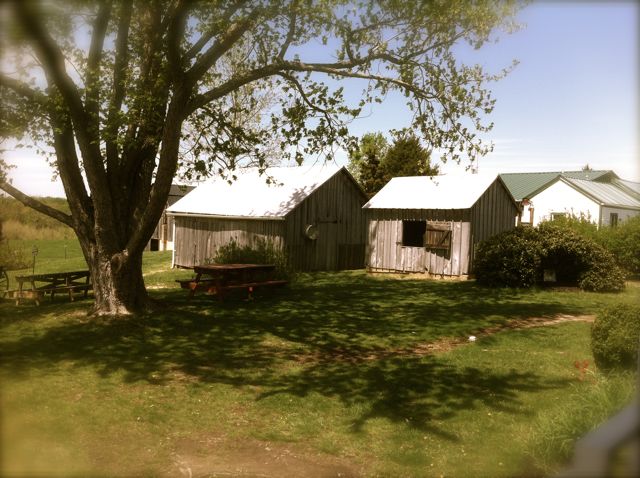
Outbuildings and barns to explore at the Mudd House

Outbuildings and barns to explore at the Mudd House

Dr.  Samuel A. Mudd House is a privately run museum and is open March to November on Wednesdays and Saturdays from 11 to 4  and Sundays 12 to 3:30. (Closed on Easter.) The museum is also open the first weekend in December for a Victorian Christmas.

Call 1-301-274-9358 for more information.