Written By: Frances Goodrich, Albert Hackett, Frank Capra, Jo Swerling, Philip Van Doren Stern and Michael Wilson. From the 1939 short story “The Greatest Gift” by Philip Van Doren Stern.
Date Released: 1946
Why: ZuZu is the epitome of Christmas innocence.
Pros: Sweet, innocent, adorable.
Cons: Unrealistic. (But come on, she’s only 5!)
Shining Moment: When George realizes that he really IS better off alive then not… he reaches into to his pocket and finds the petals to ZuZu’s flower. He understands that he is back in the real world with his real family waiting for him at home. And no matter what other trouble might befall him, he has that love, and the love of his friends to rely on.
Least Shining Moment: (She really should have buttoned that coat.)
Iconic screen shot from the movie It’s a Wonderful Life. (Photo credit: Wikipedia)
Karolyn Grimes, the actress who played ZuZu in the movie, remembers making the movie 60+ years ago. She remembers Jimmy Stewart lifting her up for endless takes and gently setting her down each time after some one yelled “CUT”. She remembers Frank Capra squatting down to give her a direction. She only had 6 minutes of screen time in the movie, but it has stayed with her for a lifetime.
… A lifetime that hasn’t always been so wonderful, frankly. Her mother died when Karolyn was 14, her father passed a year later, she went to a an unhappy “bad” home from there. But she got out and went to college and had a family and career as a medical technologist. But then her first husband died in a hunting accident. Her son committed suicide. Her second husband died of cancer. And she lost her life savings in the economic down turn in 2001.
“You have a choice,” she says. “You can drown in your sorrows, be the grumpy old Mr. Potter and be hurt and be in pain … but I think you need to put that behind you because, my gosh, life is a wonderful gift.” [Today Entertainment]
So instead of turning bitter she remains upbeat. She wrote a cookbook, “ZuZu Bailey’s It’s a Wonderful Life Cookbook” and does personal appearances (especially around the holidays.)
“I’m that little girl and I stand for something those people love,” she says. “… For some reason or other, that little girl embodies the image, or maybe the power to make them happy.” [Ibid]
At one appearance, as Grimes analyzes the movie with the crowd, she asks them if they think ZuZu sees her father, George, hide the petals he can’t paste back on the flower? She thinks ZuZu is on to him.
“I think what Frank Capra is trying to say is she knows her father isn’t perfect,” she said. [Ibid]
And that speaks to LIFE and Christmas too. It isn’t perfect. And it doesn’t have to be, but it can still be WONDERFUL if you let it.
—————————————————-
Some Christmas seasons you can’t swing a candy cane without hitting a showing of It’s a Wonderful Life on television. Sadly this wonderfully done movie has become part of the forced sentiment I like to call “Christmas Sausage” (That’s stuff YOU HAVE TO DO!!! to fulfill some one’s requirement of the Holiday) But this year, thankfully, it looks like the movie is only on once. So catch ZuZu, George, Mary, Uncle Billy and the rest of the gang at 8:00 pm Christmas Eve on NBC.
“I’ve always wondered, what am I going to do that’s important with these stupid jokes that I tell,” —Ray Romano
Raymond Albert Romano was born on this day in Queens, New York, USA in 1957. He is 55 years old.
Son of a piano teacher and a real estate agent/engineer, Romano and his brothers grew up in the Forest Hills area of Queens. The Romano boys attended Our Lady Queen of Martyrs until high school. Ray went to Archbishop Molloy High School before transferring to Hillcrest High School from which he graduated in 1975. He briefly attended Queens College as an Accounting major before dropping out to start his stand up comedian career.
After working for years in stand up he made the move to TV. His first gigs came in the form of guest roles on Dr. Katz, Professional Therapist, Cosby, The Nanny and Becker.
In 1996 he got his big break, the starring role in a national television comedy, Everybody Loves Raymond. The show, which drew loosely from Romano’s real-life Italian American family stories, won 2 Emmy Awards and Romano won an Outstanding Lead Actor Emmy in 2002. It ran for nine seasons.
The five principal characters during an argument. Episode: “The Can Opener” (Photo credit: Wikipedia)
Romano voiced the part of Manfred, the depressed Wooly Mammoth in Ice Age in 2002 (a role he would revise in countless sequels.) He played the local hardware store guy who runs against the former President of the United States for mayor of Mooseport in Welcome to Mooseport in 2004.
More guest spots followed, both on television and on the big screen.
In 2009 he joined Andre Braugher and Scott Bakula for the comedy-drama series Men of a Certain Age.Romano played Joe Tranelli, he is also one of the shows creators. While the show only lasted two years it garnered critical acclaim for both its writing and acting.
[Image courtesy: Men of Certain Age/ TNT]
Currently you can catch Romano on Parenthood. He is Hank Rizzoli, Sarah’s new boss at a photography studio.
Français : Centrage sur le visage de Steven Spielberg (Photo credit: Wikipedia)
Steven Allan Spielberg was born on this day in Cincinnati, Ohio, USA in 1946. He is 66 years old.
Spielberg grew up in Haddon Township, New Jersey and Scottsdale, Arizona. He made 8mm films that he charged his friends a quarter a piece to see, his sister sold popcorn. He’d do special effects train wrecks using his model trains. He earned the photography merit badge in Boy Scouts producing an 8mm movie called “The Last Gunfight. (Spielberg went on to become an Eagle Scout.)
While attending California State University, Long Beach he took an unpaid internship at Universal Studios. When studio VP Sid Sheinberg saw his 26 minute, silent film Amblin’ he offered Spielberg a seven-year contract with Universal Television. Thus making Spielberg the youngest director to be signed to a long-term deal with a major motion picture studio. He left Cal State, Long Beach to take the gig, but eventually finished his degree in 2002.
At Universal Television he directed episodes of Marcus Welby, MD, Rod Sterling’s Night Gallery, The Name of the Game, The Psychiatrist,Columbo and TV movies.
His first feature film was The Sugarland Expresswith Goldie Hawn (1974). Sugarland Expresswas a good first effort, and the critics liked it, but it got tepid reaction at the box office.
[Image courtesy: Wikimedia]
In 1975 he made everybody afraid to get into the water with Jaws. Based on a Peter Benchley novel Jaws had that mix of small town life invaded by something big and ominous — in this case a great white shark named “Bruce” — that became a Spielberg hallmark. Jaws starred Roy Scheider as the mild-mannered sheriff, Marty Brody, Richard Dreyfuss as smart, hyper Matt Hooper and Robert Shaw as crusty Quint. Jaws was the highest-grossing film of all time until Star Wars knocked it off the top of the list.
He revisited the theme of an earlier, student, film, Firelight, to make his third film, Close Encounters of the Third Kind. Firelight had a budged of $500 and, with tickets that cost $1 each and the film made a profit of exactly $1. The budget and profit for Close Encounters was considerably larger. He wore both writing and directing hats on Close Encounters.
World wide adventure came calling with Indiana Jones in 1981 in Raiders of the Lost Ark, the first [and best] of the Indiana Jones series.
Then he came home for another small town meets alien film with E.T. The Extra-Terrestrial. [Spielberg fans are generally split on this one with some voting it as their favorite and others dismissing it as over sentimental and saccharine. I’m on team saccharine. Discuss.]
He did two segments of the Twilight Zone movie (no, not the Vampire one with Edward Cullen) and a couple of TV shows before making the wonderful The Color Purple. Based on the Alice Walker novel, the film was nominated for eleven Academy Awards — but not for directing — however, it didn’t win any Oscars.
[Image courtesy: Wikimedia]
Empire of the Sun is a war movie and is set in almost the same time frame at the Indiana Jones flicks, but it couldn’t be more different. Based on the J.G. Ballard novel and with a screen play by Tom Stoppard this move starred John Malkovich, Miranda Richardson, Nigel Havers and a young Christian Bale (in one of his first roles for film.) Empire of the Sun did well with the critics, although it did not do as well at the box office as some of Spielberg’s more action packed films. It (along with Color Purple) marked a transition point for the film maker. From here on out he had the chutzpah to make a full-fledged drama. [Empire is my #1 favorite Spielberg film. It is beautifully filmed, has amazing performances, and a wonderful score, go put it on you Netflix queue right now.]
He closed out the 1980s with the third installment in his Raider’s series — this time with Sean Connery along for the ride with Harrison Ford; and an under appreciated movie about daredevil pilots who put out forest fires, Always. Spielberg teamed up with Richard Dreyfus again for Always, and it’s Audrey Hepburn’s last role.
Hook, a spin on the Peter Pan story came in 1991, followed by Jurassic Park. Both seem like a perfect fit for this director who revels in letting his inner child come out on the screen. Jurassic Park has DINOSAURS! What’s not to like? [Well if you’ve read the book, you might cite a the lack of character or plot development, which Michael Crichton taut novel had in spades. The movie relied more on special effects and product placement than writing. — Seemed to work though, they made a LOT of money and squeeze out a couple of sequels.]
[Image courtesy: Wikimedia]
Schindler’s List is another of his best movies. It won Spielberg his first Academy Award for Best Director (it also won for Best Film). He found a very human way to tell a very inhumane story. Like Empire of the Sun it is a WWII drama, and it also takes place largely in a concentration camp. But Schindler’s Listis in the European theater and it encompasses a larger scope. Amazing acting, story, sets, and it is largely done in black and white. [It is my other favorite of Spielberg, and needless to say, you ought to put it on your queue.]
After another dance with dinos in The Lost World: Jurassic Park, he returned to drama with Amistad. Amistad tells the true story of an uprising that took place on the slave ship La Amistad and the legal battle that followed. Look for Anthony Hopkins as [my guy] John Quincy Adams. Amistad lacked box office appeal, but did well critically.
Saving Private Ryan showed yet another side to WWII, this time from the US soldier’s point of view. It was a big box office hit. and Spielberg won his second Academy Award as Best Director. Wonderful acting, especially from his lead, Tom Hanks, again a great story line, and beautifully shot. [A bit too realistic in the graphic depiction of the battle scenes for me, but still a great movie. Queue it.]
2001 brought A.I. Artificial Intelligence, which was started on Stanley Kubrick’s watch. 2002 gave us Minority Report based on the Philip K. Dick novel. Both are nearish future sci-fi stories. Catch Me If You Can goes back in time (a little) to tell the story of a con artist played by Leonardo DiCaprio and the cop that chases him, Tom Hanks. Hanks stars again in The Terminalas kind-hearted Eastern European traveller stuck in an airport when his country experiences a coupe. [All of them deserve a spot in your queue. As does…]
[Image courtesy: Wikimedia]
Spielberg’s reboot of War of the Worlds is creepy good with a capital C. The director joined forces again with Tom Cruise for this blockbuster, and it pulled in the big bucks — but it was also a darn good movie.
[It seems odd to me that I have seen SO many Spielberg movies, and yet after the 2005 War of the Worlds I haven’t seen any! How did that happen? I want to see Munich; War Horse; and definitely Lincoln. Any body up for a movie night?]
[It’s Second Character Saturday! Today’s character is Piglet. I’ll be going straight to the source and discussing the AA Milne Piglet with illustrations by Ernest Shepard— not the Disney-fied Piglet.]
“But Piglet is so small that he slips into a pocket, where it is very comfortable to feel him when you are not quite sure whether twice seven is twelve or twenty-two.”― A.A. Milne, Winnie-the-Pooh
Why: Piglet is shy, but brave. He reminds us that no matter how small and un-impowered we are… we are still big enough to stand up for what is right and face our fears.He is a role model for friendship.
In the stories he grounds the more popular (and more flighty) Pooh. He has a very strong relationship with Pooh, Eeyore and Christopher Robin. As readers (especial children) we relate to him because of his size and soft voice and WE want to be his friend too.
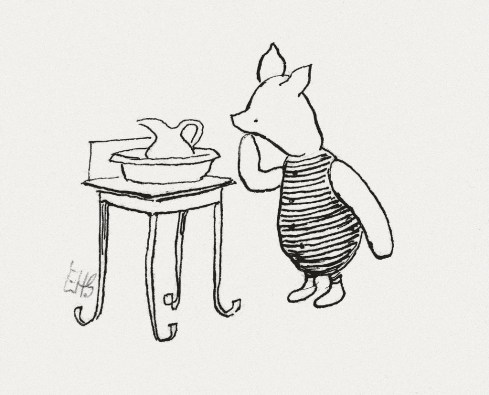
Piglet plants a haycorn plant.
Pros: Loyal, brave, innocent, earnest, creative, humble, good listener, hard worker.
Cons: Excitable, follower, gullible.
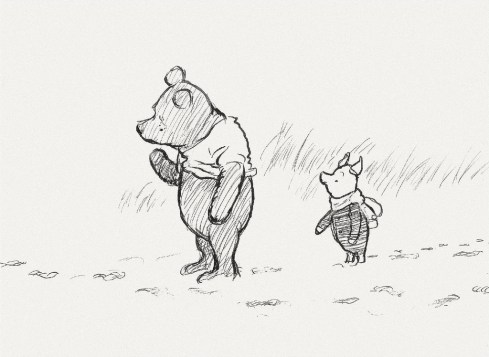
Pooh and Piglet on an adventure
Shining Moment: I love all the moments with Piglet in the books. I especially the quiet moments between Pooh and Piglet that just say “friendship” to me…
Piglet sidled up to Pooh from behind. “Pooh?” he whispered.
“Yes, Piglet?”
“Nothing,” said Piglet, taking Pooh’s hand. “I just wanted to be sure of you.”
“I don’t feel very much like Pooh today,” said Pooh.
“There there,” said Piglet. “I’ll bring you tea and honey until you do.”
“How do you spell ‘love’?” – Piglet
“You don’t spell it…you feel it.” – Pooh”
When you wake up in the morning, Pooh,” said Piglet at last, “what’s the first thing you say to yourself?”
“What’s for breakfast?” said Pooh. “What do you say, Piglet?”
“I say, I wonder what’s going to happen exciting today?” said Piglet.
Pooh nodded thoughtfully. “It’s the same thing,” he said.”
I love when he listens to Eeyore and does something to help him out of his funk.
He’s there for his friends and always willing to help. Despite his diminutive size he is brave enough to face great odds. He may be afraid of everything, but that doesn’t get in the way of his standing up for what is right, or standing next to a friend to face a challenge.
The Disney-fied version of my beloved porcine friend. [Image courtesy: render-graphiques.fr]
Least Shining Moment: I do not like what Disney did with Piglet. They turned his innocence into a cartoon. I was OK with that as a kid, but as I get older, and Disney keeps chugging out more and more Pooh related crap, I resent that they are forcing the Milne characters into cookie-cutter cartoons of themselves to sell more DVDs and plastic stuff. Piglet just gets squeekier and squeekier and the tender, brave, humble pig gets more and more diluted. SHAME.
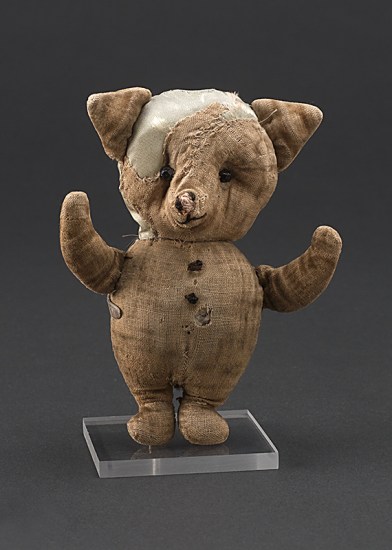
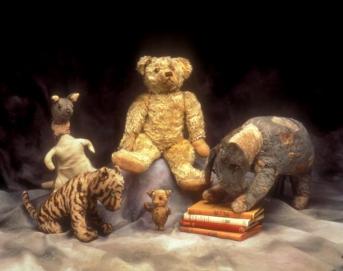
In 1921, as a first-birthday present, Christopher Robin Milne received a small stuffed bear, which had been purchased at Harrods in London. Eeyore, Piglet, Kanga, and Tigger soon joined Winnie-the-Pooh as Christopher’s playmates and the inspiration for the children’s classics When We Were Very Young (1924), Winnie-the-Pooh (1926), Now We Are Six (1927), and The House at Pooh Corner (1928), written by his father, A.A. Milne, and illustrated by Ernest H. Shepard.
You can see just how small Piglet is compared to the other stuffed animals in this photo. [Image courtesy: The New York Public Library
Brought to the United States in 1947, the toys remained with the American publisher E.P. Dutton until 1987, when they were donated to The New York Public Library. [Treasures of The New York Public Library.]
Cover of Winnie-the-Pooh (Photo credit: Wikipedia)
One more image… Piglet dancing with delight. Keep that image in your heart today, OK?
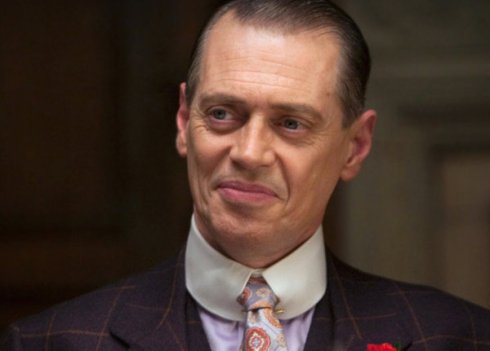
Steven Vincent Buscemi was born on this day in Brooklyn, New York, USA in 1957. He is 55 years old.
Buscemi is part Irish and part Italian, he’s one of four boys born to John Buscemi, a sanitation worker, and Dorthy Buscemi a hostess. He went to Valley Stream Central High School where he wrestled and acted. After graduating in 1975 he attended Nassau Community College then moved Manhattan to attend the Lee Strasberg Institute. He worked on FDNY Engine #55 as a fire fighter. He has worked as a bartender, a stand-up comedian, an ice-cream truck driver before breaking into acting. One of his brothers, Michael, is also an actor.
He made his film debut with a short called Tommy’s (in which he played Tommy), in 1985. He took on the odd ball, character actor roles — often the mafia types and worked in dozens of TV shows and movies. When he hooked up with the Coen Brother’s his off beat sensibilities found a home.
He played Mr. Pink in Quentin Tarntino’s Reservoir Dogs. Then paired up with the director again for a bit part in Pulp Fiction.
English: Photo of a young Steve Buscemi (American actor). Taken in Silverlake / Los Angeles. (Photo credit: Wikipedia)
Buscemi was brilliant as Carl Showalter, the can’t-catch-a-break smal-time crook in Fargo.
His movie and tv CV is impressive, and he’s the kind of actor where you see a movie title and you think “Oh, yeah, he WAS in that.” From Templeton the Rat (in 2006’s Charlotte’s Web) to Donny (in 1998’s The Big Lebowski) to Lenny Wosniak (his recurring guest spot on 30 Rock) Buscemi is wonderful to watch — even when you want to turn away.
Most recently he’s been the star of HBO’s Boardwalk Empire. As amoral Nucky Thompson he manages to hang on to a thread of inner humanity to keep his character viable. And , oh, yeah, he’s a hoot. (When he’s not killing people.)
Rosita Dolores Alverio was born on this day in Humacao, Puerto Rico in 1931. She is 81.
She moved to New York with her mother when she was six. Her first entertainment gig was doing Spanish voice overs to American films when she was 11. She made her Broadway debut in November of 1945 in Skydriftat the Belasco Theatre. Her name appeared in the program as Rita Moreno.
She appeared as Zelda Zanders in Singin’ in the Rain in 1952 and as Tuptim in The King and I in 1956. She also played a lot of Latino “sexpot” roles, something she found degrading, but that she put up with.
Then came West Side Story…
Moreno (co-stars) as “Anita”, the Puerto Rican girlfriend of Sharks’ leader Bernardo, whose sister Maria is the piece’s Juliet. A seasoned singer and dancer, Moreno delivered a superb performance that completely overshadowed the Maria of the movie, the non-singer (and non-Hispanic) Natalie Wood, the only movie star in the ensemble cast. [IMDB Rita Moreno]
Watch her sing and dance up a storm with Geroge Chakiris and the Sharks (et al) in West Side Story…
But her performance went well beyond wise cracking, dancing and singing. She was…
…unforgettable in a harrowing scene where she had to deliver a message from Maria to the Romeo of the piece, the Jets’ member Tony, and is assaulted by his fellow gang-members. This is the real climax of the film.[Ibid]
She won an Oscar for her Anita.
Moreno is, in fact, the first person to win an Oscar, Emmy, Tony and Grammy — something only 12 other people have managed to achieve.. (She won Emmys for The Muppet Show and The Rockford Files; The Tony was for the musical The Ritz (’76), and the Grammy was for the soundtrack to the “Electric Company.”) In 2010 President Obama awarded Moreno a National Medal of Arts.
Here she mets her match with the Muppet Show‘s Animal (or was it the other way around?)
From PBS kids shows like Where In the World is Carmen Sandiegoto the hard-hitting HBO prison drama OZ (she won 3 American Latino Media Arts awards for her role as Sister Peter Marie Reimondo) Moreno always gives herself 100% to a project.
Here she is singing It’s An Art from the musical Working...
Moreno has over 130 credits listed in her TV and Movie database and has been working for over 6 decades. At 81 she still looks and sounds great, and shows little sign of slowing down.
“A hit for me is if I enjoy the movie, if I personally enjoy the movie.”
-Ridley Scott
Cover of Alien (The Director’s Cut)
Ridley Scott was born on this day in South Shields, Tyme & Wear, England in 1937. He is 75 years old.
An army brat, Scott moved often as a child. He lived in Northern England, Wales, & Germany. He went to the Royal College of Art. Upon graduation he worked as a trainee set designer. Later he started Ridley Scott Associates with his brother Tony.
His first feature was The Duelists,but it was his second film, ALIEN, that made his name in film. He followed Alien with BLADE RUNNER. Next he named a big budget commercial for Apple Macintosh in 1984. 1991 brought THELMA AND LOUISE with Susan Sarandon and Geena Davis. GLADIATOR won 5 Academy Awards. He followed that with BLACK HAWK DOWN.
Other titles by Scott include:
A Good Year
American Gangster
Body of Lies
Robin Hood
G.I. Jane
In June of 2012 Scott released Prometheus, an Alien semi-prequel.
Bruce Lee: Quest of the Dragon (Photo credit: Wikipedia)
Love is like a friendship caught on fire. In the beginning a flame, very pretty, often hot and fierce, but only light and flickering. As love grows older, our hearts mature and our love becomes as coals, deep-burning and unquenchable.
The key to immortality is first living a life worth living.
I fear not the man who has practiced a thousands kicks once; but I fear the man who has practiced one kick a thousand times.
A goal is not always something to be reached, it often serves simply to as something to aim at.
If you want to swim jump into the water.
–Bruce Lee
Lee Jun-fan (Bruce Lee) was born on this day in San Francisco, CA, USA in 1940. Today is the 2nd anniversary of his birth.
Although he was born in San Francisco he was raised in Hong Kong. He began to train in the martial arts at 13. He studied philosophy at the University of Seattle. Upon graduation he opened a martial arts studio in Oakland and Los Angeles and developed his own art called Jeet Kun Do.
Bruce Lee trained several celebrities before entering the film industry himself. He was born under the sign of the Dragon and the word dragon appears in several of his movie titles.
Lee died at the age of 32 from a cerebral edema from an allergic reaction to medicine in July of 1973.
Bruce Lee (Madame Tussauds Hong Kong). (Photo credit: Wikipedia)
“He looked like something that had gotten loose from Macy’s Thanksgiving Day Parade.”
–Harpo Marx
Adolph Marx was born on this day in New York City, New York, USA in 1888. Today is the 124th anniversary of his birth.
The second of five brothers in the Marx family, Adolph didn’t make it past second grade in school. He was small for his age and he was picked on by the bigger boys because he was Jewish. Two boys literally threw him out of the (first floor) classroom window on several occasions before he gave up and left school. He joined his brother Chico in doing odd jobs to help the family.
His uncle Al Schoenberg (stage name Al Shean) was in a Vaudeville act. His older brother Chico played piano, and his younger bother Julius (Groucho) was a boy soprano. Adolph joined Julius and Milton (Gummo) to form “the Three Nightingales” in 1910. Lou Levy joined them to make the group “The Four Nightingales.” When their mother, Minnie, and Aunt Hannah joined the act they changed the name to “The Six Mascots.”
The five Marx brothers with their parents in New York City, 1915. From left to right; Groucho, Gummo, Minnie (mother), Zeppo, Frenchy (father), Chico, and Harpo. (Photo credit: Wikipedia)
In 1911 he changed his name to Arthur because he didn’t like the sound of Adolph. He adopted the stage name of Harpo when his mother sent him a harp. He didn’t know how to tune it or play it. He didn’t even know how to hold it until he found an image of an angel holding a harp at the 5&10 store. He tuned it the best he could and taught himself to play.
At that point Harpo’s two-fold schtick — he “couldn’t talk” so he blew his horn or whistled to communicate; and he played the harp — was in place. (He could, in fact, talk. And he did so — a lot — off stage/scene. His “speaking career” stopped after he received a bad review for a largely ad-libbed performance in the play Home Again.)
A critic in the local newspaper described the show by saying, in part, “Adolph Marx performed beautiful pantomime which was ruined whenever he spoke.” Harpo then decided he could do a better job of stealing focus by not speaking. [The Marx Brothers; Harpo Marx from an article in Theatre Arts Monthly, October 1939]
The four Marx Brothers stowing away on an ocean vessel by hiding in barrels in this promotional still for Monkey Business. Left to right: Harpo, Zeppo, Chico, Groucho. (Photo credit: Wikipedia)
From the Vaudeville stage the Marx Brothers moved on to Hollywood. They made the short, Humor Risk, in 1921. (The film has since been lost.) Harpo was then in Too Many Kissesas the character “The Village Peter Pan.” He actually has a line in this movie, but, as it’s a silent film, you don’t actually hear him speak it. His brothers did not appear in the film.
In 1929 the brothers put out The Cocoanuts.The film was based on their Broadway play of the same name. In it…
the Marx Brothers run a hotel, auction off some land, thwart a jewel robbery, and generally act like themselves. [IMDB]
They shot during the day and performed in the stage show of Animal Crackers at night. It was an exhausting schedule and the Brothers were not happy with the result. They were “so appalled … that they offered to buy the negative from Paramount so that they could burn it.” [Ibid]
Marx Brothers, head-and-shoulders portrait, facing front. Top to bottom: Chico, Harpo, Groucho and Zeppo. (Photo credit: Wikipedia)
The Brothers made Animal Crackers,Horse Feathers , Duck Soup, A Night at the Opera, A Day at the Races, Room Service, At the Circus, Go West, The Big Store, A Night in Casablanca, and Love Happy in quick succession.
Starting in 1952 Harpo started doing guest spots on Television, most notably on the I Love Lucy Show.
His last film was The Story of Mankindin 1957. He played Sir Isaac Newton.
Off screen Harpo, the elementary school drop out, rubbed shoulders with some pretty high level literary types. In the 1920’s he held his own at the Algonquin Round Table with writers such as George S. Kaufman and Dorothy Parker. In 1928 he spent the summer on the French Riviera with George Bernard Shaw.
He attributes his welcome hanging out with the fast literary crowd at the Algonquin Round Table in New York in the 1920s to his ability to listen — in fact, to being the one real listener in that set. [Robert Wilfred Franson’s review of Harpo Speaks]
In 1933 Harpo did a 6-week goodwill mission in the Soviet Union. He was the “first American to perform in the Soviet Union after the United States government officially recognized it.” [Harpo’s Place] According to his autobiography, Harpo Speaks, the trip was part performance and part spy caper. He smuggled papers out of the USSR by taping them to his leg.
Marx died while having open-heart surgery on September 28, 1964.
Here’s a clip of Harpo actually speaking (and honking):


![[Image courtesy: Men of Certain Age/ TNT]](https://ritalovestowrite.com/wp-content/uploads/2012/12/tv_men_of_a_certain_age01.jpg?w=387&h=290)


![[Image courtesy: Wikimedia]](https://ritalovestowrite.com/wp-content/uploads/2012/12/jaws_movie_poster.jpg?w=490)
![[Image courtesy: Wikimedia]](https://ritalovestowrite.com/wp-content/uploads/2012/12/220px-empire_of_the_sun.jpg?w=490)
![[Image courtesy: Wikimedia]](https://ritalovestowrite.com/wp-content/uploads/2012/12/220px-schindlers_list_movie.jpg?w=490)
![[Image courtesy: Wikimedia]](https://ritalovestowrite.com/wp-content/uploads/2012/12/war_of_the_worlds_2005_poster.jpg?w=490)


![The Disney-fied version of my beloved porcine friend. [Image courtesy: render-graphiques.fr]](https://ritalovestowrite.com/wp-content/uploads/2012/12/porcinet_piglet_disney_1.png?w=161&h=324)





![Moreno in 2009. [Image courtesy NOVA Southeastern University.]](https://ritalovestowrite.com/wp-content/uploads/2012/12/rita_moreno.jpg?w=490)


 ritaLOVEStoWRITE