Category Archives: American History

Thought of the Day 11.20.12 Robert F. Kennedy

“It is from numberless diverse acts of courage and belief that human history is shaped. Each time a man stands up for an ideal, or acts to improve the lot of others, or strikes out against injustice, he sends forth a tiny ripple of hope.”


“People say I am ruthless. I am not ruthless. And if I find the man who is calling me ruthless, I shall destroy him.”


“I believe that, as long as there is plenty, poverty is evil.”


“Ultimately, America’s answer to the intolerant man is diversity, the very diversity which our heritage of religious freedom has inspired.”


Robert F. Kennedy


Robert F. Kennedy, Cabinet Room, White House, ...

Robert F. Kennedy, Cabinet Room, White House, Washington, DC. (Photo credit: Wikipedia)


Robert Francis Kennedy was born on this day in Brookline, Massachusetts in 1925. Today is the 87th anniversary of his birth.


He was the seventh of nine Kennedy children, the third son. The family split their time between New York and their summer home in Hyannis Port, Massachusetts. Bobby attended public schools until 6th grade. He went to a series of private schools including a Benedictine boarding school for boys and Milton Academy.


Shortly before he turned 18 he enlisted in the US Naval Reserve. He participated in the V-12 Navy College Training Program at Harvard and Bates College from 1944 to 1946 and served  on the USS Joseph P. Kennedy, Jr, a destroyer named after his brother, on it’s shakedown cruise  in the Caribbean. He was honorably discharged later that year. He then went on to the University of Virginia Law School.


English: Kennedy brothers; left to right John,...

English: Kennedy brothers; left to right John, Robert, Ted. Česky: Bratři Kennedyové – vlevo John F., uprostřed Robert F. (Photo credit: Wikipedia)


In 1952 he managed John F. Kennedy’s run for U.S. Senate. His brother won the Senate seat and Robert Kennedy served


briefly on the staff of the Senate Subcommittee on Investigations, chaired by Senator Joseph McCarthy. Disturbed by McCarthy’s controversial tactics, Kennedy resigned from the staff after six months. He later returned to the Senate Subcommittee on Investigations as chief counsel for the Democratic minority, in which capacity he wrote a report condemning McCarthy’s investigation of alleged Communists in the Army. [John F. Kennedy Presidential Library & Museum]


Next he tackled corruption in trade unions as Chief Counsel for the Senate Rackets Committee. His book The Enemy Within details the corruption he confronted with the Teamsters and other unions.


In 1956 he was an aide to Democratic presidential  nominee Adlai Stevenson. Stevenson lost, but the experience was good training. Bobby took the reigns again for his brother’s bid for the presidency against Richard Nixon in 1960. When John Kennedy won he made Bobby the Attorney General.


He fought organized crime  and “became increasingly committed to helping African-Americans win the right to vote.” [Ibid] In a 1961 speech in Georgia he said:


“We will not stand by or be aloof. We will move. I happen to believe that the 1954 [Supreme Court school desegregation] decision was right. But my belief does not matter. It is the law. Some of you may believe the decision was wrong. That does not matter. It is the law.” [Ibid]


He worked with the administration  to create the Civil Rights Act of 1964.


Attorney General Robert F. Kennedy speaking to...

Attorney General Robert F. Kennedy speaking to a crowd of African Americans and whites through a megaphone outside the Justice Department; sign for Congress of Racial Equality is prominently displayed. (Photo credit: Wikipedia)


He was also instrumental in foreign affairs including the Berlin Crisis of 1961 and the Cuban Missile Crisis of 1962.


John F. Kennedy was assassinated in Dealey Plaza, Dallas, Texas on November 22, 1963. Robert Kennedy was devastated by the death of his brother and friend. He even felt guilt — had his aggressive pursuit against organized crime and obsession to “get” Castro  some how brought this about? [I won’t even attempt to resolve the myriad of conspiracy theories here. Suffice it to say Bobby was not the same man after the death of his brother.]


He resigned from his post as Attorney General nine months after the assassination and began a run for U.S. Senate. He won the seat.


He climbed Mount Kennedy, a mountain that was named for his brother and the highest peak in Canada that had not be summited, in 1965.


In 1966 he went to South Africa to speak out against the Apartheid government. He dared to ask “Supposed God is black? What if we go to Heaven and we, all our lives, have treated the Negro as an inferior, and God is there, and we look up and He is not white? What then is our response?”


As Senator he also spoke out against the Vietnam War, continued to work for Civil Rights and the War on Poverty.


He sought to remedy the problems of poverty through legislation to encourage private industry to locate in poverty-stricken areas, thus creating jobs for the unemployed, and stressed the importance of work over welfare. [John F. Kennedy Presidential Library & Museum]


On March 16, 1968 he declared his bid for the Presidency. His platform was based on racial and economic justice, he was also  anti-war


…he challenged the complacent in American society and sought to bridge the great divides in American life – between the races, between the poor and the affluent, between young and old, between order and dissent. His 1968 campaign brought hope to an American people troubled by discontent and violence at home and war in Vietnam.[Ibid]


When Martin Luther King, Jr. was assassinated in April of 1968 Kennedy found out about it minutes before he was to give a speech in downtown Indianapolis. He could have gotten back in his limo and let some one else make the announcement to a crowd that was certain to be upset by the news, but he stepped in front of the inner city crowd and gave an impromptu speech calling for reconciliation between the races.


http://youtu.be/j6mxL2cqxrA?t=3m


Many other American cities burned after King was killed. But there was no fire in Indianapolis, which heard the words of Robert Kennedy… a well-organized black community kept its calm. It’s hard to overlook the image of one single man, standing on a flatbed truck, who never looked down at the paper in his hand — only at the faces in the crowd. [NPR.org]


Kennedy also fell victim to an assassin’s bullet. He was fatally shot at the Ambassador Hotel in Los Angeles, California on June 5, 1968. He had just won California’s Democratic Primary.


The Robert F. Kennedy Memorial

The Robert F. Kennedy Memorial (Photo credit: Bernt Rostad)


[One of my earliest real memories is watching the train that carried Robert Kennedy’s body to its Arlington National Cemetery. My parents had taken us all on a picnic at the the ball field near the train tracks. We weren’t the only family there, there were lots of kids playing and other families on blankets eating cold chicken and potato salad. Then a train rolled through and all the adults stood up and faced the tracks. We kids didn’t need to be hushed. My mother was silently crying. I took her hand and asked her what was going on. As the flag festooned final car passed she whispered “A great American is on that train.”  And then it was over. We packed up the picnics. No one was hungry or wanted to play any more.]

[Do you have a Bobby Kennedy story? Share it with us please.]


Thought of the Day 11.19.12 Roy Campanella

“You have to have a lot of little boy in you to play baseball for a living.”
Roy Campanella

English: Brooklyn Dodgers catcher and Hall of ...

English: Brooklyn Dodgers catcher and Hall of Famer . (Photo credit: Wikipedia)

Roy Campanella was born on this day in Philadelphia, Pennsylvania, USA in 1921. Today is the 91st anniversary of his birth.

Campanella’s father, John, was an Italian American, his mother, Ida was African-American. The family lived in a rough section of Philly known, ironically as Nicetown. Roy was one of five children. As a kid he did odd jobs like delivering newspapers, shining shoes and cutting grass, to help out with family finances.  He was athletic and loved to play baseball, but he knew that the color barrier meant that would be barred from playing in the Major Leagues. He  “started out on Philadelphia’s sand lots and by the age 15 was signed on to the Negro leagues.” [Biography.com] By 11th grade he dropped out so he could play ball full-time.

For the next decade, Campanella excelled in the segregated world of black baseball, barnstorming on buses across the country and playing winter ball in Mexico, the Caribbean, and Latin America. He was such a natural leader and had such an astute baseball mind that he often managed clubs he played for in Latin America. [Gale Encyclopedia of Biography: Roy Campanella]
By 1946 The Dodger’s president Branch Rickey was sewing the seeds for Jackie Robinson and Campanella to break the color barrier. Robinson was sent to the Triple A team in Montreal and Campanella went to Nashua, New Hampshire to play Class B ball. Campanella had been making $500 in the Negro Leagues, but took a pay cut to $150 a month at the new club. He “…was better than a Class B player, …but he knew why he was there. He was part of Rickey’s plan to begin integrating baseball.” [Ibid] He was voted the Eastern League’s MVP.
1972 Los Angeles Dodgers season

1972 Los Angeles Dodgers season (Photo credit: Wikipedia)

Campanella followed Robinson into the Majors, making his debut on April 20, 1948. Both men played for the Brooklyn Dodgers.

The man they called “Campy” was the complete package, leading National League catchers in putouts six times, and clubbing 242 home runs in his 10-year Major League career. From 1948-1957, Roy Campanella was securely anchored behind home plate for the Brooklyn Dodgers. [The Official Roy Campanella Site.]

He played in eight straight All-Star games, starting in 1949  (he, Robinson, Larry Doby and Don Newcombe were the first African-American men to play in the All-Star game.)

He caught in five World Series, won the National League Most Valuable Player award in 1951, 1953, and 1955, and was the first black catcher in Major League Baseball history. In 1969, he joined baseball’s elite with his induction into the Hall of Fame. [The Official Roy Campanella Site.]

List of Pennsylvania state historical markers ...

List of Pennsylvania state historical markers in Philadelphia County (Photo credit: Wikipedia)

The Dodgers moved from Brooklyn to Los Angeles, California after the 1957 Baseball season and Campy was set to go with them, but that was not to be. While driving to his Long Island home late on January 28, 1958 his car hit a patch of ice and skidded into a telephone pole. Campanella was badly injured and left paralyzed from the shoulders down. He eventually regained the use of his arms and hands, but he would never walk again.

Although he couldn’t play he maintained ties with the Dodgers.

The Dodgers hired him as a special instructor, and for 20 years he helped groom many young catchers during spring training. He also worked with disabled people through the Dodgers’ community-service division. He was expert at cheering up people. Campanella once said: “People look at me and get the feeling that if a guy in a wheelchair can have such a good time, they can’t be too bad off after all.” Scully observed: “He looked upon life as a catcher. He was forever cheering up, pepping up, counseling people.” [Gale Encyclopedia of Biography: Roy Campanella]
Campanella wrote his autobiography, It’s Good to Be Alive, in 1969. He was voted into the National Baseball Hall of Fame in 1969.
Roy Campanella died at the age of 71 in Woodland Hills, California.
Catcher Roy Campanella

Catcher Roy Campanella (Photo credit: NedraI)


Thought of the Day 11.18.12 Johnny Mercer

[For those of you who are playing along… I posted a blog yesterday seeking advice as to who I should profile in today’s birthday post — song smith Johnny Mercer or Gilbert or Gilbert and Sullivan fame. Just about everyone picked Mercer, so put on your Breakfast at Tiffanys ’cause there’s some Moon River coming your way.]

“Days of wine and roses laugh and run away, like a child at play.”
–Johnny Mercer

English: Johnny Mercer, New York, N.Y., betwee...

English: Johnny Mercer, New York, N.Y., between 1946 and 1948 (Photograph by William P. Gottlieb) (Photo credit: Wikipedia)

John Herndon Mercer was born on this day  in Savannah, Georgia, USA in 1909. Today is the 103rd anniversary of his birth.

He grew up in Savannah (though never in the Mercer House — made famous in Midnight in the Garden of Good and Evil) He enjoyed music as a child and he could hum a tune before he could talk. He was singing in a choir by six and all the song memorized by 11. He tried to take lessons on various instruments  but never made it very far. Even as an adult he could only play piano one finger at a time.

He wrote his first song, “Sister Susie, Strut Your Stuff,”  at age 15 while a student at the exclusive boy’s school Woodbury Forest School in Orange Co,  Virginia. After graduation he moved to New York to try his hand at acting. Although he was cast in bit roles  in a few shows, it was his talent for writing songs (both the witty lyrics and the snappy melodies) that showcased his real talent.

In 1930, while … looking for an acting job … he was informed that (a) play was all cast, but that they could use some songs. In the show were two other future great writers — Vernon Duke and E.Y. “Yip” Harburg, who accepted Mercer’s “Out of Breath and Scared to Death of You. [Johnny Mercer.com]

The show, “Garrick Gaieties,” also featured a dancer named Ginger Meehan who Mercer fell in love with. The two married in 1931.

Mercer began to collaborate with Hoagy Carmichael in 1932. Their first hit was “Lazy Bones” which hit #1 for one artist, Ted Lewis, and broke the top ten for two other singers.

By 1938 he was recording duets with Bing Crosby for Decca and the following year, he was on Benny Goodman’s Camel Cavalcade radio program as a featured singer. [AllMusic]

His string of hit in 1934 included “You Have Taken My Heart”,  “Pardon My Southern Accent”  and “P.S. I Love You”

Heres a really sweet version of P.S. I Love You featuring Bridget Davis and Sam Petitti …

In 1935 he went to Hollywood to appear in and write some songs for a couple of RKO musicals. One was “To Beat the Band,” a movie that featured the songs “Eeny-Meeney-Miney-Mo, “If You Were Mine,” Meet Miss America” and “I saw her at Eight O’Clock.” Mercer played a member of the band.

He started Capitol Records in 1942 with Glenn Wallichs and Buddy DeSylva. There he produced “Atchison, Topeka and Sante Fe,” “Ac-Cent-Tchu-Ate The Positive” and “Personality.” The label attracted the talents of Nat King Cole and Peggy Lee.

Jaques Edmond of The Capitol News called Mercer “One of the greatest lyricists of all times.”  He added that Mercer could have made it as a singer too.

Johnny Mercer epitomized the hip songwriter a hipness that was also reflected in his cool Southern accented singing. His voice was relaxed, swinging and bang on. One of the few writers who could have easily made it as a vocalist even if he had never written a lyric or a note of music. [Capitol News]

His smooth, upbeat story telling, southern style of singing made Ac-Cent-Tchu-Ate the Positive a peppy anthem of hope during World War II. It was quickly snapped up by other, bigger named, singers, like Bing Crosby.

Here’s Mercer’s version…


He also worked with Crosby in 1936  with the song “I’m an Old Cowhand from the Rio Grande.”  In 1937 he wrote the iconic “Hooray For Hollywood”.

In ’37 he had a hit with “Too Marvelous for Words” from the film Ready, Willing and Able. Frank Sinatra made it a hit.

Here’s Old Blue Eyes being fabulous…

Among Mercer’s most durable lyrics — a highly abbreviated list — are those for “One for My Baby (And One More for the Road),” “Blues in the Night,” “Come Rain or Come Shine,” [AllMusic] You can add to that “Jeepers Creepers,” “That Old Black Magic,” “Something’s Gotta Give, ” “Days of Wine and Roses,” “G.I. Jive,”  “You Must Have Been a Beautiful Baby,” “Tangerine,” “Glow Worm,” “Autumn Leaves” and the unforgetable “Moon River.”

Here’s Audrey Hepburn singing Moon River in the 1961 film  Breakfast at Tiffanys:

Of his writing style he said: “Usually a title or simple idea comes first, and then the rest of the words just seem to fall into place. … It’s all as easy  as chopping up ten cords of wood per day.” [The Johnny Mercer Educational Archives]

in 1971 Mercer  was inducted into the Songwriter’s Hall of Fame. Mercer died on June 25, 1976 in Westwood, California.


Thought of the Day 11.15.12 Georgia O’Keeffe

“I found I could say things with color and shapes that I couldn’t say any other way –– things I had no words for.”
— Georgia O’Keeffe

Pineapple Bud, oil on canvas painting by ''Geo...

Pineapple Bud, oil on canvas painting by ”Georgia O’Keeffe, 1939 (Photo credit: Wikipedia)

Georgia Totto O’Keeffe was born in Sun Prairie, Wisconsin, USA in 1887. Today is the 125 anniversary of her birth.

O’Keeffe knew she wanted to be an artist by the time she was 10-years-old. At 18 she attended the Art Institute of Chicago and transferred to the Art Students League of New York a year later.

Though her student work was well received she found it unfulfilling, and for a short time abandoned the fine arts. She worked briefly as a commercial artist in Chicago before moving to Texas to teach. [American Masters]

At 28 she took some classes at the Teachers College of Columbia University in South Carolina. There she met instructor Arthur Down who “Helped O’Keeffe move away from the forms she had found so stifling” and toward her own, unique style.

Charcoal on paper 1915. [Image courtesy: Oberon’s Grove]

A friend mailed some of the charcoal drawings she did  in Texas to Alfred Stieglitz in 1916. The photographer and gallery owner was so “enthused with the vibrant energy of the work” [American Masters]that he put together an exhibition of the work. “So, without her knowledge, Georgia O’Keeffe had her first exhibition… at Steiglitz’s “291 Gallery.” [Ibid]

The following year O’Keeffe and Stieglitz worked together on a larger solo show that included both watercolors and oil paintings. By June 1918 Stieglitz had convinced her to move to New York and spend all her time painting.

Six years later the two were married, beginning one of the most fruitful and well-known collaborations of the modernist era. For the next twenty years the two would live and work together, Stieglitz creating an incredible body of portraits of O’Keeffe, while O’Keeffe showed new drawings and paintings nearly every year at the gallery. [Ibid]

1918 photograph of Georgia O’Keeffe taken by Stieglitz  [Image courtesy: Oberon’s Grove]

A vacation to New Mexico in 1929 proved a turning point for the artist. She discovered “the open skies and sun-drenched landscape” of the desert that she would return to  annually.  She bought a Model A Ford to drive around the desert, and if the heat got too intense she would crawl under the car for shade.

More than almost any of her other works, these early New Mexico landscapes and still lifes have come to represent her unique gifts. The rich texture of the clouds and sky were similar to her earlier, more sensuous representations of flowers. But beneath these clouds one found the bleached bones of animals long gone. [American Masters]

Georgia O'Keeffe, Ram's Head White Hollyhock a...

Her summer pilgrimages lasted until Stieglitz’s death in 1946 when she took up residence in a pre-Civil War period adobe outside Abiquiu.

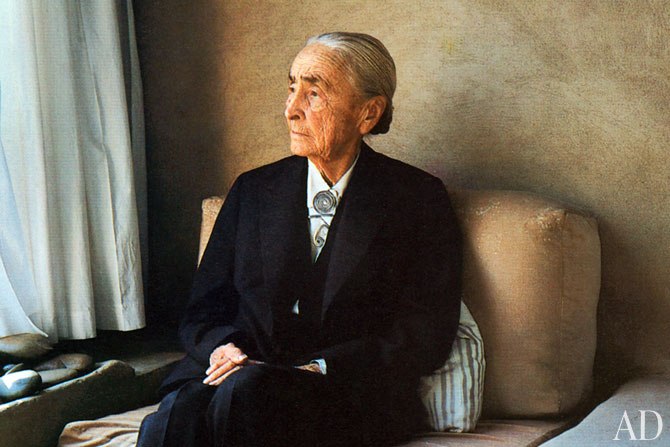
“When I bought it, it was totally uninhabitable. Architecturally it is not a masterpiece, but a house that grew.” The rooms were mostly bare, though some contained dilapidated furniture. The house had been added to in various stages after the Civil War. A large summer house and a lilac tree stood in the garden. The rooms inside were in disarray…. However, the arrangement was appealing, and all the rooms opened to the patio. When O’Keeffe began to stay at Abiquiu… there was hardly a room she could live in. [Architectural Digest.com]

O’Keeffe’s reputation as an artist continued to grow throughout the 50’s and 60’s. In 1970 she has a solo show at the Whitney Museum of American Art which cemented her position among “the most important and influential American painters.” [American Masters]

O’Keeffe later in life. [Image courtesy: Architectural Digest.com]

By 1972 her vision began to fail (she suffered from macular degeneration) and she stopped painting with oils. But when a young potter by the name of Juan Hamilton came to her house looking for work in 1973 a new artistic world opened up for O’Keeffe. “With his encouragement and assistance, she resumed painting and sculpting.” [Ibid] Hamilton became her business manager and closest companion.

In 1976 she wrote her autobiography “Georgia O’Keeffe.” It was  a best seller. In 1977 President Ford awarded her with the Medal of Freedom and in 1985 President Reagan gave her the Medal of the Arts.

Georgia O’Keeffe died at the age of 98 in Santa Fe, New Mexico in 1986.

————————————————–

UPDATE: We went to the Virginia Museum of Fine Arts in Richmond, Virginia on Friday and I snapped this shot of O’Keeffe’s White Iris.

Georgia O'Keeffe's White Iris, 1930, Oil on Canvas. At the VMFA.

Georgia O’Keeffe’s White Iris, 1930, Oil on Canvas. At the VMFA.


Thought of the Day 11.14.12 Fred Haise

“I grew up on Buck Rodgers and Flash Gordon. There wasn’t a space program or NASA when I was a kid,”

“We just kept putting off the worry as we focused on the next problem and how to solve it,”

“Given that the movie had to condense four days into two hours, and given that the communications were sometimes rather tedious and technical, it was pretty accurate…”

–Fred Haise

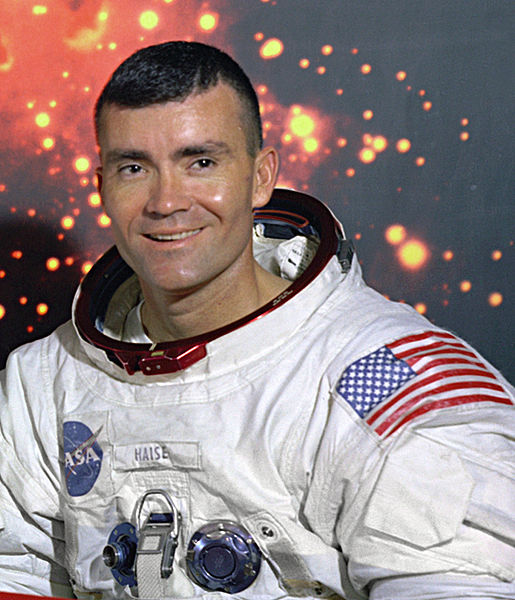
Astronaut Fred Haise in his Apollo 13 space suit. [Image courtesy: Wikimedia Commons.]

Fred Wallace Haise, Jr.was born in Biloxi, Mississippi, USA on his day in 1933. He is 79 years old.

His interest in flying happened by accident.  He was in junior college pursuing a career in Journalism when the Korean War broke out. Haise wanted to enlist

“The only program I could get into that would lead to a commission, which was my primary goal, was the Naval Aviation Cadet Program. So… I ended up in the flying business, which I loved.” [Johnson Space Center Oral History Project]

After being honorably discharged from the service –Haise went from the Cadet Program to the Marine Corps, served a tour of duty, then went into the Air National Guard —  he got his  BS in aeronautical engineering from the University of Oklahoma.

It was quite a path for a young man who had never been in a plane (not even for a commercial flight) prior to entering the Navy. He reckons he’s “flown about 80 types of aircraft.” [Ibid.]

While in the Oklahoma Air National Guard he was introduced to the idea of becoming a NASA research pilot. He was very interested, but the queue at Langley, Ames and Edwards Air Force Bases — NASA’s premier flight test centers at the time — was long. So Haise opted for Lewis Research Center. He worked for 7 years before entering the NASA astronaut program as a research pilot. This was the same path Neil Armstrong had taken three years ahead of him.

He was part of the “Original 19”  astronauts, nine of whom flew in the Apollo program and eight of whom flew in the Shuttle Program. Haise did both. He was a the back up Lunar Module Pilot for Apollo 8 and Apollo 11 and the back up commander for Apollo 16. But the flight he is best remembered for is Apollo 13.

Apollo 13 was slated to go to the Fra Mauro region of the Moon; deploy “a set of scientific experiments involved in the ALSEP [Apollo Lunar Surface Experiments Package] packages” [Ibid]  and do field geological work while on EVA.

English: S70-34854 (11 April 1970) --- The Apo...

English: S70-34854 (11 April 1970) — The Apollo 13 (Spacecraft 109/Lunar Module 7/Saturn 508) space vehicle is launched from Pad A, Launch Complex 39, Kennedy Space Center (KSC), at 2:13 p.m. (EST), April 11, 1970. The crew of the National Aeronautics and Space Administration’s (NASA) third lunar landing mission are astronauts James A. Lovell Jr., commander; John L. Swigert Jr., command module pilot; and Fred W. Haise Jr., lunar module pilot . (Photo credit: Wikipedia)

The mission took off from Kennedy Space Center, Florida on April 11, 1970. The crew included Commander by James Lovell, Lunar Module Pilot, Haise and Command Module Pilot, Jack Swigert. Swigert was a last-minute replacement for Ken Mattingly who was exposed to the measles and pulled off the primary crew a week before take off.

When the Saturn V rocket carrying the Apollo 13 crew was about 2/3rds to the Moon there was an explosion in the oxygen tank. Haise recalls:

‘I was still buttoning up and putting away equipment from a TV show we had completed, and… we were going to get ready to go to sleep. I knew it was a real happening, and I knew it was not normal and serious at…that instant. I did not necessarily know that it was life-threatening.” [Ibid]

He quickly went to his station where he encountered an “array of warning lights.” [Ibid] Haise looked at an instrument panel that read the pressure, temperature and quantity of the oxygen tanks. One had the needles at the bottom of all three gauges.

They had lost an oxygen tank, and, according to Mission Rules, that meant they had lost the Moon. They were now in abort mode.

Still, the situation didn’t seem life threatening. But after a few minutes it became evident that the second oxygen tank– the remaining tank — was also leaking.

“When it became obvious it was dwindling or losing oxygen, then the handwriting was on the wall that the command module was going to die and have to be powered-down.” [Ibid]

The crew transferred to the smaller Lunar Module.

Ground controllers in Houston faced a formidable task. Completely new procedures had to be written and tested in the simulator before being passed up to the crew. The navigation problem had to be solved; essentially how, when, and in what attitude to burn the LM descent engine to provide a quick return home. [NASA.gov]

Power and consumables were the first concern, but another danger, Carbon Dioxide, proved a hidden foe.

There were enough lithium hydroxide canisters, which remove carbon dioxide from the spacecraft, but the square canisters from the Command Module were not compatible with the round openings in the Lunar Module environmental system…Mission Control devised a way to attach the CM canisters to the LM system by using plastic bags, cardboard, and tape- all materials carried on board.[Ibid]

To navigate back to Earth the space craft was  put on a free-return course that required two burns of the engines. The first burn lasted  35 seconds and occurred  5 hours after the explosion. The second burn was 5 minutes and took place as they approached the Moon.

Apollo 13 crew aboard the USS Iwo Jima after splash in the Pacific. They are (l-r) Fred Haise, John Swigert and James Lovell. [Image courtesy: about.com]

Amazingly the three men in the capsule and the hundreds of people back at Mission Control were able to get the space craft back to Earth safely. Apollo 13 splashed down near Samoa  on April 17, 1970.

After Apollo 13 both Haise and Swigert had hopes of being assigned another Moon mission, but that did not come to pass.  (Swigert went on to become a member of the House of Representatives from Colorado in 1982 before dying of bone cancer.)  Haise stayed with NASA and worked on the Shuttle program.

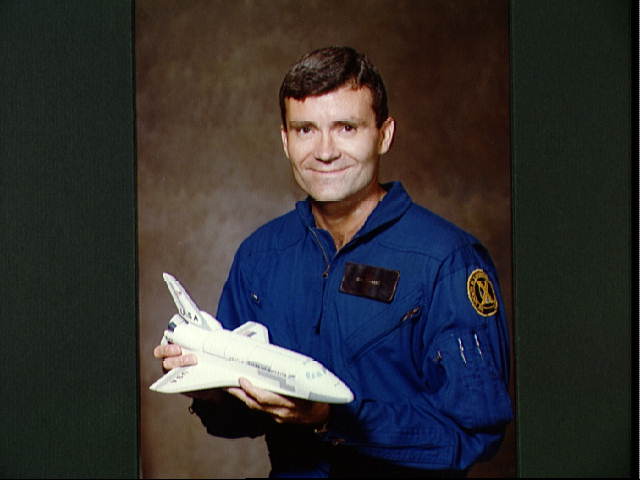
Portrait of Astronaut Fred H. Haise Jr. in flight suit holding a model of the space shuttle. [Image courtesy NASA]

He was commander of one of the two 2-man crews who piloted space shuttle approach and landing test (ALT) flights during the period June through October 1977. [Ibid]

There were a total of 8 “piggy back” flights that tested  the Shuttle’s critical glide, approach, landing, rollout, and flare capabilities.

After resigning from NASA in 1979 Haise became VP of Space Programs at Grumman Aerospace Corporation.

View of NASA 747 and T-38s flying over Shuttle Orbiter 101 “Enterprise” just after Haise and C. Gordon Fullerton landed the Shuttle on September 23, 1977. [Image courtesy NASA]


Thought of the Day 11.9.12 Benjamin Banneker

“Evil communication corrupts good manners. I hope to live to hear that good communication corrects bad manners.”

“The colour of the skin is in no way connected with strength of the mind or intellectual powers.”

“Presumption should never make us neglect that which appears easy to us, nor despair make us lose courage at the sight of difficulties”

Benjamin Banneker

Woodcut of Benjamin Bannecker

Woodcut of Benjamin Bannecker (Photo credit: Wikipedia)

Benjamin Banneker was born on this day outside Ellicott City, Maryland USA  in 1731. Today is the 281st anniversary of his birth.

His maternal grandmother, Molly Walsh, had been an indentured servant who came to colonial Maryland from Ireland. At the end of her seven years of bondage she bought a small farm and two slaves. Eventually she freed the slaves, marrying one of them, Bannaky. Their daughter Mary Bannaky married a slave named Robert (who may have been a fugitive; may have been freed after the wedding;  or may have been bought out of slavery after the wedding).  Mary and Robert had four children, Benjamin and his three younger sister.

All of the children had to help run the tobacco farm. They weeded the tobacco plants, picked worms and caterpillars off the leaves… by Benjamin’s calculation it took 36 chores to raise a crop of tobacco. He also cared for the farm animals, helped plant the corn, and did other farm chores with this father.

His maternal grandmother used a Bible to teach Benjamin (and her other grandchildren) how to read.

He learned to play the flute and the violin, and when a Quaker school opened in the valley, Benjamin attended it during the winter where he learned to write and elementary arithmetic. He had an eighth-grade education by time he was 15, at which time he took over the operations for the family farm. He devised an irrigation system of ditches and little dams to control the water from the springs (known around as Bannaky Springs) on the family farm. Their tobacco farm flourished even in times of drought. [Mathematicians of the African Diaspora]

It was at school that a teacher suggested he change his last name to the more anglicized Banneker, the rest of the family followed suit.

He loved to read and to do arithmetic . He taught himself advanced mathematics and eventually astronomy.

He would borrow books from his neighbors and friends. His close friends, the Ellicott brothers, lent him most of their books. [American Heroes: Benjamin Banneker]

A clock similar to the one Banneker made.

He loved puzzles and challenges too.

Sometime in the early 1750s, Benjamin borrowed a pocket watch from a wealthy acquaintance, took the watch apart and studied its components. After returning the watch, he created a fully functioning clock entirely out of carved wooden pieces. The clock was amazingly precise, and would keep on ticking for decades. As the result of the attention his self-made clock received, Banneker was able to start-up his own watch and clock repair business. [Famous Black Inventors]

He predicted the solar eclipse of 1789. He earned the nickname the “Sable Astronomer” He started to compile information into Almanac and Ephemeris of Pennsylvania, Delaware and Maryland best-selling almanacs. He even put a skylight in the ceiling of his cabin so he could watch the stars at night. He sent a copy of his almanac to Thomas Jefferson along with “a letter urging the abolition of slavery.” [Ibid]

When Banneker was 60 George Washington appointed him along with his friend Andrew Ellicott to survey what would become the District of Columbia.

A contemporary reprint of Andrew Ellicott's 17...

A contemporary reprint of Andrew Ellicott’s 1792 “Plan of the City of Washington in the Territory of Columbia” (Photo credit: Wikipedia)

Banneker and Ellicott worked closely with Pierre L’Enfant, the architect in charge. However, L’Enfant could not control his temper and was fired. He left, taking all the plans with him. But Banneker saved the day by recreating the plans from memory. [Mathematicians of the African Diaspora]

[For more on Pierre L’Enfant visit his Thought of the Day bioBlog HERE]

He published a treatise on bees, did a mathematical study on the cycle of the seventeen-year locust, and became a pamphleteer for the anti-slavery movement. [Mathematicians of the African Diaspora]

On October 9, 1806 Banneker died at his Ellicott City/ Oella farm.

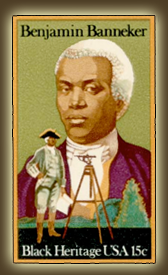
The Banneker postage stamp. [Image courtesy: USPS]

In 1980, the U.S. Postal Service issued a postage stamp in his honor. [Benjamin Banneker Center]

Benjamin Banneker

Benjamin Banneker (Photo credit: crazysanman.history)


Thought of the Day 11.8.12 Margaret Mitchell

“Death and taxes and childbirth! There’s never any convenient time for any of them”
–Margaret Mitchell

Margaret Mitchell all set to launch cruiser af...

Margaret Mitchell all set to launch cruiser after long training as Red Cross launchee / World Telegram & Sun photo by Al Aumuller. (Photo credit: Wikipedia)

Margaret Munnerlyn Mitchell was born on this day in Atlanta, Georgia, USA in 1900. today is the 112th anniversary of her birth.

Mitchell was the younger of two children born to an Atlanta attorney and suffragette. Her father’s family stretched back to colonial Georgia, and he had ancestors who fought in the War of Independence and the War of 1812. Her paternal grandfather was wounded twice in the head at Battle of Antietam, but he survived. After the war he made a fortune selling lumber to an Atlanta eager to rebuild.  Her mother’s people were from Ireland. Her maternal grandfather, Philip Fitzgerald, came over to America and bought a plantation in Georgia. He too fought in the Civil War.

If all of that has the Tara theme of Gone With The Wind playing in your head… well, lets just say Mitchell wrote what she knew, and growing up she was fed a steady diet of Old South stories along with the collard greens and fried chicken that graced every good Georgian table.

As a child Margaret Mitchell was saturated with stories of the Civil War told to her by family members who had lived through it. They indoctrinated her so effectively that Mitchell was ten years old before she learned that the South had lost the war. [Book Rags: Encyclopedia of the World]

Her mother was strict– she was “quick with the hairbrush whenever she thought her daughter was acting spoiled or ill-mannered.”[ReoCities; Margaret Mitchell] — When Mitchell came home from her first day of school frustrated at not being able to do the math and vowing not to go back Maybelle Mitchelle beat the little girl’s bottom with a hairbrush then took her in the carriage on a tour of ruined plantations near Atlanta.

‘ “Fine and wealthy people once lived in those houses,” she told the child, slowing the horses and pointing at the shabby former plantation houses they passed. “Now they are old ruins and some of them have been that way since Sherman marched through. Some fell to pieces when the families in them fell to pieces. …Now, those folk stood as staunchly as their house did. You remember that, child — that the world those people lived in was a secure world, just like yours is now. But theirs exploded right from underneath them. Your world will do that to you one day, too, and God help you, child, if you don’t have some weapon to meet that new world. Education!…People — and especially women — might as well consider they are lost without an education, both classical and practical… You will go back to school tomorrow,” she ended harshly, “and you will conquer arithmetic.” [Ibid]

Mitchell went back to school.

She was an avid reader and story-teller. She would snatch up her older brother’s books when he was finished with them. She loved sharing time with Maybelle as her mother read Mary Johnson’s historical/romance novels to her — they especially liked the ones dealing with the Old South. And she was a life long fan of children’s contemporary fantasy author Edith Nesbit. She told stories to her brother and his friends and made up plays for her school mates. She’d write the stories down and illustrate them. She created her own “publishing company” called “Urchin Publishing Co.” By 13 she’d written a 237 page book of Civil War stories.

When the First World War broke out Mitchell’s older brother joined up. She volunteered at refuge center. Toward the end of the war she met Lieutenant Clifford West Henry. He could

… quote poetry and passages from Shakespeare. Some of Margaret’s friends thought that he was of weak personality, strongly contrasting to Margaret’s, and was unmanly. But Margaret was quite taken by him. Clifford soon gave her a heavy gold family ring. In August, however, Clifford was told he was to be transferred overseas, and that night, he and Margaret secretly got engaged. [Ibid]

Mitchell went off to Smith College and Clifford went to war. At first she didn’t like Smith, which she called ‘a crusty old place,’ but soon enough she grew accustomed to it and the chic,  sophisticated, northern fellow students. They thought ‘Peggy’ cut a very romantic figure with her southern accent and her letters from an overseas lover.  Sadly in October Clifford died from shrapnel wounds he received from air bomb.

Mabelle  was sick too, but the news was kept from Mitchell. Her mother died  in January from the influenza epidemic and Mitchell returned home to take care of the household.

In 1922 she married Berrien Kinnard “Red” Upshaw, “an ex-football player and bootlegger.” [Margaret Mitchell House]  He was  “broad-shouldered, six feet and two inches, had brick-red hair, green eyes, and a cleft chin.”[ReoCities; Margaret Mitchell] so he towered over Mitchell, who was just 5 feet tall. Red was also violent and unpredictable. He physically and verbally abused Mitchell and marriage only lasted a few months.

Finances were not good. Her father had suffered financial setbacks. So, in 1922, Mitchell took a job as a features writer for the Atlanta Journal Sunday Magazine for $25 a week.

In 1925 she found true love with John Marsh. “Marsh was soft-spoken, not as tall as Red, and not extremely attractive. He was stoop-shouldered, wore glasses over his grey brown eyes, and had sandy hair which was receding and flecked with grey.” [Ibid] He’d long been  Red and Mitchell’s friend, and was the best man at their wedding. Whenever Red went too far Marsh was the first phone call Mitchell made. When things finally fell apart he was there to pick up the pieces, and Margaret Mitchell, finally, saw who the “best man” in the scenario really was.

English: Photograph of the Margaret Mitchell H...

English: Photograph of the Margaret Mitchell House in Atlanta, Georgia, USA taken by Jin-Ping Han on January 30th 2006 using a Canon Inc. Powershot S400 digital camera Category:Images of Atlanta, Georgia (Photo credit: Wikipedia)

When Mitchell injured her ankle in a car accident in May of 1926 she was bedridden for several weeks. Marsh dutifully stopped at the library to pick up stacks of novels for her to read. By the time she was able to hobble about on crutches she’d read her way through the library. Mitchell folk-lore has it that the next time he came home it was with a Remington Portable No. 3 typewriter. He gave it to her saying that she could write a better book than the thousands he’d been lugging back and forth.

She had no outline, but her authentic background gave her guidelines and structure. The story would commence with the war and end with Reconstruction, and it would be the story of Atlanta during that time as much as it would be the story of the characters she created. She did not come to the typewriter cold. She knew the story would involve four major characters, two men and two women, and that one of the men would be a romantic dreamer like Clifford Henry; and the other, a charming bounder like Red Upshaw…[Ibid]

For the women she would choose a paragon of Southern virtue for one character and some one  who was strong, hot-headed and “a bit of a hussy.” [Ibid] In other words some one vaguely like her maternal grandmother and herself. At first her heroine was named Pansy O’Hara.

She wrote ferociously 6 to eight hours a day “She kept index-card files for the characters, no matter how minor they were.” [Ibid] but the novel took years to complete.

Gone with the Wind cover

Gone with the Wind cover (Photo credit: Wikipedia)

Gone With the Wind was published in June 1936. Mitchell was awarded the Pulitzer Prize for her sweeping novel the following May.[Margaret Mitchell House]

It was a Book of the Month main selection. Mitchell won the Pulitzer Prize for fiction in 1937 and the book sold eight million copies by the time of her death.   Selznick-International purchased the movie rights for $50,000 shortly after its publication.

It was made into an equally famous motion picture starring Vivien Leigh and Clark Gable. The movie had its world premiere at the Loew’s Grand Theater in Atlanta December 15, 1939. [Ibid]

The film won 10 Academy Awards.

Mitchell “spent the rest of her life shepherding her book through many foreign editions, protecting her financial and copyright interests, and answering her extensive fan mail.” [Book Rags: Encyclopedia of the World]

Margaret Mitchell was killed by a drunk driver while crossing an Atlanta street in August 1949.

Mitchell's grave in Oakland Cemetery in Atlanta

Mitchell’s grave in Oakland Cemetery in Atlanta (Photo credit: Wikipedia)


Thought of the Day 11.6.12 John Philip Sousa

“Jazz will endure just as long people hear it through their feet instead of their brains.” –John Philip Sousa

John Philip Sousa, the composer of the song.

John Philip Sousa, the composer of the song. (Photo credit: Wikipedia)

I can’t think of any one who would make a better Thought of the Day Bio subject on Election Day 2012 than John Philip Sousa. He practically wrote the soundtrack for American patriotism AND he’s got a great mustache. What’s not to like?

He was born on this day in Washington, DC, USA in 1854. Today is the 158th anniversary of his birth.

He started his music career playing the violin, and soon added voice, piano, flute, cornet, baritone, trombone and alto horn to the mix.  After John Phillip tried to run away to join a circus band, his father, John Antonio Sousa,  “enlisted him in the Marines at age 13 as an apprentice…”[John Philip Sousa] in 1867.

He wrote and published his first composition “Moonlight on the Potomac Waltzes” in 1875 and was honorably discharged from the Marines two years later. Sousa “began performing (on violin), touring and eventually conducting theater orchestras. Conducted Gilbert & Sullivan’s H.M.S. Pinafore on Broadway.” [Ibid] While rehearsing Pinafore he met his wife Jane van Middlesworth Bellis.

In 1880 he returned to the US Marine Band as the Band’s leader, a post he kept for next 12 years.  Sousa conducted

“The President’s Own”, serving under presidents Hayes, Garfield, Cleveland, Arthur and Harrison. After two successful but limited tours with the Marine Band in 1891 and 1892, promoter David Blakely convinced Sousa to resign and organize a civilian concert band. [Ibid]

Sousa and his newly-formed civilian band, 1893

Sousa and his newly-formed civilian band, 1893 (Photo credit: Wikipedia)

Sousa wrote his own operetta, El Capitan in 1895.

He wrote 136 marches including Semper Fidelis March, King Cotton, Fairest of the Fair, Hands Across the Sea, And Stars and Stripes Forever — which he wrote in 1896. (In 1987 Congress proclaimed it the National March of the United States)

He designed a new type of bass tuba called the sousaphone. The Sousa Band toured throughout the world.

During World War I, Sousa joins the US Naval Reserve at age 62. He is assigned the rank of lieutenant and paid a salary of $1 per month…. After the war, Sousa continued to tour with his band. He championed the cause of music education, received several honorary degrees and fought for composers’ rights, testifying before Congress in 1927 and 1928.[Ibid]

Sousa died at the age of 77 in Reading, Pennsylvania after conducting a rehearsal. Fittingly, the last piece he conducted was Stars and Stripes Forever.

"Stars and Stripes Forever" (sheet m...

“Stars and Stripes Forever” (sheet music) Page 4 of 5 (Photo credit: Wikipedia)

Click HERE for a page with lots of audio clips of Sousa marches.

————————————-


Thought of the Day 11.4.12 Walter Cronkite

“And that’s the way it is.”
–Walter Cronkite, Jr.

Walter Leland Cronkite, Jr was born on this day in  Saint Joseph, Missouri, USA in 1916. Today is the 98th anniversary of his birth.

Walter was the oldest of six children. The Cronkites lived in Kansas City, Missouri (where young Walter was a paper boy for the Kansas City Star) until 1926 when the moved to Houston, Texas. At San Jacinto High School he worked for the school newspaper, eventually becoming editor.

Young Cronkite read the World Book Encyclopedia. He built a telegraph system to link the houses of friends. The churchgoing Boy Scout also learned he had an alcoholic father, and about divorce. His single mother taught him tolerance in a Jim Crow state. [Newsday.com]

According to Boy Scout lore Cronkite wanted to become a newsman after reading an article reporters in Boys Life Magazine.

He went to the University of Texas at Austin but dropped out in his Junior year  to start working as a reporter. He worked for a number of newspapers (including the Huston Post) and radio stations (under the name “Walter Wilcox”) reporting the news and sports.

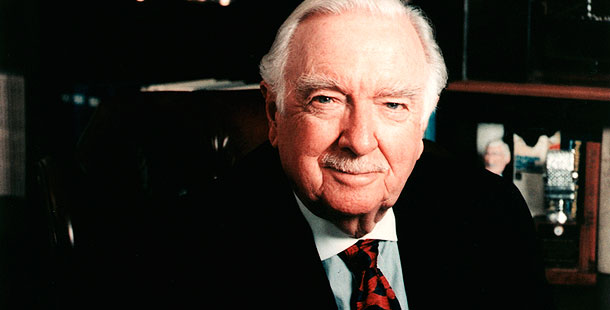
... Walter Cronkite

During World War II Cronkite became a War correspondent covering the North African and European campaigns for the United Press. After covering the Nuremberg Trials for that organization  he was recruited to CBS News by Edward R. Murrow.

Cronkite started at the Washington, DC affiliate for CBS.

…He worked on a variety of programs, and covered national political conventions and elections. He helped launch the CBS Evening News in 1962 and served as its news anchor until his retirement in 1981. [Biography.com]

He was “The most trusted man in America” and he covered events from the assignations of John and Bobby Kennedy and Martin Luther King, to Apollo 11 landing on the Moon, to Watergate and Vietnam.

U.S. television journalist Walter Cronkite in ...

He also hosted:  You Are There, a historical reenactment program; The Twentieth Century, a documentary using newsreel footage to explore historical events; and a game show, It’s News to Me.

He retired in 1981. He continued to report as a special correspondent and presenter.

After retiring, Cronkite hosted CBS’s Universe (1982), co-produced Why in the World (1981) for Public Broadcasting System, and hosted Dinosaur (1991) for the Arts and Entertainment cable television. He also did a special short series for CBS and the Discovery Channel in 1996 called Cronkite Remembers. In addition to his television work, Cronkite wrote several books, including A Reporter’s Life (1996) and Around America (2001). [Ibid]

Walter Cronkite passed away on July 17, 2009 in New York City.

RIP 2009-Walter Cronkite