Monthly Archives: March 2013

Marcel Marceau 3.22.13 Thought of the Day

”               ” — Marcel Marceau

English: Marcel Marceau Français : Marcel Marceau

English: Marcel Marceau Français : Marcel Marceau (Photo credit: Wikipedia)

Marcel Mangel was born on this day  in Strasbourg, France in 1923. Today is the 90th anniversary of this birth.

He was the son of Anne Werzber Mangel and Charles Mangel.  Charles was a kosher butcher who loved to sing — he was a baritone — and supported art and theatre as well as music. Because Anne  was Alsatian Marcel and his brother, Alain, grew up bilingual.

When he was five Marcel’s mother took him to see a Charlie Chaplain movie and Marcel was hooked. He marked seeing that movie as the point where he wanted to become a mime. He also listed: “Buster Keaton, Harry Langdon, Stan Laurel and Oliver Hardy” [ Marcel Marceau .com ] and the Marx Brothers as inspirations.

He did well in literature, art and English (as a foreign language) in school. So by the time WWII broke out he was trilingual.

As a Jewish family the Mangels suffered under the German occupation in France. They fled to Limoges.

He had to hide his Jewish origin and changed his name to Marceau… His father was deported to Auschwitz, where he was killed in 1944. Both Marceau and his brother, Alain, were in the French underground, helping children to escape to safety in neutral Switzerland… [IMDb.com]

During the dangerous route to Switzerland Marceau used his miming skills to keep the children calm and quiet.

Marcel and Alain served in the underground and then joined French Army. Marcel acted  “as interpreter for the Free French Forces under General Charles de Gaulle, acting as liaison officer with the allied armies.” [IMDb.com] “After the war, in 1946, he enrolled as a student in Charles Dullin’s School of Dramatic Art at the Sarah Bernhardt Theatre in Paris.” [Ibid] The following year he created his most famous character, Bip.

Marcel Marceau

Marcel Marceau (Photo credit: phoenixdiaz)

Bip was a mixture of Chaplin and pantomine’s Pierrot. Marceau’s costume for the character was a battered opera hat, a striped  pull over shirt and either overalls or a jacket. And he always performed Bip in white face. His one prop was a red rose. He formed the Compagnie de Mime Marcel Marceau aka ‘Compagnie de Mimodrame’. The group toured internationally. In 1978 he opened École Internationale de Mimodrame de Paris. He was actually an eloquent speaker and a respected teacher.

His “art of silence” filled a remarkable acting career that lasted over 60 years. He was an actor, director, teacher, interpreter, and public figure, and made extensive tours in countries on five continents. Outside of his mime profession, Marcel Marceau was a multilingual speaker and a great communicator, who surprised many with his flowing speeches in several languages. [IMDb.com]

He was featured in 14 films and several television programs, but his only speaking role was in Mel Brooks‘ film Silent Movie (1976). In 1956 he won an Emmy Award for Best Specialty Act.

In his later years he was living on a farm at Cahors, near Toulouse, France. He continued his routine practice daily to keep himself in good form, never losing the agility that made him famous. He also continued coaching his numerous students. [Ibid]

He died on September 23, 2007, at his home in France.

Français : Tombe de Marcel Marceau au cimetièr...

Français : Tombe de Marcel Marceau au cimetière Père Lachaise. (Photo credit: Wikipedia)


Charlotte Bronte 4.21.13 ritaLOVEStoWRITE

Dear reader: Cut another piece of birthday cake for Charlotte Bronte. It seems I was a month early in celebrating (oops, sorry Char!) Today, April 21st is really her big day. Happy Birthday, girl! Cheers, Rita

————————————————————————————————

“Better to be without logic than without feeling.” — Charlotte Bronte

Portrait of Charlotte Brontë

Portrait of Charlotte Brontë (Photo credit: Wikipedia)

Charlotte Bronte was born in Thornton, Yorkshire, England in 1816. Today is the 197th anniversary of her birth. Charlotte Bronte was the third child born to Maria and Rev. Patrick Bronte. Brother Branwell joined his older sisters, Maria, Elizabeth and baby Charlotte in 1817. Emily came along the next year and Anne was born in 1820. The Brontes moved to Haworth parsonage in 1820.

The parsonage where they lived stood midway between natural beauty and human squalor. To the rear stretched clear, broad moorland. On the other side, the township sprawled up the hill like an ugly sore. Most families shared an outhouse with their neighbors, and the main street was awash with sewage. Disease lurked in every filthy corner. The average age of death was twenty-five. [Charlotte Bronte and Jane Eyre, by Stewart Ross, Viking Press, 1997]

It wasn’t long after the family settled at Haworth that Mrs. Bronte was diagnosed with incurable stomach cancer. After her mother’s death in 1821 Charlotte, her brother and sisters were raised by their father and her Aunt Elizabeth Branwell.  The family was squarely middle class (although Rev. Bronte insisted on referring to himself as a gentleman), so they neither fit in with their working class neighbors in town, nor did they mix with the local gentry. The children grew up isolated from everyone but their immediate family.

They loved to explore the wilds of moors. They made up stories and games and performed plays they had penned themselves.

In 1824 Rev. Bronte felt the older children needed to be formally educated. He chose for the girls a school called “Cowan Bridge, a boarding school for the daughters of clergymen… it was cheap and respectable and promised a good education.” [Ibid]  The brochure skipped the part about the cruel teachers and the Tuberculosis and Typhus.

Charlotte found the school to be a prison.

She had to wear a “charity girl” uniform and was allowed to write home only once every three months. The cook ruined the food. The dormitory was cold, the rules strict, the education narrow. [Ibid]

Her older sisters took ill. First Maria came down with TB and had to go home (she died in May of 1825) Then the school was hit with a typhus epidemic. 10-year-old Elizabeth was returned home “to Haworth where, on June 15, she, too died of tuberculosis. ” [Ibid]

That was enough, Charlotte and Emily were called home in the summer of 1825. Rev. Bronte and Aunt Branwell once again took over the children’s education. “They read widely and freely,” had private music and art lessons and some Latin and Greek , but no science and limited math, history and geography.

Brontë

Brontë (Photo credit: Wikipedia)

There was plenty of time to play and explore as well. When Rev. Bronte gave Branwell a set of toy soldiers as a gift the four remaining children created a whole fantasy world called“ Glasstown.” Charlotte and Branwell  created “Angria” for the 12 wooden soldiers. (Emily and Anne made up “Gondal.”)

Unmarried middle class women of limited income in Victorian England had two choices in employment. They could become a teacher or a governess. But either profession would require more formal training. Charlotte was sent to Roe Head school in 1831. It was a much nicer institution than the dreaded Cowan Bridge, and Charlotte enjoyed her year and a half there. She returned home to help teach her brother and sister.  She went back to the school a few years later as a teacher, this time with Emily in tow.  (Emily didn’t take to the school. Anne replaced her after a few months.) After that, “She made two attempts at being a governess, first with a local family, then with a merchant in Bradford. Neither was a success. She found the children hard to control and her work humiliating and boring.” [Ibid]

In 1841, backed by Aunt Branwell, Charlotte, Emily and Anne decided to start their own school. But first the girls needed to be educated abroad. Charlotte went to Brussels to stay with her friend Mary Taylor.  Overseas travel changed her. The food, freedom and culture excited her. And in her teacher, Monsieur Heger, she had found her intellectual equal.  When their term ended Charlotte suggested she Emily stay on and pay their way by teaching. Slowly she fell in love with her  older, married teacher. But eventually she was forced to face reality and leave for home.

In 1845 Charlotte needed to regroup and focus on something positive.  She was  determined to get published. She convinced her sisters to publish some of their poems. They used the pseudonyms Currer, Ellis and Acton Bell (their initials) because they would be taken more seriously if readers thought they were men. Aylott and Jones published 62 of the sister’s poems in “Poems by Currer, Ellis and Acton Bell.”  Although the collection received favorable reviews, it sold only 2 copies.

Their next literary projects, this time in prose, would fare much better. Emily penned Wuthering Heights, Anne, Agnes Gray and Charlotte wrote The Professor about her time with Monsieur Heger. Although the first two novels were published (after Emily and Anne put up 50 pounds to help with the printing costs) The Professor was not picked up.

Undaunted, Charlotte wrote her second novel, Jane Eyre while nursing her father after an operation to restore his eye sight. Smith, Elder & Co. published Jane Eyre for 100 pounds  in 1847. They optioned her next two novels for the same amount.  Charlotte began work on Shirley.

Emily and Anne were busy on new novels too. Anne’s The Tenant of Wildfell Hall was published, but Emily was ill, TB again, and, although she may have finished the novel it never saw publication. Branwell was sick too, both physically and mentally.  He died in September of 1848, Emily passed away in December of the same year.  By spring of the  1849 Anne was showing “the familiar symptoms of tuberculosis.”  She died on May 23.

Charlotte Brontë Photography from 1854, free l...

Charlotte Brontë Photography from 1854, free licence (Photo credit: Wikipedia)

Charlotte continued to write. The mysterious Currier Bell was by now revealed to be the shy, plain Charlotte Bronte to her publisher George Smith. Smith and his mother did what they could to bring her out into society. Charlotte met fellow writers Harriet Martineau and Elizabeth Gaskell both of whom she remained friends with for the rest of her life.

She wrote her fourth novel Villette.

Rev. Bronte’s curate, Arthur Bell Nicholls fell in love with Charlotte and he proposed to her. At first Charlotte didn’t take to the idea. She found him both dull-looking and narrow-minded. Her father objected to the union as well. Nicholls was socially (and financial) inferior to the Brontes. She turned him down. But Gaskell encouraged her in the match, and as Charlotte watched the younger man’s devotion to her father she reconsidered. (Gaskell also used her influence to improve Nicholl’s financial standing.) Rev. Bronte continued to object, but he finally gave in, and the couple were married in June of that year of 1854.

Charlotte was soon with child, suffered from constant morning sickness.

The strain of pregnancy at the age of thrity-nine taxed her strength to its limits. By February she had grown alarmingly thin and was vomiting blood… The wasting sickness dragged painfully on until, by mid-March , all hope was gone. [Ibid]

Bronte died on March 31, 1855. Her novel, The Professor was published two years later, the same year as Elizabeth Gaskell’s biography The Life of Charlotte Brontë.

——————————–

Related articles


Fred Rogers 3.20.13 Thought of the Day

“Anyone who does anything to help a child in his life, is a hero to me.” — Fred Rogers

Mister Rogers' Neighborhood
Mister Rogers’ Neighborhood (Photo credit: Wikipedia)

Fred McFeely Rogers was born on this day in Latrobe, Pennsylvania, USA in 1928.  Today is the 85th anniversary of his birth.

Rogers was born to James and Nancy Rogers. He also spent a lot of time with maternal grandparents the McFeelys. James started out as a laborer at McFeely Brick Factory and wound up buying out his father-in-law to own the business. From there he bought Latrobe Die Casting Company. The family was well-respected and influential in town.  His mother, Nancy, volunteered as a nurses aid. Rogers said she had  “something like 25,000 volunteer hours at the hospital…. And during the Second World War she was in charge of making surgical dressings for the troops.” [The Wonder of It All] Nancy also knitted sweaters for the troops.

In fact, my mother, as long as I could remember, made at least one sweater every month. And at Christmas time, she… would give us each a hand-knit sweater … Until she died, those zipper sweaters that I wear on the Neighborhood were all made by my mother.” [Ibid]

That iconic red cardigan — the one that is in the Smithsonian? — Fred’s mom knit that for him.

Hand-made sweater worn by Fred Rogers, on disp...
Hand-made sweater worn by Fred Rogers, on display in the Smithsonian Institution’s Museum of American History. (Photo credit: Wikipedia)

But despite the outward Norman Rockwell appearance not everything was sugar and sweetness in Fred Rogers childhood. He was painfully shy, overweight and sickly. His parents were hyper protective of the little boy. They worried that he’d get sick, get hurt, or worse, get kidnapped (the Lindbergh kidnapping was fresh in every one’s mind.) The summer air was humid and the Pittsburgh’s factories added to the low air quality. That meant asthmatic Fred spent almost all his time inside his air-conditioned room during school break. He was isolated and lonely.

I was… very, very shy when I was in grade school. And when I got to high school, I was scared to death to go to school. Every day, I was afraid I was going to fail… I resented those kids for not seeing beyond my fatness or my shyness. I didn’t know that it was all right to resent it, to feel bad about it, even to feel very sad about it. … because the advice I got from the grown-ups was, “Just let on you don’t care, then nobody will bother you.” [Ibid]

One thing he did to make himself feel better was to play the piano. He started taking lessons when he was five and he soon found that music allowed him to express the feelings he otherwise had to keep inside.

He blossomed by Senior year, and finished high school as the, and was no longer the painfully shy child he had been when he entered as a Freshman. He started at Dartmouth College but transferred to Rollin College in Florida because their had a better music program. He got his degree in music composition and planned to attend Pittsburg Theological Seminary.

But then he saw his first  TV show. It was a base affair — with “people throwing pies at each other” — and Rogers “decided he wanted to be involved with this new medium to make it something better.” [Ibid]

He went to New York and began to work at NBC. He started as an assistant to the producer for NBC Opera Theater and later became floor manager for various music programs. His work on the Gabby Hayes children’s show convinced him that programing for children should be commercial free and educational. He quit NBC.

In 1954 he started  as a puppeteer on The Children’s Corner at WQED, a public  television station at Pittsburgh. Other shows followed, most famously Mr. Rogers’ Neighborhood. The show went national in 1968.

Not only was Fred Rogers a pioneer in children’s media, but he also was an artist, minister, composer and musician, environmentalist, and advocate for children and families.  With his gentle, unassuming manner, he made a profound impression on everyone he encountered. [Fred Roger Center]

Rogers authored the following books:

  • Mister Rogers Talks with Parents, 1983;
  • The New Baby (Mister Rogers’ First Experiences Books), 1985;
  • Making Friends (Mister Rogers’ First Experiences Books), 1987;
  • Mister Rogers: How Families Grow, 1988;
  • You Are Special, 1994.
President George W. Bush greets Fred Rogers of...
President George W. Bush greets Fred Rogers of Mister Rogers Neighborhood in the Blue Room before an early childhood education event in the East Room April 3, 2002. (Photo credit: Wikipedia)

He won the following awards:

  • Lifetime Achievement Award from the National Academy of Television Arts and Sciences as well as the TV Critics Association.
  • The Presidential Medal of Freedom
  • Two George Foster Peabody Awards.
  • Rogers was appointed Chairman of the Forum on Mass Media and Child Development of the White House Conference on Youth in 1968.
  • “Pennsylvania Founder’s Award” in June 1999 for his “lifelong contribution to the Commonwealth in the spirit of Pennsylvania’s founder, William Penn.”

In December of 2002 Rogers was diagnosed with stomach cancer.  He died on February 27, 2003.


Glenn Close 3.19.13 Thought of the Day

“As an actor, I go where the good writing is. That’s the bottom line.“–Glenn Close

[Image courtesy: FanPOP.com]

[Image courtesy: FanPOP.com]

Glenn Close was born on this day in Greenwich, Connecticut, USA in 1947. She is 66 years old.

She is one of four children born to Bettine and Dr. William Taliaferro Close. The first seven years of her live were ones of privilege. She fondly remembers the ease and freedom of living in on her grandmother’s estate in the Connecticut countryside. But then things changed. Her parents joined the conservative salvation group Moral Re-Armament. The family moved into communal living centers and eventually her parents traveled to the Belgian Congo where her father ran several medical clinics and became a personal physician to  Mobutu Sese Seko. Close went to school in Switzerland. She attended Choate Rosemary Hall in Greenwich. And for a while in the mid-to-late 1960’s she performed with the MRA’s singing group “Up With People.”

At 22 she left the MRA and entered William and Mary College in Williamsburg, Virginia. There she took up acting in earnest.  Upon graduation she moved to New York and found work on the stage. She had her Broadway debut in 1974 as Angelica in Love for Love. Her break out role on the Great White Way was as Chairy Barnum in the Original Broadway Production of Barnum in 1980.

Close in The World According to Garp. [Image courtesy: Fixster.com]

Close in The World According to Garp. [Image courtesy: Fixster.com]

She made the jump to film in 1982 with The World According to Garp. She played Jenny Fields. The role earned her the first of her many Academy Award nominations. Another Oscar nomination came for her role as Sarah Cooper in The Big Chill in 1983, and yet another for her part as Iris Gaines in 1984’s the Natural.

She went against type and starred as Alex Forrest in Fatal Attraction in 1987. She got another Academy nod — this time for Best Actress. And got nominated again in that category for Dangerous Liaisons in 1988.

Close as Marquise de Merteuil in Dangerous Liaisons. [Image courtesy: the Oscar Nerd.com]

Close as Marquise de Merteuil in Dangerous Liaisons. [Image courtesy: the Oscar Nerd.com]

In 1990 she played Queen Gertrude to Mel Gibson’s Hamlet, And Sunny Von Bulow to Jeremy Iron’s Claus  in Reversal of Fortune.

In 1991 She played Sarah Wheaton in Sarah, Plain and Tall. It was the first of a Hallmark trilogy which also includes Skylark and Sarah, Plain and Tall: Winter’s End.

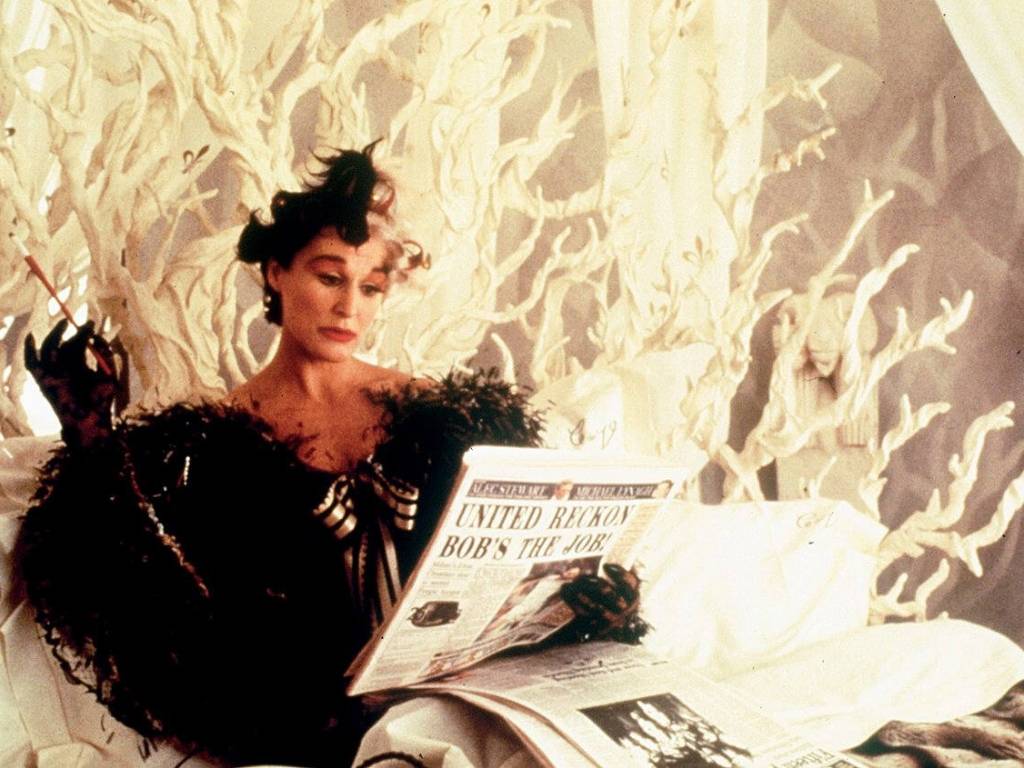
Cruella De Ville (Image courtesy: FanPop.com)

Cruella De Ville (Image courtesy: FanPop.com)

But not everything on her CV is a drama. In 1996 she co-starred as First Lady Marsha Dale in Tim Burton’s Mars Attacks! and the first of her gigs as the villainous, puppy hating Curella de Vil in 101 Dalmatians.

Dvd cover for Paradise Road. [Image courtesy: Amazon.com]

Dvd cover for Paradise Road. [Image courtesy: Amazon.com]

In 1997 she was Adrienne Pargiter in the brilliant and under rated Paradise Road. The film is a…

Fact-based recounting of a group of women who are imprisoned on the island of Sumatra by the Japanese during World War II and used music as a relief to their misery. [IMDb]

The movie co-stars Pauline Collins, Frances McDormand, Cate Blanchette, Jennifer Ehle and Julianna Margulies  and is a beautiful testament to the human spirit and the power of music. If you haven’t seen it… do your self a favor and put it in your queue.

She showed off her pipes again as Nellie Forbush in a made for TV version of South Pacific. (An interesting counter part to Paradise Road — considering both films cover the same period in history, the same conflict,  and approximately the same geography, and both contain some lovely music… yet they take a very different look at WWII.)

Close was Eleanor of Aquitaine opposite Patrick Stewart’s Henry II  in the TV version of The Lion in Winter, in 2003.

Promo shoot for Damages. [Image courtesy: FanPop.com]

Promo shoot for Damages. [Image courtesy: FanPop.com]

She had a 13 episode character arch as Captain Monica Rawling on The Shield. She voiced Mother Simpson on the Simpsons several times, and, more dramatically,   played Patty Hewes  on the TV series Damages starting in 2007.

Close was nominated for yet another Best Actress Oscar for her work in Albert Nobbs. The film came out in 2012.

Close as Albert Nobbs (Image courtesy: NPR.com photo by Patrick Redmond.]

Close as Albert Nobbs (Image courtesy: NPR.com photo by Patrick Redmond.]

Currently she has two films in the works for 2014, The Grace That Keeps This World, and Always on My Mind. Maybe she’ll get nominated again for one of these, and maybe, just maybe, the 7th time will be a charm!


Muffin Monday! Date Zucchini Orange Muffins

So… I thought I’d indulge in another of my passions — BAKING — one day a week. What do you think? Unless I hear some serious uproar in protest I proclaim Mondays “Muffin Monday” in all the land. You may have noticed the amended bit at of the legal portion of my Home Page… please note that although the recipes I’ll be highlighting in Muffin Monday worked brilliantly in my kitchen they may not work for you. I’m not calling you a bad cook or any thing, but SOMETHING might happen… and since I’m not there watching you add the ingredients one at time or setting the temperature I can’t be responsible for the end results. Having said that… give it a go and see if you like it.  If you do please let me know.

————————————————————————————

Date Zucchini Orange Muffins

CookbookCupcakePan

CookbookCupcakePan (Photo credit: Wikipedia)

Ingredients:

  • 1 cup of chopped dates

IMG_4510

  • 1 teaspoon baking soda

IMG_4513

  • 1 1/4 cup of very hot water
  • 3/4 cups of butter (1 1/2 sticks) melted and slightly cooled

IMG_4518

  • 2/3 cup Tuvia sugar substitute (or 1 cup sugar)

IMG_4532

  • 2 eggs

IMG_4522

  • 1 orange (peeled and sectioned)

IMG_4517

  • 1 medium zucchini grated

IMG_4520

  • 1 teaspoon vanilla

IMG_4540

  • 2 cups flour

IMG_4535

  • 1/4 teaspoon salt

IMG_4537

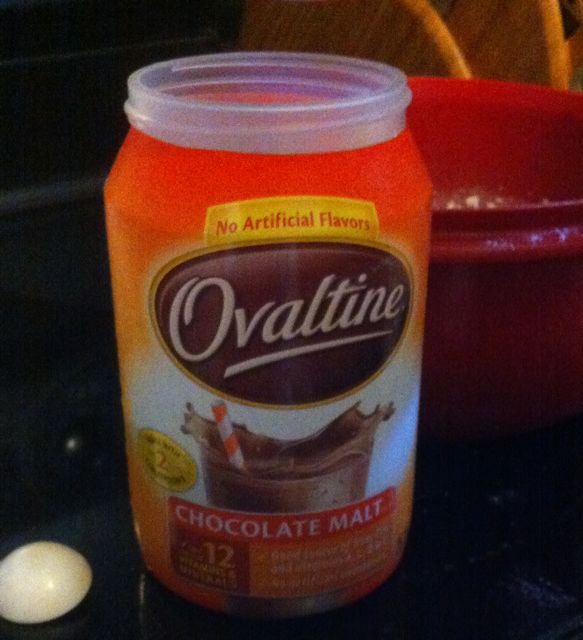
  • 1/2 cup Ovaltine Chocolate Malt mix (optional)

IMG_4542

Directions:

Heat the oven to 375 degrees F.

Step One: Put Dates and Baking Soda into the hot water and stir. Set aside to cool.

IMG_4515

Step Two: Put the peeled/sectioned Orange in a blender …

IMG_4525

…add the Tuvia (or sugar),  the Eggs…

IMG_4526

…and melted (liquid but cooled) Butter and blend.

…Add the grated Zucchini and Vanilla and blend.

…Add the Date mixture and blend.

Step Three: In a bowl mix the Flour, Ovaltine, and Salt.

IMG_4544

Slowly incorporate the liquid from the blender into the dry ingredients in the bowl.

IMG_4549

Prepare the muffin cups (this recipe will make about 18 muffins.) Put “muffin pants” into the tin and spray lightly with cooking spray.

IMG_4551

Divide the batter evenly into the muffin cups. They should be about 2/3rds of the way full.

Place into hot oven and bake for 20 – 25 minutes until tops are brown and a tooth pick stuck into the center of the muffin comes out clean.

Let cool and enjoy.

IMG_4556


St. Patrick 3.17.13 Thought of the Day

“Christ beside me, Christ before me, Christ behind me,
Christ within me, Christ beneath me, Christ above me.”
St. Patrick

[Image courtesy: Wikipedia]

[Image courtesy: Wikipedia]

St. Patrick died on this day in 461, in Saul, Ireland. Today is his Feast Day.

Patrick was born in Scotland sometime around 385 AD to Roman parents, Calpurnius and Conchessa. When he was about 14 he was kidnapped by a raiding party and taken to Ireland to work as a slave. There he tended sheep.

In the despair of his captivity he turned to God in intense and desperate prayer, drawing comfort from the Christian faith that he and so many others of his people had abandoned under Roman rule. …Patrick’s captivity became a preparation for his future in ministry. He learned the language and customs of the Irish people who held him, and even while he practiced devotion to Christ he also became very familiar with the pagan and druidic practices that were popular throughout Ireland at that time. After six years as a slave he was told by an angel in a dream to run away to the coast. He travelled over 200 miles from Ballymena to Wexford and escaped on a ship that was taking dogs to Gaul (France). After landing in England he was recaptured and returned to slavery, but this time he escaped again after only two months and traveled around Europe seeking his destiny. [All Saints Brookline.org]

Once home he had another dream that called him back to Ireland to teach the people about God. He studied to become a priest and eventually be came a Bishop. At 48 he was sent to Ireland.

Patrick preached and converted all of Ireland for 40 years. He worked many miracles and wrote of his love for God in Confessions. After years of living in poverty, traveling and enduring much suffering he died March 17, 461. [Catholic Online.org]

His ability to connect with the people on a personal level helped him win over hundreds of thousands of converts from peasants to tribal kings.

Oxalis Shamrocks, Two Kinds

Oxalis Shamrocks, Two Kinds (Photo credit: cobalt123)

He is, perhaps, most famously known for using the common shamrock [NOT THE 4-LEAF CLOVER] to explain the Holy Trinity.

Familiar with the Irish language and culture, Patrick chose to incorporate traditional ritual into his lessons of Christianity instead of attempting to eradicate native Irish beliefs. For instance, he used bonfires to celebrate Easter since the Irish were used to honoring their gods with fire. He also superimposed a sun, a powerful Irish symbol, onto the Christian cross to create what is now called a Celtic cross, so that veneration of the symbol would seem more natural to the Irish. [History.com]

Mythology has Patrick “bringing Christianity to Ireland,” but the Church was already there. He expanded it and made it more appealing to the Irish. He’s also suppose to have “driven the snakes out of Ireland.” Another myth. There weren’t any snakes in Ireland to drive out.

The Patrick of historical record is just as compelling as the Patrick of legend. … He was the first real organizer of the Catholic Church in Ireland by dividing the church into territorial sees; he raised the standard of biblical scholarship and especially encouraged the wider teaching of Latin; he travelled throughout the country preaching, teaching, building churches, and opening schools and monasteries; and he converted countless people of all social classes, and inspired many to become monks and nuns. He not only shared God with the people of Ireland, but also grew in his understanding of God through them. [All Saints Brookline.org]

In Ireland St. Patrick’s day is a holy day of obligation, but Catholics and non Catholics alike celebrate it world wide. So whether you are saying a rosary or lifting a glass in St. Patrick’s name today… I wish you Sláinte (good health)…. and …

May the strength of God pilot us,
may the wisdom of God instruct us,
may the hand of God protect us,
may the word of God direct us.
Be always ours this day and for evermore.

Statue of St. Patrick in Aughagower, County Mayo


Secondary Character Saturday: Alan Rickman: Steven Spurrier (Bottle Shock)

“Great wine is great art, my friend. I am, in effect, a shepherd… whose mission is to offer the public another form of great art and to guide its appreciation thereof.”–Steven Spurrier

“Wine is sunlight, held together by water.” The poetic wisdom of the Italian physicist, philosopher, and stargazer, Galileo Galilei. It all begins with the soil, the vine, the grape. The smell of the vineyard – like inhaling birth. It awakens some ancestral, some primordial… anyway, some deeply imprinted, and probably subconscious place in my soul.” — Steven Spurrier

Alan Rickman as Stephen Spurrier  in Bottle Shock [Image courtesy: 20th Century Fox]

Alan Rickman as Stephen Spurrier in Bottle Shock [Image courtesy: 20th Century Fox]

Who: Steven Spurrier

From: Bottle Shock

…The British owner of a struggling Parisian wine shop, Steven Spurrier (Alan Rickman), concocts an idea to jumpstart his business and attract new customers – pit the French against the Americans in a wine tasting showdown. Certain that the established French wines will emerge victorious, Spurrier travels to the New World to sample the wines of Napa Valley with the intention of bringing back a few bottles to include in the blind tasting. Upon landing in California, Spurrier meets Chateau Montelena Winery owner, Jim Barrett (Bill Pullman), an attorney who left the legal field to start a winery, and his wayward son, Bo (Chris Pine), who works at the winery alongside his father. Spurrier samples the Barretts’ Chardonnay, finds himself impressed, and realizes that his planned publicity stunt may have a more profound impact than he had initially imagined. Back in Paris, on May 24, 1976, a panel of some of the most respected names in the French wine industry convenes to participate in Steven Spurrier’s tasting event. In the end, America emerges triumphant as the 1973 Chateau Montelena Chardonnay takes top honors, putting California at the forefront of the wine world and changing the future of the wine industry forever. When asked for comment about the victory, Jim Barrett simply replied, “Not bad for kids from the sticks.” [montelena.com]

By: Jody Savin, Randall Miller, Ross Schwartz & Lannett Pabon

Produced: 2008

Pros: He’s passionate about wine. Although he comes off aloof, he’s actually a pretty good guy underneath it all. He’s such a snob that by dropping his out of his element and forcing him to drive an AMC Gremlin around the hills of California eating Kentucky Fried Chicken and guacamole and drinking wine from jelly jars gives the movie a comic rhythm that it would otherwise be too earnest without, so he’s funny too.

Cons: He’s a terrific snob. “My definition of palatable might be slightly different from yours.”

Most Shining Moment: Realizing the Americans have won, he pulls Bo aside and encourages him to put on a coat and comb his hair. Spurrier pads his speech until Bo is ready then tells the assembled Francophiles that the distinguished panel of judges have just picked a wine from Bo’s American vineyard.

CD cover of Bottle Shock [Image courtesy: 20th Century Fox]

CD cover of Bottle Shock [Image courtesy: 20th Century Fox]

Why Rickman is so good: “Rickman is a hoot as Spurrier, though nothing like the actual man …. Making the wine merchant a pompous ass … ” [Los Angeles Times.com] Rickman does fish-out-of-water disdain so beautifully. And this is one of his best examples of it. He’s kind of the Mr. Darcy of Wine and the Napa Valley chardonnay and cab sauvignon  is the Lizzie that makes him rethink his prejudice and let down his guard (a bit.)

http://youtu.be/Qy5rkvYCVIg

Why I picked Bottle Shock: Odds are you have never heard of Bottle Shock. So I wanted to make people aware of this little gem. It doesn’t have a good Rotten Tomatoes (49%) and it wasn’t critically acclaimed. But foo-foo on that. It’s a terrific little movie that makes me smile every time I see it. I don’t really drink wine, but when we left the theater after seeing this movie I did get a glass (though NOT of the 73 Montelena Chardonna). The Movie is a video valentine to the beautiful, lush Napa Valley. And the Doobie Brothers / Allman Brothers / Harry Nilsson /America,  California acoustic guitar heavy, soundtrack will leave you wishing you still had that vintage record collection of your youth.

Rickman as Spurrier toward the end of Bottle Shock [Image courtesy: 20th Century Fox]

Rickman as Spurrier toward the end of Bottle Shock [Image courtesy: 20th Century Fox]

Related articles

Andrew Jackson 3.15.13 thought of the Day

“Take time to deliberate; but when the time for action arrives, stop thinking and go in.” –Andrew Jackson

English: Andrew Jackson - 7 th President of th...

English: Andrew Jackson – 7 th President of the United States (1829–1837) (Photo credit: Wikipedia)

Andrew Jackson was born on this day in the  Waxhaws region between North and South Carolina in 1767. Today is the 246th anniversary of his birth.

He was born to Andrew and Elizabeth Hutchinson Jackson, Scots-Irish emigrants who had come over from Ireland two years before with their young sons Hugh and Robert. Andrew Jackson never met his father, who died three weeks before the baby was born.

Raised by his widowed mother, Jackson grew up with a large extended family—aunts, uncles, and cousins— who were also Irish immigrant farmers. As a youth, Jackson attended a good school and his mother had hopes of him becoming a Presbyterian minister. However, young Jackson’s propensity for pranks, cursing, and fighting quickly dashed those hopes. [The Hermitage.com]

The American Revolutionary War left the Jackson family devastated. All three boys signed up to fight the British (Andrew was just 13 and became a courier.) Older bother Hugh died of heat stroke at the Battle of Stono Ferry in 1779. In 1781 Jackson and his remaining brother Robert were taken prisoner. The boys nearly starved to death in the camp, and Jackson was slashed with a sword when he refused to polish a British officer’s boots. He carried the scars on his hand and head for the rest of his life. Both Jackson and Robert

contracted smallpox in prison and were gravely ill when Jackson’s mother arranged for their release in a prisoner exchange. Jackson survived, however, his brother died. After Jackson recovered, his mother traveled to Charleston to aid the war effort by nursing injured and sick soldiers. She contracted cholera and died leaving Jackson an orphan. [Ibid]

Growing up in the backwoods of the Carolinas, Jackson’s education was sporadic. He attended a “old-field” school in his youth. (An old-field school was a school that washeld on– either an open field or in a building built — on an exhausted corn, tobacco or cotton field.)  After the Revolutionary War he worked for a while at a saddle makers shop, but then took up law.

In 1787, after three years of studying law, Jackson received his license to practice law in several counties scattered through the North Carolina back country. To supplement his income, he also worked in small-town general stores. While living in North Carolina, Jackson gained a reputation for being charismatic, wild, and ambitious. He loved to dance, entertain, gamble, and spend his free time with friends in taverns. [Ibid]

At 21 he became public prosecutor of the Western District of North Carolina. He became the prosecutr for both Jonesborough and Nashville. It was during this time that he met Rachel Donelson Robards (who was separated — and she assumed divorced — from her first husband Lewis Robards.) Jackson married Rachel while the two were in the wilderness of the Western District only to come back to Nashville to find out that Robards had not completed the divorce proceedings. He, Robards, then used  Rachel’s ‘bigomy’ as grounds  to finalize the divorce. Jackson and Rachel remarried, but the controversy followed them for the rest of their lives, and Jackson was willing to duel with any man who  besmirched his wife’s name.

English: Portrait of Rachel Donelson Jackson, ...

English: Portrait of Rachel Donelson Jackson, wife of U.S. President Andrew Jackson, by the artist Ralph E. W. Earl. Oil on canvas, 30 in. x 20 in. Circa 1830-1832. Portrait is in the collection of The Hermitage, Nashville, Tennessee. Image courtesy of the Tennessee Portrait Project. (Photo credit: Wikipedia)

None of that stopped Jackson’s rise in the political arena. “He was the first man elected from Tennessee to the House of Representatives, and he served briefly in the Senate” [Whitehouse.gov]

During the War of 1812 President Madison “commissioned Jackson Major General of U.S. Volunteers and ordered him to lead 1,500 troops south to Natchez and eventually to defend New Orleans” [The Hermitage.com] His leadership in the Battle of New Orleans made “Old Hickory ” a national hero. In 1824 he made an unsuccessful run for President against John Quincy Adams. Four years later he ran again. This time he won the White House.

Accomplishments of his presidency:

  1. He paid off the National Debt
  2. Fought against corrupt bureaucracy with the Spoil System
  3. Enfranchisement policy

Crisis / Negatives of his presidency:

  1. Nullification Crisis
  2. Ethnic cleansing of  about 45,000 Native Americans from their ancestral lands under his “Indian Removal Act”  which lead to the Trail of Tears .

Neutral effects of his presidency:

  1. Tried to eliminate the Electorial College
  2. Opposed the National Bank

After leaving the White House he retired The Hermitage in Nashville. He died on June 8, 1845, of chronic tuberculosis, dropsy, and heart failure.

78 year old Andrew Jackson

78 year old Andrew Jackson (Photo credit: Wikipedia)


Frank Borman 3.14.13 Thought of the Day

“Exploration is really the essence of the human spirit.” — Frank Borman

Frank Borman

Frank Borman (Photo credit: Wikipedia)

Frank Frederick Borman, II was born on this day in Gary, Indiana, USA in 1928. He is 85  years old.

The Bormans, Frank, his father Edwin, and mother, Marjorie moved to Tucson, Arizona when he was a kid . He began to take flying lessons at 15. After graduating from Tuscon High School He attended the United States Military Academy. He graduated in 1950 and joined the US Air Force.

He was “a fighter pilot, an operational pilot and instructor, an experimental test pilot and an assistant professor of Thermodynamics and Fluid Mechanics at West Point.” [NASA.gov] during his time in the USAF. Later he went to the California Institute of Technology and earned his MS in aeronautical engineering in 1957 before become a test pilot and instructor at the Aerospace Research Pilot School at Edwards Air Force Base.

Astronaut Groups 1 and 2 - GPN-2000-001333

Astronaut Groups 1 and 2 – GPN-2000-001333 (Photo credit: Wikipedia)

The National Aeronautics and Space Administration (NASA) chose him to be a member  of the “New Nine” group of astronauts in 1962. The New Nine (which included Neil Armstrong, Pete Conrad, Jim Lovell, James McDivitt, Elliott See, Tom Stafford, Ed White, and John Young as well as Borman) augmented the 7 Mercury Astronauts and  assured that the space agency was staffed through the Gemini and Apollo missions (with the addition of NASA’s Astronaut Group 3) During his NASA days…

Apollo8 Prime Crew

Apollo8 Prime Crew (Photo credit: Wikipedia) Borman is on the right.

  • Borman and Lovell performed the first rendezvous in of two spacecraft in orbit during their Gemini 7 flight.  The 1965 flight set a 14 day long endurance record. (Borman was commander.)
  • He served on the AS-204 Accident Review Board investigating the fire on Apollo 1 that killed Astronauts Gus Grissom, Ed White and Roger Chaffee.
  • He led “the team that re-engineered the Apollo spacecraft” [NASA.gov] after the accident.
  •  “As commander of the Apollo-8 mission, he and his crew (James A. Lovell and William Anders) were launched into Earth’s orbit on December 21, 1968. They then became the first men to leave Earth’s gravity and journey to the moon. After 10 lunar orbits, they returned safely to the Earth.” [National Aviation Hall of Fame]
  • He was President Nixon’s special ambassador when Apollo-11 landed on the Moon.

After Borman retired from NASA he…

“joined Eastern Airlines as vice president of operations and, after completing an advanced management course, became senior vice president of operations. In 1974 he was named executive vice president, general operations manager and a member of the board of directors. By 1976 he had risen to chairman, president and chief executive officer of Eastern. ” [Ibid]

In 1986 Borman retired from Eastern and moved to New Mexico with his wife Susan where he acts as a consultant.

Earth rise taken during Apollo 8 [Image courtesy: NASA]

Earth rise taken during Apollo 8 [Image courtesy: NASA]