Thought of the day 8.9.12 Audrey Tautou

“In France we have a law which doesn’t allow the press to publish a photo that you didn’t approve. It lets the paparazzi take the picture, but if they publish this picture, you have the choice to sue the newspaper. So me, I always sued them.”

Audrey Justine Tautou

Amélie

Amélie (Photo credit: Wikipedia)

Audrey Justine Tautou  was born on this day in  Beaumont, in the Auvergne region of France in 1976 (or maybe it was 1978, no one seems to really know, and Tautou isn’t telling.) She is 36  (or 34).

She was named after actress Audrey Hepburn, it seemed destined that the French waif would become an actress. She studied acting Cours Florent (a private drama school in Paris), and, upon graduation quickly found work on television.

She won the Canal+ “Young Debut” award in 1998. The following year she won a Ceasar for Best New Actress in her work in the film Venus Beauty Institute .  She had three movies come out in 2000, Le Libertin, Voyous Voyelle, and Happenstance. She won the Prix Suzanne Bianchetti Award for her work that year.

Then came Amelie. Le Fabuleux destin d’Amélie Poulain, was directed by Mathieu Kassovitz, who also co-starred. Tauto plays the a young waitress who, despite a sad and lonely childhood, decides

to dedicate herself to bringing happiness to those who are less fortunate than she, whilst punishing those who deserve to be punished.[FilmsdeFrance.com]

It made her the best paid actress in France, and gave her international exposure.

The Da Vinci Code (film)

The Da Vinci Code (film) (Photo credit: Wikipedia)

In 2002 she made her first English Language film with director Stephen Frears, Dirty Pretty Things. And in 2006 she starred in the block buster Da Vinci Code directed by Ron Howard and starring Tom Hanks.

Coco Before Chanel

Coco Before Chanel (Photo credit: Wikipedia)

In 2009 she embraced the role of fashion icon Coco Chanel in Coco Before Chanel.

In 2012 she made her stage debut at the Theatre de la Madeleine in Paris in Ibsen’s A Doll’s House.

Tautou says she is not interested in doing sequels. “ I certainly don’t want to be in Thingy Blah Blah 3, if you know what I mean.”  She enjoyed working with Howard and Hanks on Da Vinci Code, but ““I never want to do the same things twice. I like surprises.”


Thought of the Day 8.8.12 Marjorie Kinnan Rawlings

“I do not know how anyone can live without some small place of enchantment to turn to.”

Marjorie Kinnan Rawlings

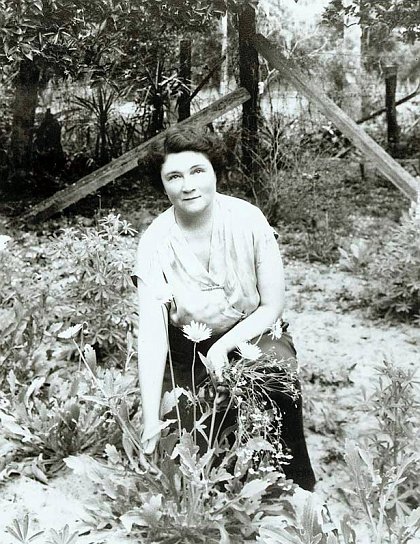
Rawlings in her garden.

Marjorie Kinnan was born on this day  in Washington D.C. in 1896. Today is the 116th anniversary of her birth.

She got her love of nature from her parents. Although her father was a principal examiner in the U.S. Patent Office, he was happiest when he was walking his Maryland farm. Her mother grew up on a farm in Southern Michigan, and Marjorie would spend summers at the family homestead. According to The Marjorie Kinnan Rawlings Society website:

Living close to the land as she was growing up “planted deep in [her] a love of the soil, the crops, the seasons and a sense of kinship with men and women everywhere who live close to the soil”

At six she started to write short stories, some of which she submitted to the children’s section of the Washignton Post. At 15 her short story “The Reincarnation of  Miss Hetty” won a literary prize and Marjorie was hooked.

When she was 17 her father passed away and she moved with her mother to Wisconsin. She attended the University of Wisconsin and her works were published in  the Wisconsin Literary Magazine.  While at the University she met Charles Rawlings.
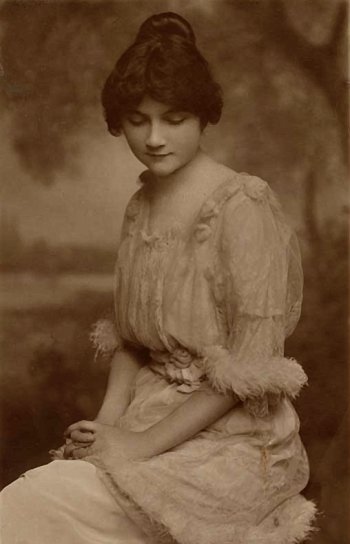
Rawlings in 1913.

After graduating with honors she moved to New York. She married Rawlings in 1919 and the couple moved to Louisville, Kentucky. They both wrote for the Louisville Courier-Journal (Charles was a features writer, Marjorie wrote the “Live Women in Louisville” column.  When they moved to Rochester, New York Marjorie wrote poems about cooking, mending, gardening, et ect. in the syndicated column  Songs of a Housewife.  It was distributed nationwide to 50 papers. She also worked  on a novel, Blood of My Blood.  The manuscript  for Blood was lost for years, and the novel wasn’t published until 2002, nearly sixty years after her death.)
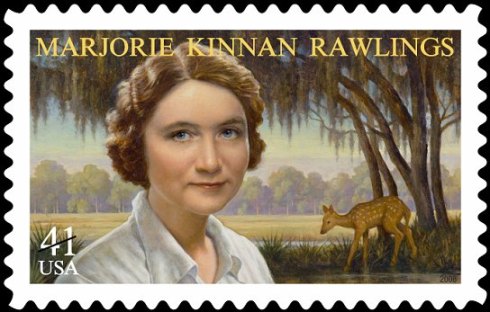
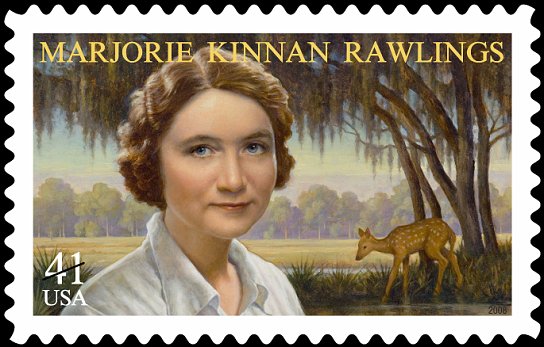
The US Postal Service stamp

When her mother passed away in 1928 she left Marjorie a small inheritance and the couple purchased an orange grove named Cross Creek near Hawthorne, Florida.

“This was not the Gold coast of Florida. . . . It was a primitive section off the beaten path, where men hunted and fished and worked small groves and farms for a meager living. . . . And the country was beautiful, with its mysterious swamps, its palms, its great live oaks, dripping gray Spanish moss, its deer and bear and raccoons and panthers and reptiles” [The Marjorie Kinnan Rawlings Society website]

Rawlings was smitten by the rough Floridian back wood and groves, and the people who lived there. She found a new voice as she began to chronicle their stories. Gal Young Un won the 1932 O Henry Award. She moved further into the “scrub” to research her novel South Moon Under. She stayed with Piety Fiddia and her son Leonard and learned how to kill rattlesnake and  to make moonshine. The book was a Pulitzer Prize finalist and Book-of-the Month Club selection.

But the Florida wild was not for Charles Rawlings and the couple divorced in 1933.

Cover of "The Yearling"

Cover of The Yearling

Rawlings wasn’t happy with her next novel, Golden Apples, which she called “interesting trash instead of literature.” But, in 1939, she rebounded with her follow-up novel, The Yearling. The Yearling is a coming of age tale about a back woods boy named Jody Baxter who adopts a fawn, Flag. The book earned Rawlings a Pulitzer Prize for Literature. MGM  made it into a major motion picture starring Gregory Peck as Jody’s kindly father “Penny” Baxter and Jane Wyman as his distant mother. (Both performers were nominated for Academy Awards).

Cover of "Cross Creek"

Cover of Cross Creek

The autobiographical Cross Creek hit in 1942. Upon reading it one critic called Rawlings a “female Thoreau.” It was a Book-of-the-Month Club pick and stayed at the top of the best sellers list for months. It was also published in a special armed forces edition for those serving overseas in WWII. According to Powells City of Books the novel tells the story…

of Marjorie Kinnan Rawlings’s experiences in the remote Florida hamlet of Cross Creek, where she lived for thirteen years. From the daily labors of managing a seventy-two-acre orange grove to bouts with runaway pigs and a succession of unruly farmhands, Rawlings describes her life at the Creek with humor and spirit. Her tireless determination to overcome the challenges of her adopted home in the Florida backcountry, her deep-rooted love of the earth, and her genius for character and description result in a most delightful and heartwarming memoir.

Cover of "Cross Creek Cookery"

Cover of Cross Creek Cookery

She wrote Cross Creek Cookery as kind of a companion piece in 1942. She’d been so descriptive about the food in Cross Creek that the readers deluged her with request for recipes. She shrugged, remembered the old adage that if you “Scratch a cook and you get a recipe” and began work on Cross Creek Cookery. It’s been called “the classic book on southern cooking” and is filled with over 250 recipes from alligator-tail, hush-puppies, sweet potato pone, grits, and desserts like Deadly Southern Pecan Pie. Rawlings loved to cook and entertain for, as she said:

“Food imaginatively and lovingly prepared, and eaten in good company, warms the being with something more than mere intake of calories.”

She married Norton S. Baskin, a long time friend and business associate  in 1941.

Through out the 40’s she worked on her last book The Sojourner. Rawlings leaves Florida behind and sets The Sojourner in Michigan. Good Reads gives this synopsis of the book:

The Sojourner is the story of a good man: of the influence of his steady, quiet strength upon others, especially the members of his immediate family, and of what they–characters less strong and less stable–do to him throughout the course of a long life.

She bought a farm-house in Upstate New York to aid in the research of the book. It was published in 1953.

Cross Creek

[All photos are courtesy of the Marjorie Kinnan Rawlings: Author of The Yearling site. Click on the link to see many more photos of Cross Creek, Mrs. Rawlings, her articles and book covers.)


Thought of the Day 8.7.12 Mata Hari

“I am a woman who enjoys herself very much; sometimes I lose, sometimes I win.”

–Mata Hari

Postcard of Mata Hari in Paris

Postcard of Mata Hari in Paris (Photo credit: Wikipedia)

Gertrud Margarete “M’greet” Zelle was born on this day in Leeunwarden, Netherlands in 1876. Today is the 136 anniversary of her birth.

The second of five children, M’greet was the only girl. Her father doted on her calling her “an orchid among buttercups.” She did well in school, especially in langauge classes. She had an active imagination and a flair for the dramatic (her dark hair and eyes and olive skin already marked her as exotic amongst the pale skinned, blond haired Dutch villagers) and was popular with her classmates. She lived happily until her father lost his money, and the family status, in stock market speculations.  When her mother died M’greet and the boys were separated and shipped off to relatives willing to look after them. After a short stint training to become a kindergarten teacher she moved to The Hague and stayed with her uncle.

At 5’10” M’greet was taller than the average dutch man. And she was small chested. She also didn’t have any money. Not the most attractive qualities for a young woman in wont of a husband. But she was pretty in an exotic sort of way, she was vivacious, she had style and grace and she planned to make the most of it. She answered an ad that read “Officer on home leave from Dutch East Indies would like to meet girl of pleasant character — object matrimony.” The officer the ad referred to was 38 year old Captain Rudolph Macleod, (a friend of his placed the ad with out his knowledge, but he he agreed to meet M’greet and the two fell for each other.) Despite the 20 year difference in their ages the two got married. The marriage proved an unhappy one with Rudolph, an alcoholic, openly taking mistresses and abusing his wife. They moved to Java and Sumatra for his job in the Dutch Colonial Army.

Rudolph and Norman John Mac Leod

Rudolph and Norman John Mac Leod (Photo credit: Wikipedia)

Despite Rudolph’s orders otherwise, M’greet learned to speak Malay. She immersed herself in the culture and joined a local dance company. It was here that she took the artistic pseudonym “Mata Hari” Although the phrase “Mata Hari” has come to mean a kind of femme fatal spy, the term literally means “eye of the day” or “sun”.  They had two children, Norman John and Louise Jeanne. While the MacLeods were stationed in Sumatra the children took seriously ill (they were either poisoned or suffered from complications from the treatment of syphilis.) The little boy died.

Louise Jeanne Mac Leod (1898-1919) daughter of...

Louise Jeanne Mac Leod (1898-1919) daughter of Mata Hari (Photo credit: Wikipedia)

M’greet and Rudolf’s marriage, already on rocky ground, spiraled downward. When they returned to Amsterdam in 1902 she filed for separation. The Dutch courts, surprisingly, granted her request, gave her custody of little Louise Jeanne and ordered Rudolph to pay 100 guilders a month is support.  The support never came. and a bitter Rudolph publicly denounced his “evil” wife for deserting him. With out a  means of feeding or clothing her daughter she reluctantly turned the child over to her father. M’greet eked by relying on the kindness of her relatives.

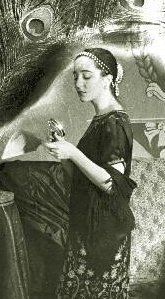
Mata Hari

Mata Hari (Photo credit: Wikipedia)

In 1903 she decided to change her life. She moved to Paris and under the name “Lady MacLeod” she performed as a circus horse rider, a dancer and an artist’s model. The Orientalism movement in dance was sweeping Europe and her exotic/erotic style and Java inspired dancing became a hit. The website  Mata Hari.com quotes Russell Warren Howe’s book to describe the dance…

…(the) diaphanous shawls she wore as the dance began were cast away to tempt the god until finally…the sarong was abandoned and her silhouette, with her back to the audience, writhed with desire toward her supernatural lover. … All passion spent, she touched her brow to Siva’s feet; one of the attendant dancers tiptoed delicately forward and threw a gold lamé cloth across the kneeling figure, enabling her to rise and take the applause.”

He goes on to say that  her overnight success “was pivotal in elevating the striptease to an art form.” She took her act on the road and danced at all the European hot spots and capitals. She was a master of illusion in that she did a striptease without stripping all the way down. She wore a body stocking that matched her own skin color and she never took off her bejeweled bra (which she padded.) She dropped the moniker of “Lady MacLeod” and went as “Mata Hari”  reinventing herself as a daughter of Indian temple dancer, raised in the temple of Siva. She became a courtesan and developed relationships  with wealthy, powerful men.  She had always loved “a man in uniform” and now she had lovers of the highest rank.

The Netherlands remained neutral during WWI so she had access to both Germany and France. According to FirstWorldWar.com :

It was said that while in The Hague in 1916 she was offered cash by a German consul for information obtained on her next visit to France.  Indeed, Mata Hari admitted she had passed old, outdated information to a German intelligence officer when later interrogated by the French intelligence service.

Mata Hari herself claimed she had been paid to act as a French spy in Belgium (then occupied by German forces), although she had neglected to inform her French spymasters of her prior arrangement with the German consul.  She was, it seemed, a double agent, if a not very successful one.

While traveling in France she was arrested in Paris on February 13, 1917. She was held Saint-Lazare prison and interrogated on charges of espionage. She maintained her innocence.  The trail was held on July 24 & 25. She was found guilty  and sentenced to death. On October 15, 1917 she refused a blind fold and faced her execution squad. She blew them a kiss just before the fired.

The Execution of Mata Hari in 1917. http://www...

The Execution of Mata Hari in 1917. Probably a reconstruction for the movie of 1920. (Photo credit: Wikipedia)


Thought of the Day 8.6.12 M. Night Shyamalan

“I like to write in a shroud of secrecy because I have to keep finding ways to scare myself.”

–M. Night Shyamalan

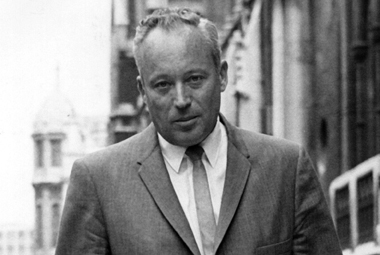
M. Night Shyamalan

M. Night Shyamalan (Photo credit: Wikipedia)

Manoj Shyamalan was born on this day in Mahe, Pondicherry, India in 1970. Today is his 42nd birthday.

His parents lived in the US prior to his birth, but his mother traveled back to India to be with her parents for the last few months of her pregnancy. She came back to the states with the baby when he was 6 weeks old. He was raised outside of Philadelphia, Pennsylvania. He was given a Super 8 camera as a kid and began making home movies starring himself, his friends and his toys.  While attending New York University’s Tisch School of the Arts he added “Night” as his middle name. He also finished his first  feature film, Praying with Anger. The film roughly echoed his own experiences on a visit to India and deals with cultural tensions and family secrets.

Miramax optioned Wide Awake which Shyamalan directed and shot in Pennsylvania (his location of choice.) Then he penned the script for Stuart Little.


Cover of "The Sixth Sense (Collector's Ed...

Cover via Amazon

His big break came with The Sixth Sense. [No spoilers here, all I’ll say is… if you haven’t seen this tight, dramatic, ghost story rent it now. It is part 1 of the  M. Night trifecta ] The movie was filmed in Philadelphia and starred Bruce Willis and Haley Joel Osment. Shyamalan  again directed. And it received Academy Award nominations for Best Picture and Best Director.

He added Producer credit to the list with 2000’s Unbreakable. The film tapped Willis as star again, this time partnering him with Samuel L. Jackson.   More superhero than supernatural this film did well at the box office, but didn’t deliver the punch of its predessor.


Mel Gibson and Joaquin Phoenix starred in Signs a sci-fi, alien invasion thriller. [It is  part 2 of the M. Night trifecta so add this to your queue as well.]


Cover of "The Village (Full Screen Editio...

Cover via Amazon

The Village shifts the action to an idealistic 19th century farming village. There’s just one problem, the surrounding woods are populated by huge clawed monsters. As long as the villagers keep inside set boundaries and don’t wear red (red is a bad color and attracts the monsters) all is well. But this is an M. Night Shyamalan film… nothing ever stays all well.  The Village did not achieve the audience or critical favor that Sixth Sense or Signs enjoyed. [But I really like it. So it’s my number 3 pick for the trifecta. ]

He based The Lady in the Water with Bryce Dallas Howard and Paul Giamatti on a story he told his kid. During filming of Lady he had a break with Disney films. Warner Bros. picked up the picture, but it lost money.

The writer/director returned to his horror roots with The Happening starring  Mark Walhberg and Zoey Deschanel .

In 2010 He made The Last Airbender  based on Nickelodeon’s Avatar: The Last Airbender. The show received very poor reviews, but has done well internationally. He also wrote and produced Devil, a story about people stuck on an elevator with the Devil in disguise.

He is currently in post-production for After Earth, a science fiction thriller staring Jaden Smith.

Shyamalan’s latest project takes him to the television’s cable network Syfy where it has just been announced that he will work with producer Marti Noxon  (of Buffy the Vampire Slayer fame) on of a scripted series called Proof. According to a press release for the show:

In Proof, after the tragic accident and sudden death of his parents, the son of a billionaire tech genius offers a large reward for anyone who can find proof of life after death,

Shyamalan will direct the pilot which he and Noxon will co-write .


Thought of the Day 8.5.12 Neil Armstrong

—————————————UPDATE—————————————

Sadly I have to give an update to this post.

One of America’s greatest heros, Neil Armstrong, passed away today due to complications from cardiovascular procedures. He had  heart surgery last month in Cincinnati, Ohio.

“Looking back, we were really very privileged to live in that thin slice of history where we changed how man looks at himself and what he might become and where he might go,” Armstrong said.

—————————————UPDATE—————————————

“I believe every human has a finite number of heartbeats. I don’t intend to waste any of mine”

–Neil Armstrong

Neil A. Armstrong was born on this day in Wapakoneta, Ohio, in 1930. He is 82 years old.

He grew up near the local airport and took flying lessons as a teenager. He got his pilots license before he got his driver’s license.

Armstrong was a naval aviator for three years, flying 78 combat missions during the Korean War,  prior to joining the National Advisory Committee of Aeronautics (NACA) in 1955. (The NACA was the precursor to NASA.) He  logged over 2,400 hours of air time testing experimental aircraft at Edwards Airforce Base.

According to the NASA’s Glenn Research Center web site:

He has flown over 200 different models of aircraft, including jets, rockets, helicopters and gliders.

In 1962 Armstrong became one of the “New Nine” NASA astronauts, the second group of men selected for US space flight to augment the Mercury 7. The Mercury astronauts established orbital space flight, the New Nine would fly in Gemini space capsules and would tackle docking two vehicles in space and space walks.

English: Close-up on orbiting Agena D rocket s...

English: Close-up on orbiting Agena D rocket stage Polski: Zbliżenie orbitującego członu rakietowego Agena D (Photo credit: Wikipedia)

On his historic Gemini 8 mission Armstrong and Dave Scott successfully docked their ship with an unmanned Agena target vehicle. It was an essential first step  towards getting to the moon. Unfortunately about 27 minutes after docking the two ships began to roll and yaw. Assuming the problem was with the Agena, Armstrong undocked, but it was a faulty thruster on the Gemini that was making the capsule spin, and undocking only exacerbated the problem. Armstrong and Scott had to shut down Gemini’s main reaction control system and use the reentry thrusters to zero out yaw and roll on the wildly spinning craft. Armstrong’s masterful flying skills were successful, but they used up 75% of the system’s fuel and Mission Control cut short the flight.

On the Gemini 11 flight he acted as CAPCOM — the person at Ground Control who interfaces with the astronauts in space — and he was the commander of the back-up crew for Apollo 8 (the first human space flight to leave Earth’s orbit, fly to the moon — but not land — and return to Earth.)

Flag of the United States on American astronau...

Flag of the United States on American astronaut Neil Armstrong’s space suit (Photo credit: Wikipedia)

Armstrong was the Commander of Apollo 11, the first manned space craft to land on the Moon. He accompanied by Michael Collins, who stayed aloft in the Command Module, and Edwin “Buzz” Aldrin, Jr. who touched down on the Moon’s surface on July 20, 1969 with with Armstrong. Armstrong descended a lader and took the first steps on the lunar surface. Armstrong and Aldrin had about 2 hours outside the lander, the Eagle,  to take photographs, set up experiments and collect moon rocks. The Eagle blasted off from the Sea of Tranquility and  Armstrong and Aldrin rejoined Collins on the Command Module, Columbia.

The reverse of the Anthony dollar is based upo...

The reverse of the Anthony dollar is based upon the insignia of the Apollo 11 mission, which was also used on the reverse of the Eisenhower dollar that preceded it. (Photo credit: Wikipedia)

He worked for NASA as Deputy Associate Administrator for aeronautics until 1971.

Post NASA he taught and did research as a professor of aerospace engineering at University of Cincinnati and served as the chairman of the board for several privately owned aerospace/defense industries.

Buzz Aldrin walks on the moon, July 20, 1969

Buzz Aldrin walks on the moon, July 20, 1969. The photo was taken by Armstrong. (Photo credit: Wikipedia)

[Please note that I did not say Armstrong was the first man to LAND on the moon. Both Aldrin and Armstrong landed on the Moon at the same time.  … Armstrong was the first man to WALK on the Moon.]


Thought of the Day 8.4.12 Louis Armstrong

“I got a simple rule about everybody. If you don’t treat me right / shame on you!”

–Louis Armstrong

Louis Armstrong

Louis Armstrong (Photo credit: late night movie)

Louis “Satchmo” Armstrong was born this day in New Orleans, Louisiana in 1901. Today would be his 111th birthday.

The grandson of slaves, his family was very poor. His father, William Armstrong, abandoned the family when Louis was a baby. His mother, Mayann often turned to prostitution to make ends meet and she left Louis and his little sister Beatrice with their grandmother Josephine Armstrong. The little boy did what he could to earn money. He worked as a  paper boy. He hauled coal to the red-light district — and lingered around the clubs to listen to the music. In 1907 he sang in a street quartet for change.  He did odd jobs for the Karnofsky family, a Lithuanian-Jewish family who took him in and treated him well. The Karnofskys lent Armstrong the money buy his first cornet.

b/w line drawing of cornet

b/w line drawing of cornet (Photo credit: Wikipedia)

When he was 11 years old he was sent to the New Orleans Home for Colored Waifs, a reform school, for firing his a pistol into the air on New Year’s Eve. While at the home Armstrong really learned to play the cornet (he had been self taught and could play by ear prior to the lessons he had at the home).

He was released from the home at 14. He worked hauling coal and unloading barges during the day and brought out his horn at night. He went to honky tonk clubs like “the Funky Butt Hall” to listen to established musicians and learn from them. Joe “King” Oliver mentored the young man. By 17 he was playing professionally.

By the 1920’s he was playing on riverboats and traveled up to St. Louis. His jazz trumpet solos and vocals became his signature style. In 1922 “King” Oliver invited him to join his Creole Jazz Band in Chicago. The money was good enough that Armstrong no longer had to work the menial labor day jobs to make ends meet. By 1925 he was headlining his own band and playing with artist like Bessie Smith and Ma Rainey. He was billed as “The World’s Greatest Jazz Cornetist” for a gig at the Dreamland Cafe, and cut his debut record with his own group Louis Armstrong and His Hot Five. By the 1930s his act had gone international.

[Portrait of Louis Armstrong, Carnegie Hall, N...

[Portrait of Louis Armstrong, Carnegie Hall, New York, N.Y., ca. Apr. 1947] (LOC) (Photo credit: The Library of Congress)

According to the Louis Armstrong House Museum Site he:

  • developed a way of playing jazz, as an instrumentalist and a vocalist, which has had an impact on all musicians to follow;
  • recorded hit songs for five decades, and his music is still heard today on television and radio and in films;
  • wrote two autobiographies, more than ten magazine articles, hundreds of pages of memoirs, and thousands of letters;
  • appeared in more than thirty films (over twenty were full-length features) as a gifted actor with superb comic timing and an unabashed joy of life;
  • composed dozens of songs that have become jazz standards;
  • performed an average of 300 concerts each year, with his frequent tours to all parts of the world earning him the nickname “Ambassador Satch,” and became one of the first great celebrities of the twentieth century.

Here’s Louis Armstrong (Trumpet), Trummy Young (Trombone), Peanuts Hucko (Clarinet), Billy Kyle (Piano), Mort Herbert (Bass), and Danny Barcelona (Drums) in Stutttgart Germany in 1959.

[note to self: MUST sing more jazz so I can play in a band with some one named Trummy and Peanuts.]


Thought of the Day 8.3.12 Leon Uris

“Often we have no time for our friends but all the time in the world for our enemies.”

–Leon Uris

Leon Marcus Uris was born on this day in Baltimore, Maryland in 1924. This is the 88th anniversary of his birth.

Son of Polish and Russian Jewish immigrants Leon went to schools in Baltimore, Norfolk and Philadelphia. He failed English three times, but he loved History and Literature. He allegedly wrote an operetta about the death of his dog when he was only six years old.

When the Japanese attacked Pearl Harbor on December 7, 1941 Uris dropped out of high school and enlisted in the Marine Corps. He served from 1942 to 1945 in the South Pacific. He  was a radio operator  and saw combat at Guadalcanal and Tarawa. When he contracted malaria he was sent to San Francisco to recuperate. There he met his first wife Marine sergeant Betty Beck.

1st edition cover Pages: 694 pp (Mass Market P...

1st edition cover Pages: 694 pp (Mass Market Paperback) (G.P. Putnam’s Sons) (Photo credit: Wikipedia)

After his discharge from the service he worked  for the San Francisco Call-Bulletin and wrote fiction in his spare time. His first book, Battle Cry,  retold his war experiences. Published in 1953 ,and made into a movie by Warner Brothers with Uris as screen writer, the film did well at the box office.

His second novel also took place during WWII, but this time in the European Theatre. The Angry Hills is about Greek resistance fighters.  It too was made into a movie, this one starring Robert Mitchum.

Research Uris did for The Angry Hills and his time  as a war correspondent during Arab-Israeli fighting in 1956  lead to most his most successful novel, Exodus. Published in 1958 the book is the result of  thousands of interviews. Uris traveled 12,000 miles in Israel and read hundreds of books on Jewish history. Doubleday bought the book which out sold Gone with the Wind, becoming the biggest bestseller in the United States. It was translated into 50  languages. A blockbuster movie starring Paul Newman came out in 1960.

Mila 18 is about Jewish resistance fighters during the Warsaw uprising. Armageddon: A Novel of Berlin is about the complications of the Cold War during and after and the Berlin Airlift. Topaz, a spy story, has the Cuban Missile Crisis and the Cold War in its cross hairs. Alfred Hitchcock  directed it for the big screen.  QBVII  is a courtroom drama about a doctor who was pressed into service in a Nazi concentration camp.  It was made into a mini series starring Anthony Hopkins in 1974.

In Trinity Uris tacked the troubles in Ireland, following the lives of several families from the potato famine to the Easter Uprising. Redemption, written two decades later follows up on the Irish story.

The Haj delves again into the troubled Middle East. The Milta Pass is about the Suez Crisis.

A God in Runs takes on the American political scene when Quinn Patrick O’Connell runs for president. His last novel, O’Hara’s Choice, was published posthumously, and was not well received.

Non fiction works include: Ireland: A terrible Beauty and Jerusalem: Song of Songs both include photographs by his with Jill Uris.

More on Leon Uris try this site: http://www.kirjasto.sci.fi/uris.htm


Thought of the Day 8.2.12 L’Enfant

Pierre Charles L'Enfant

Pierre Charles L’Enfant (Photo credit: Wikipedia)

Pierre Charles L’Enfant was born on this day in 1754 at Anet, Eure et Loir, France. Today is the 258th anniversary of his birth.

L’Enfant was educated at the Royal Academy in Paris as an engineer before joining Lafayette  to help the American side during the War of Independence. He arrived in 1777 at the age of 23 and fought as military engineer. He joined George Washington’s staff  after recovering from injuries at the Siege of Savannah. He attainted the rank of Major of Engineers in 1783.

He moved to New York after the war and established a civil engineering firm. In 1788 he redesigned the  New York’s city hall to be the United States’ first capitol building, Federal Hall.  The building was the site of George Washington’s inauguration and where the Bill of Rights was signed.

Federal Hall, Seat of Congress 1790
hand-colored engraving by Amos Doolittle, depicting Washington’s April 30, 1789 inauguration. [Image Courtesy Wikimedia Commons: public domain]

In 1791 the US Congress authorized the building of a capital city on the Potomac River. George Washington appointed his old friend L’Enfant  to design the new city in 1791.

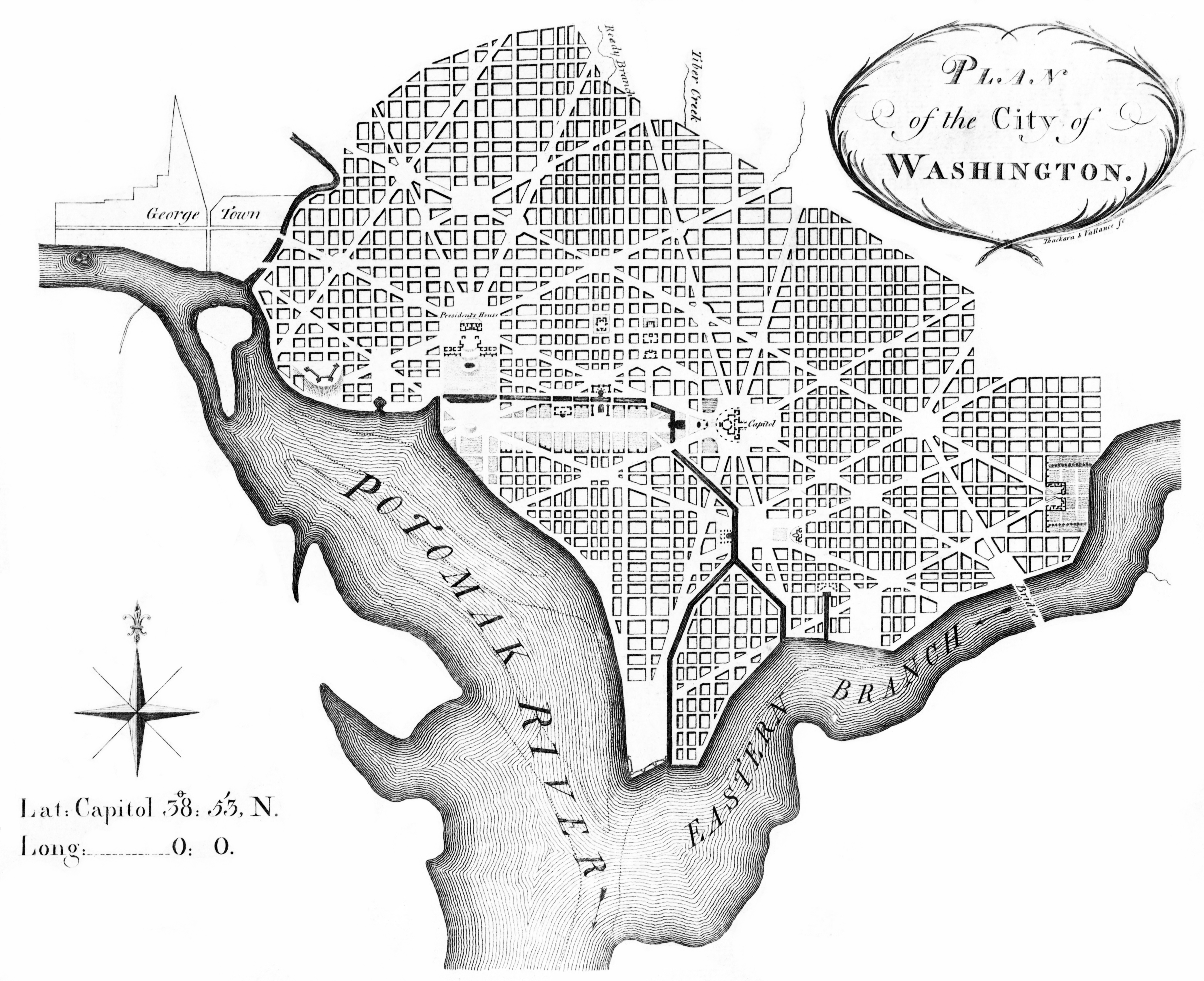
L’Enfant’s “Plan of the city of Washington” March 1792 is at the Library of Congress. [Image courtesy Wikimedia Commons. This image is in the Public Domain.]

“Congress House” (the Capitol) was to be on top a hill, a place of honor overlooking the rest of the city.  The “President’s House” (the White House) was to be a grand mansion fit for the leader of the country. His plan outlined the need for public spaces including a grand public walk (today’s National Mall) ). It would be 1 mile long and 400 feet wide and would stretch from the Capitol to an equestrian statue of Washington (the Washington Monument is now where the statue would have been).

The western front of the United States Capitol...

The western front of the United States Capitol. The Capitol serves as the seat of government for the United States Congress, the legislative branch of the U.S. federal government. It is located in Washington, D.C., on top of Capitol Hill at the east end of the National Mall. The building is marked by its central dome above a rotunda and two wings. It is an exemplar of the Neoclassical architecture style. (Photo credit: Wikipedia)

According to “A Brief History fo Pierre L’Enfant and Washington, D.C.”:

L’Enfant placed Congress on a high point with a commanding view of the Potomac, instead of reserving the grandest spot for the leader’s palace as was customary in Europe. Capitol Hill became the center of the city from which diagonal avenues named after the states radiated, cutting across a grid street system. These wide boulevards allowed for easy transportation across town and offered views of important buildings and common squares from great distances. Public squares and parks were evenly dispersed at intersections.

Wide avenues and public squares would make it “people’s city”, while monuments  and inspiring buildings would give it the stature and importance of world capital.

While he was concerned with the grand vision of the city  his bosses on the Congressional appointed committee were concerned with how much the project was going to cost . They  wanted to keep the wealthy plantation owners in the area happy. L’Enfant “delayed producing a map for the sale of city lots (fearing real estate speculators would buy up land and leave the city vacant).” And he angered the commission when he had a prominent resident’s house torn down because it was in the way of one his boulevards.  When the city’s surveyor went behind his back and produced a lot map L’Enfant resigned. He was never properly paid for the work he did on the Capital.

The city was built, but the design had been greatly altered. Gone were the arrow straight streets and parkways. The Mall between the Capitol and the White House was a tree-covered park of irregular shape. Cows grazed on it.

Visitors ridiculed the city for its idealistic pretensions in a bumpkin setting and there was even talk after the Civil War of moving the capital to Philadelphia or the Midwest.

But in 1901 the McMillan Commission resurrected L’Enfant’s ideas and updated them for a modern city. The Mall was reclaimed, cleared and lined with American Elm trees. Memorials to Lincoln and Jefferson were added, and Museums and government buildings lined the perimeter.

L’Enfant worked on commissions

after the Capital, but non were very successful. His design for Philadelphia millionaire Robert Morris’ mansion was called Morris’ Folly. His final years were spent at the home of his friend William Dudley Digges, near Bladensburg, Maryland. He was buried there, but his body was exhumed and reinterred at Arlington National Cemetery with full military honors. His tomb now overlooks the city he helped design.

Tomb of Pierre Charles L'Enfant, designer of W...

Tomb of Pierre Charles L’Enfant, designer of Washington, D.C.’s original city plan, on the grounds of Arlington House (the Robert E. Lee Memorial) at Arlington National Cemetery in Arlington, Virginia, in the United States. (Photo credit: Wikipedia)


Thought of the Day 8.1.12 Herman Melville

“To the last, I grapple with thee; From Hell’s heart, I stab at thee; For hate’s sake, I spit my last breath at thee”

–Herman Melville


Photo of Herman Melville

Photo of Herman Melville (Photo credit: Wikipedia)

Herman Melvill was born this day on 1819 in New York City. Today is the 193 Anniversary of his birth.

He was the third of eight children. He grew up in Boston and Albany.  His father, Allan Melvill, was a successful merchant and the family lived comfortably for several years until an unsuccessful trading venture led to financial ruin. The elder Melvill sparked Herman’s love for adventure and the sea with stores of seafaring excitement and faraway places. Herman was 12 when his father died and the family moved to Lansingburg on the Hudson. It was then that his mother added the “e” to the end of the family name, and Melvill became Melville.

He got a job on a ship bound from New York to Liverpool as a cabin boy.  After several years as a teacher he heard the call of the sea again. In 1840 he signed on with the Acushnet from Fairhaven, Massachusetts. The ship left port for an 18 month journey in Pacific journey in January of 1841.  The Acushnet was a whaler and much of his material for Moby-Dick came from his time on board the ship. By the time they reached the Marquesas Islands in July of 1842 Melville had had enough of life on the Acushnet.

He deserted the ship and lived among the Typee tribe for three weeks. He then joined the crew of another whaler, this one, an  Australian ship called the Lucy Ann, was bound for Tahiti. Melville participated in a mutiny and landed in jail. Upon his release he signed up with yet another whaler and made it as far as Honolulu where he jumped ship again. He worked as a clerk until he was able to sign on with the USS United States which got him back to Boston in 1844. There Melville began to write about his adventures.

Cover of "Typee (Signet classics)"

Cover of Typee (Signet classics)

Typee is a quasi-autobiographical adventure novel about Tommo’s four month stay on a tropical paradise amidst the “nobel savages” (or cannibals) who may or may not be about to eat him,  and his relationship with the beautiful, and exotic, Faraway. He had trouble fining an American publisher, but the book was an overnight success when it was published in England. Omoo, continued the tale, again roughly following Melville’s adventures in the Pacific. Mardi, and a Voyage Thither showed a more sophisticated writing style. It was not a successful as the straight forward narratives of Typee and Omoo. In 1849 He published Redburn : His First Voyage, the fictionalized account of his first sea journey  as a cabin boy. In 1850 White-Jacket, based on his time as a seaman on the USS United States, was published. Because of its graphic depiction’s of flogging the U.S. Navy banned the punishment.

Sadly at this point the tides seem to have turned in his literary career. His popularity waned. Other books didn’t garner critical or popular acclaim in his lifetime. The Confidence-Man, Pierre, Billy Budd, and even Moby-Dick had to wait until a Melville revival, some 30 years after his death, to get their rightful praise.

Herman Melville: Moby-Dick

Herman Melville: Moby-Dick (Photo credit: wolfgraebel)

Melville went on the lecture circuit to supplement his writing income. He then moved his family to New York City and worked at the New York Custom House. He continued to write, working on both poetry and fiction, until his death.

http://www.online-literature.com/melville/

http://en.wikipedia.org/wiki/Herman_Melville