Category Archives: United States

Thought of the Day 10.30.12 John Adams PART TWO

John Adams [PART TWO] [Click here to read PART ONE]

“If we do not lay out ourselves in the service of mankind, whom should we serve?”
–John Adams

John Adams, ca 1816, by Samuel F.B. Morse (Bro...

John Adams, ca 1816, by Samuel F.B. Morse (Brooklyn Museum) (Photo credit: Wikipedia)

In 1777 Adams was dispatched to Europe as Ambassador to France. Unfortunately he didn’t speak French, (and his background as a New England farmer’s son left him a little adrift in the powdered wig-ed drawing rooms of the French court.)

The Hague to obtain a much needed loan and to open commerce. In 1781, together with Franklin, John Jay, and Henry Laurens, Adams was part of the commission of American diplomats that negotiated the Treaty of Paris, the pact that brought an end to the War of Independence. [Miller Center.org]

After the war he was the first US minister to England.

In 1787 He wrote Defence of the Constitutions of Government of the United States of America, that called for a strong Executive branch that would act as “father and protector” of the nation.

He expanded on this theme in a series of essays for a Philadelphia newspaper that were ultimately known as “Discourses on Davila.” Many contemporaries mistakenly believed that they advocated a hereditary monarchy for the United States.[Ibid]

After  ten years in Europe he came back to America in 1788. He was elected Vice President (under George Washington) the next year. He faithfully served as Washington’s Vice President for eight years, a job he describe as “the most insignificant office that ever the invention of man contrived or his imagination conceived.”[Thinkexist.com]

John Adams, ca.1788, by Mather Brown.

When Washington announced that he would retire after his second term the first contested American Presidential election took place. It was four man race with the Federalist nominating Adams and Thomas Pinckney of  South Carolina, and the Democratic-Republicans nominating Thomas Jefferson and Aaron Burr. Jefferson was labeled a Francophile, a coward and an atheist. “Adams was portrayed as a monarchist and an Anglophile who was secretly bent on establishing a family dynasty by having his son succeed him as President.”  [Miller Center.org]  Adams won  by three votes; Jefferson came in second, making him Vice President.

When Adams became President, the war between the French and British was causing great difficulties for the United States on the high seas and intense partisanship among contending factions within the Nation. [Our Presidents/2.John Adams. whitehouse.gov.]

Adams sent commissioners to France, but Paris refused to meet with them unless they paid a bribe. “Adams reported the insult to Congress, and the Senate printed the correspondence, in which the Frenchmen were referred to only as “X, Y, and Z.”” [Ibid] The X,Y,Z affair increased Adam’s and the Federalist’s popularity.  Congress passed the Alien and Sedition act and  funded three new frigates for the navy.

President Adams did not call for a declaration of war, but hostilities began at sea. At first, American shipping was almost defenseless against French privateers, but by 1800 armed merchantmen and U.S. warships were clearing the sea-lanes. [Ibid]

The US had some spectacular victories at sea and France sent word that it would now receive an envoy (this time without a bribe). Negotiations ensued and the quasi war ended.  But by sending an envoy to France to sue for peace the Adams Administration infuriated the Democratic-Republicans. The Federalist were weakened. Washington’s death in 1799 hurt the party even more. In the 1800 Election Jefferson won the electoral vote  by 8 votes.

Just before he left the office of Presidency, Adams arrived at the new Capital City (now Washington DC)

to take up his residence in the White House. On his second evening in its damp, unfinished rooms, he wrote his wife, “Before I end my letter, I pray Heaven to bestow the best of Blessings on this House and all that shall hereafter inhabit it. May none but honest and wise Men ever rule under this roof.” [Ibid]

In retirement he moved back to Massachusetts to his farm at Peacefield. He did not attend Jefferson’s inauguration (Adam’s son Charles had just died and he was anxious to get home).

English: One of the last letters between forme...

English: One of the last letters between former President Thomas Jefferson and Abigail Adams, wife of former President John Adams. Written by Jefferson at Monticello, his Virginia home, 15 May 1817. The Thomas Jefferson Papers, Series 1, General Correspondence, The Library of Congress, Washington, D. C. (Photo credit: Wikipedia)

Charles’s widow, Sally, and her young daughters moved in with John and Abigail, filling the house with laughter and life. For five years, John Quincy’s son lived there as well while his parents were abroad on public service. The family of Thomas Adams, another son, also lived nearby.[Miller Center.org]

The farm was a lively and happy place. John Quincy was a frequent visitor as he sought his father’s advice on matters “that ranged from diplomatic to elected office and culminated in his election as President in 1824.” [Ibid]

John Adams wrote his biography (which he did not complete) in which he addressed everything “from the nature of his manure piles at the farm to history and political philosophy.” [Ibid] In 1812 He and Jefferson renewed their friendship through an exchange of letters that lasted for 14 years. The two men died on the same day, July 4th 1826.

"The original sketch of Mr. Adams, taken ...

“The original sketch of Mr. Adams, taken when dying by A.J.S. in the Rotunda of the Capitol at Washington” “Sketch showing head of John Q. Adams as he lay unconscious in the Rotunda after suffering a stroke.” (Photo credit: Wikipedia)


Thought of the Day 10.30.12 John Adams (PART ONE)

“Let us tenderly and kindly cherish, therefore, the means of knowledge. Let us dare to read, think, speak, and write.”
John Adams

President of the Senate John Adams

President of the Senate John Adams (Photo credit: Wikipedia)
John Adams was born on this day in Braintree, Massachusetts Bay Colony, USA in 1735. Today is the 275th anniversary of his birth.

His ancestors came over on the Mayflower. His father was a farmer, shoemaker, a Puritan deacon, a lieutenant in the militia and a member of town council.  John loved being outdoors and he sometimes skipped school to hunt or fish.

He said later that he would have preferred a life as a farmer, but his father insisted that he receive a formal education. His father hoped that he might become a clergyman. John attended a dame school, a local school taught by a female teacher that was designed to teach the rudimentary skills of reading and writing, followed by a Latin school, a preparatory school for those who planned to attend college. He eventually excelled at his studies and entered Harvard College at age fifteen. He graduated in 1755. [Miller Center.org]

After graduation he taught school for a time to earn enough money to study law.  In 1756 he began a two-year apprenticeship studying law with John Putnam  and was admitted to the bar  at 26. He opened his practice in 1758, but things were slow going at first. He had only one case in his first year of practicing law which he lost.

Abigail Adams by Benjamin Blythe, 1766

Abigail Adams by Benjamin Blythe, 1766 (Photo credit: Wikipedia)
His Law practice began to grow and he felt he was on sturdy enough financial ground to begin courting Abigail Smith. They married in 1764. John and Abigail Adams had six children together (including John Quincy Adams [click HERE for my John Quincy bioBlog ] and one of American History’s most endearing relationships.

“He early became identified with the patriot cause.” [Our Presidents/2.John Adams. whitehouse.gov.]  He gained a reputation by opposing the Stamp Act 1765 that same year he published an article “Essay on the Canon and Feudal Law.” 

When the Incident on King Street (aka the Boston Massacre) resulted in the death of five civilians in March of 1770 Adams defended the eight British soldiers and Captain Preston, the lone officer, charged with the crime. It was important that the soldiers receive a fair trail so the Crown would not have grounds for retaliation. Adams, with his Patriot pedigree and commitment to the letter of the law, was the perfect man for the job. His impassioned speech that “Facts are stubborn things; and whatever may be our wishes, our inclinations, or the dictates of our passion, they cannot alter the state of facts and evidence.”[Quotes.net] saved the men’s lives. (Sam Adams was on the prosecuting team).

He was elected to the Massachusetts Assembly in 1770, and was chosen one of five to represent the colony at the First Continental Congress in 1774. [Signers of the Declaration of Independence. US History.org]

While his flashier (and more popular) cousin Samuel Adams rallied/roused crowds in the square, John worked in the courts, taking a more measured approach to American equality.

He was reelected to the Second Continental Congress, … in May 1775, just a few days after war … erupted at Lexington and Concord. When Congress created the Continental army in June 1775, Adams nominated George Washington… to be its commander. Adams soon emerged as the leader of the faction in Congress that pushed to declare independence. . [Miller Center.org]

In June of 1776 the Continental Congress appointed Adams, Thomas Jefferson, Benjamin Franklin, Roger Sherman and Robert Livingston to the Committee of Five to draft a Declaration of Independence. “A Declaration by the Representatives of the United States of America, in General Congress assembled” was presented on June 28th. After much debate (especially about the slavery issue) the Declaration was adopted late in the morning of July 4th 1776.

John Adams, Second President (1797-1801)

John Adams  (Photo credit: cliff1066™)

Adams wrote a pamphlet detailing his Thoughts on Government. In it he advised that the new Continental government be one which benefited the happiness and virtue of the greatest number of people (not one that benefited the knighted few or the King). He advocated  a government with separate executive, judicial and legislative branches.

[Continued in PART TWO]


Thought of the Day 10.24.12 Kweisi Mfume

“And it really gets down to an issue of class. The poor and the poorest of the poor tend to be the ones that are being missed by the census,”
–Kweisi Mfume

Mfume delivering a speech at NOAA during Black...

Mfume delivering a speech at NOAA during Black History Month, 2005 (Photo credit: Wikipedia)
Frizzel Gerald Gray was born on this day in Tuner Station, Dundalk just outside of Baltimore, Maryland in 1948. He is 64 years old.

He is the oldest of four siblings. His father left the family when Gray was a 11 and his mother, Mary Elizabeth Gray, raised the children as best she could as a single mother. She died of cancer when he was 16.

“After she died of cancer, things spun out of control.” Mfume quit high school during his second year and went to work to help support his sisters. At times he worked as many as three different jobs in a single week.” [Kweisi Mfume Biography. Encyclopedia of the World Biography

He began to hang out on the corner drinking with friends to blow off steam. He admits to hanging with the wrong crowd. He could feel his life spiraling out of control as he was arrested on suspicion of theft “Because” he said in a U.S. News and World Report interview ” I happened to be black and happened to be young.” And soon found himself the teenaged parent of five children.

But on a July night in the late 60s all that changed. He felt something come over him and he stepped away from the corner and toward the future. He spent “the rest of the night in prayer, then proceeded to earn his high-school diploma and pursue a college degree.” [IBID] He changed his name to Kweisi Mfume, a phrase that means “conquering son of kings” in Ghana.

He began to work in radio, first as a volunteer than as an announcer. When his college, Morgan State University  opened its own radio station Mfume became the program director.
Flag of Baltimore, Maryland. Image created by ...

Flag of Baltimore, Maryland. Image created by uploader based on images found at crwflags.com and nava.org, as well as other images found on the web. (Photo credit: Wikipedia)
He parlayed his popularity on the Radio and in Baltimore’s African-American community into politics in 1978 when he ran for Baltimore City Council. There he became a vocal critic of Mayor William Donald Schaefer whom he accused  of ignoring poor neighborhoods. Eventually Mfume learned the three-pronged art of negotiation, compromise and coalition building.
DSC_0120

DSC_0120 (Photo credit: owillis)

In 1986 he ran for U.S. House of Representatives and won a seat in Congress. He worked on the House Committee on Banking, Finance and Urban Affairs and later on farming and zoning issues. He maintained a strong tie to Baltimore City and the residents that lived in the inner city.
By his fourth term, Mfume had enough influence to become chairman of the Congressional Black Caucus, a group in Congress that supports the interests of African-Americans. Soon after his election as chairman, Mfume and the Caucus presented a list of demands to President Bill Clinton (1946–), most of them having to do with federal aid to cities and the poor. [IBID]
In 1996 Mfume left Congress and became the president of the NAACP (the National Association for the Advancement of Colored People. He successfully managed the organization’s financial issues and illuminated the NAACP’s $4.5 million debt. He worked to address “affordable health care, conservation, voting reform, and hate crimes.” [IBID.] He helped raise over $90 million and created the NAACP’s National Corporate Diversity Project during his tenure at the organization. His term at the NAACP ended on January 1, 2005.
Kwesi Mfume, Fmr Prez of NAACP

Kwesi Mfume, Fmr Prez of NAACP (Photo credit: Youth Radio)

Mfume made an unsuccessful bid for a U.S. Senate seat. Although he remains active as a political supporter and organizer he has not run for public office since. Currently he serves on a number of boards of public and private institutions such as the National Advisory Council on Minority Health and Health Disparities, the Platform Committee of the Democratic National Convention and the National Advisory Council of Boy Scouts of America. He actively lectures at…
Colleges, Universities, Corporations, and Bar Associations across the country on corporate diversity, compliance, inclusion, disparities in health care, tolerance and the new challenges of gender and race. [kweisimfume.com]

Thought of the Day 10.20.12 Viggo Mortensen

“There’s no excuse to be bored. Sad, yes. Angry, yes. Depressed, yes. Crazy, yes. But there’s no excuse for boredom, ever.”
Viggo Mortensen

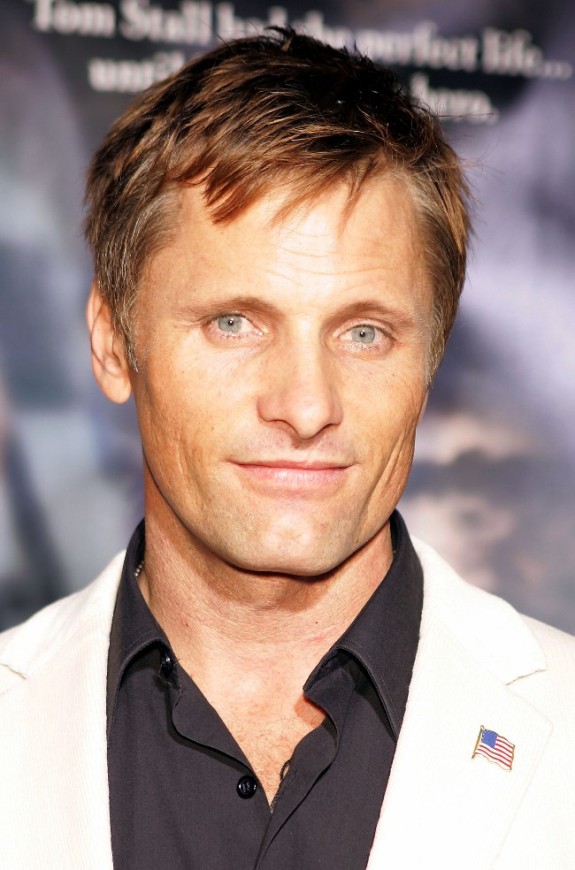
Viggo Mortensen was born on this day in New York City, New York, USA  in 1958. He is 54 years old.

His family lived in Venezuela, Denmark and Argentina where his father managed farms and ranches.   He learned to speak fluent Danish, Spanish and English growing up. His parents divorced when he was 11 and he moved with his mother back to New York. After graduating St. Lawrence University he moved to Europe and lived in Spain, England and Denmark making his way as a truck driver and flower seller. Eventually he returned to the US ready to try his hand at acting.

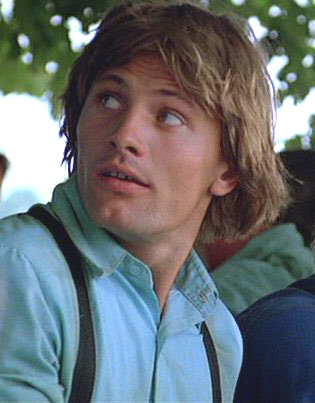
Viggo Mortensen in a still from Witness [Image courtesy: Brego.net]

He did some theatre then expanded to film. His footage in 1984’s Swing Shift and  Woody Allen’s The Purple Rose of Cairo ended up on the cutting room floor, but he had more luck in Peter Weir’s Witness. Mortensen played Moses Hochleitner, the younger brother to Alexander Godunov’s Daniel Hochleitner. He didn’t have a lot of lines in the Harrison Ford flick, but some how he stood out from the sea of blond-haired Amish men in blue shirts.

His next step was to Television where he was cast as Bragg on Search for Tomorrow [BRAGG, what a great soap opera name, right?]

In 1987 he played a crooked cop on Miami Vice. There was more theatre too, this time in LA’s Coast Playhouse’s production of Bent, for which he earned a Dramalogue Critics’ Award.

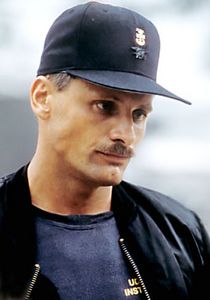
Movie still from G.I. Jane [Brego.net]

A splay of supporting roles in the 1990s saw him acting in some good movies (The Portrait of a Lady directed by Jane Campion) and some not so good movies (Leatherface: The Texas Chainsaw Massacre III)  Critics started to take notice when he starred opposite Demi Moore as brutal Master Chief John Urgayle in G.I. Jane (some critics said he stole the movie from Moore) and as the other man in A Walk on the Moon with Diane Lane. He played another ‘other’ man in A Perfect Murder, a reboot of Hitchcock’s Dial M for Murder with Michael Douglas and Gwyneth Paltrow. He was Eddie Boone, a major league baseball player with a trifecta of additions in rehab with Sandra Bullock in 28 Days. And rounded out the decade by playing the devil in The Prophecy.

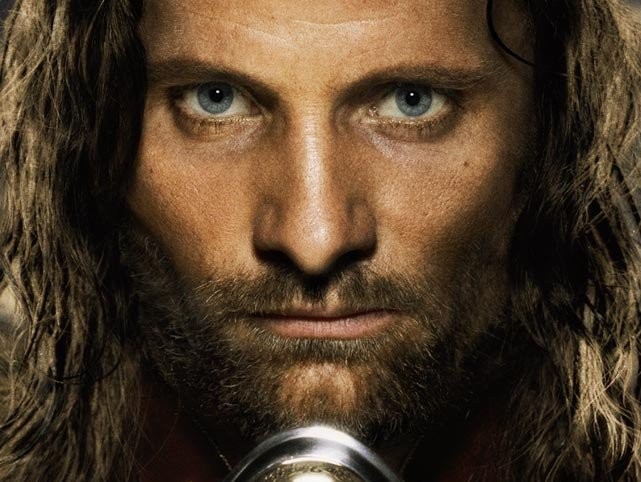
Movie poster from Lord of the Rings [Image courtesy: Beyond Hollywood.com]

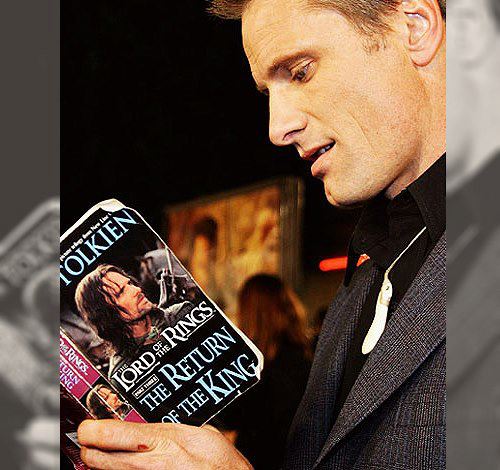
2001 saw the release of The Lord of the Rings: The Fellowship of the Rings, the first in Peter Jackson’s epic Tolkien cycle. With his role as the heroic Aragorn “Mortensen was established as a major leading man among Hollywood’s A-list ranks.” [Viggo Mortensen — Biography, Movies. yahoo.com The Two Towers followed in 2002 and The Return of the King premiered in 2003. He brought quiet strength, “commanding good looks”[ibid] and a rye sense of humor to Aragorn. He embraced the role whole heartedly. He did all his own stunts in the movies (and took quiet a few knocks in the process). He wore his sword and costume for days on end so they would have an authentic lived in look. And he became so attached to his equine co-stars, Uraeus and Kenny, that he purchased the horses after the film wrapped and took them home.

After his success in the Lord of the Rings Mortensen managed to keep himself centered…

Exceedingly humble about success and uncharacteristically un-Hollywood, Mortensen managed to stay somewhat reclusive and focused on other interests outside of acting, namely painting and writing poetry, despite becoming one of the most recognizable stars in the world. [Viggo Mortensen — Biography, Movies. yahoo.com ]

He used some of his earnings from playing Aragorn to start Perceval Press publishing house in Santa Monica, California.

Perceval Press is a small, independent publisher specializing in art, critical writing, and poetry. The intention of the press is to publish texts, images, and recordings that otherwise might not be presented. [Percival Press]

Mortensen’s own artistic, musical and written works are available through Perceval Press. He writes poetry, essays, and companion pieces for his paintings and photographic work in English, Spanish and Danish. Musically he has completed 16 albums, working almost exclusively with the guitarist Buckethead.

Back on the silver screen was Hidalgo in 2007.  It is the true story of American Frank T. Hopkins who participation in a 3,000-mile race across the Najd desert called the “Ocean of Fire”.

He gave “his most compelling and carefully drawn performance to date” [ibid] as an everyday man who’s violent past catches up to him in A History of Violence a film directed by David Cronenberg. He worked with Cronenberg again in 2007 for Eastern Promises, where he played a Russian gangster. He was nominated for an Academy Award for his role in the film.

In 2008 he was Ed Harris’ sidekick in the Western Appaloosa. He also starred in Good which takes place in the 1930s. Mortensen is a professor struggling to decide if he should join the Nazi party.

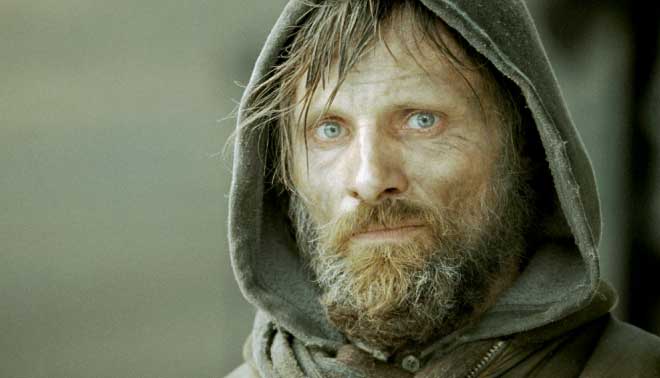
Movie still from The Road. [Image courtesy: Wired.com]

The grim Cormac McCarthy novel was the basis for Mortensen’s next movie, The Road. It is a post-apocalyptic story of a father and son trying to survive in a bleak wasteland.

Once again teaming up with Cronenberg, Mortensen plays Dr. Sigmund Freud in his the 2011 film,  A Dangerous Method.

Coming up Mortensen has several film ready for release including: On The Road and Everybody Has a Plan; and in 2013 The Faces of January and The Last Voyage of Demeter.

Publicity shot. [Image courtesy: TheReelist]

Found this on Facebook and had to share.


Thought of the Day John Lennon

PROGRAMMING NOTE: Switching up the formula a little today as it is NOT John Lennon’s Birthday — that was October 9th — but I was away that day, so I thought I’d retroactively give John the birthday nod.
———————————————————————–

“If someone thinks that love and peace is a cliché that must have been left behind in the Sixties, that’s his problem. Love and peace are eternal.”
— John Lennon

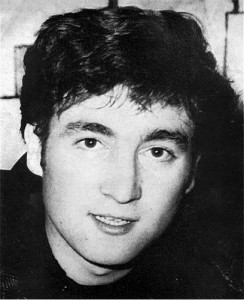
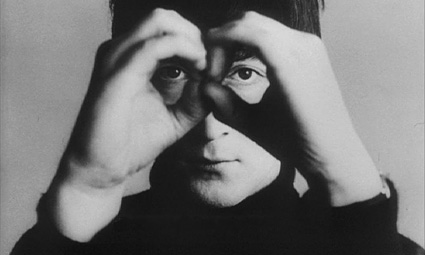
John Winston Lennon was born on October 9th, 1940 in Liverpool, England. He would be 72 years old this year.

John was born during World War II, indeed he was born during an air raid, to Julia and Alfred Lennon. His father worked as a merchant seaman and was often away from home. By the time John was four-years-old his parents were divorced and he went to live with his Aunt Mimi Smith. Although Alfred was largely out of the picture, Julia remained close, she visited John regularly.

She taught John how to play the banjo and the piano and purchased his first guitar. [biography.com]

Julia Lennon died when John was 18, she was stuck by a car.

He did not do well in school, and preferred to be the class clown rather than study. He did love art and music though. John drew unique (almost grotesque) line drawings that quickly and simply captured the image.

John started a ‘skiffle band’ (a band that used the instruments they had at hand) called the Quarry Men when he was 16. The Quarry Men take their name from John’s high school, Quarry Bank High School in Liverpool. The next year he asked Paul McCartney to join the group.  George Harrison and Lennon’s art school mate Stu Sutcliffe also joined the band and they later added Pete Best on drums.

John at the Cavern Club [Image courtesy: Join the Cavern Club]

The group changed their name to the Beatles and played clubs in Hamburg, Germany and the Cavern Club in Liverpool. Brian Epstein came on board in 1961 as manager, and they got a recording contract with EMI records.

1962 saw huge changes for both Lennon and  the group.  In April of 1962 Sutcliffe died tragically of a brain aneurysm. In August John married Cynthia Powell, the couple had a son, Julian in April the next year. The band replaced drummer Pete Best with Ringo Starr. The realigned group recorded  at EMI with George Martin as their producer, and released Love Me Do in October. The single reached #17 on the British Charts. Please, Please Me the follow-up single, topped the charts. And the Beatles were off.

Beatlemania invaded the US in 1964. They appeared on The Ed Sullivan Show and played sold out concerts.

Still from Hard Day’s Night. [Image courtesy: Cinematical]

Back in the UK they made the movie A Hard Day’s Night.  The movie is a delightfully fun, pop romp of a mockumentary. It featured songs from the album of the same name, notably: A Hard Days Night, If I Fell, I’m Happy Just to Dance with You, Tell Me Why, Any Time At All and Can’t Buy Me Love. The popularity of the movie helped keep the album at #1 for 14 weeks on the Billboard chart. The budget was limited so it was shot in black and white, and everything was kept simple. Not so with their second film HELP! which still manages to be charming but not as charming as  Hard Day’s Night. It is overproduced and over done. Lennon said that the Beatles felt like extras in their own movie with HELP! and it shows.  Still the music was pretty awesome: Help!, You’ve Got to Hide Your Love Away, You’re Going to Lose That Girl! Ticket to Ride, It’s Only Love, I’ve Just Seen a Face, and Yesterday. The Album held the top spot on Billboard for 9 weeks.

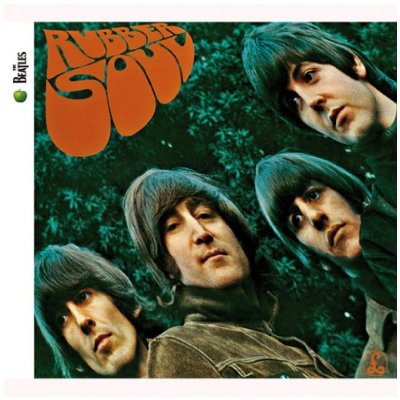
Musically the lads from Liverpool were in top form, releasing the breakthrough album, Rubber Soul in 1965. Their song writing had transformed from the harder R&B influenced Hold My Hand kind of song to lyrical, mature songs like Norwegian Wood, Nowhere Man, Michelle, Girl, In My Life, and If I Needed Someone. It was another #1 Billboard album (6 weeks).   [I’m guessing that if you are still reading this blog you are a Beatles fan and already have most of their albums, but if you don’t… I’d put Rubber Soul at the top of the list. For my money Rubber Soul and Revolver are two of the best albums every made.]

Rubber Soul [Image courtesy: Amazon.com]

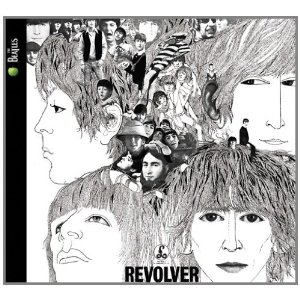
Revolver [Image courtesy: Amazon.com]

Yesterday…and Today came out in 1966. Stand out songs include: Drive My Car, Nowhere Man, Yesterday, If I Needed Someone, We Can Work It Out and Day Tripper. The album reached #1 for 5 weeks. Revolver also came out in 1966.  Taxman, Eleanor Rigby, Here, There and Everywhere, Yellow Submarine, Good Day Sunshine, And Your Bird Can Sing, and Got to Get You Into My Life are some of the hits off the album, which spent 6 weeks at the #1 spot on Billboard’s chart. By 1966 the strain of constant touring, recording, and the hounding fans was weighing on the band. Lennon got in trouble for his “We’re more popular than Jesus now” remark. They played their last concert in Candlestick Park stadium, San Francisco in August.

The following year the Beatles put out their eighth LP, Sgt. Pepper’s Lonely Hearts Club Band. An eclectic mix of pop, rock n roll, and Indian influenced tracks.  It won Album of the Year and was #1 on the Billboard charts for a whopping 15 weeks. Hits from the album include: With a Little Help from My Friends, Lucy in the Sky with Diamonds, Getting Better, –the amazing — A Day in the Life, and of course, Lovely Rita.  But as good as Pepper was, and it was very good, it was also over produced. All those horns and whistles and animal sounds didn’t quite get in the way enough to ruin the songs, but were they really necessary? Listening back on them now… well, I prefer a simpler production. [It worked somehow in A Day in the Life; not so much in Lovely Rita, but still, the later has such a great title.]

Speaking of over produced…there’s Magical Mystery Tour — a movie that makes absolutely no sense.  The LP had some lovely songs though. And even if it was becoming painfully clear that Lennon was writing  the “Lennon” songs– which were leaning toward sarcasm — and McCartney was writing the “McCarntney” songs — which were tending to  get more nostalgic and saccharine — both came up with some good ones here, like: The Fool on the Hill, Strawberry Fields Forever, Penny Lane, and All You Need Is Love.

1968 brought the animated (and equally bizarre) film Yellow Submarine. In November they release a new album called The Beatles aka The White Album. It was at the top of the charts for 9 weeks.   This double album seems almost schizophrenic with some great songs like the hard rock and roll Back in the USSR, Why Don’t We Do It in the Road? Helter Skelter, and  Revolution; others that are lovely and lyrical; While My Guitar Gently Weeps, Blackbird, Julia, Long, Long, Long, Good Night; And others that I’m not going to waste my time talking about.

On the personal side John divorced Cynthia Lennon in November of 1968. He and Yoko Ono, who he had been seeing since 1966, and living with since the summer of ’68, put out a collaborative album Two Virgins.  The album showed the couple nude on the cover and was banned in most record stores. On March 20, 1969 John and Yoko married in Gibraltar.

The following week, the two master media manipulators used their celebrity for good, hosting a honeymoon “bed-in” for peace in room 902, the presidential suite of the Amsterdam Hilton. The… pajama-clad newlyweds spoke out about world peace. It was the honeymoon as performance art, interlaced with a protest against the Vietnam War. [About.com]

They repeated the “performance” in Montreal  the following week and with a bedroom full of musicians, artist, writers and other 1960’s counter-culture dignitaries, they recorded  Give Peace a Chance.

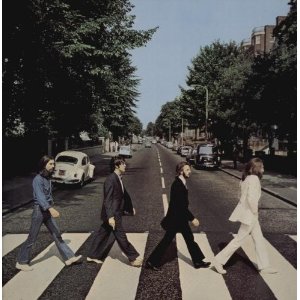
Abbey Road [Image courtesy: Amazon.com]

Abbey Road was released  in 1969. It is actually the last album the Beatles recorded, but it was released before Let It Be.
Notable songs include: Come Together, Something, Here Comes the Sun, and I Want You. Abbey Road stayed at #1 for 11 weeks.

Recorded largely in January in 1969,  Let it Be wasn’t released until 1970 and was #1 for 4 weeks. Lennon had already left the group (September of 1969.) A film of the same name came out the same year. The film was supposed to be a documentary that went behind the scenes to show the world’s most famous rock band making an album. Instead it showed the world’s most famous rock band dissolving.  The film culminated in a rooftop concert on January 30th. Songs from the album include: Don’t Let Me Down, Get Back, Two of Us, Let It Be, and The Long and Winding Road.

After the Beatles John released Plastic Ono Band.

The raw, confessional nature of Plastic Ono Band reflected the primal-scream therapy that Lennon and Ono had been undergoing with psychologist Arthur Janov. He dealt with such fundamental issues as “God” and “Mother” and the class system (“Working Class Hero”) on an album as full of naked candor as any in rock has ever been. [Rock & Roll Hall of Fame]

1971 brought Imagine. Rolling Stone Magazine called the title track the third all-time best song ever written.

English: John Lennon and Yoko Ono

English: John Lennon and Yoko Ono (Photo credit: Wikipedia)
John and Yoko followed Imagine with an anti-war release Happy Xmas (War is Over). The Nixon administration was not amused.  It decided to begin deportation proceeding against Lennon.  The stress took its toll on Lennon’s marriage with Ono and the two separated. For 18 months he lived in Los Angeles with another woman, May Pang. It is a period he calls his “Lost weekend” of drinking a partying. He fished Mind Games, and recorded Walls and Bridges. Whatever Gets You Thru the Night, a single off the later album became a number one hit. He co-wrote Fame with David Bowie.

He and Ono were reunited in 1975 shortly before the release of Rock n Roll. The couple celebrated the birth of their son Sean in October of 1975. And, after releasing Shaved Fish, John became a stay at home dad for five years.

In 1980 he came out of retirement and released Double Fantasy with the single Just Like Starting Over.

On December 8, 1980 the music died. As Lennon and Ono were returning home from recording tracks for the following up album,  Milk and Honey  he was assassinated in front of his New York apartment building, the Dakota.


Thought of the Day 10.7.12 John Cougar Mellencamp

“Forget all that macho shit, and learn how to play guitar.”
–John (Cougar) Mellencamp

Cover of "American Fool (Rpkg)"

Cover of American Fool (Rpkg)

John Mellencamp was born on this day in Seymour, Indiana, USA in 1951. He is 61 years old.

He had spinalbifida as baby. With a growth the size of a man’s fist on the back of his neck that was removed during a day-long operation when he was  three weeks old. His house was filled with music growing up, and Mellencamp learned to play guitar. He was troublemaker at school who drank, smoked, cursed and trolled for girls.

Mellencamp is first and foremost an American storyteller. His classic song Jack and Diane starts out “Little ditty about Jack and Diane /Two American kids growin up in the heartland…” He might as well have begun Once upon a time in a small town in the midwest.

“His songs document the joys and struggles of ordinary people seeking to make their way, and he has consistently brought the fresh air of common experience to the typically glamour-addled world of popular music.” [–Anthony DeCurtis]

He played in bands with names like “Crepe Soul,” “Trash,” “Snakepit Banana Barn” and “the Mason Brothers.” He spent more time partying and playing music than studying so he didn’t do well in school. At 18 he eloped with his older pregnant girlfriend while still a Senior in high school.

He worked odd jobs and took classes at community college, Vincennes, University where he binged on drugs and alcohol while listening to Roxy Music. But by 1974 he’d graduated from Vincesse, sobered up, and got serious about his career.

He cut a four song demo tape and moved to New York City. It took 18 months to get a manager,  Tony DeFries, and land a record deal, with MCA Records. DeFries is the one who came up with the idea of changing his Mellencamp’s last name to Cougar. It was all part of the pre-packaged “rebel” rock star that DeFries was putting together. And it was something Mellencamp didn’t know about until he saw the proofs for the album art  emblazoned with “Johnny Cougar.” No one, DeFries, thought, would buy records from some guy named Mellencamp. Thus Chestnut Street Incident, Johnny Cougar‘s first album was pressed in 1976 by MCA. The album was a mix of cover tunes and originals. It was hardly a chart topping effort and MCA declined to release a second album (The Kid Inside — it was released after Mellencamp made it big.) and “Cougar” and DeFries parted ways.

Mellencamp  signed  with Billy Gaff and release the album “A Biogrpahy” by Riva Records overseas. The single I Need a Lover  became a hit in Australia, and Pat Benatar had a top 40 hit with her cover of the tune. It became the single from his next U.S. album John Cougar.

He embraced his bad boy, rebel reputation with his next album and was rewarded with first top 40 album with Nothing Matters and What if It Did.

In American Fool he stripped away the pre-packaged pop of the Johnny Cougar /Chestnut Street Incident sound and went with two guitars, a bass and a drum to back up his raw, honest vocals. He found his voice as a singer songwriter and Jack and Diane were born. Other cuts from American Fool include: Hurt So Good and Hand to Hold On To.

Here is Hurts Good:

Pink Houses and Crumblin’ Down, two singles of Mellencamp’s 1983 album Uh-Huh hit #8 and #9 on the Billboard Top Ten.


Crumblin' Down

Crumblin’ Down (Photo credit: Wikipedia)
With Scarecrow he began to mix social issues with the music. The album was dedicated to his grandfather and sold 5 million copies. Singles Lonely Ol’ Night, R.O.C.K. in the U.S.A, and Small Town cracked the top 10 charts while  Rain on the Scarecrow became an American anthem.

Here’s Lonely Ol’ Night:

Mellencamp became active in helping farmers keep their farms when he worked with Willie Nelson and Neil Young to create FARM AID. Using the LIVE AID (see the 10.5.12 Thought of the Day on Bob Geldof ) Mellencamp et al held concerts to help American farmers who faced foreclosure. The first concert was in Champaign, Illinois on September 25, 1985 and raised over $9 million. Mellencamp and Nelson worked to bring farmers to US Congress to testify about plight of farmers, resulting in the Agricultural Credit Act. The effort continues, with the organizers coming together for annual concerts, and the organization (of which Mellencamp is a board member) establishing an emergency hot line for farm disaster relief when an area is hit with natural disaster.

Here’s Mellencamp performing Rain On The Scarecrow at Farm Aid 2008

For Lonesome Jubilee he added fiddle and backing vocals to his four piece band sound. The album garnered the hit singles  Paper in Fire, Check It Out and Cherry Bomb. It reached #1 on the Canadian Charts and #6 on US Billboard 200. 

Cover of "Lonesome Jubilee (Rpkg)"

Cover of Lonesome Jubilee (Rpkg)

After Big Daddy he stepped away from the music industry for three years and  took up a different artistic pursuit, painting. He used some of that art on the cover of his next album, Whenever We Want It.

While touring to promote his 1994 Dance Naked album he had a heart attack. Mellencamp smoked 5 packs prior to the attack. He started to eat a heart healthy diet and started to exercise and reduced the number of  cigarettes he smokes (but can’t seem to give them up all together.)

Mellencamp sept2000

Mellencamp sept2000 (Photo credit: Wikipedia)
He has put out 22 albums thus far and was inducted into the Rock and Roll Hall of Fame in 2008


“He’s painted little movies, little stories … a slice of America”  Kenny Aronoff, Mellencamp’s Drummer [A&E Biography]


Oh, you didn’t really think I’d leave you with out a little Jack and Diane, did you?


Thought of the day 10.6.12 David Brin

“When it comes to privacy and accountability, people always demand the former for themselves and the latter for everyone else.”
David Brin

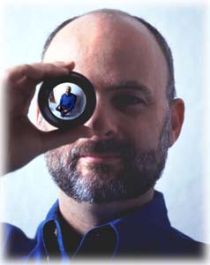
[Image courtesy: Scientific American.com]

David Brin was born on this day in Glendale, California, USA in 1950. He is 61 years old.

Brin is a graduate of the California Institute of Technology where he majored in astrophysics. He earned a Masters in applied physics and Doctor of Philosophy in space science from the University of  California, San Diego.

He is a consultant for NASA and the writer of  hard science fiction.

Brin serves on advisory committees dealing with subjects as diverse as national defense and homeland security, astronomy and space exploration, SETI and nanotechnology, future/prediction and philanthropy. His non-fiction book — The Transparent Society: Will Technology Force Us to Choose Between Freedom and Privacy? — deals with secrecy in the modern world. It won the Freedom of Speech Prize from the American Library Association. [The Worlds of David Brin]

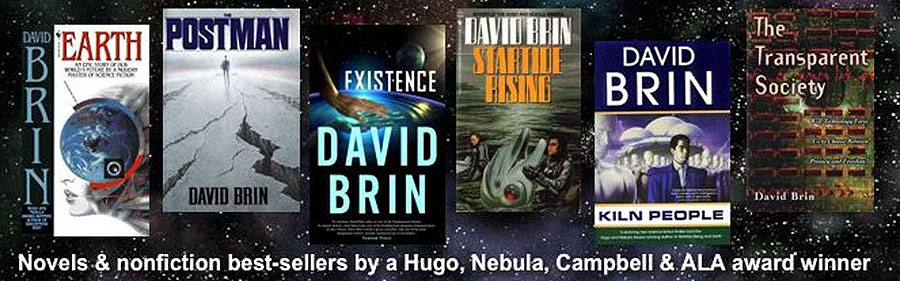
Some of Brin’s book covers. [Image courtesy: The worlds of David Brin]

Brin won two Hugo Awards for his Uplift series. The “Uplift Universe explores a future when humans genetically engineer higher animals like dolphins to become equal members of our civilization.” [The Worlds of David Brin] The books in the series are: Sundiver, Startide Rising (which won the Hugo, Locus and Nebula awards,) The Uplift War (which won the Hugo  and Locus awards) and The Uplift Trilogy: Brightness Reef, Infinity’s Shore and Heaven’s Reach.

Other books he’s written include:

  • The Postman (which won  a Campbell and Locus Award and — after some major reworking– was made into a movie starring Kevin Costner.)
  • Earth (which ” foreshadowed global warming, cyberwarfare and near-future trends such as the World Wide Web” [The Worlds of David Brin])
  • Kiln People (“a fast-moving and fun noir detective story, set in a future when new technology enables people to physically be in more than two places at once.”[The Worlds of David Brin])
  • Foundation’s Triumph (a book that “brings a grand finale to (Isaac) Asimov’s famed Foundation Universe.”  [The Worlds of David Brin]
  • Sky Horizon (Winner of the Hal Clement Award for Best Sci Fi for young readers.)
  • Existence (“Existence – is set forty years ahead, in a near future when human survival seems to teeter along not just on one tightrope, but dozens, with as many hopeful trends and breakthroughs as dangers… a world we already see ahead.” [Amazon.com]

He has a trio of Graphic Novels on the shelf: Forgiveness (A Star Trek the Next Generation graphic novel), The Life Eaters (a graphic novel that loooks at what the world would be like if WWII had ended differently) and Tinkerers.

On the nonfiction front Brin has written : The Transparent Society: Will Technology Force Us to Choose Between Privacy and Freecom?  (Won the Freedom of Speech Award) and Star Wars on Trail: Science Fiction and Fantasy Writers Debat the Most Popular Science Fiction Films of All Time.

[Image courtesy: The Worlds of David Brin]

He’s also written novels for young adults, short stories, and a plethora of articles (both fiction and non fiction) like the excellent guest blog in Scientific American  “Too Hard For Science?”
http://blogs.scientificamerican.com/guest-blog/2011/04/29/too-hard-for-science-david-brin-raising-animals-to-human-levels-of-intelligence/


Thought of the Day 10.4.12 Buster Keaton

“Tragedy is a close-up; comedy is a long shot.”
Buster Keaton

Buster Keaton

Buster Keaton (Photo credit: twm1340)

Joseph Frank Keaton IV was born on this day in Piqua, Kansas, USA in 1895. Today is the 117th anniversary of his birth.

Keaton’s parents were vaudeville actors and he joined their act at age three. He got his nickname, Buster, when he fell down a flight a stairs and landed at Harry Houdini‘s feet. The magician picked him up and handed him to his mother saying “What a buster.”

Physical comedy and slapstick was part of the family act — redubbed “The Three Keatons” when Buster became a permanent fixture.  The little boy was

knocked over, thrown through windows, dropped down stairs, and essentially used as a living prop. It was this training in vaudeville that prepared him for the fast-paced slapstick comedy of the silent movies. [American Masters: Buster Keaton]

Keaton later noted that “It was the roughest knockout act that was ever in the history of the theater.” [Buster Keaton.biography] He knew how to land and never got hurt from the onstage antics as “the little boy who can’t be damaged,” he enjoyed flying about the stage so much that he would giggle when his father tossed him about. But when he realized that the audience liked the heightened sense of danger, Buster  developed his famous “deadpan face.”

Buster Keaton

Buster Keaton (Photo credit: Wikipedia)

Buster moved to Hollywood at 22 and began to work with Fatty Arbuckle. His first film was The Butcher Boy in 1917. Arbuckle was already an established comedian and he became Keaton’s mentor. Keaton earned $40 a week for his work with Arbuckle, and the two worked together until 1920 when Keaton was confident enough to go it alone.

He made a number of “two-reelers,” or shorts, and then feature films including One Week, The Playhouse, Cops, The Camera man, Steamboat Bill, Jr.Our Hospitality, Sherlock. Jr. and The General.  

Here’s the classic “hat” scene from Steamboat Bill, Jr...

He did all his own stunts — instructing the cameras to keep rolling “no matter what” until he yelled “cut” or he died.  And he didn’t use special effects.In another scene from Steamboat Bill, Jr. Keaton stands outside a dilapidated house. The front of the house (a 2 ton facade) falls on him, and he happens to be standing where an open window lets him escape injury. It is not a very big window (there is a much bigger on right next to him) and it must have taken both a lot of mathematics and a lot of courage to do the stunt, but it made for some movie magic…

The General is considered one of the greatest silent films ever made now, but when it came out the reception was tepid.  It resulted in Keaton’s switch to MGM studios, something he regretted for the rest of his career.  Keaton thought The General was his greatest movie, and the public, eventually, came around to his point of view. In 1989 the National Film Registry added The General  to its list. Roger Ebert named the film  the #1 greatest film of the silent era.

Buster Keaton

Buster Keaton (Photo credit: twm1340)

MGM let him make one more truly classic “Buster style” film, The Cameraman in 1928, but then MGM lowered the boom and  took away his creative control. How sweet is this scene from the Cameraman?

With the studio calling the shots Keaton became just another comic actor. He had a number of hits in the 30’s, many of them with Jimmy Durante at his side, but he lacked the stoic charm and the ownership of his previous movies. He worked on Marx Brothers and Red Skelton movies — uncredited — and did what he could to make a living.

Screen shot from Sunset Boulevard. [Image courtesy: Bobby Rivers TV]

In  1950 he played himself as a member of the “waxworks” in Billy Wilder‘s Sunset Boulevard and then in 1953 he was in  Charlie Chaplin’s Limelight. Interest in his old movies revived and he started to make television appearances. Paramount made a movie about his life, The Buster Keaton Story starring Donald O’Connor.

 “…By the 1960s, his films were returning to the theaters and he was being hailed as the greatest actor of the silent era.” [American Masters: Buster Keaton]

He was given an Honorary Academy Award “for his unique talents which brought immortal comedies to the screen” in 1960.

Keaton passed away on February 1, 1966. He was suffering from Cancer.


Thought of the Day 10.2.12 Don McLean

American Pie (album)

Donald McLean was born on this day in New Rochelle, NY in 1945. He is 67 years old.

McLean had severe asthma as a child and missed a lot of school. He loved to sit and listen to his father’s large record collection while at home. Consequently his studies didn’t progress very quickly, but his love of music grew. As a teen he bought a guitar and took opera lessons. He worked on his breathing and got a handle on his asthma.

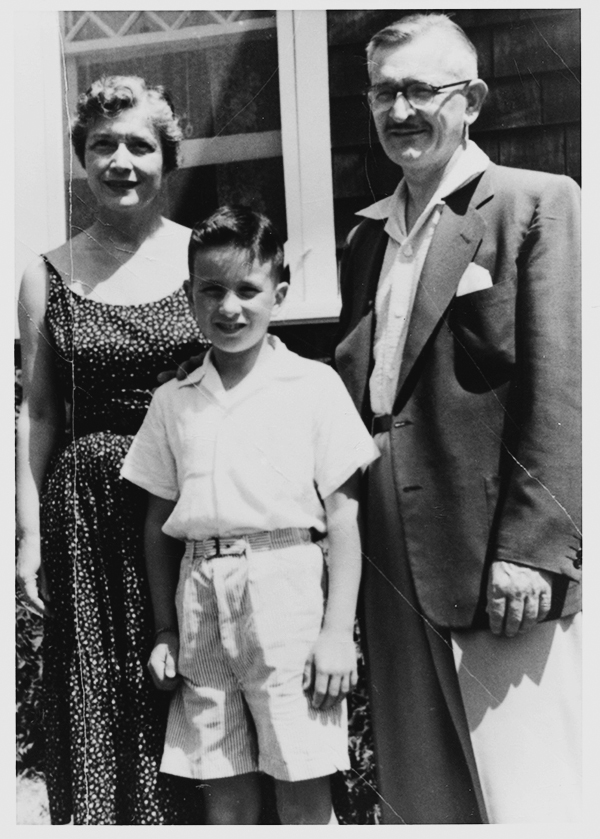
McLean with his parents. (Image courtesy: Don McLean Online]

When McLean was 15 he lost his father. It was his father’s death along with President Kennedy’s assassination and death of Buddy Holly that formed the catalyst for his most famous  song, American Pie.

As a teen he began to work his way up through the music industry. McLean thought of himself as an American folk Troubadour, and he resisted efforts to be molded into other musical styles. He briefly attended Villanova University in 1963, where he met fellow songwriter Jim Croce, before dropping out to pursue music full-time. He worked the club, cafe, and college circuit appearing along with folk headliners like Arlo Guthrie, Pete Seeger and Janis Ian. McLean continued his education at night at Iona College.

McLean was offered a scholarship to attend Columbia for grad school, but he opted for a resident gig at Caffe Lena in NYC. Photo by Joseph Deuel. [Image courtesy: Don McLean Online.]

He worked with Pete Seeger in the group Sloop Clearwater, then put out his first solo album Tapestry. (1969). The album did well, but didn’t sky-rocket him to success. Singles include Castles in the Air and And I Love You So.

[Image courtesy: last.fm]

Here’s Castles in the Air [Besides Don’s smooth voice and great guitar playing, just listen and look as that bass player walks the bass line up and down the fret board,  I’m impressed.]

His second album, American Pie, was recorded in May of 1972.  The title song became a folk/rock anthem (and was voted the #5 Song of the Century by Recording Industry Association of America and the National Endowment for the Arts.) McLean was really a paper boy when he found out about the plane crash that killed Buddy Holly, so the song

:.. is partly biographical and partly the story of America during the idealized 1950s and the bleaker 1960s… “American Pie” presents an abstract story of McLean’s life from the mid-1950s until the end of the 1960s, and at the same time it represents the evolution of popular music and politics over these years… metaphorically the song continues to evolve to the present time…” [Don McLean Online]

[For all the lyrics scroll down to the bottom of this post.]

For Vincent, the second single on American Pie, McLean was inspired by  a book he was reading about Vincent Van Gough.

Other McLean hits include:

  •  Crying, his cover the Roy Orbison song.
  • Wonderful Baby which was not only influenced by Fred Astaire, but was also recorded by Astaire.
  • Till Tomorrow 
  • Babylon http://youtu.be/HpydaQgOviA?t=3m33s
  • He’s Got You, a cover the Patsy Cline standard

McLean has 24 albums to his credit and he continues to tour internationally (and have a great time on stage.) He’s in the UK this month.

Don McLean at Town Hall, NYC

Don McLean at Town Hall, NYC (Photo credit: ShellyS)

American Pie

Verse 1
A long long time ago
I can still remember how that music used to make me smile
And I knew if I had my chance
That I could make those people dance
And maybe they’d be happy for a while
But February made me shiver
With every paper I’d deliver
Bad news on the doorstep
I couldn’t take one more step
I can’t remember if I cried
When I read about his widowed bride
But something touched me deep inside
The day the music died

{Refrain}

So, bye-bye, Miss American Pie
Drove my chevy to the levee
But the levee was dry
And them good old boys were drinkin’ whiskey and rye
Singin’ this’ll be the day that I die
This’ll be the day that I die

Verse 2
Did you write the Book of Love
And do you have faith in God above
If the Bible tells you so
Do you believe in rock n’ roll
Can music save your mortal soul
And can you teach me how to dance real slow
Well, I know that you’re in love with him
‘Cause I saw you dancin’ in the gym
You both kicked off your shoes
Man, I dig those rhythm & blues
I was a lonely, teenage broncin’ buck
With a pink carnation and a pickup truck
But I knew I was out of luck
The day the music died
I started singin’

{Refrain}

Verse 3 
Now for ten years we’ve been on our own
And moss grows fat on a rollin’ stone
But that’s not how it used to be
When the Jester sang for the King and Queen
In a coat he borrowed from James Dean
In a voice that came from you and me
Oh, and while the King was looking down
The Jester stole his thorny crown
The courtroom was adjourned
No verdict was returned
And while Lenin read a book on Marx
The quartet practiced in the park
And we sang dirges in the dark
The day the music died
We were singin’

{Refrain}


Verse 4 

Helter Skelter in a summer swelter
The birds flew off with a fallout shelter
Eight miles high and falling fast
It landed foul on the grass
The players tried for a forward pass
With the Jester on the sidelines in a cast
Now the half-time air was sweet perfume
While the Sergeants played a marching tune
We all got up to dance
Oh but we never got the chance
‘Cause the players tried to take the field
The marching band refused to yield
Do you recall what was revealed
The day the music died
We started singing

{Refrain}

Verse 5 
Oh, and there we were, all in one place
A generation lost in space
With no time left to start again
So come on, Jack, be nimble, Jack be quick
Jack Flash sat on a candlestick
‘Cause fire is the devils only friend
Oh, and as I watched him on the stage
My hands were clenched in fists of rage
No angel born in Hell
Could break that Satan’s spell
And as flames climbed high into the night
To light the sacrificial rite
I saw Satan laughing with delight
The day the music died
He was singing

{Refrain}

Verse 6
I met a girl who sang the blues
And I asked her for some happy news
But she just smiled and turned away
I went down to the sacred store
Where I’d heard the music years before
But the man there said the music wouldn’t play

And in the streets the children screamed
The lovers cried, and the poets dreamed
But not a word was spoken
The church bells all were broken
And the three men I admire most
The Father, Son and the Holy Ghost
They caught the last train for the coast
The day the music died
And they were singin’

{Refrain}

Bye-bye, Miss American Pie
Drove my chevy to the levy
But the levy was dry
And them good old boys were drinking whiskey and rye
Singing this’ll be the day that I die

They were singin’
Bye-bye, Miss American Pie
Drove my chevy to the levy
But the levy was dry
And them good old boys were drinking whiskey and rye
Singing this’ll be the day that I die