Category Archives: Today’s Birthday

James Montgomery Flagg 6.18.13 Thought of the Day

English: American artist James Montgomery Flag...

English: American artist James Montgomery Flagg (1877-1960) (Photo credit: Wikipedia)

“I Want You for U.S. Army.”

James Montgomery Flagg was born in Pelham Manor, New York, USA in 1877. Today is the 136th anniversary of his birth.

He knew he wanted to be an artist at a young age. By 12 he sold his first illustration to St. Nicholas Magazine for $10. “By 14 he was a contributing artist for Life magazine, and the following year was on the staff of another magazine, Judge.”  [RoGallery.com] Although he attended art school in New York, London and Paris he was dubious as to their benefit. He once said “Art cannot be taught. Artists are born that way…I wasted six years of my young life in art schools… You can’t breed an artist. You can only breed mediocrity.”  [spartacus.schoolnet.com.uk] When he returned to the States he married Nellie McCormick, a St. Louis socialite 11 years his senior. The couple moved about the country eventually landing in New York City where Flagg established himself as a magazine illustrator.

English: Caricature of Rupert Hughes (1872-195...

English: Caricature of Rupert Hughes (1872-1956) by James Montgomery Flagg (1877-1960) (Photo credit: Wikipedia)

He worked with a dozen or so of the top publications in the country and produced an illustration a day (on average).

Flagg was not only a productive illustrator, he was also enormously versatile.. Flagg displayed his powers in opaque and transparent watercolor and oils. He worked in monochrome for halftone reproduction; with a full palette for color reproduction. He was equally skilled in charcoal and pencil. He was even a consummate sculptor. No medium was too difficult for him and except for pastel (which he disliked) he used them all with ease.” [spartacus.schoolnet.com.uk]

Flagg started to draw for Photoplay Magazine in 1903, producing illustrated portraits of movie stars.

When the US entered World War I he joined a group of fellow artist called the Division of Pictorial Publicity which designed patriotic posters. Among the 46 posters Flag created is his famous “I Want You for the US Army”. He posed as Uncle Sam himself (to save the trouble and expense of finding a model.)

English: Uncle Sam recruiting poster.

English: Uncle Sam recruiting poster. (Photo credit: Wikipedia)

He was a fan of Franklin D. Roosevelt and created political posters promoting the New Deal and Roosevelt’s presidential campaigns.  When the US entered WWII he revived Uncle Sam and made a series of Red Cross posters.

After the War he mounted an exhibition of his fine art at the Ferargil Gallery in New York City. But by the 1950’s magazines had moved to photography over illustration and he found his skills less in demand.

He was outspoken and he didn’t suffer fools. He had a high opinion of himself and once said “The difference between an artist and an illustrator is that the latter knows how to draw, eats three square meals a day and can pay for them.”

Along with his artwork he also wrote screenplays and acted on both the stage and set.

Flagg died on May 27th , 1960. He was 83 years old.

Click HERE to see a nice selection of his artwork.

Jas. Montgomery Flagg  (LOC)

Jas. Montgomery Flagg (LOC) (Photo credit: The Library of Congress)


Mary Katherine Goddard 6.16.13 Thought of the Day

“He carries every point, who blends the useful with the agreeable, amusing the reader while he instructs him.”
the English translation of the Goddard family motto.

[Image courtesy: The Baltimore Sun]

[Image courtesy: The Baltimore Sun]

Mary Katherine Goddard was born on this day n Groton, Connecticut, USA, in 1738. Today is the 275th anniversary of her birth.

She was elder of two children born to Sarah Updike Goddard and Dr. Giles Goddard. Mary Katherine and her brother William learned to read and write at their New London, Connecticut home. Their mother also taught them “Latin, French, and the literary classics.” [WHMN.org] Shakespeare, Pope and Swift  were favorite reading assignments.

When Mary Katherine was 19 her father passed away. The family stayed in Connecticut for a few years while William was apprenticed to a local printer, but in 1762 they moved to Providence, Rhode Island, and  Sarah Goddard lent William the money to start his own printing business. All three members of the family pitched in to help establish the business.

William was ostensibly in charge, (but) he traveled a great deal, and it was Sarah Updike Goddard who was the true publisher of the Providence Gazette and Country Journal.  Mary Katherine took a great interest in the business and forewent many of the usual activities for young ladies to work as a typesetter, printer, and journalist.  The mother/daughter team made their print shop a hub of activity at a time when newspapers exerted great political influence.  They added a bookbindery, and in addition to the Gazette, printed almanacs, pamphlets, and occasionally books.[WHMN.org]

In 1765 William left Rhode Island for the more metropolitan Philadelphia.  Mary Katherine took over the printing operation in Providence.

…Left with a burden upon her shoulders, Mary Katherine acquired the skills she needed to print a successful publication. “It was probably during the years of [William’s] absence… that his sister… learned the practical side of typography and journalism… ” Lawrence C. Wroth wrote.[University of Rhode Island web site URI.edu]

Three years later William asked the two women to sell the Providence business (They sold the Gazette,  press and building for $550) and move to Pennsylvania to help him with the Philadelphia Chronicle.

Upon their arrival they ran the newspaper and press and William headed to Baltimore, Maryland  on a new venture.  Mary Katherine followed him again in 1774 when she took over her brother’s weekly publications the Maryland Journal and Baltimore Advertiser as he continued to travel.

With her mother dead and her brother prioritizing his political inclinations, Mary Katherine Goddard finally assumed the title of publisher of the Maryland Journal and the Baltimore Advertiser.  She put “Published by M.K. Goddard” on the masthead on May 10, 1775 — and it remained there even when William returned from his New Hampshire-to-Georgia travels in 1776.  [WHMN.org]

She also became a postmaster in 1775 — the first woman in the colonies to do so. As postmaster she was at the  “center of the information exchange.”  [Ibid] and was privy to the news before her competitors. The Journal broke important news stories  (like the skirmishes at Lexington and Concord).

[Image courtesy the Library of Congress]

[Image courtesy the Library of Congress]

Mary Katherine kept the tone of the Journal professional. Other newspapers — and William — editorialized and included op eds that advanced political agendas. “Mary Katherine Goddard used a more objective, impersonal, and professional tone.” [Ibid]

She was a shrewd business woman who accepted alternate forms of payment when the taxes or the War made cash subscription payments difficult.

These included beef, pork, animal food, butter, hog’s lard, tallow, beeswax, flour, wheat, rye, Indian corn, beans and other goods she could sell in her shop. [University of Rhode Island web site URI.edu]

She ran a stationary and printing press where fine printing was produced. She also had a local paper mill.

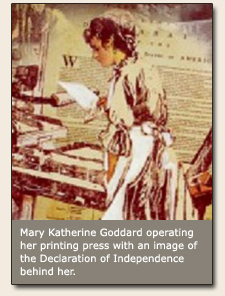
Mary Katherine biggest scoop as a newspaper woman came in January of 1777 when her press printed the first official copy of the Declaration of  Independence to include the names of the signers.

Goddard's published copy of the Declaration of Independence with all the signers identified. [Image courtesy McHenry Country Turning Point.org]

Goddard’s published copy of the Declaration of Independence with all the signers identified. [Image courtesy McHenry Country Turning Point.org]

She successfully ran both the publication and the related printing and paper companies AND served as postmaster through out the long Revolutionary War. But things changed in 1784. She had a falling out with William and he forced her off the paper’s staff. Then in 1789 Mary Katherine was forced to give up her postmaster position. As a woman — it was as argued — she could not handle the traveling the job would demand. Her appeals — backed by a petition of endorsement signed by over 200 Baltimore businessmen — went to President Washington and Congress but got nowhere. She resigned her self to running her bookstore.

Mary Katherine Goddard died att he age of 78 on April 12, 1816. “A copy of the Declaration of Independence printed by her is at the Maryland Hall of Records.”[WHMN.org]


Margaret Bourke-White 6.14.13 Thought of the Day

[Image courtesy: http://lichnosti.net]

[Image courtesy: http://lichnosti.net%5D

Margaret White was born on this day in the Bronx, New York City, New York, USA in 1904. Today is the 109th anniversary of her birth.

She was one of three children born to Joseph and Minnie. The family lived in Bound Brook, New Jersey.  Margaret, her brother, Roger, and sister, Ruth, went to school locally. Margaret was the editor of the high school year book. After attending several universities (Columbia, Michigan, Western Reserve University, Cornell, Purdue) she received her degree from  Cornell in 1927.

She took up photography as a hobby  but after graduating and moving to New York City she began to work in the field as a professional freelance photographer.

 She combined her own last name with her mother’s maiden name (Bourke) to create her hyphenated professional name. Beginning her career in 1927 as an industrial and architectural photographer, she soon gained a reputation for originality, and in 1929 the publisher Henry Luce hired her for his new Fortune magazine. [Britannica.com]

She went  to German on assignment for Fortune to shoot the Krupp Iron Works in 1930. That done she continued her journey (on her own) to the Soviet Union where she was “the first photographer to seriously document its rapid industrial development. She published her work in the book Eyes on Russia (1931).” [Notablebiographies.com] In 1936 she became a staff photographer for a new magazine called LIFE.

1936 LIFE First Cover

1936 LIFE First Cover (Photo credit: Chuck_893) Featuring Bourke-White’s photograph.

As America sank into the economic Depression of the 1930 Bourke-White turned her camera toward those suffering in the Dust Bowl or waiting in bread lines.

These projects also introduced people and social issues as subject matter into her oeuvre, and she developed a compassionate, humanitarian approach to such photos. In 1935 Bourke-White met the Southern novelist Erskine Caldwell, to whom she was married from 1939 to 1942. The couple collaborated on three illustrated books: You Have Seen Their Faces (1937), about Southern sharecroppers; North of the Danube (1939), about life inCzechoslovakia before the Nazi takeover; and Say, Is This the U.S.A. (1941), about the industrialization of the United States. [Britannica.com]


[Image courtesy: http://jewpics.blogspot.com/] Check this blog out for some more of Bourke-White's intense photography.

[Image courtesy: http://jewpics.blogspot.com/%5D Check this blog out for some more of Bourke-White’s intense photography.

During World War II she became the first female war correspondent to work in a combat zone. The transport she was taking across to North Africa was struck by a U-boat’s torpedo and sunk, but she survived. She covered the Allies in Italy, the Siege of Moscow, Patton’s march across the Rhine into Germany, and the liberation of Buchenwald Concentration Camp.

An iconic photograph of Gandhi at a spinning w...

An iconic photograph of Gandhi at a spinning wheel, taken by Margaret Bourke-White in 1946 (Photo credit: Wikipedia)

After the War she covered  the independence and partition of India and Pakistan. In 1949 and 1950 she covered apartheid in South Africa. In 1952 she went to Korea, again  working as a war correspondent.

Shortly after her return from Korea she noticed signs of Parkinson’s disease, the nerve disorder which she battled for the remainder of her life. …White died at her home in Darien, Connecticut. She left behind a legacy as a determined woman, an innovative visual artist, and a compassionate human observer. [Notablebiographies.com]


Here’s a mini documentary on her life….

http://youtu.be/iAkBu63H8H0


Anne Frank 6.13.13 Thought of the Day

Somehow I missed Anne Frank’s birthday yesterday. So I’m posting her bioBLOG today instead.

—————————————————————————————————————-

“How wonderful it is that nobody need wait a single moment before starting to improve the world.”— Anne Frank

Anne Frank

Anne Frank (Photo credit: Wikipedia)

Annelies Marie Frank was born on June 12, 1929 in Frankfurt am Main, Germany. Yesterday was the 84th anniversary of her birth.

Anne was the younger daughter of Otto and Edith Frank.  Otto Frank was a “lieutenant in the German Army during World War I who later became a businessman in Germany and the Netherlands..”[Biography.com] Anne’s older sister Margot was three years her senior.

The Franks were upper middle-class German Jews. They lived in a diverse neighborhood. Anne went to school and played with children of various religions. But when the Nazis came to power  in Germany Otto Frank moved his family to Amsterdam.

Anne Frank started at the Montessori School in 1934, and throughout the rest of the 1930s she lived a relatively happy and normal childhood. Frank had many friends, Dutch and German, Jewish and Christian, and she was a bright and inquisitive student. [Ibid]

She particularly liked reading and writing, while Margot liked arithmetic. It was one of the many ways in which the sisters were dissimilar. Anne was outgoing, rambunctious and loud; Margot was reserved, well behaved and quiet.

Germany invased the Netherlands on May 10, 1940. Anne later wrote about the invasion:

“After May 1940, the good times were few and far between; first there was the war, then the capitulation and then the arrival of the Germans, which is when the trouble started for the Jews.”

By October of 1940 Anti-Jewish laws were put into place. Anne and Margot had to leave their schools and attend the Jewish Lyceum.  The family had to sew the yellow Star of David on their clothing and had to follow a curfew. Otto Frank took measures to transfer his businesses to Gentile partners so the companies would not be liquidated.

For her birthday in 1942 Anne’s parents gave her a red and white checkered diary which she dubbed  “Kitty”. Less than a month later Margot was called up for service in a German work camp and the family went into hiding.

English: Reconstruction of the bookcase at the...

English: Reconstruction of the bookcase at the Anne Frank house. (Photo credit: Wikipedia)

For the next two years her family, along with Herman, Auguste and Peter Van Pels and Fritz Pfeffer, lived in the secret annex of one of Otto Frank’s former businesses. Anne…

wrote extensive daily entries in her diary. Some betrayed the depth of despair into which she occasionally sunk during day after day of confinement. “I’ve reached the point where I hardly care whether I live or die,” she wrote on February 3, 1944. “The world will keep on turning without me, and I can’t do anything to change events anyway.” However, the act of writing allowed Frank to maintain her sanity and her spirits. “When I write, I can shake off all my cares,” [Biography.com]

The Secret Annex was raided on August 4, 1944 and Anne, her family and the others hiding there were taken to  Camp WesterBork in Northeast Netherlands. On September 3rd, 1944 They were transferred to Auschwitz in Poland. That winter Anne and Margot were transferred to Bergen-Belsen. Both girls contracted typhus and died in March of 1945.

Otto Frank, the only one from the Annex to survive the Camps, returned to Amsterdam after the War. He found Anne’s diary and had selections from it published. It has since been published as a novel, a play and filmed for both television and the big screen.

And so it is that Anne Frank’s words live on 71 years after she began to scribble them down in a little red and white diary.

“Despite everything, I believe that people are really good at heart.”

English: The Diary of a Young Girl by Anne Fra...

English: The Diary of a Young Girl by Anne Frank on display at the Anne Frank Zentrum in Berlin, Germany. (Photo credit: Wikipedia)

For a terrific look inside Anne’s journey and life inside the Annex go HERE to The Secret Annex On Line


Peter Dinklage

“I like playing the guy on the sidelines. They have more fun.” — Peter Dinklage

[Image courtesy: MTV]

[Image courtesy: MTV]

Peter Hayden Dinklage was born on this day in Morristown, New Jersey, U.S. in 1969. He is 44 years old.

He is the youngest child born to Diane an John Dinklage. He attended Delbarton School then  received a degree in drama from Bennington College in 1991. He went on to study in London and Wales.

His stage work includes time at London’s Royal Academy of Dramatic arts and shows Off-Broadway in New York, like:

  • The Killing Act
  • Imperfect Love
  • Richard III*
  • Uncle Vanya
  • A Doll’s House
  • Evolution

In 1995 he made his film debut in Living In Oblivion. He played an actor who resents being cast as a dwarf in a dream sequence. He calls the movie inside the movie’s director — Steve Buschemi — on the blantantly campy choice.

“Why does my character have to be a dwarf? … Is that the only way you can make this a dream? Put a dwarf in it? Have YOU ever had a dream with a dwarf in it? Do you know any one who has had a dream with a dwarf in it?’ NO. I DON’T even have dreams with dwarves in them. The only place I’ve seen dwarves in dreams is in stupid movies like this…” [dialog from Living In Oblivion]

Cover of "The Station Agent"

Cover of The Station Agent

His breakthrough movie was The Station Agent. Dinklage plays Finbar McBride, a man who inherits a defunct, rural train station.  He…

moves to rural New Jersey to live a life of solitude, only to meet a chatty hot dog vendor and a woman dealing with her own personal loss.    [IMDb]

The movie won the Sundance Film Festival’s Audience Award. Dinklage was nominated for an Independent Spirit Award  and a Screen Actors Guild Award for the role.

[Image courtesy: Bing]

[Image courtesy: Bing]

He followed that with smaller roles in such films as:
  • Elf
  • Find Me guilty
  • Surviving Eden
  • The Baxter
  • Escape Artists
  • Lassie
  • Penelope
  • Death at a Funeral
  • The Chronicles of Narnia: Prince Caspian

And starring roles in smaller movies like:

  • Pete Smalls is Dad
  • I Love You Too

In between he built his television resume with guest spots and recurring story arches on shows like:

  • Threshold
  • I’m With Her
  • Life As We Know It
  • Nip/Tuck
  • 30 Rock
{Image courtesy: HBO]

{Image courtesy: HBO]

In 2011 he took on the role of Tyrion Lannister, the drinking, womanizing, black sheep of the powerful, rich Lannister family in Game of Thrones. He sums up his character in this exchange…

Dwarfs don’t have to be tactful. Generations of capering fools in motley have won me the right to dress badly and say any damn thing that comes into my head….Let me give you some counsel …Never forget what you are, for surely the world will not. Make it your strength. Then it can never be your weakness. Armor yourself in it, and it will never be used to hurt you.” [Geroge R.R. Martin, Game of Thrones]

Dinklidge won an Emmy  and Golden Globe (along with other acolades) for his performance as Tyrion.

[Image courtesy: Bing]

[Image courtesy: Bing]

Next up for the actor, besides another season of Game of Thrones, are:

Personally I’d like to see him in a period drama. Might I suggest the role of Mr. Benson in Elizabeth Gaskell’s Ruth?

I was seriously thinking of choosing Tyrion Lannister for this Saturday’s Secondary Character. But then Dinklage went and had his birthday today, so I went with a bioBLOG instead.  Unfortunately there’s a lot NOT to like about Game of Thrones (the way women are treated / portrayed, the violence, the graphic … well everything, the author’s amoral determination to casually and cruelly kill off just about every honorable character) but Dinklage’s Tyrion is fantasic gem.

Dinklage visiting the NPR studios  [Image courtesy: NPR] [Yes Maggie, I put this on in just for you.]

Dinklage visiting the NPR studios [Image courtesy: NPR] [Yes Maggie, I put this on in just for you.]

• ritaLOVEStoWRITE Secondary Character Saturday: Ned Stark.

* I don’t know which role he played in Richard III, but oh how wonderful he would be as Richard. Am I right?


Aaron Sorkin 6.9.13 Thought of the Day

Well, it has officially happened. I’ve lapped myself. When I checked to see who’s birthday it was today in preparation for this blog I saw Cole Porter and thought “Cool, a music day! I love Cole Porter.” Then I thought “Wait a minute… didn’t I already do Cole Porter?” I checked. Yep. I did. LAST YEAR, and while I’ve still got him under my skin, I think I’d better profile some one else today. So how about… Aaron Sorkin?

[Image cortesy: Los Angees Times]

[Image cortesy: Los Angees Times]

“There’s a great tradition in storytelling that’s thousands of years old, telling stories about kings and their palaces, and that’s really what I wanted to do.” — Aaron Sorkin

“I love writing but hate starting. The page is awfully white and it says, ‘You may have fooled some of the people some of the time but those days are over, giftless. I’m not your agent and I’m not your mommy, I’m a white piece of paper, you wanna dance with me?’ and I really, really don’t. I’ll go peaceable-like.”— Aaron Sorkin

Aaron Benjamin Sorkin was born on this day in New York City, New York, USA in  1961. He is 52 years old.

He grew up in the affluent suburb of  Scarsdale, New York. His first love was acting. He was involved in theatre at Scarsdale High School and went on to major in Musical Theatre at Syracuse University. When he graduated in 1979 he moved to New York City and tied to break into the theatre scene there, but with little success. After a few years of odd jobs he discovered his writing talents.

His first professionally staged play, Hidden in This Picture, was debuted at the West Bank Cafe Downstairs Theatre Bar in 1998.He later adapted the one-act into a full-length show called Making Movies.

A Few Good Men at the Haymarket Theatre, Londo...

A Few Good Men at the Haymarket Theatre, London in 2005. (Photo credit: Wikipedia)

His sister, Deborah, who was working as a Navy Judge Advocate General, gave him the idea for A Few Good Men. She told her little brother about a trip she was about to take to Cuba to interview Marines at Guantanamo Bay. The conversations served as the bones for the story which Sorkin wrote on cocktail napkins while he was tending bar. At home he translated those notes into the script to A Few Good Men. The movie rights were sold before the play saw its Broadway premier (1989). Sorkin rewrote the play as a screenplay. The film, wiht Jack Nicholson, Tom Cruise and Demi Moore was released in 1992.

Malice (1993), with Nicole Kidman and Alec Baldwin, and The American President (1995), with Michael Douglas and Annette Benning, followed.

Sorkin worked though much of the rest of the 1990s as a script doctor on various other film projects.

Sports Night cast [Image courtesy: ABC]

Sports Night cast [Image courtesy: ABC]

He found his stride with Sports Night, a comedy  that ran for two seasons on ABC. Sports Night is one of the best written shows to ever grace Prime Time. Fast, witty, intelligent, beautifully acted — it’s a wonder it  lasted 2 seasons.

His next offering was better received. The West Wing won a total of nine Emmy Awards just in its first season. He wrote almost all the of show’s episodes for the first four seasons before leaving.

West Wing cast [Image courtesy: NBC]

West Wing cast [Image courtesy: NBC]

In 2006 he delved behind the scenes of a late night sketch comedy show in Studio 60 on the Sunset Strip.    The show, while highly anticipated, didn’t make it past the first season, and Sorkin went back to the theatre, writing The Farnsworth Invention. The play won the Joseph Jefferson Award for best midsize production.

He returned to screenwriting  for Charlie Wilson’s War (2007), The Social Network (2010) and Money Ball (2011). He won an Academy Award for his screenplay for The Social Network.

The Social Network

The Social Network (Photo credit: Wikipedia)

Then TV came calling again, this time  in the form of the cable giant HBO. Last June The Newsroom, a behind the scenes look at a fictional cable news show, premiered. The show, which stars Jeff Daniels, features Sorkin’s signature ‘walk and talk’ tracking shots and quick fire dialog. The show begins its second season next month.

The Newsroom

The Newsroom (Photo credit: Brennen Schmidt)


George III 6.4.13 Thought of the Day

“Born and educated in this country, I glory in the name of Britain.”–George III

King George III (in coronation robes)

King George III (in coronation robes) (Photo credit: Wikipedia)

George William Frederick was born on this date in Norfolk House, St. James’s Square, London, England in 1738 . Today is the 275th anniversary of his birth.

The eldest of two sons born to Frederick, Prince of Wales and August of Saxe-Gotha, George was born two months early. The Royal family feared he wouldn’t survive infancy and he was quickly baptized. A month later he was presented publicly and formally baptized into the Anglican Church.

He was educated along with his brother, Prince Edward, Duke of York and Albany, by tutors. The boys learned to read and write English and German as well as the Romance Languages, Science, Math, History, Geography, Economics, Law, Music,  Dancing, Fencing, Riding and Sports.

 On his father’s death in 1751, the 12-year-old George became Prince of Wales. He was cared for in relative isolation by his mother and tutored by the Scottish nobleman Lord Bute. [History.com]

Nine years later he followed his grandfather to the Throne. Crowned in 1761 he reigned for 59 until his death in 1820. George III had the third longest reign of a British monarch (surpassed only by his granddaughter Victoria — 63 years — and the current queen — 61 years).

English: George III of the United Kingdom whil...

English: George III of the United Kingdom while Prince of Wales (Photo credit: Wikipedia)

Positive things that happened while he was king…

  •  Ended the Seven Year’s War
  •  Democracy increased during his reign
  •  Britain Defeated Napoleon
  •  Enhanced the Royal Academy of Arts
  •  Opened the King’s Library to researchers and academics.

Neutral things that happened while he was king…

  • Survived an assassination attempt by James Hadfield
  • Had a planet named after him (It was later renamed Uranus)

Negative things related to his reign…

  • Suffered from madness as early at 1788 and spent much of the last decade of his reign in a fog.

“certainly as early as 1788. By 1810 his madness—now thought perhaps to be the result of a congenital disease called porphyria—had completely taken over his mind, and he was judged unfit to rule during the final decade of his reign” [Home At Fist.com]

’’’Coat of arms of the Hanoverian Princes of W...

’’’Coat of arms of the Hanoverian Princes of Wales’’’ used by George II, Frederick and George III. (Photo credit: Wikipedia)


Edward Elgar 6.2.13 Thought of the Day

“My idea is that there is music in the air, music all around us, the world is full of it and you simply take as much as you require.”–Edward Elgar

Elgar in 1919, by William Rothenstein

Elgar in 1919, by William Rothenstein (Photo credit: Wikipedia)

Edward William Elgar was born on this day in Broadheath, near Worcester, England in 1857.  Today is 156th anniversary of his birth.

He was the fourth child born to William and Ann Elgar. William Elgar ran a music shop and tuned pianos in Broadheath. A trained violinist, he taught all his children — The Elgars had a total of seven children — piano, violin and the basics of music theory. By  eight young Edward was tagging along with his father as William went to the richer houses of the county to tune their pianos. The little boy would play for the gentry while his father fixed the piano. He also started to compose at an early age.

It is a remarkable fact that Elgar was very largely self-taught as a composer – evidence of the strong determination behind his original and unique genius.[www.elgar.org]

Although he wanted to go to Germany to study at the Leipzig Conservatory his family couldn’t afford it, so he  had no formal musical training. Instead, in 1872 he went to work as a clerk for a local solicitor.  He didn’t last long in the stifling office setting. He began to give lessons (piano and violin), sing in the town’s Glee Club, compose, conduct and play violin professionally. He became the conductor of the  County Lunatic Asylum (an unusual combination of instruments and talent levels) and worked with the Worcester College for the Blind Sons of Gentlemen.

Slowly, and through such early works as Froissart(1890), the Imperial March (1897) and the cantatas King Olaf (1896) and Caractacus (1898), his reputation began to spread beyond the area immediately around his native Worcestershire. His first big success came with the Variations on an Original Theme (Enigma) in 1899. [Ibid]

In 1900 he was awarded a Doctorate by Cambridge. Four years later he was Knighted.

Eventually Elgar was feted all over the world; he dined with royalty, was knighted and awarded the Order of Merit.  Yet he never forgot his roots, and when he became a Baronet in1931, he chose as his title First Baronet of Broadheath. [Elgar Foundation.org]

Edward Elgar died on February 23, 1934.

It is graduation season here in the US, and nary a matriculation takes place with out the school’s orchestra pulling out Elgar’s most famous piece Pomp and Circumstance. (The part every one recognizes comes at about the 2 minute mark.)

But might I suggest a listen to his Sea Pictures, OP. 37 with Contralto Linda Finnie and The London Philharmonic

http://youtu.be/DG9qAvIZxp0

Or the fabulously layered Symphony No. 1 in A-flat major, Op. 55, Sir John Barbiolli conducting the Halle Orchestra

or his delightful Serenade for String Orchestra in E minor, Op. 20,  performed by the New Philharmonia Orchestra with Giuseppe Sinopoli  at the podium,


Idina Menzel 5.30.13 Thought of the Day

“I’ve been singing since I was born. It’s something I do everywhere I go. In the shower, walking down the street. I don’t need any impetus to do it. I just sing” — Idina Menzel

English: Singer/actress Idina Menzel outside t...
English: Singer/actress Idina Menzel outside the Today Show studios following an appearance and performance promoting the release of her debut Warner Bros album “I Stand.” (Photo credit: Wikipedia)

Idina Kim Menzel  was born in Queens, New York City, New York, in  1971. She is 42 years old.

She is one of two girls born to Helene and Stuart Mentzel. She grew up in New Jersey and Syosset, New York. She attended the Tisch School of the Arts and earned her Bachelors of fine Arts from New York University.  A singer since childhood Menzel began to perform professionally at weddings and bar mitzvahs as a teenager.

She had her first Five Hundred Twenty-Five Thousand Six Hundred Minutes of fame as Maureen Johnson in RENT in 1996. She originated the role in New York Theatre Workshop and moved with the show to Broadway. Menzel later played Maureen in the 2005 movie version of the play. She earned a Tony nomination the role.

Here’s Take Me or Leave Me...

Menzel had a string of smaller, but successful gigs both on and off Broadway  (including: Tha Vagina Monologues, Aida, The Wild party, Summer of ‘42, and a Hair encore concert) but she really defied gravity with her second big role as Elphaba in Wicked.

http://youtu.be/3g4ekwTd6Ig

The show, based on the Gregory Maguire novel, hit the Great White Way in 2003. She won the 2004 Tony for her role as the green witch.

Her post Wicked stage resume includes See What I Wana See, Chess and Nero. Next year she will return to Broadway to open in Tom Kit and Brian Yorkey’s musuical If/Then.

In 2008 Menzel released I Stand on Warner Bros. Records. The album is a …

powerful collection of exquisite new songs written by the Tony Award winning actress/singer/songwriter…filled with pop tunes and heartfelt ballads—intimate yet universal stories of life, its challenges, relationships and of course – the subject of love. [Idena Menzel.com ]

Here’s Brave from I Stand:

She tours domestically and internationally to promote both her original work from the album and her Broadway work.

Most recently Menzel has appeared on television’s Glee’s.