“You have your thoughts and I have mine. This is the fact and you can’t change it even if you kill me. —Ba Jin
Li Yaotang was born on this day in in Chengdu, Sichuan, China in 1908. Today is the 104th anniversary of his birth.
He began his career in 1927, and has a collected work of 14 volumes of novels and proses. The first volume contains his novel The Family, completed in 1931, and his novellette Autumn in Spring in 1932. The second volume contains his two novelettes Garden of Repose, completed in 1944, and Bitter Cold Nights in 1946. The third volume contains the novelette The Grit Men, and 22 short stories. The fourth volume contains 43 articles on literary creation and other subjects by Ba Jin.[Selected Works of Ba Jin]
He was an anarchist who was often at odds with the Communist Party.But after the Communist Revolution he renounced his anarchist ideas and was considered a politically reliable person.
He was nominated for the Nobel prize in Literature in 1975.
Only Ba Jin statue I’ve ever seen in China (Photo credit: Foto Jenny)
[today’s blog is a little light because I am traveling.]
“He looked like something that had gotten loose from Macy’s Thanksgiving Day Parade.”
–Harpo Marx
Adolph Marx was born on this day in New York City, New York, USA in 1888. Today is the 124th anniversary of his birth.
The second of five brothers in the Marx family, Adolph didn’t make it past second grade in school. He was small for his age and he was picked on by the bigger boys because he was Jewish. Two boys literally threw him out of the (first floor) classroom window on several occasions before he gave up and left school. He joined his brother Chico in doing odd jobs to help the family.
His uncle Al Schoenberg (stage name Al Shean) was in a Vaudeville act. His older brother Chico played piano, and his younger bother Julius (Groucho) was a boy soprano. Adolph joined Julius and Milton (Gummo) to form “the Three Nightingales” in 1910. Lou Levy joined them to make the group “The Four Nightingales.” When their mother, Minnie, and Aunt Hannah joined the act they changed the name to “The Six Mascots.”
The five Marx brothers with their parents in New York City, 1915. From left to right; Groucho, Gummo, Minnie (mother), Zeppo, Frenchy (father), Chico, and Harpo. (Photo credit: Wikipedia)
In 1911 he changed his name to Arthur because he didn’t like the sound of Adolph. He adopted the stage name of Harpo when his mother sent him a harp. He didn’t know how to tune it or play it. He didn’t even know how to hold it until he found an image of an angel holding a harp at the 5&10 store. He tuned it the best he could and taught himself to play.
At that point Harpo’s two-fold schtick — he “couldn’t talk” so he blew his horn or whistled to communicate; and he played the harp — was in place. (He could, in fact, talk. And he did so — a lot — off stage/scene. His “speaking career” stopped after he received a bad review for a largely ad-libbed performance in the play Home Again.)
A critic in the local newspaper described the show by saying, in part, “Adolph Marx performed beautiful pantomime which was ruined whenever he spoke.” Harpo then decided he could do a better job of stealing focus by not speaking. [The Marx Brothers; Harpo Marx from an article in Theatre Arts Monthly, October 1939]
The four Marx Brothers stowing away on an ocean vessel by hiding in barrels in this promotional still for Monkey Business. Left to right: Harpo, Zeppo, Chico, Groucho. (Photo credit: Wikipedia)
From the Vaudeville stage the Marx Brothers moved on to Hollywood. They made the short, Humor Risk, in 1921. (The film has since been lost.) Harpo was then in Too Many Kissesas the character “The Village Peter Pan.” He actually has a line in this movie, but, as it’s a silent film, you don’t actually hear him speak it. His brothers did not appear in the film.
In 1929 the brothers put out The Cocoanuts.The film was based on their Broadway play of the same name. In it…
the Marx Brothers run a hotel, auction off some land, thwart a jewel robbery, and generally act like themselves. [IMDB]
They shot during the day and performed in the stage show of Animal Crackers at night. It was an exhausting schedule and the Brothers were not happy with the result. They were “so appalled … that they offered to buy the negative from Paramount so that they could burn it.” [Ibid]
Marx Brothers, head-and-shoulders portrait, facing front. Top to bottom: Chico, Harpo, Groucho and Zeppo. (Photo credit: Wikipedia)
The Brothers made Animal Crackers,Horse Feathers , Duck Soup, A Night at the Opera, A Day at the Races, Room Service, At the Circus, Go West, The Big Store, A Night in Casablanca, and Love Happy in quick succession.
Starting in 1952 Harpo started doing guest spots on Television, most notably on the I Love Lucy Show.
His last film was The Story of Mankindin 1957. He played Sir Isaac Newton.
Off screen Harpo, the elementary school drop out, rubbed shoulders with some pretty high level literary types. In the 1920’s he held his own at the Algonquin Round Table with writers such as George S. Kaufman and Dorothy Parker. In 1928 he spent the summer on the French Riviera with George Bernard Shaw.
He attributes his welcome hanging out with the fast literary crowd at the Algonquin Round Table in New York in the 1920s to his ability to listen — in fact, to being the one real listener in that set. [Robert Wilfred Franson’s review of Harpo Speaks]
In 1933 Harpo did a 6-week goodwill mission in the Soviet Union. He was the “first American to perform in the Soviet Union after the United States government officially recognized it.” [Harpo’s Place] According to his autobiography, Harpo Speaks, the trip was part performance and part spy caper. He smuggled papers out of the USSR by taping them to his leg.
Marx died while having open-heart surgery on September 28, 1964.
Here’s a clip of Harpo actually speaking (and honking):
“We have too many high-sounding words, and too few actions that correspond with them.” — Abigail Adams
Abigail Adams by Benjamin Blythe, 1766 (Photo credit: Wikipedia)
Abigail Smith was born on this day in Weymouth, Massachusetts, in 1744. Today is the 268th anniversary of her birth.
Abigail was literally born in a church. Her father, Reverend William Smith was the pastor at the North Parish Congregational Church, her mother, Elizabeth Quincy Smith was first cousins to Dorothy Quincy Hancock (John Hancock’s wife). Reverend Smith believed in reason and morality and he imparted those lessons to his daughters Mary, Elizabeth and Abigail. Her mother home schooled the girls with the aid of her extended family’s libraries. The girls studied English and French literature, philosophy, history, and the Bible. Abigail
“was a keen political observer, prolific writer…” [abigailadams.org]
Abigail’s third cousin John Adams visited the Smith’s with his friend Richard Cranch. Cranch was engaged to Mary Smith, the eldest Smith sister. Adam’s was just a country lawer, and Abigail’s mother didn’t approve of him as a suitor, but the couple prevailed.
On October 25, 1764 Abigail married John Adams, a Harvard graduate pursuing a law career. Their marriage was one of mind and heart, producing three sons and two daughters, and lasting for more than half a century. [Ibid]
As a young married couple they lived on the farm John inherited, Braintree. Later they moved to Boston. She stayed in Massachusetts when John went to Philadelphia to participate in the Continental Congress (1 & 2), travelled abroad as an envoy, and served in elected office.
Abigail struggled alone with wartime shortages, lack of income, and difficult living conditions. She ran the household, farm, and educated her children. Abigail’s letters to John were strong, witty and supportive. The letters, which have been preserved, detail her life during revolutionary times, and describe the many dangers and challenges she faced as our young country fought to become independent. Most of all, the letters tell of her loneliness without her “dearest friend,” her husband John. [Ibid]
She joined John in Paris in 1784 and travelled with him to England the following year. In 1800 she became the First Lady to preside over the White House as John Adams became the second President of the United States. (The Capitol had recently been moved to Washington DC).
English: “Abigail Smith Adams,” oil on canvas, by the American artist Gilbert Stuart. Courtesy of the National Gallery of Art, Washington, D. C. (Photo credit: Wikipedia)
When John Adams lost his bid for a second term he and Abigail moved back to Braintree …”and for 17 years enjoyed the companionship that public life had long denied them.” [Ibid]
Abigail Adams died on October 28, 1818. She was a woman …
often ahead of her time with many of her ideas. She opposed slavery, believed in equal education for boys and girls, and practiced what she learned as a child – the duty of the fortunate is to help those who are less fortunate. [Ibid]
“It is from numberless diverse acts of courage and belief that human history is shaped. Each time a man stands up for an ideal, or acts to improve the lot of others, or strikes out against injustice, he sends forth a tiny ripple of hope.”
“People say I am ruthless. I am not ruthless. And if I find the man who is calling me ruthless, I shall destroy him.”
“I believe that, as long as there is plenty, poverty is evil.”
“Ultimately, America’s answer to the intolerant man is diversity, the very diversity which our heritage of religious freedom has inspired.”
—Robert F. Kennedy
Robert F. Kennedy, Cabinet Room, White House, Washington, DC. (Photo credit: Wikipedia)
Robert Francis Kennedy was born on this day in Brookline, Massachusetts in 1925. Today is the 87th anniversary of his birth.
He was the seventh of nine Kennedy children, the third son. The family split their time between New York and their summer home in Hyannis Port, Massachusetts. Bobby attended public schools until 6th grade. He went to a series of private schools including a Benedictine boarding school for boys and Milton Academy.
Shortly before he turned 18 he enlisted in the US Naval Reserve. He participated in the V-12 Navy College Training Program at Harvard and Bates College from 1944 to 1946 and served on the USS Joseph P. Kennedy, Jr, a destroyer named after his brother, on it’s shakedown cruise in the Caribbean. He was honorably discharged later that year. He then went on to the University of Virginia Law School.
English: Kennedy brothers; left to right John, Robert, Ted. Česky: Bratři Kennedyové – vlevo John F., uprostřed Robert F. (Photo credit: Wikipedia)
In 1952 he managed John F. Kennedy’s run for U.S. Senate. His brother won the Senate seat and Robert Kennedy served
briefly on the staff of the Senate Subcommittee on Investigations, chaired by Senator Joseph McCarthy. Disturbed by McCarthy’s controversial tactics, Kennedy resigned from the staff after six months. He later returned to the Senate Subcommittee on Investigations as chief counsel for the Democratic minority, in which capacity he wrote a report condemning McCarthy’s investigation of alleged Communists in the Army. [John F. Kennedy Presidential Library & Museum]
Next he tackled corruption in trade unions as Chief Counsel for the Senate Rackets Committee. His book The Enemy Within details the corruption he confronted with the Teamsters and other unions.
In 1956 he was an aide to Democratic presidential nominee Adlai Stevenson. Stevenson lost, but the experience was good training. Bobby took the reigns again for his brother’s bid for the presidency against Richard Nixon in 1960. When John Kennedy won he made Bobby the Attorney General.
He fought organized crime and “became increasingly committed to helping African-Americans win the right to vote.” [Ibid] In a 1961 speech in Georgia he said:
“We will not stand by or be aloof. We will move. I happen to believe that the 1954 [Supreme Court school desegregation] decision was right. But my belief does not matter. It is the law. Some of you may believe the decision was wrong. That does not matter. It is the law.” [Ibid]
He worked with the administration to create the Civil Rights Act of 1964.
Attorney General Robert F. Kennedy speaking to a crowd of African Americans and whites through a megaphone outside the Justice Department; sign for Congress of Racial Equality is prominently displayed. (Photo credit: Wikipedia)
He was also instrumental in foreign affairs including the Berlin Crisis of 1961 and the Cuban Missile Crisis of 1962.
John F. Kennedy was assassinated in Dealey Plaza, Dallas, Texas on November 22, 1963. Robert Kennedy was devastated by the death of his brother and friend. He even felt guilt — had his aggressive pursuit against organized crime and obsession to “get” Castro some how brought this about? [I won’t even attempt to resolve the myriad of conspiracy theories here. Suffice it to say Bobby was not the same man after the death of his brother.]
He resigned from his post as Attorney General nine months after the assassination and began a run for U.S. Senate. He won the seat.
He climbed Mount Kennedy, a mountain that was named for his brother and the highest peak in Canada that had not be summited, in 1965.
In 1966 he went to South Africa to speak out against the Apartheid government. He dared to ask “Supposed God is black? What if we go to Heaven and we, all our lives, have treated the Negro as an inferior, and God is there, and we look up and He is not white? What then is our response?”
As Senator he also spoke out against the Vietnam War, continued to work for Civil Rights and the War on Poverty.
He sought to remedy the problems of poverty through legislation to encourage private industry to locate in poverty-stricken areas, thus creating jobs for the unemployed, and stressed the importance of work over welfare. [John F. Kennedy Presidential Library & Museum]
On March 16, 1968 he declared his bid for the Presidency. His platform was based on racial and economic justice, he was also anti-war
…he challenged the complacent in American society and sought to bridge the great divides in American life – between the races, between the poor and the affluent, between young and old, between order and dissent. His 1968 campaign brought hope to an American people troubled by discontent and violence at home and war in Vietnam.[Ibid]
When Martin Luther King, Jr. was assassinated in April of 1968 Kennedy found out about it minutes before he was to give a speech in downtown Indianapolis. He could have gotten back in his limo and let some one else make the announcement to a crowd that was certain to be upset by the news, but he stepped in front of the inner city crowd and gave an impromptu speech calling for reconciliation between the races.
Many other American cities burned after King was killed. But there was no fire in Indianapolis, which heard the words of Robert Kennedy… a well-organized black community kept its calm. It’s hard to overlook the image of one single man, standing on a flatbed truck, who never looked down at the paper in his hand — only at the faces in the crowd. [NPR.org]
Kennedy also fell victim to an assassin’s bullet. He was fatally shot at the Ambassador Hotel in Los Angeles, California on June 5, 1968. He had just won California’s Democratic Primary.
The Robert F. Kennedy Memorial (Photo credit: Bernt Rostad)
[One of my earliest real memories is watching the train that carried Robert Kennedy’s body to its Arlington National Cemetery. My parents had taken us all on a picnic at the the ball field near the train tracks. We weren’t the only family there, there were lots of kids playing and other families on blankets eating cold chicken and potato salad. Then a train rolled through and all the adults stood up and faced the tracks. We kids didn’t need to be hushed. My mother was silently crying. I took her hand and asked her what was going on. As the flag festooned final car passed she whispered “A great American is on that train.” And then it was over. We packed up the picnics. No one was hungry or wanted to play any more.]
[Do you have a Bobby Kennedy story? Share it with us please.]
“You have to have a lot of little boy in you to play baseball for a living.” —Roy Campanella
English: Brooklyn Dodgers catcher and Hall of Famer . (Photo credit: Wikipedia)
Roy Campanella was born on this day in Philadelphia, Pennsylvania, USA in 1921. Today is the 91st anniversary of his birth.
Campanella’s father, John, was an Italian American, his mother, Ida was African-American. The family lived in a rough section of Philly known, ironically as Nicetown. Roy was one of five children. As a kid he did odd jobs like delivering newspapers, shining shoes and cutting grass, to help out with family finances. He was athletic and loved to play baseball, but he knew that the color barrier meant that would be barred from playing in the Major Leagues. He “started out on Philadelphia’s sand lots and by the age 15 was signed on to the Negro leagues.” [Biography.com] By 11th grade he dropped out so he could play ball full-time.
For the next decade, Campanella excelled in the segregated world of black baseball, barnstorming on buses across the country and playing winter ball in Mexico, the Caribbean, and Latin America. He was such a natural leader and had such an astute baseball mind that he often managed clubs he played for in Latin America. [Gale Encyclopedia of Biography: Roy Campanella]
By 1946 The Dodger’s president Branch Rickey was sewing the seeds for Jackie Robinson and Campanella to break the color barrier. Robinson was sent to the Triple A team in Montreal and Campanella went to Nashua, New Hampshire to play Class B ball. Campanella had been making $500 in the Negro Leagues, but took a pay cut to $150 a month at the new club. He “…was better than a Class B player, …but he knew why he was there. He was part of Rickey’s plan to begin integrating baseball.” [Ibid] He was voted the Eastern League’s MVP.
1972 Los Angeles Dodgers season (Photo credit: Wikipedia)
Campanella followed Robinson into the Majors, making his debut on April 20, 1948. Both men played for the Brooklyn Dodgers.
The man they called “Campy” was the complete package, leading National League catchers in putouts six times, and clubbing 242 home runs in his 10-year Major League career. From 1948-1957, Roy Campanella was securely anchored behind home plate for the Brooklyn Dodgers. [The Official Roy Campanella Site.]
He played in eight straight All-Star games, starting in 1949 (he, Robinson, Larry Doby and Don Newcombe were the first African-American men to play in the All-Star game.)
He caught in five World Series, won the National League Most Valuable Player award in 1951, 1953, and 1955, and was the first black catcher in Major League Baseball history. In 1969, he joined baseball’s elite with his induction into the Hall of Fame. [The Official Roy Campanella Site.]
List of Pennsylvania state historical markers in Philadelphia County (Photo credit: Wikipedia)
The Dodgers moved from Brooklyn to Los Angeles, California after the 1957 Baseball season and Campy was set to go with them, but that was not to be. While driving to his Long Island home late on January 28, 1958 his car hit a patch of ice and skidded into a telephone pole. Campanella was badly injured and left paralyzed from the shoulders down. He eventually regained the use of his arms and hands, but he would never walk again.
Although he couldn’t play he maintained ties with the Dodgers.
The Dodgers hired him as a special instructor, and for 20 years he helped groom many young catchers during spring training. He also worked with disabled people through the Dodgers’ community-service division. He was expert at cheering up people. Campanella once said: “People look at me and get the feeling that if a guy in a wheelchair can have such a good time, they can’t be too bad off after all.” Scully observed: “He looked upon life as a catcher. He was forever cheering up, pepping up, counseling people.” [Gale Encyclopedia of Biography: Roy Campanella]
Campanella wrote his autobiography, It’s Good to Be Alive, in 1969. He was voted into the National Baseball Hall of Fame in 1969.
Roy Campanella died at the age of 71 in Woodland Hills, California.
[For those of you who are playing along… I posted a blog yesterday seeking advice as to who I should profile in today’s birthday post — song smith Johnny Mercer or Gilbert or Gilbert and Sullivan fame. Just about everyone picked Mercer, so put on your Breakfast at Tiffanys ’cause there’s some Moon River coming your way.]
“Days of wine and roses laugh and run away, like a child at play.”
–Johnny Mercer
English: Johnny Mercer, New York, N.Y., between 1946 and 1948 (Photograph by William P. Gottlieb) (Photo credit: Wikipedia)
John Herndon Mercer was born on this day in Savannah, Georgia, USA in 1909. Today is the 103rd anniversary of his birth.
He grew up in Savannah (though never in the Mercer House — made famous in Midnight in the Garden of Good and Evil) He enjoyed music as a child and he could hum a tune before he could talk. He was singing in a choir by six and all the song memorized by 11. He tried to take lessons on various instruments but never made it very far. Even as an adult he could only play piano one finger at a time.
He wrote his first song, “Sister Susie, Strut Your Stuff,” at age 15 while a student at the exclusive boy’s school Woodbury Forest School in Orange Co, Virginia. After graduation he moved to New York to try his hand at acting. Although he was cast in bit roles in a few shows, it was his talent for writing songs (both the witty lyrics and the snappy melodies) that showcased his real talent.
In 1930, while … looking for an acting job … he was informed that (a) play was all cast, but that they could use some songs. In the show were two other future great writers — Vernon Duke and E.Y. “Yip” Harburg, who accepted Mercer’s “Out of Breath and Scared to Death of You.“ [Johnny Mercer.com]
The show, “Garrick Gaieties,” also featured a dancer named Ginger Meehan who Mercer fell in love with. The two married in 1931.
Mercer began to collaborate with Hoagy Carmichael in 1932. Their first hit was “Lazy Bones” which hit #1 for one artist, Ted Lewis, and broke the top ten for two other singers.
By 1938 he was recording duets with Bing Crosby for Decca and the following year, he was on Benny Goodman’s Camel Cavalcade radio program as a featured singer. [AllMusic]
His string of hit in 1934 included “You Have Taken My Heart”, “Pardon My Southern Accent” and “P.S. I Love You”
Heres a really sweet version of P.S. I Love You featuring Bridget Davis and Sam Petitti …
In 1935 he went to Hollywood to appear in and write some songs for a couple of RKO musicals. One was “To Beat the Band,” a movie that featured the songs “Eeny-Meeney-Miney-Mo, “If You Were Mine,” Meet Miss America” and “I saw her at Eight O’Clock.” Mercer played a member of the band.
He started Capitol Records in 1942 with Glenn Wallichs and Buddy DeSylva. There he produced “Atchison, Topeka and Sante Fe,” “Ac-Cent-Tchu-Ate The Positive” and “Personality.” The label attracted the talents of Nat King Cole and Peggy Lee.
Jaques Edmond of The Capitol News called Mercer “One of the greatest lyricists of all times.” He added that Mercer could have made it as a singer too.
Johnny Mercer epitomized the hip songwriter a hipness that was also reflected in his cool Southern accented singing. His voice was relaxed, swinging and bang on. One of the few writers who could have easily made it as a vocalist even if he had never written a lyric or a note of music. [Capitol News]
His smooth, upbeat story telling, southern style of singing made “Ac-Cent-Tchu-Ate the Positive“ a peppy anthem of hope during World War II. It was quickly snapped up by other, bigger named, singers, like Bing Crosby.
Here’s Mercer’s version…
He also worked with Crosby in 1936 with the song “I’m an Old Cowhand from the Rio Grande.” In 1937 he wrote the iconic “Hooray For Hollywood”.
In ’37 he had a hit with “Too Marvelous for Words” from the film Ready, Willing and Able. Frank Sinatra made it a hit.
Here’s Old Blue Eyes being fabulous…
Among Mercer’s most durable lyrics — a highly abbreviated list — are those for “One for My Baby (And One More for the Road),” “Blues in the Night,” “Come Rain or Come Shine,”[AllMusic] You can add to that “Jeepers Creepers,” “That Old Black Magic,” “Something’s Gotta Give, ” “Days of Wine and Roses,” “G.I. Jive,” “You Must Have Been a Beautiful Baby,” “Tangerine,” “Glow Worm,” “Autumn Leaves” and the unforgetable “Moon River.”
Here’s Audrey Hepburn singing Moon River in the 1961 film Breakfast at Tiffanys:
Of his writing style he said: “Usually a title or simple idea comes first, and then the rest of the words just seem to fall into place. … It’s all as easy as chopping up ten cords of wood per day.” [The Johnny Mercer Educational Archives]
in 1971 Mercer was inducted into the Songwriter’s Hall of Fame. Mercer died on June 25, 1976 in Westwood, California.
August Ferdinand Mobius was born on this day in Schulpforta, Saxony (Germany) in 1790. Today is the 222nd anniversary of his birth.
Möbius was an only child whose father died when he was just three years old. Möbius was home schooled until he was 13 when he went to the College of Schulpforta. He went to the University of Leipzig to study Law, but after about a half a year’s study he switch to his real calling of math, astronomy and physics.
He went on to study astronomy at the Gottingen Observatory in 1813. Then he went to Halle where he cemented his studies in mathematics.
In 1815 Moebius wrote his doctoral these on The occultation of fixed stars and began work on his Habilitation thesis… on Trigonometrical equations …he was appointed to the chair of astronomy and higher mechanics at the University of Leipzig in 1816. [Mac Tutor History — Möbius biography]
He became a full professor in astronomy at Leipzig in 1844 where he held the post of “Observer at the Observatory at Leipzig.” [Ibid] He supervised the rebuilding of the Observatory and became the director in 1884.
Möbius published several important papers in both astronomy and math. His…
1827 work Der barycentrische Calcul, on analytical geometry, became a classic and includes many of his results on projective and affine geometry. In it … He introduced a configuration now called a Möbius Net, which was to play an important role in the development of projective geometry. [Ibid]
Giant Möbius Strips have been used as conveyor belts (to make them last longer, since “each side” gets the same amount of wear) and as continuous-loop recording tapes (to double the playing time). In the 1960’s Sandia Laboratories used Möbius Strips in the design of versatile electronic resistors.[bellevuecollege.edu]
A parametric plot of a Möbius strip (Photo credit: Wikipedia)
“Video games are bad for you? That’s what they said about rock-n-roll.”
–Shigeru Miyamoto
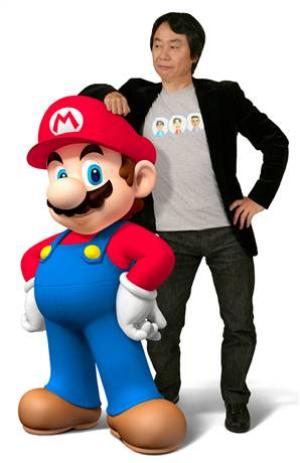
[Image courtesy: Giantbomb.com]
Shigeru Miyamoto was born on this day in Sonobe, Kyoto, Japan in 1952. He is 60 years old.
[OK raise your hand if you know who Shigeru Miyamoto is. For the three of you who know who he is … pat yourself on the back — you are a game playing hipster, and I appreciate you taking time away from your Wii to read this blog. For the rest of us… raise your hand if you’ve heard of Mario, Donkey Kong, Zelda or played Nintendo. Shingeru Miyamota is Mario’s father if you will.]
The Miyamoto grew up in a small town in the Kyoto region of Japan. Only a few of the homes in the area had Televisions, and Miyamoto’s wasn’t one of them.
Instead, he found entertainment in a steady stream of comic books and puppet shows. [Los Angeles Times ]
He also loved to explore the woods and caves around his town. He embraced the Manga style of art and had hopes of becoming a professional manga artist before switching to video.
A graduate of the Kanazawa College of Industrial Arts Miyamoto says his instructors didn’t always know what to make of him. “I made a lot of strange things in school,” [Ibid] and he was constantly thinking outside the box.
That kind of thinking (and some family connections) got him in the door at Nintendo in 1977. Instead of bringing a portfolio of drawings Miyamoto brought clothes hangers.
He had designed and made them for children who were too small to reach closet bars and too young for traditional, hooked, metal wire hangers. “I came up with a different solution,” Miyamoto said. “I made a wooden hanger that had a little cross shape which would fit into a notch on the wall. I painted pictures of elephants on them.” [Ibid]
He also showed them his idea for a three-way seesaw and an amusement park clock he designed. Nintendo loved it. He got the job.
His first big hit at Nintendo was Sheriff in 1979. He came to the rescue when the nascent Nintendo of America found itself with an overstock of Radar Scope arcade games. His challenge was to create a game that would fit into the existing stand up arcade style games.
He had always wondered why video games had no plot and felt that there was an unexplored potential for engrossing stories. He … desperately wanted to get the license for a Popeye game. Nintendo was unable to get it, however, so Miyamoto resorted to creating his own characters. [Nintendo.wikia.com]
What he came up with was Donkey Kong. The “hero” of Donkey Kong is, of course, Mario.
Donkey Kong as seen in Donkey Kong Country Returns (Photo credit: Wikipedia)
In 1984 Miyamoto entered the world of consuls withSuper Mario Bros. for the new Nintendo Entertainment System. It was a huge success and spawned a number of sequels.
Super Mario Bros. 2 (Photo credit: Wikipedia)
Next he developed the fantasy world for The Legend of Zelda.
The game was inspired by notable events that Miyamoto experienced as a child. For example, Miyamoto has expressed that he found it enjoyable to travel through an unknown city without the use of a map. This way, the person won’t know what they’ll find at every corner. He also found a maze like structure near his home as a child, which was also an influence for the game. Finding new things… brought joy to Miyamoto which would be incorporated into his game. [Ibid]
51 – The Legend of Zelda: Skyward Sword Pal Wii Demo (Photo credit: ddconsole)
As new Nintendo gaming counsels came out (which, conveniently, happened just in time for the Christmas selling season) he was involved in developing games that worked specifically for each product.
He takes inspiration from the world around him. That cave near his childhood home was the basis for The Legend of Zelda … The bathroom scale started Wii Fit, and a dog training class was the inspiration for Nintendogs.
He has dozens of titles to his name. Together Donkey Kong, Mario and Zelda have sold over 350 million copies.
Real Japanese Hero #1: Shigeru Miyamoto (Photo credit: Andy Heather)
[So here’s the big question… who is your favorite Miyamoto character?… I’m a Princess Peach girl myself. ]







 ritaLOVEStoWRITE