
“If people knew the reasons for my fears, they would Be able to understand my pain.” — Lucrezia Borgia

Italiano: Lucrezia Borgia ritratta nella “Disputa di Santa Caterina” dell’Appartamento Borgia, nella Sala dei Santi in Vaticano. (Photo credit: Wikipedia)
Lucrezia Borgia was born on this day in Subiaco, near Rome, Italy in 1480. Today is the 533rd anniversary of her birth.
Lucrezia was the daughter of the powerful Cardinal Rodrigo Borgia and his mistress Vannozza dei Cattanei, and younger sister of Cesare and Giovanni Borgia. When she was a toddler her father took the children away from their mother and sent them to live with his cousin, Adriana de Mila. The Cardinal took an active role in raising the children, making sure they were well-educated and properly brought up. He doted on pretty Lucrezia.
“Lucrezia was educated according to the usual curriculum of Renaissance ladies of rank, and was taught languages, music, embroidery, painting, etc…” [NNDB] She studied poetry and read the classics. She could converse in Latin, Italian, French and Greek. She was also a beauty. Her long blond hair, flawless complexion, hazel eyes and graceful stature were all the fashion in Renaissance Italy.
By eleven she was betrothed to a Spanish nobleman, Don Cherubin do Centelles, but that brokered arrangement was broken for a more advantageous one, with another Spaniard, Don Gasparo de Procida. Before the two could marry Cardinal Borgia became Pope Alexander VI, and “he annulled the union with Procida; in February 1493 Lucrezia was betrothed to Giovanni Sforza, Lord of Pesaro.” (Ibid)

Portrait of Pope Alexander VI. Painting located at Corridoio Vasariano (museum) in Florence (Firenze), Italy. Measures of painting: 59 x 44 cm. (Photo credit: Wikipedia)
This time Lucrezia, at 13, did walk down the aisle. Sforza was 15 years older than the girl and it was hardly a match made in heaven. So when the political winds shifted and the Pope wanted to annul the marriage his daughter didn’t object. But Sforza did. Alexander claimed the reason for the annulment was Sforza’s impotency, a charge the Lord of Pesaro vehemently denied — and offered to prove in front of anyone who cared to act as witness. He countered that Alexander and Lucrezia were having an incestuous relationship. He later recanted the allegations and accepted the annulment, but there were other Borgia enemies who took up the rumors.
Whispers of incest filled the streets of Rome and 14-year-old Lucrezia’s reputation was damaged beyond repair. There was also a claim that she poisoned her enemies. She allegedly had her own special formula for a an undetectable poison. She’s even supposed to have had a specially designed ring with a compartment for the poison and a tiny needle with which to administer it.

Coin of Lucrezia Borgia (Photo credit: Wikipedia)
Pope Alexander married her off again, this time to Alphonso of Aragon, the 18-year-old duke of Bisceglie, to firm up his political alliances with Naples. Although it was an arranged marriage the match was a happy one. Lucrezia and Alphonso had a baby, Rodrigo and seemed to be very much in love. Alas it only lasted 2 years. “Pope Alexander and Lucrezia’s brother Cesare sought a new alliance with France, and Lucrezia’s marriage to Alfonso was a major obstacle.” [Biography] Alfonso was attacked by assassins in the streets of Rome. He was brutally stabbed in the head, arm and leg. With the help of his own guards he made it back to the papal residence, where he was nursed by Lucrezia and others. But, while he was recovering an assassin (almost certainly working for her brother) gained admittance to the sick room and strangled him. Lucrezia was heart broken.
After Alphonso’s death Pope Alexander went away to survey a “new acquisition” and “left the administration of the Vatican and the Church in the hands of Lucrezia.” [trutv.com]

English: Lucrezia Borgia presiding over the Curia Romana in the abcense of her father Pope Alexander VI (Photo credit: Wikipedia)
But the political chess game that was Lucrezia’s life wasn’t over yet. Single again at 20 her father found her yet another husband Alfonso I d’Este. The d’Este family had heard the rumors of Lucrezia’s infamous behavior, they’d seen how her last two marriages had ended, and they knew how dangerous it was to dance with the Borgas . They bulked at the union, but when Alexander applied pressure — and upped the dowry — they gave in and the wedding took place in 1502. Lucrezia was packed up and sent to Ferrara.
At first her new life in Ferrara was very difficult. Her husband was distant and unloving, her new family was suspicious and shunned her and she was removed from everyone she had every loved — especially her baby, Rodrigo. But Alfonso d’Este and eventually his family came to realize she wasn’t the murderous adulterer she painted to be.”She won over her reluctant husband by her youthful charm (she was only twenty-two), and from that time forth she led a peaceful life, about which there was hardly a breath of scandal.” [NNDB]

Possibly portrait of Lucrezia Borgia (Photo credit: Wikipedia)
In 1503 Pope Alexander died and she was finally free from her role as the family’s pawn. Two years later Alfonso’s father died making the couple the Duke and Duchess of Ferrara.
During their seventeen year marriage Alfonso and Lucrezia had 6 children, 2 of whom lived to adulthood. (Rodrigo lived to be 12-years-old. Although Lucrezia tried she never saw her son after she left Rome)
As Duchess she helped make the court of Fererra a truly Renaissance place. She…
gathered many learned men, poets and artists at her court, among whom were Ariosto, Cardinal Bembo, Aldus Manutius the printer, and the painters Titian and Dosso Dossi. She devoted herself to the education of her children and to charitable works [Ibid]
She died due to complications of child birth on June 24, 1519.

English: Lucrezia Borgia (Photo credit: Wikipedia)
![De Forest with his dog [Image courtesy: UC Davis]](https://ritalovestowrite.com/wp-content/uploads/2013/02/roydeforest_w-uc-davis.jpg)
![Young General George (1976) [Image Courtesy: ]](https://ritalovestowrite.com/wp-content/uploads/2013/02/young-general-george-1976.jpg)
![Canis Prospectus (1986) [Image Courtesy: Preview Art]](https://ritalovestowrite.com/wp-content/uploads/2013/02/canis-prospectus-1986.jpg)
![Dogs were an important subject in De Forest's work. [Image courtesy SFMOMA]](https://ritalovestowrite.com/wp-content/uploads/2013/02/73-32_01_d02.jpg)
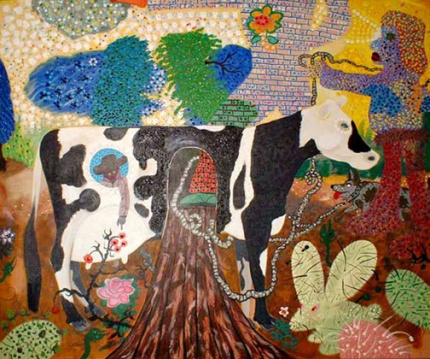
![Goat Daze [Image Courtesy: George Adams Gallery.]](https://ritalovestowrite.com/wp-content/uploads/2013/02/goat-daze.jpg)


 ritaLOVEStoWRITE