“When I perform Strauss, it is as if the music fits me like a glove. My voice seems to lie in a happy area in this music, which is lyrical and passionate at the same time.”–Kiri te Kanawa
Claire Mary Teresa Rawstron was born on this day in Gisborne, on the North Island of New Zealand in 1944. She is 69 years old.
She was adopted by Thomas and Nell Te Kanawa as an infant. She went to school at Saint Mary’s College in Auckland where she was trained to sing. In her teens and 20’s she was a popular singer in New Zealand. “She enrolled in the London Opera Center in 1966, and had her Covent Garden debut 1 December 1971.” [IMDb — Kiri Te Kanawa] Her first performance on stage was as the Second Lady in Mozart’s The Magic Flute.
She “was granted a three-year contract as a junior principal at Covent Garden.” [Bach Contatas.com] and soon came to…
international attention singing the role of Xenia in Boris Godunov and the Countess in Le Nozze di Figaro….after her successes at Covent Garden, Kiri Te Kanawa performed her Metropolitan Opera debut as Desdemona in Otello (replacing an ill Theresa Stratas). Her other performances include Fiordiligi in Cosi fan tutte, Arabella in Arabella, Rosalinde in Die Fledermaus, Violetta in La Traviata, Tosca in Tosca, Pamina in Die Zauberflöte and, most notably, her numerous performances as Donna Elvira in Mozart’s Don Giovanni.[Ibid]
Te Kanawa sang “Let the Bright Seraphim” at Prince Charles and Lady Diana’s wedding. Her “O Mio Babbino Caro,” and “Ch’il bel sogno di Doretta,” by Puccini, were featured in 1986’s “A Room With A View.”
She was made a Companion of the Order of Australia in 1990, awarded the Order of New Zealand in the 1995, made an Officer of the Order of the British Empire in 1973, and made “Dame Commander of the Order of the British Empire in 1982 for her services to music.” [IMDb — Kiri Te Kanawa]
But why am I TALKING about her when I could be letting you HEAR her sing ?
Here’s O Mio Babbino Caro by Puchinni
And how about a little Mozart on a snowy afternoon? Here’s Porgi amor from Le nozze di Figaro
When word reached Henry that Becket was hiring armed men to protect him he said “What miserable drones and traitors have I nourished and brought up in my household, who let their lord be treated with such shameful contempt by a low-born cleric?” [History of Britain, Schama, pg 142] It was said in a moment of frustration and anger, and probably not given as command, but it was all the anti- Becket faction needed. Four knights set out to murder the Archbishop while he was at Vespers in Canterbury Cathedral. “Almost overnight Becket became a saint. Henry reconciled himself with the church.” [BBC.co.uk] He was genuinely grief-stricken over the loss of his former friend. He did penance at Beckett’s tomb and reversed the Constitution of Clarendon.
Family
English: Henry II and his wife Eleonora (Photo credit: Wikipedia)
Henry had trust issues. Those extended to his family. Eleanor, 10 years Henry’s senior, was very much in love with him when they first married. She was a dutiful wife and bore him seven children, five of whom were boys. She traveled with him when she could. But he preferred to have Becket entertain visiting royalty — usually the Queen’s job — and he was a restless busy man who gave her titles but not power. She put up with it for 14 years before returning to Aquitaine to “assume personal control of the lands. Henry was left to his own affairs (of every sort) back in England.” [About.com]
Henry now had problems within his own family. His sons – Henry, Geoffrey, Richard and John – mistrusted each other and resented their father’s policy of dividing land among them. There were serious family disputes in 1173, 1181 and 1184. The king’s attempt to find an inheritance for John led to opposition from Richard and Philip II of France. Henry was forced to give way. [BBC.co.uk]
[James Goldman’s excellent play The Lion in Winter portrays a fictionalized Christmas between the imbittered royal family in 1183.]
Henry and Richard were at war in France when Henry took seriously ill. After so many years of refusing to name Richard his heir he was forced to do so at Ballan. He died on the 6th of July, 1189.
———————————————-
Links:
We saw The Lion in Winter at the American Shakespeare Center in Staunton, Virginia last summer. It was an amazing theatre and an awesome Shakespeare (and historical) experience. Click on the link and check them out.
James Keegan as King Henry in The Lion in Winter, 2012. Photo by Michael Bailey. [At the American Shakespeare Center.]
Henry II of England was born on this day in Le Mans, France in 1133. Today is the 880th anniversary of his birth.
Henry, Count of Anjou, Count of Maine, Duke of Normandy, Duke of Aquitaine, Count of Nantes, Lord of Ireland, and eventually King of England (1154–89) was the oldest child of Empress Matilda and Geoffrey the Fair. Matilda was the eldest daughter of England’s Henry I who died unexpectedly in 1135 without naming an heir. She had a strong claim that her baby boy, a direct male descendant should be next in line for the throne, but her cousin Stephen, Count of Blois, (aka Stephen the Usurper), got there first. Matilda, aided by her half-brother Robert of Gloucester, raised an army and a 17 year civil war ensued.
Stephen and Henry discuss across the River Thames how to settle the succession of the English throne. (Photo credit: Wikipedia)
Henry’s early years were spent in the Court of Anjou with his father, but beginning in 1142 the boy traveled to England to join the campaign. The years he spent living in a Spartan manner followed him the rest of his life and Henry eschewed the opulence and soft pleasures of other monarchs.
1151, Henry became ruler of Normandy and Anjou, after the death of his father. In 1152, he married Eleanor of Aquitaine, the greatest heiress in western Europe. In 1153, he crossed to England to pursue his claim to the throne, reaching an agreement that he would succeed Stephen on his death, which occurred in 1154. [BBC.co.uk]
Henry and Becket
The next order of business was to restore peace and order in England. To do that Henry turned to Thomas Becket. Together they rid the country of the robber barons, disloyal knights and criminals who were lapping up the offal of 17 years of war. As a reward for a job well done (and to strengthen his own power over the church) Henry named Becket Archbishop of Canterbury when the old Archbishop died. The church hierarchy was stunned and dismayed, Becket was the King’s man. He wasn’t even a priest. He was ordained on June 2nd, 1162, and consecrated Archbishop on June 3rd. But Becket surprised everyone, especially Henry. He undertook a religious transformation, and where he had been loyal wholly to the King he was now loyal only to God. He began to work to restore the powers of the Archbishop and the Church, especially in matters of Law.
English: King Henry II and Thomas Archbishop Česky: Jindřich II. a Thomas Beckett From the Liber Legum Antiquorum Regum, a 12th century work (Photo credit: Wikipedia)
Henry thought the Law of the Land superseded the Law of the Church. Becket disagreed. Henry called and assembly of clergy to Clarendon Palace in January 1164 where he demanded that Becket sign the Constitution of Clarendon which “established procedures of criminal justice, establishing courts and prisons for those awaiting trial. In addition, the assizes gave fast and clear verdicts, enriched the treasury and extended royal control.” [BBC.co.uk] In other words it gave Henry power over the church. After much heated debate Becket pledged an oath to the idea of the Constitution, but he refused to sign. Henry was satisfied. But later when Becket refused to say mass until the oath was overturned. Henry was outraged and had the Archbishop put on trail for treason. Becket fled for exile in France. A battle of wills ensued between two of Europe’s most stubborn men and neither Queen Elinor nor the Pope Alexander III could bring the parties together. Becket used the last most powerful arrow in his quiver. He tried to excommunicate Henry. Henry countered by threatening to arrest any one who supported Becket with treason. Becket’s support dwindled. He agreed to meet Henry in July of 1170. Becket accepted Henry’s legal supremacy in England. He was allowed to return to England. But he wasn’t willing to leave well enough alone.
Henry II with Thomas Becket, from a 13th-century illuminated manuscript (Photo credit: Wikipedia)
“If you do things out of time you’re weird.” — Robyn Hitchcock
[Image courtesy: TurnTableInterview.com]
Robyn Rowan Hitchcock was born on this day in London, England in 1953. He is 60 years old.
[I couldn’t find anything about Hitchcock’s upbringing or family. Nada. Zip. Really… I looked. If you can find something send a reply.]
He started his music career as a singer songwriter in the 1970’s. He listened to the Beatles, Dylan, the Velvet Underground and absorbed it all. He says he developed a kind of song writing muscle that takes hold every summer and starts producing with out his taking any notice of it. He genre hopped from Folk to Punk with his band, the proto-punk group The Soft Boys.
The Soft Boys (Photo credit: Wikipedia)
The group, “a punk-era band specializing in melodic, chiming jangle pop and clever lyrics” [All Music] mixed the psychedelic with the weird, but they kept away from the “aggressive, simplistic approach of most punk bands.” [About.com] Their “masterpiece” [Ibid] album Underwater Moonlight, released in 1980. Soon after Underwater Moonlight was released the group broke up and Hitchcock made his solo debut with Black Snake Diamond Role.
Black Snake Diamond Role represented a subtle but clear shift away from the more aggressive tone of The Soft Boys toward a more pop-oriented sound. “The Man Who Invented Himself” is user-friendly… and the production, while mostly straightforward, is …polished and professional. …the surrealism of the lyrics and the trippy undertow of the melodies are in the same league as Hitchcock’s earlier work…. Black Snake Diamond Role staked out a distinct sonic territory for Hitchcock’s solo career [All Music — Black Snake Diamond Role review]
Here’s I’m the Man with the Lightbulb Head:
The 80’s progressed with Groovy Decay and the all-acoustic I Often Dream of Trains. Then he formed Robyn Hitchcock and the Egyptians and produced the album that usually tops the Best of Robyn Hitchcock list, Fegmania!
Featuring layered, intertwining guitars and keyboards that created lush and thick sonic textures. … Fegmania! was Hitchcock’s most consistent work to date, featuring such highlights as the Eastern-tinged “Egyptian Cream,” and the creepy “My Wife & My Dead Wife,” and the relatively straightforward “The Man with the Lightbulb Head.” [All Music review of Fegmania!]
In 1988 he signed with A&M Records, thus widening his reach to an American audience. He put out Globe of Frogs in ’88 and (my favorite Hitchcock record) Queen Elvis ’89.
Here’s a live version of Lost Madonna of the Wasp:
and a very MTV version of the brilliant One Long Pair of Eyes:
Perspex Island and Respect followed in 2 year intervals for A&M. Then he switch to Warner for Moss Elixir for which he…
returned to the spare singer/songwriter format for his best set of songs in more than ten years. Everything is here: the quirky on “Man with a Woman’s Shadow,” and the elegant on “Beautiful Queen,” and the straight-ahead Beatlessque music in which Hitchcock excels in the perfect pop of “Alright, Yeah.” [All Music review of Moss Elixir]
He did a few more “solo” LPS — Jewels for Sophia, 1999, Luxor, 2003, and Spooked, 2004 — before teaming up various rockers to form the Venus 3 project in 2006. With Venus 3 he put out Olé! Tarantula, 2006, Goodnight Oslo, 2009 and Propellor Time, 2010. In 2011 he released Tromsø, Kaptein, on Hype City Records, a Norwegian label.
He has a new album, “Love from London,” coming out on Tuesday. He’ll be touring the UK and the US shortly to celebrate the album.
“Forty years ago, when I first got hold of an electric guitar, if someone had told me that at 60 I’d be playing amplified beat music, I would have just said, ‘Get out of here! … It’s like Mr. Rogers is playing guitar; that’s gross!’ But you know, rock ‘n’ roll is an old man’s game now.” [NPR: Weekend Edition]
English: Musician Robyn Hitchcock on stage at Iron Horse in Northampton, Massachusetts, 13 March 2005 (Photo credit: Wikipedia)
—————————–
This blog goes out to my buddy Sam who reminded me that today is Robin Hitchcock’s birthday. Sam, who is a freshman in college, learned about Hitchcock through his dad, Chip. He says “I think what I like most about Robyn’s style is his dreamy weirdness, but also the ability his songs have to be interpreted many different ways.” Some of Sam’s favorite Hitchcock songs are
Queen Elvis,
So You Think You’re In Love,
Victorian Squid,
Balloon Man,
The Man Who Invented Himself, and
The Man With The Lightbulb Head.
Blogger’s Note: When I started to thinking about Secondary Character Saturday somehow Alan Rickman kept coming to mind. He’s been around for a long time, he’s been in a LOT of great movies, and he’s almost always in the secondary character spot. He’s PERFECT for this blog segment. But WHICH Alan Rickman role to feature on Secondary Character Saturday? Ah that’s the rub. He’s done everything from rom-com, to Shakespeare, to comic science fiction, to serious drama. Which side of A.R. do I show? Frankly, I couldn’t decide. So I’m claiming the month of MARCH as Alan Rickman Month! (He’s also one of my all time favorite actors so I wont mind spending a month researching him and maybe re-watching a few movies!)
By: J.K. Rowling wrote the fabulous and engaging books. The movies were directed with varying degrees of success by different people. For my money Alfonso Cuarón saved (the movie) franchise from generic blandom with his wickedly good HP and the Prisoner ofAzkaban, and David Yates brought the magic in HP and the Deathly Hallows 1&2.
Released: The character of Severus Snape first appeared in June of 1997when Rowling published Harry Potter and the Philosopher’s Stone in Great Britain. We first got to see A.R. as Snape in 2001 with the release of Harry Potter and the Sorcerer’s Stone.
Pros: He’s brilliant, of course. He’s got fantastic wand skills and is so fab at potions that he literally rewrote the book. He’s inventive, hard-working, intuitive. He protects Harry even though he can’t stand him. He teaches Harry Occlumency so he can keep Voldemort out of his mind. He’s acts as a double agent for Dumbledore. And he’s loyal to Lily, his one true and unrequited love. Having made both Lily and Dumbledore (and Narcissa Malfoy) promises he stops at nothing to keep them. He’s the perfect Slytherin.
Still from HP and the Prisoner of Azkaban. Snape rushes in front of Harry, Ron and Hermione to protect them from a werewolf. Maybe he’s just being a good teacher/adult. But I doubt whether some other teachers at the school would have done the same. [Image courtesy: Warner Brothers]
Cons: Well… he’s mean. He’s REALLY mean to Harry! And that’s just not right! (OK I’ve got that off my chest. But lets face it, Snape isn’t the meanest one of the lot. He’s got nothing on Umbridge.) He’s a bully and he takes out his resentment for what James Potter did to him on Harry. He’s spiteful, malicious, angry, bitter, resentful, and cruel. He always favors Slytherin . He’s a double spy for Voldemort. He’s a Death Eater. And he KILLS Dumbledore! He’s the perfect Slytherin.
Most Shining Moment: I agree with Harry Potter Blog Spot who picks Dumbledore’s Death as Snape’s Shining Moment“For to honor Dumbledore’s wishes and protect Harry’s (and Draco’s) life, Snape risked the damage his own soul that this horrific act would bring.” [Harry Potter blog spot] It is the crowning action of commitment, loyalty and self-sacrifice, while on the outside (and to the reader) it looks completely the opposite.
Least Shining Moment: All the times he was meaner than he had to be to Harry and the other students who weren’t in Slytherin … and when he killed Dumbledore.
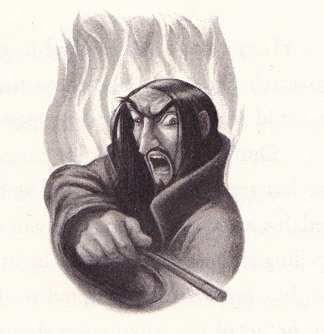
The Mary Grandpre illustration of Half-Blood Prince.
Yeah, I know I sound schizophrenic, but things with Snape are COMPLICATED. And nothing in the books was more complex and, dare I say, misleading, than Snape’s killing Dumbledore. When it happened it was THE WORST THING EVER in the HP universe and I didn’t think I could ever forgive Snape. Up until then Rawlings had given me enough ammunition to forgive away his nastiness towards Harry. But this? How could he be redeemed from this? Hmmmm. Things have changed.
He remained true to himself by remaining loyal to Dumbledore and his lost love. As the stakes and danger increased for him, and Dumbledore pushed him to greater acts of spying and risk, Snape met these challenges bravely, even if irritably, to protect the son of the man he loathed and thereby preserve the memory of the woman he loved. [Ibid]
Something clearly resonates with Snape. He was the top pick of for favorite character in a poll done by the H.P. British publisher Bloomsbury. He received 20% of the votes in the poll that asked readers to rank their favorite 40 characters. (Hermione came in second. Harry was a distant 5th!)
Not to take anything away from the Snape Rowlings painted on the page, but Alan Rickman’s nuisanced performance as the greasy haired potions professor had a lot to do with that high rating. He’s delightful to watch throughout the series. (He makes the first couple of movies bearable with his dark, snarkiness). And as Snape’s story arch progresses Rickman’s performance builds in a measured, restrained, mysterious pace. He respects the character enough not to give anything away. He’s multidimensional in a very limited scope of dimension, many shades of black, as it were. And he’s fun to watch … right up to the moment he makes you cry.
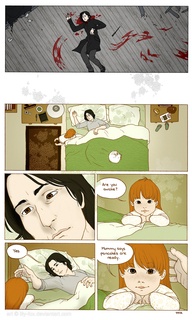
Sorry the text is small in the comic:This is what it says…
Snape wakes from the dream to find his daughter at his bed side.
She asks “Are you awake?”
He reaches out to touch her red hair — she looks so much like Lily “Yes.”
She smiles “Mommy says pancakes are ready.” Life is good.
Frankly… (if you haven’t guessed) I’m not a big fan of the HP movies. (LOVED the books — so don’t kick me out the club — but he movies… for the most part … eh.) But Rickman was always worth watching.
——————————————————————————————-
So which other A.R. characters should we tackle this month? We’ve got 4 more Saturdays in the month so get your votes in!
Hans Gruber (Die Hard’s evil bad guy)
Alexander Dane (Galaxy Quest’s classically trained science officer)
Dr. Blalock (the life saving doctor in Something the Lord Made)
Judge Turpin (the evil judge in Sweeny Todd)
Steven Spurrier (the wine snob from Bottle Shock)
Alex (the grief-stricken stranger in Snow Cake)
Jamie (the cello playing ghost in Truely, Madly, Deeply), or
Col Christopher Brandon (from Jane Austen’s Sense and Sensiblity) — Yeah, I’m doing Branon.
To see how Rickman “elevates the role of a villain from the plain ol’ bastard to a bastard coated bastard with bastard filling.”…go to the excellent blog The Many Faces of Alan Rickman.
“Stubborn and ardent clinging to one’s opinion is the best proof of stupidity.” –Michel de Montaigne
Painting by Thomas de Leu (Franco-Flemish painter and engraver, 1560–1612, active 1580-1610). An engraving of this painting was published in the first edition of Montaigne’s Essais, 1617. (Photo credit: Wikipedia)
He was born into a very wealthy French family, but as a toddler he lived with a peasant family for three years. This, his father thought, would give him an appreciation for the conditions of the poor.
The fourteenth-century château, in which Michel de Montaigne was born and died, was burnt down in 1885. But soon after rebuilt in a similar style by the Montaign family. Michel Eyquem de Montaigne (February 28, 1533 – September 13, 1592) was an influential French Renaissance writer, generally considered to be the inventor of the personal essay. Michel de Montaigne Another view: Flickr (Photo credit: Wikipedia)
When he returned to the Chateau he was taught by a German tutor and only spoken to in Latin and (eventually) in Greek. So Latin, not French, was his first language. “So the young Montaigne grew up speaking Latin and reading Vergil, Ovid, and Horace on his own. At the age of six, he was sent to board at the Collège de Guyenne in Bordeaux, which he later praised as the best humanist college in France.” [Stanford.edu] In 1546 he went to the University of Toulouse. He studied law and became a counselor of the Court des Aides of Périgueux before being appointed counselor to Parlement and serving as a courtier to Charles IX.
Michel Eyquem de Montaigne, statue sur l’Esplanade des Quinconces, Bordeaux (Photo credit: Wikipedia)
While at Parlement he became close friends with the humanist poet Etienne de La Boëtie whose early death greatly effected Montaigne. “the void left by La Botie’s death in 1563 likely led Montaigne to begin his writing career.” [Answers.com] He retired to the Château de Montaigne to study and write. Although he traveled a bit and served as Mayor of Bordeaux, but his primary office was as a writer.
He was…
one of the most influential writers of the French Renaissance. … He became famous for his effortless ability to merge serious intellectual speculation with casual anecdotes and autobiography — and his massive volume Essais (translated literally as “Attempts”) contains, to this day, some of the most widely influential essays ever written. Montaigne had a direct influence on writers the world over, from William Shakespeare to René Descartes, from Ralph Waldo Emerson to Stephan Zweig, from Friedrich Nietzsche to Jean-Jacques Rousseau. [Goodreads.com]
He died in his home in Montaigne of quinsy, a complication of tonsillitis at the age of 59, in 1592.
Français : Essais, éd de Bordeaux. (Photo credit: Wikipedia)
“Power does not corrupt. Fear corrupts… perhaps the fear of a loss of power.” — John Steinbeck
English: John Steinbeck (Photo credit: Wikipedia)
John Ernst Steinbeck, Jr. was born on this day in Salinas, California in 1902. Today is the 111st anniversary of his birth.
John Steinbeck home (Photo credit: sjb4photos)
His father was the treasurer for Monterey County, California. His mother, who had been a school teacher, instilled a love a reading and writing in he young Steinbeck. He graduated from high school in 1919 and went to Stanford University.
He worked his way through college at Stanford University but never graduated. In 1925 he went to New York, where he tried for a few years to establish himself as a free-lance writer, but he failed and returned to California. [Nobel Prize.org]
Back on California he met and married his first wife,Carol Henning, but he struggled to find work as a writer. For the first few years of the Great Depression his parents supported the junior Steinbecks and gave them a cottage to live in. “Steinbeck first became widely known with Tortilla Flat (1935), a series of humorous stories about Monterey paisanos.” [Ibid]
Of Mice and Men (Photo credit: Wikipedia)
The 1930s was …
his most productive decade, he wrote several novels about his native California, including Tortilla Flat (1935), set in Monterey; In Dubious Battle (1936), about fruit-pickers on strike in a California valley; and Of Mice and Men (1937), set on a ranch in Soledad, southeast of Steinbeck’s birth town. [Writer’s Almanac]
He had worked on local farms and ranches during the summers when he was growing up and he wrote from that first hand observation of the struggles of migrants and farm workers in his novels.
Cover of The Grapes of Wrath
In 1939 he published what is considered his best work, The Grapes of Wrath, the story of Oklahoma tenant farmers who, unable to earn a living from the land, moved to California where they became migratory workers. [Nobel Prize.org]
He won a Pulitzer Prize for the novel.
Steinbeck became a war correspondent for the New York Herald Tribune during World War II. He wrote from the Mediterranean and North Africa. He collected some of those stories in There Was a War.
Cover of Viva Zapata! [Region 2]
After the war he wrote Cannery Row and the screenplay for Lifeboat for Alfred Hitchcock. He recycled his characters from Tortilla Flat for the film A Medal for Benny.And he wrote The Pearl, which also was turned quickly into a movie. Followed by the screenplay for Viva Zapata!
East of Eden (novel) (Photo credit: Wikipedia)
He considered his next novel, East of Eden, his masterpiece. Other late works include …
The Winter of Our Discontent (1961), and Travels with Charley (1962), a travelogue in which Steinbeck wrote about his impressions during a three-month tour in a truck that led him through forty American states. He died in New York City in 1968. [Nobel Prize.org]
Steinbeck won “Nobel Prize in literature for his “realistic and imaginative writing, combining as it does sympathetic humor and keen social perception.” [Writer’s Almanac] in 1962.
He died six years later, in 1968, of congestive heart failure in New York City.
He was the third son of Joseph and Sophie Hugo. He was born during a time of national turmoil in France. His father supported Napoleon, his mother was a royalist. The family traveled often when he was young because of his father’s military postings. His mother separated from his father in 1803 and took the boys to Paris. There she raised them as Catholic Royalist.
Though a committed conservative royalist when he was young, Hugo grew more liberal as the decades passed; he became a passionate supporter of republicanism, and his work touches upon most of the political and social issues and artistic trends of his time. [Sony ReaderStore]
He began to write as a teenager. He created “tragedies and poetry, and translated Virgil. Hugo’s first collection of poems, Odes Et Poesies Diverses gained him a royal pension from Louis XVIII. [The Literature Network.com]
Bug-Jargal (1818) by Victor Hugo (1840-1902) (Photo credit: Wikipedia)
His first novel, Han D’Islande, came out in 1823 followed by Bug-Jargal in 1826. The later book “describes the friendship between the enslaved African prince Bug-Jargal and Leopold D’Auverney, a French military officer, during the slave revolt in Santo Domingo of August, 1791.” [Amazon.com]
The novel, set in 15th century Paris, tells a moving story of a gypsy girl Esmeralda and the deformed, deaf bell-ringer, Quasimodo, who loves her. Esmeralda aroses passion in Claude Frollo, an evil priest, who discovers that she favors Captain Phoebus. Frollo stabs the captain and Esmeralda is accused of the crime. Quasimodo attempts to shelter Esmeralda in the cathedral. Frollo finds her and when Frollo is rejected by Esmeralda, he leaves her to the executioners. In his despair Quasimodo catches the priest, throws him from the cathedral tower, and disappears. Later two skeletons are found in Esmeralda’s tomb – that of a hunchback embracing that of a woman. [books and writers]
For 20 more years Hugo continued to write lyrical poetry — he is considered France’s greatest poet — plays, novels and essays. He was a visual artist and statesman as well as a human rights activist.
English: Woodburytype of Victor Hugo (Photo credit: Wikipedia)
When the political landscape shifted in 1851 and Louis Bonaparte began to gain power. Hugo opposed the man, coining the phrase “we have had Napoleon the Great, now we have to have Napoleon the Small” [VictorHugo.gg]. When Napoleon grabbed power by way of a coup d’etat in December of that year Hugo fled the country for Brussels. Eventually he wound up on the island of Guernsey.
There, he wrote at a fast pace. And he wrote standing up, at a pulpit, looking out across the water. He had strict minimums for himself: 100 lines of poetry or 20 pages of prose a day. It was during this time that he wrote his masterpiece, Les Misérables (1865), about a poor Parisian man who steals a loaf of bread, spends 19 years in jail for it, and after his release becomes a successful small businessman and small-town mayor — and then is imprisoned once again for a minor crime in his distant past. [WritersAlmanac]
After Louis Bonaparte’s fall in 1870 Hugo returned home to Paris. He resumed his interest in politics and was elected to the National Assembly.
Les Mis (Photo credit: mgstanton)
Hugo died in 1885 at the age of 83. Two million people attended his funeral procession.
English: George Harrison in the Oval Office during the Ford administration. (Photo credit: Wikipedia)
]In 1968 Harrison’s interest in Indian music …
extended into a yearning to learn more about eastern spiritual practices. In 1968, he led the Beatles on a journey to northern India to study transcendental meditation under Maharishi Mahesh Yogi. [Biography.com]
That year the group’s White Album came out. Harrison penned “While My Guitar Gently Weeps,” “Piggies,” “Long, Long, Long” and “Savoy Truffle.” “While My Guitar Gently Weeps,” is ranked as #7 Greatest Guitar Song of All Time by Rolling Stone Magazine.
On Yellow Submarine he penned “Only A Northern Song” and “It’s All Too Much” both of which — like the rest of the album — were self indulgent and over produced.
He bounced back with Abbey Road which has two of Harrison’s best songs, “Something” and “Here Comes The Sun”
Let It Be had “I Me Mine Mine” and “For You Blue.” While recording Let It Be Harrison grew frustrated with the poor working conditions of the film studio as well as with the Lennon-McCartney lock on creative input on songs. He walked way from the recording sessions on January 10th, 1969. The other Beatles convinced him to return 12 days later but the writing was on the wall. The end was near for the super group.
When Beatles broke up in April of 1970 Harrison had a back log of music written and ready to produce. His first post-Beatles album was a triple disk, All Things Must Pass. The album yielded two hits “My Sweet Lord” and “What Is Life”
In 1971 he organized a charity concert at Madison Square Garden to raise money and awareness for the refugees in Bangladesh. The Concert for Bangladesh (and the concert film) was a fore runner to other multi-band high-profile charity concerts to come a decade later like Live Aid.
His next Album, Living in the Material World went Gold with in a week of its release. The single from the album, “Give Me Love (Give Me Peace on Earth)” became an international best seller.
But then things began to flatten out musically–sales wise at least. Harrison continued to write and experiment musically.
He “started his own film production company, Handmade Films. The outfit underwrote Monty Python’s Life of Brian and would go on to put out 26 other movies before Harrison sold his interest in the company in 1994.” [Biography.com]
In 1987 released Cloud Nine and began to work with a collection of rockers who formed the group the Traveling Wilburys.
The Traveling Wilburys, 1988. L–R: Roy Orbison, Jeff Lynne, Bob Dylan, George Harrison, and Tom Petty. (Photo credit: Wikipedia)
“In 1998, Harrison, a longtime smoker, reportedly was successfully treated for throat cancer.” [Ibid] Two years later the cancer returned, this time it had spread to his brain. He died in Los Angeles in November of 2001.
—————————–
Oy! Yesterday was full of frustration WordPress wise. I could NOT get a YouTube song/vid to successfully link.(And believe me I had TONS of great George clips to share.) So I’m trying again to day… with fresh optimism. … Here Comes the Sun…

![Kiri Te Kanawa [Image adapted from Last.fm.com]](https://ritalovestowrite.com/wp-content/uploads/2013/03/kiritekanawa-last-fm.jpg)


![James Keegan as King Henry in The Lion in Winter, 2012. Photo by Michael Bailey. James Keegan as Henry II in last summer's production of The Lion in Winter at the American Shakespeare Center.]](https://ritalovestowrite.com/wp-content/uploads/2013/03/henry.jpg)


![[Image courtesy: TurnTableInterview.com]](https://ritalovestowrite.com/wp-content/uploads/2013/03/turntableinterviewrobynhitchcock.jpg)


![Still from HP and the Prisoner of Azkaban. Snape rushes in front of Harry, Ron and Hermione to protect them from a werewolfe. Maybe he's just being a good teacher/adult. But I doubt whether some other teachers at the school would have done the same. [Image courtesy: Warner Brothers]](https://ritalovestowrite.com/wp-content/uploads/2013/03/azkaban1.jpg)


![Cover of "Viva Zapata! [Region 2]"](https://i0.wp.com/ecx.images-amazon.com/images/I/51MoPyo5A%2BL._SL300_.jpg "Cover of \"Viva Zapata! [Region 2]\"")


 ritaLOVEStoWRITE