
“I do not know how anyone can live without some small place of enchantment to turn to.”
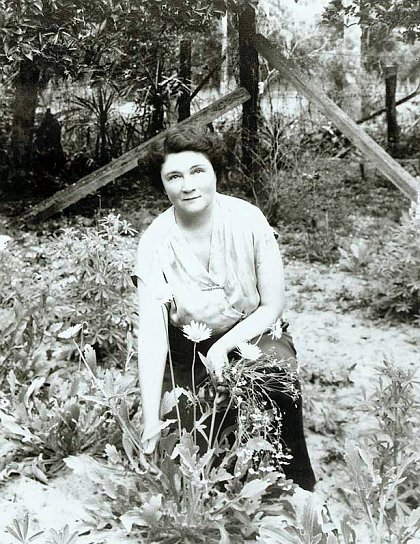
Rawlings in her garden.
Marjorie Kinnan was born on this day in Washington D.C. in 1896. Today is the 116th anniversary of her birth.
She got her love of nature from her parents. Although her father was a principal examiner in the U.S. Patent Office, he was happiest when he was walking his Maryland farm. Her mother grew up on a farm in Southern Michigan, and Marjorie would spend summers at the family homestead. According to The Marjorie Kinnan Rawlings Society website:
Living close to the land as she was growing up “planted deep in [her] a love of the soil, the crops, the seasons and a sense of kinship with men and women everywhere who live close to the soil”
At six she started to write short stories, some of which she submitted to the children’s section of the Washignton Post. At 15 her short story “The Reincarnation of Miss Hetty” won a literary prize and Marjorie was hooked.
When she was 17 her father passed away and she moved with her mother to Wisconsin. She attended the University of Wisconsin and her works were published in the Wisconsin Literary Magazine. While at the University she met Charles Rawlings.
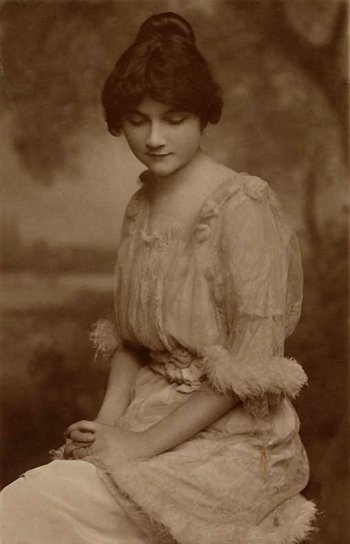
Rawlings in 1913.
After graduating with honors she moved to New York. She married Rawlings in 1919 and the couple moved to Louisville, Kentucky. They both wrote for the Louisville Courier-Journal (Charles was a features writer, Marjorie wrote the “Live Women in Louisville” column. When they moved to Rochester, New York Marjorie wrote poems about cooking, mending, gardening, et ect. in the syndicated column “Songs of a Housewife.“ It was distributed nationwide to 50 papers. She also worked on a novel, Blood of My Blood. The manuscript for Blood was lost for years, and the novel wasn’t published until 2002, nearly sixty years after her death.)
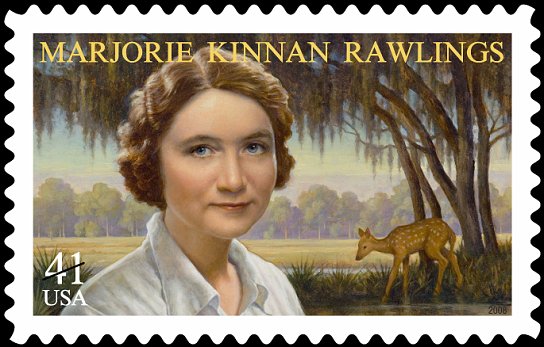
The US Postal Service stamp
When her mother passed away in 1928 she left Marjorie a small inheritance and the couple purchased an orange grove named Cross Creek near Hawthorne, Florida.
“This was not the Gold coast of Florida. . . . It was a primitive section off the beaten path, where men hunted and fished and worked small groves and farms for a meager living. . . . And the country was beautiful, with its mysterious swamps, its palms, its great live oaks, dripping gray Spanish moss, its deer and bear and raccoons and panthers and reptiles” [The Marjorie Kinnan Rawlings Society website]
Rawlings was smitten by the rough Floridian back wood and groves, and the people who lived there. She found a new voice as she began to chronicle their stories. Gal Young Un won the 1932 O Henry Award. She moved further into the “scrub” to research her novel South Moon Under. She stayed with Piety Fiddia and her son Leonard and learned how to kill rattlesnake and to make moonshine. The book was a Pulitzer Prize finalist and Book-of-the Month Club selection.
But the Florida wild was not for Charles Rawlings and the couple divorced in 1933.

Cover of The Yearling
Rawlings wasn’t happy with her next novel, Golden Apples, which she called “interesting trash instead of literature.” But, in 1939, she rebounded with her follow-up novel, The Yearling. The Yearling is a coming of age tale about a back woods boy named Jody Baxter who adopts a fawn, Flag. The book earned Rawlings a Pulitzer Prize for Literature. MGM made it into a major motion picture starring Gregory Peck as Jody’s kindly father “Penny” Baxter and Jane Wyman as his distant mother. (Both performers were nominated for Academy Awards).

Cover of Cross Creek
The autobiographical Cross Creek hit in 1942. Upon reading it one critic called Rawlings a “female Thoreau.” It was a Book-of-the-Month Club pick and stayed at the top of the best sellers list for months. It was also published in a special armed forces edition for those serving overseas in WWII. According to Powells City of Books the novel tells the story…
of Marjorie Kinnan Rawlings’s experiences in the remote Florida hamlet of Cross Creek, where she lived for thirteen years. From the daily labors of managing a seventy-two-acre orange grove to bouts with runaway pigs and a succession of unruly farmhands, Rawlings describes her life at the Creek with humor and spirit. Her tireless determination to overcome the challenges of her adopted home in the Florida backcountry, her deep-rooted love of the earth, and her genius for character and description result in a most delightful and heartwarming memoir.
Cover of Cross Creek Cookery

She wrote Cross Creek Cookery as kind of a companion piece in 1942. She’d been so descriptive about the food in Cross Creek that the readers deluged her with request for recipes. She shrugged, remembered the old adage that if you “Scratch a cook and you get a recipe” and began work on Cross Creek Cookery. It’s been called “the classic book on southern cooking” and is filled with over 250 recipes from alligator-tail, hush-puppies, sweet potato pone, grits, and desserts like Deadly Southern Pecan Pie. Rawlings loved to cook and entertain for, as she said:
“Food imaginatively and lovingly prepared, and eaten in good company, warms the being with something more than mere intake of calories.”
She married Norton S. Baskin, a long time friend and business associate in 1941.
Through out the 40’s she worked on her last book The Sojourner. Rawlings leaves Florida behind and sets The Sojourner in Michigan. Good Reads gives this synopsis of the book:
The Sojourner is the story of a good man: of the influence of his steady, quiet strength upon others, especially the members of his immediate family, and of what they–characters less strong and less stable–do to him throughout the course of a long life.
She bought a farm-house in Upstate New York to aid in the research of the book. It was published in 1953.
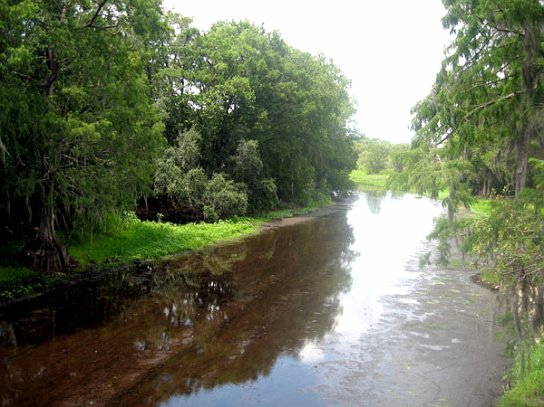
Cross Creek
[All photos are courtesy of the Marjorie Kinnan Rawlings: Author of The Yearling site. Click on the link to see many more photos of Cross Creek, Mrs. Rawlings, her articles and book covers.)




 ritaLOVEStoWRITE