Category Archives: History

Thought of the Day 7.22.12

“Give me your tired, your poor,
Your huddled masses yearning to breathe free,
The wretched refuse of your teeming shore.
Send these, the homeless, tempest-tost to me,
I lift my lamp beside the golden door!”

Emma Lazarus

Engraving

Engraving (Photo credit: Wikipedia)

Emma Lazarus was born in New York City in 1849. Today is the 163 anniversary of her birth.

She was the middle of seven children born to Moses and Ester Lazarus. The family lived very comfortably in the Union Square neighborhood of the city. They had ties to some of the earliest Jewish American families and were part of the Jewish upper class. She received a classical education and excelled in German and French, she loved to write and translate poems.

As antisemitism began to rise in Europe and America, Lazarus became more and more involved in the fight against it. As the Russian Pogroms caused large numbers of Jews to immigrate to the US she became more outspoken on refugee issues.

She wrote “The New Colossus”  for an auction to help pay for the pedestal for the Statue of Liberty. (France had donated the statue, the US had to come up with the money for the pedestal.) The sonnet perfectly exemplified the Mother of Exiles in the the New York Harbor. The poem was engraved into the Statue of Liberty’s base after Lazarus’ death.


She was an accomplished writer, publishing books of poetry, a novel, a play, and several translations for the American market. She sought out Emerson as her mentor, and the two shared a long friendship.

"I lift my lamp. . .

“I lift my lamp. . . (Photo credit: ckaiserca)


Thought of the Day 7.20.12

“People do not decide to become extraordinary. They decide to accomplish extraordinary things.”

–Sir Edmund Hillary
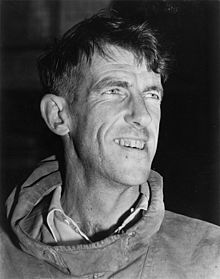
Edmund Hillary circa 1953 taken by an unidentified photographer. (Photo: Courtesy Wikimedia)http://upload.wikimedia.org/wikipedia/en/4/4a/Commons-logo.svg

Edmund Hillary was born in Auckland, New Zealand on this day in 1919. He would have turned 93 today.

Hillary’s interest in mountain climbing was sparked on a field trip at 16 to Mount Ruapehu.  The first mountain he climbed was Mount Ollivier in the Sealy Range on the country’s South Island in 1939. He became a beekeeper with his brother Rex, an occupation that left ample time for mountain climbing in the off season.

During WWII he joined the RNZAF (Royal New Zealand Air Force)  as a navigator.

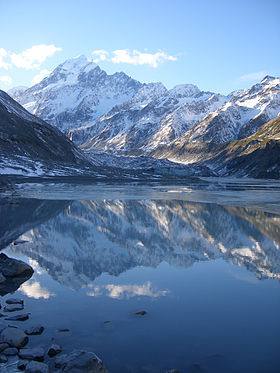
Aoraki/Mount Cook in Winter. (Photo: Wikimedia Commons) http://en.wikipedia.org/wiki/File:Commons-logo.svg

After the War he continued to climb his own country’s mountains, concurring Aorki/Mount Cook (New Zealand’s highest peak) in January of 1948. Next he travelled to Europe and tackled the Alps.

In 1951 Hillary went to the Himalayas. He joined expeditions in 1951 and 1952 to recon Everest. In 1952 He was part of a team that attempted (but didn’t reach) the summit of Cho Oyu from the South side.

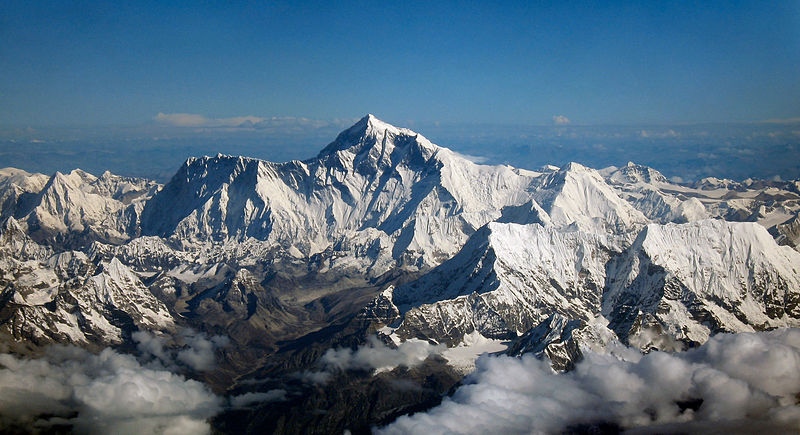
And in 1953 he was part of team to attempt 29,035ft summit of Everest. The group established 9 camps on the mountain (some of which are still in use today.) On May 26 the first team, Tom Bourdillon and Charles Evans tried for the peak. They got to about 300 ft from the summit but had to turn back. Problems with their oxygen tanks, bad weather and a fall had worked against them.
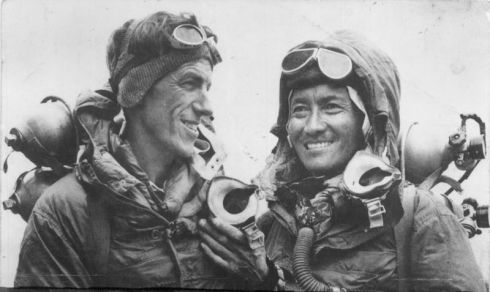
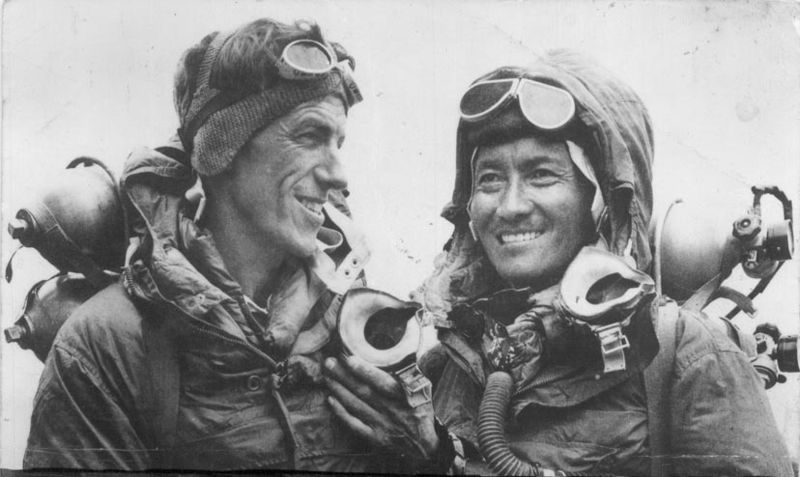
Edmund Hillary and Tenzing Norgay on their return from the summit.

So, the second team, Hillary and Tenzin Norgay made preparations for the ultimate climb. They woke early, but Hillary’s frozen boots  caused a 2 hour delay before they set off to forge the summit. They left camp at 6:30 pm. Almost at the top of the mountain they encountered a nearly vertical  40ft rock face. Hillary found a way to climb it by wedging his way up a crack. (The rock formation is now called the “Hillary Step.”) at 11:30 on May 29th, 1953 the two men stood at the top of the world.
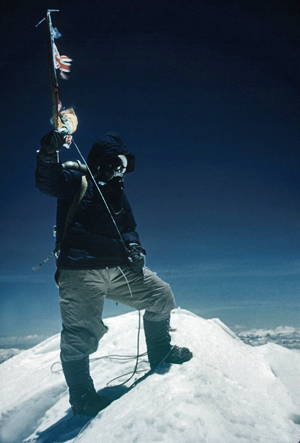
Tenzing Norgay on the summit of Mt. Everest as photographed by Edmund Hillary on May 29, 1953. Norgay offered to take a photograph of Hillary, but the later declined. They spent 15 minutes at the top of the World. They documented the event (to confirm that the ascent was not a fake); looking for any evidence that a previous team who had disappeared on the mountain might have made the summit (they didn’t find any); and leaving offerings of thanksgiving (Tenzing left chocolates, Hillary left a cross. (Photo courtesy of Wikimedia.)

Hillary‘s itch to explore turned to the Antarctic and in 1955-1958 he led the New Zealand party of  the Commonwealth Tran-Antarctic expedition  and participated in the first mechanized expedition tot he South Pole.

In 1985 he joined with another famous explorer, Neil Armstrong,  for a flight over the Arctic Ocean. The two landed at the North Pole, and Hillary became the first person to reach the northern most, southern most and highest point on Earth. (Armstrong, of course had gone a bit further.)
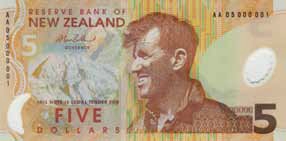
In 1992 New Zealand honored Hillary by putting his image on a $5 note. Since He was still alive this was a break with convention. (He is the only person to be awarded such an honor during his lifetime other than a head of state.) (Photo: Courtesy Wikimedia)

He returned to Nepal in the 1960s on several philanthropic missions to help the people. There he helped build clinics, hospitals and schools for the Nepalese people.  He enlisted the help of the New Zealand government to provide aid and technical support to Nepal in setting up the agencies needed to establish and run Everest National Park and the tourist industry that grew around climbing the peak. He spent the rest of his life working to help the Nepalese people.
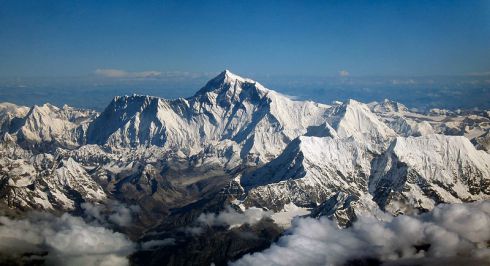
Mount Everest (Photo: Courtesy Wikimedia)


Thought of the Day 7.13.12

“All bad precedents begin as justifiable measures”

–Julius Caesar

Gaius Julius Caesar was born in Rome on this day in 100 BC.

He was a soldier, statesman and writer. After impressive victories on the battlefield Caesar turned to politics. He entered into a power sharing governorship, the First Triumvirate with Marcus Licinius Crassus and Gnaeus Pompeius Magnus (Pompey). Caesar proposed social reforms including the distribution of land to the poor (always popular with masses, but not so popular with the ruling class).

He went back to the provinces and looked toward unconquered territory to grow Rome’s (and his own) coffers. He conquered Gaul building a bridge to cross the Rhine and  invaded Britain. All the while his popularity with the people grew.

With the death of Crassus the Triumvirate was in trouble. Pompey was appointed sole consul. Caesar was told to disband his army  and return to Rome, but if he entered the city with out the immunity of a magistrate he could be prosecuted by his political enemies. Pompey accused him of insubordination and treason.  And when Caesar and his 13th Legion crossed the Rubicon the die was cast. Civil war ensued, and Caesar emerged the victor. He was appointed Dictator but after being elected to a second consulship he resigned as dictator.

Pompey had fled to  Egypt and Caesar went in pursuit. There he met the beautiful co-regent Cleopatra. The two became romantically involved, but, according to Roman law, could not get married. However their relationship continued for over a decade.

Caesar was assassinated on the floor of the Roman Senate by his political enemies on the Ides of March in 44 Ad.


Bust of Marcus Licinius Crassus located in the...

Bust of Marcus Licinius Crassus located in the Louvre, Paris (Photo credit: Wikipedia)


Thought of the Day 7.12.12

“There is no remedy for love but to love more.”

–Henry David Thoreau

Henry David Thoreau was born Concord Massachuset 1817. This is the 195th anniversary of his birth. 

Thoreau was an abolitionist, a naturalist,  a lecturer, a historian, a teacher, a surveyor, a pencil maker  and a writer.  He was inspired by his friend Emerson.. 

Thoreau made most of his money through surveying. He wrote that surveying “seems a noble employment  which brings you within hearing of [the birds].” He also helped to make Thoreau & Co., his family’s pencil making company one of the best in the America when he  developed a way of mixing clay with graphite to make a superior, “smudge-free” pencil. 

Thoreau loved nature. He would take long walks in the woods and he collected specimens of herbs, leaves and flowers, storing along the way. He stored them in his hat until he got home.,  then he or his sister Sophia carefully press them. He carried a notched stick that acted as both walking stick and a measuring stick. He also brought along a copy of Alexander Wilson’s bird anthology to identify the birds in the trees.  In 1845 he built his own cabin near  Walden Pond, on property owned by Emerson,  and lived for two years. His goal was to “live deliberately, to front only the essential facts of life, and see if I could not learn what I had to teach.”   He wrote about his time there in A week on the Concord and Merrimack Rivers (a memorial to his late brother) and, after seven full drafts,  Walden.

His work as an abolitionist  included “Slavery in Massachusetts, and a trio of essays about John Brown. 

English: Portrait drawing of Henry David Thoreau

English: Portrait drawing of Henry David Thoreau (Photo credit: Wikipedia)


Thought of the Day 7.11.12

“If your actions inspire others to dream more, learn more, do more and become more, you are a leader.”

–John Quincy Adams

English: John Quincy Adams

English: John Quincy Adams (Photo credit: Wikipedia)

John Quincy Adams was born in Braintree, Massachusetts in 1767. Today is the 245th anniversary of his birth.

Eldest son of John and Abigail Adams, John Quincy grew up a child of the Revolution. His father was THE voice calling for  Independence from Britain in the Continental  Congress.  When he was 8 years old he watched the Battle of Bunker Hill from his parent’s farm.

After the War he travelled with his father to Europe, acting as his secretary. He attended Harvard and became a lawyer and at 26 was appointed Minister to the Netherlands. He became a US Senator in 1802 and when his term was up he was appointed as Minister to Russia by President Madison.  His international service to the US included the negotiation of numerous treaties including the Treaty of Ghent (that ended the War of 1812.) While Secretary of State under President Monroe he nailed down America’s border with Canada as far as the Pacific Ocean and was instrumental in forming the Monroe Doctrine and acquiring Florida from Spain.

The Presidential election in 1824 was decided in the House of Representatives. Since no candidate had garner a majority of the electoral votes  in the popular count it  was a three-way run off between JQ Adams, Andrew Jackson and Henry Clay. Clay’s platform was similar to Adams’ so he ceded his support to Quincy. Adams in turn named Clay as Secretary of State. Jackson, left out in the cold, raised angry cries of “corrupt bargaining” and began an aggressive campaign to gain the White House in 1828.

As President, Quincy started the first system of interstate roads and canals (breaking ground for the C&O Canal in 1828), he worked to modernize the US economy and paid off much of the National Debt,  encouraged the arts and sciences with a national university, scientific expeditions and an observatory. But he was thwarted on many of his initiatives by an uncooperative Congress.

In 1828 he was defeated in his bid for a second term after a bitter and messy campaign against Jackson and returned to his beloved Massachusetts only to be unexpectedly elected to the US House of Representative in 1830. He is the only  man to have served first as President and then in the House of Representatives, but his 17 years in the House were far more successful than his 4 years in the White House. Ever a stalwart proponent of civil liberties, Adams now became a leading voice against Slavery. He fought against the “gag rule”   — a resolution that automatically tabled any petition having to do with Slavery without review — by attempting to use parliamentary procedures to circumvent the rule. Eventually enough Congressmen from the North came down on the side of  antislavery and freedom of expression, and Adam’s argument gained favor. In 1844, after 8 years of fighting against it, the House rescinded the “Gag Rule” on a motion made by John Quincy Adams.

In 1840 Adams, “Old Man Eloquent,”  argued successfully for the defendants in the  Amistad case in front of the Supreme Court.

JQ Adams suffered a stroke while on the floor of the House of Representatives. He was taken to the Speaker’s Chambers and died four days later.

John Quincy Adams portrait. "John Quincy ...

John Quincy Adams portrait. “John Quincy Adams”. Metropolitan Museum of Art . . Retrieved September 4, 2009 . (Photo credit: Wikipedia)


Thought of the Day 7.6.12

“I have not yet begun to fight”

John Paul Jones

John Paul was born in Arbigland Scotland in 1747. Today is the 265 anniversary of his birth.

At 13 he started his seaman’s apprenticeship. After a brief stint on Slave Ships — which he quit calling it an “abominable trade” — and time as a Master Supercargo (the officer in charge of buying and selling the cargo of a ship), Paul became a captain at 21.  He worked the trans Atlantic routes to the Caribbean and Virginia and amassed a small fortune in the merchant marine business by 1773, but his hot temper got him into trouble more than once. And when he killed a mutineer in the West Indies he had to flee to Virginia. It was then that he changed his name to John Paul Jones.

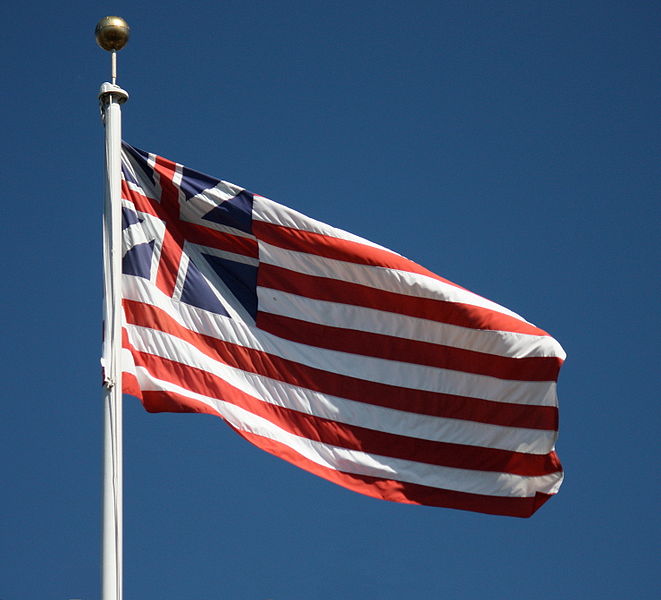
War with England was brewing and John Paul Jones offered his services on the sea. With the endorsement of Richard Henry Lee, Jones was commissioned as a First Lieutenant into the vast Continental Navy (they only had six vessels) on December 7th, 1775. As his ship, the Alfred set sail from the Delaware River on its maiden cruise he hosted the Grand Union Flag, (the first national flag of the United States,) it was the first time a US ensign was flown over a naval vessel. He next took command of the sloop Providence. He captured 16 prizes along the coast of Nova Scotia. Although he argued with Naval authorities, his reputation grew, he was given command of the USS Ranger and set sail for France. There he befriended American diplomats in Paris John Adams, Arthur Lee, and especially Benjamin Franklin (he named one of his boat the Bonhomme Richard in honor of Franklin’s Poor Richard’s Almanac.)  When the Bonhomme Richard was in dire straights in the Battle of Flamborough Head with the frigate Serapis he was offered the chance to surrender. Jones, of course answered that he had not yet begun to fight. He lost the Richard, but went on to capture the larger frigate.  Jones later earned the moniker  “Father of the American Navy.”

After the American Revolutionary War  Thomas Jefferson (who was then the American Ambassador to France) recommended him for service in Catherine II’s  Russian Navy. John Paul Jones then became Kontradmiral check Pavel Ivanovich Jones and served with Potemkin in the Black Sea campaign.

John Paul Jones, line drawing

John Paul Jones, line drawing (Photo credit: Wikipedia)

This media file is in the public domain in the United States. This applies to U.S. works where the copyright has expired, often because its first publication occurred prior to January 1, 1923.

A replica of the Grand Union Flag, the first flag of the United States of America.
(This image has been released into public domain by its author, Makaristos, and is courtesy Wikipedia.)


Public domain I, the copyright holder of this work, release this work into the public domain. This applies worldwide.
In some countries this may not be legally possible; if so:
I grant anyone the right to use this work for any purpose, without any conditions, unless such conditions are required by law.

Thought of the Day 7.5.12

“If I shoot at the sun I may hit a star”

— P.T. Barnum

Phineas Taylor Barnum was born in Bethel, Connecticut in 1810. He would be 202 years old today.

According to the Ringling Bros. and Barnum & Bailey website P.T. Barnum presented “the public of the 19th century shameless hucksterism, peerless spectacle and everything in between.”  The consummate promoter, Barnum began by presenting acts in New York. Here’s a few of the live acts and curiosities the “Master Showman” brought to the public: Joice Heth — a blind, nearly paralyzed slave woman, whom he claimed was the 161 year old Nurse to George Washington;  Charles Stratton, aka General Tom Thumb– “The Smallest Person that Ever Walked Alone;” and the embalmed remains of the “Feejee Mermaid.” In 1850 he presented a more refined act when he brought “The Swedish Nightingale” Jenny Lind to the American Stage.

In 1870 Barnum took his show on the road with P.T. Barnum’s Grand Traveling Museum, Menagerie, Caravan and Circus. The Circus made $400,000 its first year and quickly became known as the “The Greatest Show on Earth”  Barnum also started America’s first aquarium.

Barnum lectured as a temperance speaker, served two terms in the Connecticut legislature and was mayor of Bridgeport.

Image courtesy of the Ringling Bros. and Barnum & Baily Circus website


Thought of the Day 7.2.12

“None of us got where we are solely by pulling ourselves up by our bootstraps. We got here because somebody – a parent, a teacher, an Ivy League crony or a few nuns – bent down and helped us pick up our boots.”

Thurgood Marshall

Thurgood Marshall was born in Baltimore, Maryland in 1908. Today would have been his 104th birthday.

The grandson of a slave, Marshall knew first hand the long arm of a segregated society.  In 1930, after graduating cum laude from Lincoln University,  he applied to the University of Maryland Law School, but wasn’t accepted because of his race. Marshall went instead to Howard University Law School where he graduated magna cum laude. He later successfully sued UofM to admit Donald Murray to the Law school.

He moved to New York and became a special counsel for the NAACP. He helped draft  the constitutions for Ghana and Tanzania on the behest of the United Nations.

Marshall argued in numerous Supreme Court cases, most revolving around segregation. The landmark decision of Brown v. Board of Education of Topeka, Kansas demolished legal “separate but equal” segregation in the United States.

In 1961 Marshall was appointed by President Kennedy  as a circuit judge.  In 1965 President Johnson appointed him Solicitor General, and in 1967 Thurgood Marshall was appointed to the Supreme Court of the United States. He served on the Court until 1991.

He saw the Constitution as  living document , noting in 1987 on the bicentennial of the Constitution that:

“the government they devised was defective from the start, requiring several amendments, a civil war, and major social transformations to attain the system of constitutional government and its respect for the freedoms and individual rights, we hold as fundamental today…Some may more quietly commemorate the suffering, struggle, and sacrifice that has triumphed over much of what was wrong with the original document, and observe the anniversary with hopes not realized and promises not fulfilled. I plan to celebrate the bicentennial of the Constitution as a living document, including the Bill of Rights and the other amendments protecting individual freedoms and human rights.”


Thurgood Marshall, appointed by Kennedy to the...

Thurgood Marshall, appointed by Kennedy to the United States Court of Appeals for the Second Circuit. (Photo credit: Wikipedia)


Thought of the Day 6.28.12

“There are many little ways to enlarge your child’s world. Love of books is the best of all.”

-Jacqueline B. Kennedy Onassis


Jacqueline Lee Bouvier was born on this day in Southampton, New York, in 1929. She would have been 83.

She she had a  privileged childhood full of books and riding lessons. She went to Vassar College and after her Junior year abroad, in France, transferred to George Washington University.  In 1951 she began to work for the Washington Times-Herald newspaper as an “Inquiring Camera Girl,” roving the streets of the city shooting the people she met and asking them for their opinions on current events. One of the people  she met was a young Congressman — and soon to be Senator — from Massachusetts, John F. Kennedy.

Bouvier and Kennedy  wed in 1953. In 1960 he ran for President of the United States. Jackie was  pregnant with their second child and was confined to home, but she helped Jack with the campaign by writing a weekly column “Campaign Wife,” filming commercials and answering letters. Kennedy won the election by a narrow margin over Richard Nixon.  and Jackie became First Lady (a term she disliked because it made her sound like a race horse.)

As First Lady she made renovations to the White House, promoted the arts, and became Good Will Ambassador  to the World. But above all she wanted to be a good wife and mother. “If you bungle raising your children, I don’t think whatever else you do well matters very much.”

President Kennedy was assassinated on November 22, 1963 in Dallas, Texas, and Jackie became a widow at the age of 34.

In 1968 she fell in love with Aristotle Onassis a Greek shipping magnate and the two married. Sadly, Onassis died in 1975, leaving her a widow for the second time.

Jackie returned to the publishing world, becoming an editor at Viking Press and then a senior editor at Doubleday Press.

She died on May 19, 1994 and is buried next to President Kennedy at Arlington National Cemetery.


Mrs. Kennedy's trip to India. Udaipur, Rajasth...

Mrs. Kennedy’s trip to India. Udaipur, Rajasthan, cruise on Lake Pichola, March 17, 1962. (Photo credit: Sacheverelle)