Category Archives: History

Thought of the Day 11.20.12 Robert F. Kennedy

“It is from numberless diverse acts of courage and belief that human history is shaped. Each time a man stands up for an ideal, or acts to improve the lot of others, or strikes out against injustice, he sends forth a tiny ripple of hope.”


“People say I am ruthless. I am not ruthless. And if I find the man who is calling me ruthless, I shall destroy him.”


“I believe that, as long as there is plenty, poverty is evil.”


“Ultimately, America’s answer to the intolerant man is diversity, the very diversity which our heritage of religious freedom has inspired.”


Robert F. Kennedy


Robert F. Kennedy, Cabinet Room, White House, ...

Robert F. Kennedy, Cabinet Room, White House, Washington, DC. (Photo credit: Wikipedia)


Robert Francis Kennedy was born on this day in Brookline, Massachusetts in 1925. Today is the 87th anniversary of his birth.


He was the seventh of nine Kennedy children, the third son. The family split their time between New York and their summer home in Hyannis Port, Massachusetts. Bobby attended public schools until 6th grade. He went to a series of private schools including a Benedictine boarding school for boys and Milton Academy.


Shortly before he turned 18 he enlisted in the US Naval Reserve. He participated in the V-12 Navy College Training Program at Harvard and Bates College from 1944 to 1946 and served  on the USS Joseph P. Kennedy, Jr, a destroyer named after his brother, on it’s shakedown cruise  in the Caribbean. He was honorably discharged later that year. He then went on to the University of Virginia Law School.


English: Kennedy brothers; left to right John,...

English: Kennedy brothers; left to right John, Robert, Ted. Česky: Bratři Kennedyové – vlevo John F., uprostřed Robert F. (Photo credit: Wikipedia)


In 1952 he managed John F. Kennedy’s run for U.S. Senate. His brother won the Senate seat and Robert Kennedy served


briefly on the staff of the Senate Subcommittee on Investigations, chaired by Senator Joseph McCarthy. Disturbed by McCarthy’s controversial tactics, Kennedy resigned from the staff after six months. He later returned to the Senate Subcommittee on Investigations as chief counsel for the Democratic minority, in which capacity he wrote a report condemning McCarthy’s investigation of alleged Communists in the Army. [John F. Kennedy Presidential Library & Museum]


Next he tackled corruption in trade unions as Chief Counsel for the Senate Rackets Committee. His book The Enemy Within details the corruption he confronted with the Teamsters and other unions.


In 1956 he was an aide to Democratic presidential  nominee Adlai Stevenson. Stevenson lost, but the experience was good training. Bobby took the reigns again for his brother’s bid for the presidency against Richard Nixon in 1960. When John Kennedy won he made Bobby the Attorney General.


He fought organized crime  and “became increasingly committed to helping African-Americans win the right to vote.” [Ibid] In a 1961 speech in Georgia he said:


“We will not stand by or be aloof. We will move. I happen to believe that the 1954 [Supreme Court school desegregation] decision was right. But my belief does not matter. It is the law. Some of you may believe the decision was wrong. That does not matter. It is the law.” [Ibid]


He worked with the administration  to create the Civil Rights Act of 1964.


Attorney General Robert F. Kennedy speaking to...

Attorney General Robert F. Kennedy speaking to a crowd of African Americans and whites through a megaphone outside the Justice Department; sign for Congress of Racial Equality is prominently displayed. (Photo credit: Wikipedia)


He was also instrumental in foreign affairs including the Berlin Crisis of 1961 and the Cuban Missile Crisis of 1962.


John F. Kennedy was assassinated in Dealey Plaza, Dallas, Texas on November 22, 1963. Robert Kennedy was devastated by the death of his brother and friend. He even felt guilt — had his aggressive pursuit against organized crime and obsession to “get” Castro  some how brought this about? [I won’t even attempt to resolve the myriad of conspiracy theories here. Suffice it to say Bobby was not the same man after the death of his brother.]


He resigned from his post as Attorney General nine months after the assassination and began a run for U.S. Senate. He won the seat.


He climbed Mount Kennedy, a mountain that was named for his brother and the highest peak in Canada that had not be summited, in 1965.


In 1966 he went to South Africa to speak out against the Apartheid government. He dared to ask “Supposed God is black? What if we go to Heaven and we, all our lives, have treated the Negro as an inferior, and God is there, and we look up and He is not white? What then is our response?”


As Senator he also spoke out against the Vietnam War, continued to work for Civil Rights and the War on Poverty.


He sought to remedy the problems of poverty through legislation to encourage private industry to locate in poverty-stricken areas, thus creating jobs for the unemployed, and stressed the importance of work over welfare. [John F. Kennedy Presidential Library & Museum]


On March 16, 1968 he declared his bid for the Presidency. His platform was based on racial and economic justice, he was also  anti-war


…he challenged the complacent in American society and sought to bridge the great divides in American life – between the races, between the poor and the affluent, between young and old, between order and dissent. His 1968 campaign brought hope to an American people troubled by discontent and violence at home and war in Vietnam.[Ibid]


When Martin Luther King, Jr. was assassinated in April of 1968 Kennedy found out about it minutes before he was to give a speech in downtown Indianapolis. He could have gotten back in his limo and let some one else make the announcement to a crowd that was certain to be upset by the news, but he stepped in front of the inner city crowd and gave an impromptu speech calling for reconciliation between the races.


http://youtu.be/j6mxL2cqxrA?t=3m


Many other American cities burned after King was killed. But there was no fire in Indianapolis, which heard the words of Robert Kennedy… a well-organized black community kept its calm. It’s hard to overlook the image of one single man, standing on a flatbed truck, who never looked down at the paper in his hand — only at the faces in the crowd. [NPR.org]


Kennedy also fell victim to an assassin’s bullet. He was fatally shot at the Ambassador Hotel in Los Angeles, California on June 5, 1968. He had just won California’s Democratic Primary.


The Robert F. Kennedy Memorial

The Robert F. Kennedy Memorial (Photo credit: Bernt Rostad)


[One of my earliest real memories is watching the train that carried Robert Kennedy’s body to its Arlington National Cemetery. My parents had taken us all on a picnic at the the ball field near the train tracks. We weren’t the only family there, there were lots of kids playing and other families on blankets eating cold chicken and potato salad. Then a train rolled through and all the adults stood up and faced the tracks. We kids didn’t need to be hushed. My mother was silently crying. I took her hand and asked her what was going on. As the flag festooned final car passed she whispered “A great American is on that train.”  And then it was over. We packed up the picnics. No one was hungry or wanted to play any more.]

[Do you have a Bobby Kennedy story? Share it with us please.]


Thought of the Day 11.9.12 Benjamin Banneker

“Evil communication corrupts good manners. I hope to live to hear that good communication corrects bad manners.”

“The colour of the skin is in no way connected with strength of the mind or intellectual powers.”

“Presumption should never make us neglect that which appears easy to us, nor despair make us lose courage at the sight of difficulties”

Benjamin Banneker

Woodcut of Benjamin Bannecker

Woodcut of Benjamin Bannecker (Photo credit: Wikipedia)

Benjamin Banneker was born on this day outside Ellicott City, Maryland USA  in 1731. Today is the 281st anniversary of his birth.

His maternal grandmother, Molly Walsh, had been an indentured servant who came to colonial Maryland from Ireland. At the end of her seven years of bondage she bought a small farm and two slaves. Eventually she freed the slaves, marrying one of them, Bannaky. Their daughter Mary Bannaky married a slave named Robert (who may have been a fugitive; may have been freed after the wedding;  or may have been bought out of slavery after the wedding).  Mary and Robert had four children, Benjamin and his three younger sister.

All of the children had to help run the tobacco farm. They weeded the tobacco plants, picked worms and caterpillars off the leaves… by Benjamin’s calculation it took 36 chores to raise a crop of tobacco. He also cared for the farm animals, helped plant the corn, and did other farm chores with this father.

His maternal grandmother used a Bible to teach Benjamin (and her other grandchildren) how to read.

He learned to play the flute and the violin, and when a Quaker school opened in the valley, Benjamin attended it during the winter where he learned to write and elementary arithmetic. He had an eighth-grade education by time he was 15, at which time he took over the operations for the family farm. He devised an irrigation system of ditches and little dams to control the water from the springs (known around as Bannaky Springs) on the family farm. Their tobacco farm flourished even in times of drought. [Mathematicians of the African Diaspora]

It was at school that a teacher suggested he change his last name to the more anglicized Banneker, the rest of the family followed suit.

He loved to read and to do arithmetic . He taught himself advanced mathematics and eventually astronomy.

He would borrow books from his neighbors and friends. His close friends, the Ellicott brothers, lent him most of their books. [American Heroes: Benjamin Banneker]

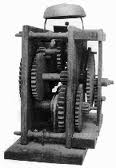
A clock similar to the one Banneker made.

He loved puzzles and challenges too.

Sometime in the early 1750s, Benjamin borrowed a pocket watch from a wealthy acquaintance, took the watch apart and studied its components. After returning the watch, he created a fully functioning clock entirely out of carved wooden pieces. The clock was amazingly precise, and would keep on ticking for decades. As the result of the attention his self-made clock received, Banneker was able to start-up his own watch and clock repair business. [Famous Black Inventors]

He predicted the solar eclipse of 1789. He earned the nickname the “Sable Astronomer” He started to compile information into Almanac and Ephemeris of Pennsylvania, Delaware and Maryland best-selling almanacs. He even put a skylight in the ceiling of his cabin so he could watch the stars at night. He sent a copy of his almanac to Thomas Jefferson along with “a letter urging the abolition of slavery.” [Ibid]

When Banneker was 60 George Washington appointed him along with his friend Andrew Ellicott to survey what would become the District of Columbia.

A contemporary reprint of Andrew Ellicott's 17...

A contemporary reprint of Andrew Ellicott’s 1792 “Plan of the City of Washington in the Territory of Columbia” (Photo credit: Wikipedia)

Banneker and Ellicott worked closely with Pierre L’Enfant, the architect in charge. However, L’Enfant could not control his temper and was fired. He left, taking all the plans with him. But Banneker saved the day by recreating the plans from memory. [Mathematicians of the African Diaspora]

[For more on Pierre L’Enfant visit his Thought of the Day bioBlog HERE]

He published a treatise on bees, did a mathematical study on the cycle of the seventeen-year locust, and became a pamphleteer for the anti-slavery movement. [Mathematicians of the African Diaspora]

On October 9, 1806 Banneker died at his Ellicott City/ Oella farm.

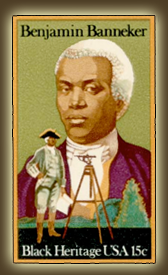
The Banneker postage stamp. [Image courtesy: USPS]

In 1980, the U.S. Postal Service issued a postage stamp in his honor. [Benjamin Banneker Center]

Benjamin Banneker

Benjamin Banneker (Photo credit: crazysanman.history)


Thought of the Day 11.6.12 John Philip Sousa

“Jazz will endure just as long people hear it through their feet instead of their brains.” –John Philip Sousa

John Philip Sousa, the composer of the song.

John Philip Sousa, the composer of the song. (Photo credit: Wikipedia)

I can’t think of any one who would make a better Thought of the Day Bio subject on Election Day 2012 than John Philip Sousa. He practically wrote the soundtrack for American patriotism AND he’s got a great mustache. What’s not to like?

He was born on this day in Washington, DC, USA in 1854. Today is the 158th anniversary of his birth.

He started his music career playing the violin, and soon added voice, piano, flute, cornet, baritone, trombone and alto horn to the mix.  After John Phillip tried to run away to join a circus band, his father, John Antonio Sousa,  “enlisted him in the Marines at age 13 as an apprentice…”[John Philip Sousa] in 1867.

He wrote and published his first composition “Moonlight on the Potomac Waltzes” in 1875 and was honorably discharged from the Marines two years later. Sousa “began performing (on violin), touring and eventually conducting theater orchestras. Conducted Gilbert & Sullivan’s H.M.S. Pinafore on Broadway.” [Ibid] While rehearsing Pinafore he met his wife Jane van Middlesworth Bellis.

In 1880 he returned to the US Marine Band as the Band’s leader, a post he kept for next 12 years.  Sousa conducted

“The President’s Own”, serving under presidents Hayes, Garfield, Cleveland, Arthur and Harrison. After two successful but limited tours with the Marine Band in 1891 and 1892, promoter David Blakely convinced Sousa to resign and organize a civilian concert band. [Ibid]

Sousa and his newly-formed civilian band, 1893

Sousa and his newly-formed civilian band, 1893 (Photo credit: Wikipedia)

Sousa wrote his own operetta, El Capitan in 1895.

He wrote 136 marches including Semper Fidelis March, King Cotton, Fairest of the Fair, Hands Across the Sea, And Stars and Stripes Forever — which he wrote in 1896. (In 1987 Congress proclaimed it the National March of the United States)

He designed a new type of bass tuba called the sousaphone. The Sousa Band toured throughout the world.

During World War I, Sousa joins the US Naval Reserve at age 62. He is assigned the rank of lieutenant and paid a salary of $1 per month…. After the war, Sousa continued to tour with his band. He championed the cause of music education, received several honorary degrees and fought for composers’ rights, testifying before Congress in 1927 and 1928.[Ibid]

Sousa died at the age of 77 in Reading, Pennsylvania after conducting a rehearsal. Fittingly, the last piece he conducted was Stars and Stripes Forever.

"Stars and Stripes Forever" (sheet m...

“Stars and Stripes Forever” (sheet music) Page 4 of 5 (Photo credit: Wikipedia)

Click HERE for a page with lots of audio clips of Sousa marches.

————————————-


Thought of the Day 11.3.12 Shirley Chisholm

I don’t measure America by its achievement but by its potential.

The emotional, sexual, and psychological stereotyping of females begins when the doctor says: It’s a girl.

Service is the rent that you pay for room on this earth.

–Shirley Chisholm

Shirley Chisholm, future member of the U.S. Ho...

Shirley Anita St. Hill  was born on this day in Brooklyn, New York, USA in 1924. Today is the 88th anniversary of her birth.
Her parents were recent immigrants to this country. Her father, Charles, was born in British Guiana, her mother, Ruby, was from Barbados. At three Shirley went to live with her Grandmother in Barbados.  She attended Vauxhall Primary School, in Christ Church.
“…I had my early education in the strict, traditional, British-style schools of Barbados. If I speak and write easily now, that early education is the main reason.” [Chisholm in her autobiography Unbought and Unbossed.]
At 10 she came back to the Brooklyn. She attended Girls High School, an integrated and prestigious public prep school in Brooklyn then earned her BA from Brooklyn College. She married Conrad Chisholm, a private investigator in 1949. In 1952 she received her Masters in elementary education from Columbia University.
Shirley Chisholm, Congresswoman from New York,...

Shirley Chisholm, Congresswoman from New York, looking at list of numbers posted on a wall (Photo credit: Wikipedia)

Chisholm spent six years as director of the Hamilton-Madison Child Care Center then an addition six-year as consultant to the Division of Day Care before delving in politics.
After a few years in local New York politics Chisholm became the first black Congresswoman in the US House of Representatives in 1969. She served in the House for seven terms.
English: Founding members of the . Standing L-...

English: Founding members of the Congressional Black Caucus. Chisholm is seated in Orange.  (Photo credit: Wikipedia)

After initially being assigned to the House Forestry Committee, she shocked many by demanding reassignment. She was placed on the Veterans’ Affairs Committee, eventually graduating to the Education and Labor Committee. She became one of the founding members of the Congressional Black Caucus in 1969. [Biography.com]

In 1972 Chisholm entered the US presidential race as a candidate for the Democratic Party. She ran in 12 primaries and won three (Louisiana, Mississippi and New Jersey, garnering 152 delegates from an ethnically diverse base that spanned social economic backgrounds and the gender divide. She was an advocate for “minority education and employment opportunities, (and) also a vocal opponent of the draft.” [Ibid] She said she ran “in spite of hopeless odds… to demonstrate the sheer will and refusal to accept the status quo.” She was the…

  • First African-American woman to seek a major party nomination for President of the United States (1972)
  • First woman to have her name placed in nomination for President at the Democratic National Convention
  • First African-American to be on the ballot as a candidate for President [About.com]
Gwendolyn Sawyer Cherry and Shirley Chisholm a...

Gwendolyn Sawyer Cherry and Shirley Chisholm at the Democratic National Convention: Miami Beach, Florida (Photo credit: State Library and Archives of Florida)

Although she lost the nomination to George McGovern (who lost the election to incumbant Richard Nixon), Chisholm “had brought the voice of the disenfranchised to the forefront.” [Ibid]

Back in Congress she continued to fight for the poor and middle class. She  worked to get domestic workers a minimum wage and to improve opportunities for inner-city residents through better education, health care and social services. She was the author of a 1970 child care bill that was vetoed by President Nixon (he called it Sovietization of American children.)
Congressman Edlophus Towns (left) and his wife...

Congressman Edlophus Towns (left) and his wife, Gwen Towns (right) pose with former Congresswoman and Brooklyn native, Shirley Chisholm (center) (Photo credit: Wikipedia)

She retired from the House in 1982 and went back to education (with a little politicking on the side.) Shirley Chisholm died on New Years Day 2005 in Ormon Beach, Florida.
She was the author of two books, Unbought and Unbossed (1970) and The Good Fight (1973). [Biography.com]

Bonus Mini Blog 11.2.12 Warren G. Harding

English: Warren G. Harding

English: Warren G. Harding (Photo credit: Wikipedia)

“America’s present need is not heroics, but healing; not nostrums, but normalcy; not revolution, but restoration; not agitation, but adjustment; not surgery, but serenity; not the dramatic, but the dispassionate; not experiment, but equipoise; not submergence in internationally, but sustainment in triumphant nationality….”
— Warren G. Harding

Warren Harding, age 17

He soon joined the political ranks himself, serving as state senator then US Senator. In 1920 he became the Republican candidate for President because, as fellow Ohioan  Harry Daugherty later explained, “He looked like a President.” [Whitehouse.gov] He won by a landslide.

Republicans in Congress easily got the President’s signature on their bills. They eliminated wartime controls and slashed taxes, established a Federal budget system, restored the high protective tariff, and imposed tight limitations upon immigration. [Ibid]

His administration was rife with cronyism and scandal and led him to say “My…friends…they’re the ones that keep me walking the floors nights!”

Harding died of a heart attack in 1923 while on a trip to San Francisco.

Warren G. Harding, seated at desk, wearing bow...

Warren G. Harding, seated at desk, wearing bow-tie, with newspaper in hand. (Photo credit: Wikipedia)


Thought of the Day 11.2.12 James K. Polk

“The Presidency is no bed of roses.”
James Knox Polk

President Polk, 1858 portrait, by George Healy

President Polk, 1858 portrait, by George Healy (Photo credit: Wikipedia)

James Knox Polk was born on this day in Mecklenburg County in North Carolina, USA in 1795. Today is the 217th anniversary of his birth.

Polk was the eldest of 10 children of Samuel and Jane Polk. His father was a farmer and slave holder. The family moved to Maury County, Tennessee when Polk was 11. And Samuel became a land speculator, owned a mercantile and a county judge.  Polk was home schooled and a good student. At 17 he suffered from urinary stones that had to be removed surgically (with only brandy for anesthetic.)

He went to the University of North Carolina where he joined the Dialectic Society and learned to debate. After graduating with honors in 1818 he studied law in Nashville and clerked for the Tennessee State Senate. He passed the bar in 1820.

English: Picture of James K. Polk

English: Picture of James K. Polk (Photo credit: Wikipedia)

He ran for state legislature in 1823 and became a Andrew Jackson supporter  when the latter ran for US Senator from Tennessee.  Two years later Polk ran for US House of representatives. He became chair of the House Ways and Means committee in 1833 and Speaker of the House in 1835.

In the House of Representatives, Polk was a chief lieutenant of Jackson in his Bank war. He served as Speaker between 1835 and 1839, leaving to become Governor of Tennessee. [Whitehouse.gov]

As Speaker he worked tirelessly to advance the agendas of both Presidents Jackson and Van Buren through the House. Polk issued the gag rule — a resolution that automatically tabled any petition having to do with Slavery without review — opposed by Northerners like John Quincy Adams* in the House. He left Congress in 1839 and ran for (and won) the office of Governor of Tennessee.

Polk ran for President of the United States in 1844. On March 4th, 1845 he was sworn in as the US’s 11th President.  (He is the only former Speaker of the House to become President.)

James Knox Polk (11th president of the United ...

James Knox Polk (11th president of the United States) (Photo credit: Wikipedia)

One of the highlights of his single term in office  was the acquisition of the Oregon Country (Oregon, Washington, Idaho and part of Montana), California, and New Mexico.

President Polk added a vast area to the United States, but its acquisition precipitated a bitter quarrel between the North and the South over expansion of slavery. [Whitehouse.gov]

He also reduced tariffs from 32% to 25% with a set of tariff rates known as the Walker Tariff in 1846.  and established a treasury system that lasted into the next century. During his tenure The U.S. Naval Academy in Annapolis, Maryland was opened,  as was The Smithsonian Institution on the Mall in DC.  Also in DC ground was broken for 555 foot tall, marble and granite obelisk, The Washington Monument.

The Mexican American War was fought under his administration. Although the US handily defeated the Mexican army the declaration of the war was much opposed in the North.

He was a President who “Said what he intended to do and did it” according to Harry S. Truman. That included increasing the US’s land mass by 1/3rd.

By the end of his term in 1949 Polk was in ill-health — he’d contracted cholera on a trip to New Orleans. He died on June 15, three months after leaving office. His will stated that his slaves were to be set freed upon the death of his wife, Sarah Childress Polk, but since she lived past the Civil War they were set free with the Emancipation Proclamation and the 13th Amendment.

James K. Polk's tomb lies on the grounds of th...

James K. Polk’s tomb lies on the grounds of the state capitol in Nashville, Tennessee. (Photo credit: Wikipedia)

[CLICK HERE to see The Thought of the Day on John Quincy Adams and get a different perspective of this period in American History.]

—————————————-

Programming Note:

At this point in the ritaLOVEStoWRITE blog history I’m finding a lot of references to previous Thought of the Day bios. I’d like to link back to them (to refresh the memory for those of you who have been around for a while and to introduce them to those of you who are newish to the blog.) But I don’t want to be intrusive. So yesterday I imbedded the links to Gwyneth Paltrow in the Toni Collette bioBlog, today I moved the JQ Adams link to the bottom.  I could also do something like [ see TotD LINK]  with a link imbedded. Would that be too intrusive? I feel there is value in knowing that the link is back to a previous blog from this serious and not to an external web site. What do you think? What’s the best way to handle this?  I really want to hear from you… Cheers, Rita


Thought of the Day 10.31.12 Juliette Gordon Low

If you are a Girl Scout you know who JGLow is. This is one of those bioBlogs that I knew I was going to do weeks before the date. It is my honor to celebrate her birthday.

————————————————–

“Right is right, even if no one else does it.”
Juliette Gordon Low

English: A portrait of Juliette Gordon Low (18...

English: A portrait of Juliette Gordon Low (1887, Edward Hughes) located in the National Portrait Gallery in Washington, D.C. (Photo credit: Wikipedia)

Juliette Magill Kinzie Gordon was born on this day in Savannah Georgia in 1860. Today is the 152nd anniversary of her birth.

“Daisy” was a beautiful baby with a sweet disposition. She was the second of the Gordon’s six children. The family lived at 10 East Oglethorpe Avenue in a double town house in a wealthy section of town. She had all the advantages of a well to do Southern girl. But she was born on the cusp of the Civil War. Daisy was born in October 1860 and hostilities at Fort Sumter, South Carolina marked the official beginning of the war on April 12th 1861. The Gordon’s was a house divided. Her father was pro-succession and a slave holder, her mother was from the Chicago and an abolitionist.

While Daisy’s father was joining the war efforts on behalf of the South, her maternal relatives were enlisting in the Northern militias. Daisy’s mother struggled with the conflicting feelings of having loved ones on both sides of the war, and often faced wrath from angry neighbors. [Biography.com]

: Juliette Gordon Low Historic District: Wayne...

: Juliette Gordon Low Historic District: Wayne-Gordon House (Photo credit: Wikipedia)

Her father joined the Confederate Army and was away from home for most Daisy’s early life. She didn’t see him for more than a few days at a time. Food shortages in the city meant that even the wealthy Gordons suffered from malnutrition. Savannah’s coastal location meant illnesses like malaria were always a threat.  By 1864 things were looking grim for the Confederacy. General Sherman had taken Atlanta and was marching through Georgia to the sea burning a path in his wake. Savannah was the last city in his way. When the city surrendered Eleanor Kinzie Gordon invited the General, an old friend, to tea.  He brought her letters and packages from her friends and family in Chicago.

He also brought the two older girls, Nelly and Daisy, a gift of rock sugar candy, the first sugar the girls had ever eaten….He often recounted a funny anecdote about the 4-year-old Daisy Gordon. After eating her sugar, she sat on his lap and began to curiously inspect his head. When he asked what she was doing, she told him she had heard him called that ”old Devil Sherman” and she wanted to see his horns. [Juliette Gordon Low Birthplace]

Some say he was so charmed by the little girl and her mother’s hospitality that he spared the city [it probably had more to do with city’s strategic sea port.] Eleanor Gordon packed up her daughters and headed north (under the protection of General Sherman) to her family in Chicago to wait out the rest of the war. (All wives of Southern officers were ordered to leave the city.)

At her grandparents’ home in Illinois, Daisy was exposed to an entirely different way of life…As a result of her maternal grandparents’ influence in the community, Daisy encountered a variety of new people, including many Native Americans… Her interactions with Native Americans gave her an early appreciation of Native American culture, which she would idealize for the rest of her life….By 1865, the family had reunited in Savannah and, thanks to her mother’s efforts to recoup their financial losses in the South, Daisy’s father was able to revitalize Belmont cotton plantation.  [Biography.com]

As a child Daisy learned to sketch, paint and sculpt, write poems, write and act in plays. Daisy loved her pets including dogs and birds. She was a good swimmer and captain of the rowing team. She liked to play tennis. She learned to stand on her head [a trick she repeated annually on her birthday to prove that she could still do it.]

When she was a teen Daisy went to the Virginia Female Institute (now Stuart Hall School) in Staunton, Virginia. Then she went to Mesdemoiselles Charbonniers for finishing school in New York City.

…She was taught the typical social graces of a highborn lady in school—excelling in drawing, piano and speech—she yearned instead to explore, hike, play tennis and ride horses—all activities discouraged by her restrictive finishing schools. Defiant in nature, Daisy was frequently caught breaking the rules.[Ibid]

As a young woman she traveled  in the US and Europe. She spent time in New York trying to make a living painting. She met and married a wealthy English cotton merchant, William Mackay Low on December 21, 1886.  When well-wishers threw the traditional rice at the newlyweds a grain became lodged in Daisy’s ear. The pain became so bad that she went to a doctor to have the rice removed. “When trying to remove the rice, the doctor punctured the eardrum and damaged the nerve-endings resulting in a total loss of hearing in that ear.” [Juliette Gordon Low Birthplace] It was an omen of things to come.

The Lows lived in England and traveled extensively. They spent their summers in England and their winters in the US.

During the Spanish-American War, Juliette came back to America to aid in the war effort. She helped her mother organize a convalescent hospital for wounded soldiers returning from Cuba…At the end of the war, Juliette returned to England to a disintegrating marriage. [Juliette Gordon Low Birthplace]

The couple, who had been unable to conceive children had begun to drift apart.

William, who had limitless funds and no restrictions, began spending more and more time apart from his wife, gambling, partying, hunting, and splurging on extravagant toys. Daisy was also gone on frequent trips, searching for cures for her hearing loss. [Biography.com]

One of William Low‘s new hobbies was his mistress, Ms. Anna Bateman. By 1901 he had asked Daisy repeatedly for a divorce, but she refused. At that time a divorce brought shame on all parties involved. But when Daisy returned home from a trip to find Ms. Bateman living in the house and her (Daisy’s) things moved to the servants quarters she gave in. Daisy went to stay with friends and the Lows were legally seperated. Before their final divorce papers could come through William Low died. He left everything to Bateman, Daisy had to go through the embaressment of contesting the will. She eventually got the Savannah Lafayette Ward estate.

Daisy began to look for new purpose in her life. She traveled, this time as far as Egypt and India. In 1911 she met Sir Robert Baden-Powell, the founder of the Boy Scouts. She worked with Baden-Powell, his wife Olive, and his sister Agnes in their efforts to create girl’s version of the scouts.

Low started several troops in Scotland and London, for girls of varying income brackets. The effect on the girls’ self-esteem was so striking that Low decided she had to take the program to the United States.  [Biography.com]

So she returned to Savannah and hatched her plans to start the Girl Guides on this side of the Atlantic…

English: Juliette Gordon Low Category:Girl Sco...

English: Juliette Gordon Low Category:Girl Scouts of the USA images (Photo credit: Wikipedia)

Less than a year later, she… made her historic telephone call to her cousin Nina Pape, saying, “I’ve got something for the girls of Savannah, and all of America, and all the world, and we’re going to start it tonight!” On March 12, 1912, Juliette Low gathered 18 girls to register the first two patrols of American Girl Guides.  [Juliette Gordon Low Birthplace]

Low used her own money (with contributions from her friends and family) and her considerable energy to forge the new organization. The name of the group was changed to Girl Scouts a year later.

It was her goal to bring girls from all backgrounds together as equals to enjoy the outdoors, to learn new skills and to be ambassadors of peace in the world.

She encouraged girls to prepare not only for traditional homemaking, but also for possible future roles as professional women—in the arts, sciences and business—and for active citizenship outside the home. [Ibid]

She remained friends with the Baden-Powells and “she helped lay the foundation for the World Association of Girl Guides and Girl Scouts.” [Ibid]

In 1923 Daisy was diagnosed with breast cancer. She died four years late on January 17, 1927. She was laid to rest at the Laurel Grove Cemetery in Savannah, Georgia. A Scout to the end, Daisy is burried her Girl Scout uniform.

Girl Scouts is the largest educational organization for girls in the world and has influenced the more than 50 million girls, women and men who have belonged to it. [Ibid]

: Juliette Gordon Low Historic District: Site ...

: Juliette Gordon Low Historic District: Site of first Girl Scout meeting (Photo credit: Wikipedia)


Thought of the Day 10.30.12 John Adams PART TWO

John Adams [PART TWO] [Click here to read PART ONE]

“If we do not lay out ourselves in the service of mankind, whom should we serve?”
–John Adams

John Adams, ca 1816, by Samuel F.B. Morse (Bro...

John Adams, ca 1816, by Samuel F.B. Morse (Brooklyn Museum) (Photo credit: Wikipedia)

In 1777 Adams was dispatched to Europe as Ambassador to France. Unfortunately he didn’t speak French, (and his background as a New England farmer’s son left him a little adrift in the powdered wig-ed drawing rooms of the French court.)

The Hague to obtain a much needed loan and to open commerce. In 1781, together with Franklin, John Jay, and Henry Laurens, Adams was part of the commission of American diplomats that negotiated the Treaty of Paris, the pact that brought an end to the War of Independence. [Miller Center.org]

After the war he was the first US minister to England.

In 1787 He wrote Defence of the Constitutions of Government of the United States of America, that called for a strong Executive branch that would act as “father and protector” of the nation.

He expanded on this theme in a series of essays for a Philadelphia newspaper that were ultimately known as “Discourses on Davila.” Many contemporaries mistakenly believed that they advocated a hereditary monarchy for the United States.[Ibid]

After  ten years in Europe he came back to America in 1788. He was elected Vice President (under George Washington) the next year. He faithfully served as Washington’s Vice President for eight years, a job he describe as “the most insignificant office that ever the invention of man contrived or his imagination conceived.”[Thinkexist.com]

John Adams, ca.1788, by Mather Brown.

When Washington announced that he would retire after his second term the first contested American Presidential election took place. It was four man race with the Federalist nominating Adams and Thomas Pinckney of  South Carolina, and the Democratic-Republicans nominating Thomas Jefferson and Aaron Burr. Jefferson was labeled a Francophile, a coward and an atheist. “Adams was portrayed as a monarchist and an Anglophile who was secretly bent on establishing a family dynasty by having his son succeed him as President.”  [Miller Center.org]  Adams won  by three votes; Jefferson came in second, making him Vice President.

When Adams became President, the war between the French and British was causing great difficulties for the United States on the high seas and intense partisanship among contending factions within the Nation. [Our Presidents/2.John Adams. whitehouse.gov.]

Adams sent commissioners to France, but Paris refused to meet with them unless they paid a bribe. “Adams reported the insult to Congress, and the Senate printed the correspondence, in which the Frenchmen were referred to only as “X, Y, and Z.”” [Ibid] The X,Y,Z affair increased Adam’s and the Federalist’s popularity.  Congress passed the Alien and Sedition act and  funded three new frigates for the navy.

President Adams did not call for a declaration of war, but hostilities began at sea. At first, American shipping was almost defenseless against French privateers, but by 1800 armed merchantmen and U.S. warships were clearing the sea-lanes. [Ibid]

The US had some spectacular victories at sea and France sent word that it would now receive an envoy (this time without a bribe). Negotiations ensued and the quasi war ended.  But by sending an envoy to France to sue for peace the Adams Administration infuriated the Democratic-Republicans. The Federalist were weakened. Washington’s death in 1799 hurt the party even more. In the 1800 Election Jefferson won the electoral vote  by 8 votes.

Just before he left the office of Presidency, Adams arrived at the new Capital City (now Washington DC)

to take up his residence in the White House. On his second evening in its damp, unfinished rooms, he wrote his wife, “Before I end my letter, I pray Heaven to bestow the best of Blessings on this House and all that shall hereafter inhabit it. May none but honest and wise Men ever rule under this roof.” [Ibid]

In retirement he moved back to Massachusetts to his farm at Peacefield. He did not attend Jefferson’s inauguration (Adam’s son Charles had just died and he was anxious to get home).

English: One of the last letters between forme...

English: One of the last letters between former President Thomas Jefferson and Abigail Adams, wife of former President John Adams. Written by Jefferson at Monticello, his Virginia home, 15 May 1817. The Thomas Jefferson Papers, Series 1, General Correspondence, The Library of Congress, Washington, D. C. (Photo credit: Wikipedia)

Charles’s widow, Sally, and her young daughters moved in with John and Abigail, filling the house with laughter and life. For five years, John Quincy’s son lived there as well while his parents were abroad on public service. The family of Thomas Adams, another son, also lived nearby.[Miller Center.org]

The farm was a lively and happy place. John Quincy was a frequent visitor as he sought his father’s advice on matters “that ranged from diplomatic to elected office and culminated in his election as President in 1824.” [Ibid]

John Adams wrote his biography (which he did not complete) in which he addressed everything “from the nature of his manure piles at the farm to history and political philosophy.” [Ibid] In 1812 He and Jefferson renewed their friendship through an exchange of letters that lasted for 14 years. The two men died on the same day, July 4th 1826.

"The original sketch of Mr. Adams, taken ...

“The original sketch of Mr. Adams, taken when dying by A.J.S. in the Rotunda of the Capitol at Washington” “Sketch showing head of John Q. Adams as he lay unconscious in the Rotunda after suffering a stroke.” (Photo credit: Wikipedia)


Thought of the Day 10.30.12 John Adams (PART ONE)

“Let us tenderly and kindly cherish, therefore, the means of knowledge. Let us dare to read, think, speak, and write.”
John Adams

President of the Senate John Adams

President of the Senate John Adams (Photo credit: Wikipedia)

John Adams was born on this day in Braintree, Massachusetts Bay Colony, USA in 1735. Today is the 275th anniversary of his birth.

His ancestors came over on the Mayflower. His father was a farmer, shoemaker, a Puritan deacon, a lieutenant in the militia and a member of town council.  John loved being outdoors and he sometimes skipped school to hunt or fish.

He said later that he would have preferred a life as a farmer, but his father insisted that he receive a formal education. His father hoped that he might become a clergyman. John attended a dame school, a local school taught by a female teacher that was designed to teach the rudimentary skills of reading and writing, followed by a Latin school, a preparatory school for those who planned to attend college. He eventually excelled at his studies and entered Harvard College at age fifteen. He graduated in 1755. [Miller Center.org]

After graduation he taught school for a time to earn enough money to study law.  In 1756 he began a two-year apprenticeship studying law with John Putnam  and was admitted to the bar  at 26. He opened his practice in 1758, but things were slow going at first. He had only one case in his first year of practicing law which he lost.

Abigail Adams by Benjamin Blythe, 1766

Abigail Adams by Benjamin Blythe, 1766 (Photo credit: Wikipedia)

His Law practice began to grow and he felt he was on sturdy enough financial ground to begin courting Abigail Smith. They married in 1764. John and Abigail Adams had six children together (including John Quincy Adams [click HERE for my John Quincy bioBlog ] and one of American History’s most endearing relationships.

“He early became identified with the patriot cause.” [Our Presidents/2.John Adams. whitehouse.gov.]  He gained a reputation by opposing the Stamp Act 1765 that same year he published an article “Essay on the Canon and Feudal Law.” 

When the Incident on King Street (aka the Boston Massacre) resulted in the death of five civilians in March of 1770 Adams defended the eight British soldiers and Captain Preston, the lone officer, charged with the crime. It was important that the soldiers receive a fair trail so the Crown would not have grounds for retaliation. Adams, with his Patriot pedigree and commitment to the letter of the law, was the perfect man for the job. His impassioned speech that “Facts are stubborn things; and whatever may be our wishes, our inclinations, or the dictates of our passion, they cannot alter the state of facts and evidence.”[Quotes.net] saved the men’s lives. (Sam Adams was on the prosecuting team).

He was elected to the Massachusetts Assembly in 1770, and was chosen one of five to represent the colony at the First Continental Congress in 1774. [Signers of the Declaration of Independence. US History.org]

While his flashier (and more popular) cousin Samuel Adams rallied/roused crowds in the square, John worked in the courts, taking a more measured approach to American equality.

He was reelected to the Second Continental Congress, … in May 1775, just a few days after war … erupted at Lexington and Concord. When Congress created the Continental army in June 1775, Adams nominated George Washington… to be its commander. Adams soon emerged as the leader of the faction in Congress that pushed to declare independence. . [Miller Center.org]

In June of 1776 the Continental Congress appointed Adams, Thomas Jefferson, Benjamin Franklin, Roger Sherman and Robert Livingston to the Committee of Five to draft a Declaration of Independence. “A Declaration by the Representatives of the United States of America, in General Congress assembled” was presented on June 28th. After much debate (especially about the slavery issue) the Declaration was adopted late in the morning of July 4th 1776.

John Adams, Second President (1797-1801)

John Adams  (Photo credit: cliff1066™)

Adams wrote a pamphlet detailing his Thoughts on Government. In it he advised that the new Continental government be one which benefited the happiness and virtue of the greatest number of people (not one that benefited the knighted few or the King). He advocated  a government with separate executive, judicial and legislative branches.

[Continued in PART TWO]