Category Archives: Film

Thought of the Day 8.6.12 M. Night Shyamalan

“I like to write in a shroud of secrecy because I have to keep finding ways to scare myself.”

–M. Night Shyamalan

M. Night Shyamalan

M. Night Shyamalan (Photo credit: Wikipedia)

Manoj Shyamalan was born on this day in Mahe, Pondicherry, India in 1970. Today is his 42nd birthday.

His parents lived in the US prior to his birth, but his mother traveled back to India to be with her parents for the last few months of her pregnancy. She came back to the states with the baby when he was 6 weeks old. He was raised outside of Philadelphia, Pennsylvania. He was given a Super 8 camera as a kid and began making home movies starring himself, his friends and his toys.  While attending New York University’s Tisch School of the Arts he added “Night” as his middle name. He also finished his first  feature film, Praying with Anger. The film roughly echoed his own experiences on a visit to India and deals with cultural tensions and family secrets.

Miramax optioned Wide Awake which Shyamalan directed and shot in Pennsylvania (his location of choice.) Then he penned the script for Stuart Little.


Cover of "The Sixth Sense (Collector's Ed...

Cover via Amazon

His big break came with The Sixth Sense. [No spoilers here, all I’ll say is… if you haven’t seen this tight, dramatic, ghost story rent it now. It is part 1 of the  M. Night trifecta ] The movie was filmed in Philadelphia and starred Bruce Willis and Haley Joel Osment. Shyamalan  again directed. And it received Academy Award nominations for Best Picture and Best Director.

He added Producer credit to the list with 2000’s Unbreakable. The film tapped Willis as star again, this time partnering him with Samuel L. Jackson.   More superhero than supernatural this film did well at the box office, but didn’t deliver the punch of its predessor.


Mel Gibson and Joaquin Phoenix starred in Signs a sci-fi, alien invasion thriller. [It is  part 2 of the M. Night trifecta so add this to your queue as well.]


Cover of "The Village (Full Screen Editio...

Cover via Amazon

The Village shifts the action to an idealistic 19th century farming village. There’s just one problem, the surrounding woods are populated by huge clawed monsters. As long as the villagers keep inside set boundaries and don’t wear red (red is a bad color and attracts the monsters) all is well. But this is an M. Night Shyamalan film… nothing ever stays all well.  The Village did not achieve the audience or critical favor that Sixth Sense or Signs enjoyed. [But I really like it. So it’s my number 3 pick for the trifecta. ]

He based The Lady in the Water with Bryce Dallas Howard and Paul Giamatti on a story he told his kid. During filming of Lady he had a break with Disney films. Warner Bros. picked up the picture, but it lost money.

The writer/director returned to his horror roots with The Happening starring  Mark Walhberg and Zoey Deschanel .

In 2010 He made The Last Airbender  based on Nickelodeon’s Avatar: The Last Airbender. The show received very poor reviews, but has done well internationally. He also wrote and produced Devil, a story about people stuck on an elevator with the Devil in disguise.

He is currently in post-production for After Earth, a science fiction thriller staring Jaden Smith.

Shyamalan’s latest project takes him to the television’s cable network Syfy where it has just been announced that he will work with producer Marti Noxon  (of Buffy the Vampire Slayer fame) on of a scripted series called Proof. According to a press release for the show:

In Proof, after the tragic accident and sudden death of his parents, the son of a billionaire tech genius offers a large reward for anyone who can find proof of life after death,

Shyamalan will direct the pilot which he and Noxon will co-write .

Thought of the Day 8.3.12 Leon Uris

“Often we have no time for our friends but all the time in the world for our enemies.”

–Leon Uris

Leon Marcus Uris was born on this day in Baltimore, Maryland in 1924. This is the 88th anniversary of his birth.

Son of Polish and Russian Jewish immigrants Leon went to schools in Baltimore, Norfolk and Philadelphia. He failed English three times, but he loved History and Literature. He allegedly wrote an operetta about the death of his dog when he was only six years old.

When the Japanese attacked Pearl Harbor on December 7, 1941 Uris dropped out of high school and enlisted in the Marine Corps. He served from 1942 to 1945 in the South Pacific. He  was a radio operator  and saw combat at Guadalcanal and Tarawa. When he contracted malaria he was sent to San Francisco to recuperate. There he met his first wife Marine sergeant Betty Beck.

1st edition cover Pages: 694 pp (Mass Market P...

1st edition cover Pages: 694 pp (Mass Market Paperback) (G.P. Putnam’s Sons) (Photo credit: Wikipedia)

After his discharge from the service he worked  for the San Francisco Call-Bulletin and wrote fiction in his spare time. His first book, Battle Cry,  retold his war experiences. Published in 1953 ,and made into a movie by Warner Brothers with Uris as screen writer, the film did well at the box office.

His second novel also took place during WWII, but this time in the European Theatre. The Angry Hills is about Greek resistance fighters.  It too was made into a movie, this one starring Robert Mitchum.

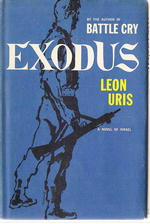
Research Uris did for The Angry Hills and his time  as a war correspondent during Arab-Israeli fighting in 1956  lead to most his most successful novel, Exodus. Published in 1958 the book is the result of  thousands of interviews. Uris traveled 12,000 miles in Israel and read hundreds of books on Jewish history. Doubleday bought the book which out sold Gone with the Wind, becoming the biggest bestseller in the United States. It was translated into 50  languages. A blockbuster movie starring Paul Newman came out in 1960.

Mila 18 is about Jewish resistance fighters during the Warsaw uprising. Armageddon: A Novel of Berlin is about the complications of the Cold War during and after and the Berlin Airlift. Topaz, a spy story, has the Cuban Missile Crisis and the Cold War in its cross hairs. Alfred Hitchcock  directed it for the big screen.  QBVII  is a courtroom drama about a doctor who was pressed into service in a Nazi concentration camp.  It was made into a mini series starring Anthony Hopkins in 1974.

In Trinity Uris tacked the troubles in Ireland, following the lives of several families from the potato famine to the Easter Uprising. Redemption, written two decades later follows up on the Irish story.

The Haj delves again into the troubled Middle East. The Milta Pass is about the Suez Crisis.

A God in Runs takes on the American political scene when Quinn Patrick O’Connell runs for president. His last novel, O’Hara’s Choice, was published posthumously, and was not well received.

Non fiction works include: Ireland: A terrible Beauty and Jerusalem: Song of Songs both include photographs by his with Jill Uris.

More on Leon Uris try this site: http://www.kirjasto.sci.fi/uris.htm


Thought of the Day 7.29.12 Ken Burns

“Good history is a question of survival. Without any past, we will deprive ourselves of the defining impression of our being.”

–Ken Burns

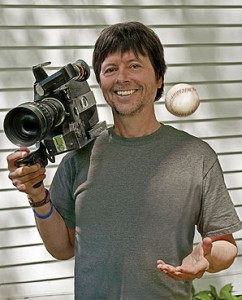
His family, including his brother Ric Burns, who is also a documentary film maker, traveled often through out Europe and the North East US. They settled in Ann Arbor.  Burns enjoyed reading, especially history. For his 17th birthday he got an 8mm movie camera and made his first documentary (it was about a factory in Ann Arbor.)  He attended Hampshire College in Amherst, MA. He Graduated in 1975 and co-founded Florentine Films in 1976 with Roger Sherman, Buddy Squires and Larry Hott.

Burns’ work as a director, writer, producer, cinematographer, and film music director began in earnest in 1977  when he started work on a documentary based on the book The Great Bridge by David McCullough.  The result, Brooklyn Bridge (1981) brought Burns an Academy Award nomination. He followed that success with 23 (and counting) award winning documentaries most of which saw their debut on PBS.

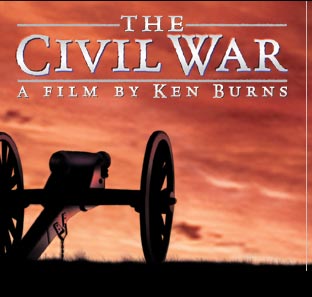
His break out series was the 11 hour  The Civil War which first ran in 1990. Burns used over 16,000 photographs  and archival images. He had first person narratives (mostly letters) read by different actors, giving each historic figure their on personality in the film. He had live interviews with noted historians. And the finishing touch was the music — a mix of Civil War era tunes and the haunting theme song, Jay Unger’s Ashokan Farewell.  The Civil War won two Emmy Awards, two Grammy Awards, a Peabody Award,  a Producers Guild of America Award, a People’s Choice Award and a slew of other accolades.


Films by Ken Burns:

  • The Shakers: Hands to Work, Hearts to God
  • The Statue of Liberty (which also received an Oscar nomination)
  • Huey Long
  • The Congress
  • Thomas Hart Benton
  • The Civil War
  • Empire of the Air: The Men Who Made Radio
  • Baseball
  • The West
  • Thomas Jefferson
  • Lewis & Clark: the Journey of the Corps of Discovery
  • Frank Lloyd Wright
  • Not for Ourselves Alone: Elizabeth Cady Stanton and Susan B. Anthony
  • Jazz
  • Mark Twain
  • Horatio’s Drive: America’s First Road Trip
  • Unforgivable Blackness: The Rise and Fall of Jack Johnson
  • The War
  • The National Parks: America’s Best Idea
  • The 10th Inning
  • Prohibition
  • The Dust Bowl

Films in production include:

  • The Central Park Five
  • The Roosevelts
  • Jackie Robinson
  • Vietnam
  • Country Music
  • Ernest Hemingway

The Baltimore Sun’s Media Critic, David Zurawik, has called Burns “… not only the greatest documentarian of the day, but also the most influential filmmaker period. ”


Thought of the Day 7.28.12 Beatrix Potter

“Thank goodness I was never sent to school; it would have rubbed off some of the originality.”*

-Beatrix Potter

English: A picture of Beatrix Potter

English: A picture of Beatrix Potter (Photo credit: Wikipedia)

Helen Beatrix Potter was born on this day  in South Kensington, London in 1866. Today is the 146th anniversary of her birth.

Beatrix and her younger brother (Walter) Bertram were raised in London, but enjoyed long holidays in rural Scotland and the English Lake District. According to the web site for the Beatrix Potter Society she was educated by a governess at home and loved languages and literature especially fairy tales and folk tales. Her early talent for drawling and as a water colorist was encouraged and she illustrated several popular fairy tales for her family’s entertainment. She wrote stories about the family pets . The children kept  “rabbits, a hedgehog, some mice and bats…” most of which would one day wind up in her stories.

She kept a journal — written in a code she invented herself (and which was not deciphered until 1958) — and a sketchbook. In her 20’s she “sold some of her artwork for greetings (sic) cards and illustrations” but she largely concerned herself with the study of natural  history, giving special focus to mycology — the study of fungi. She produced beautiful and technically accurate watercolors of mushrooms and became an adept scientific illustrator. She wrote a paper on the reproduction of fungi. On April 1, 1897 the paper was presented by a male scientist since women weren’t allowed to attend, much less present at, The Linnean Society (“the world’s oldest biological society” has since changed their  Men Only policy).

She also wrote delightful letters to children of her acquaintance that were wonderfully illustrated and told tales of little woodland creatures and pets. In 1901 she adapted some of those letters into The Tale of Peter Rabbit.

Cover of the first, privatley printed edition ...

Cover of the first, privatley printed edition of The Tale of Peter Rabbit by Beatrix Potter (Photo credit: Wikipedia)

Since she couldn’t get any commercial publishers to take on the book she self published the initial edition. But then Frederick Warne & Co.  agreed print Peter Rabbit and Potter converted the black and white illustrations to color.

Cover of the first edition, The Tale of Peter ...

Cover of the first edition, The Tale of Peter Rabbit (Photo credit: Wikipedia)

Norman Warne, the youngest son of the publishing magnet was assigned as Potter’s editor and the two brought twenty Potter books to market, usually at a rate of 2 or 3 a year. Potter also marketed stuffed animals, paint books and wall paper based on the characters in her books.

In 1905 Norman Warne proposed to Beatrix Potter. Her parents vehemently against the match because Warne was socially inferior and “from Trade.” Beatrix found this ironic since her grand parents had been engaged in the cotton trade. But ultimately their pressure won out and she kept the engagement a secret. It didn’t matter. Norman had lymphatic leukemia — a disease that was hard to diagnose at the turn of the century — he died within a month. Potter was summoned to the sick bed, but she arrived too late.

Photo of Norman Warne ca 1900

Photo of Norman Warne ca 1900 (Photo credit: Wikipedia)

Beatrix bought Hill Top Farm in the Lake District  in Lancashire as a sanctuary. She wanted to paint, write and learn about  land management. Later she purchased Castle Farm across the road from Hill Top Farm. Her goal was to preserve land in the area from development.

English: Hill Top Farm, Near Sawrey, Cumbria. ...

English: Hill Top Farm, Near Sawrey, Cumbria. Home of children’s author, Beatrix Potter. As requested in her will, the interior has been “left as if she had just gone out to the post”: a fire burning in the hearth, cups and saucers on the table ready for a visitor! (Photo credit: Wikipedia)

In 1923 she bought and restored Troutbeck Park. The sheep at Troutbeck were disease-ridden and under her stewardship the Herdwick sheep were restored to health.  She became very involved in the local community and joined several committees to help improve rural live including the founding of  a nursing trust to improve local health care. In 1913 she married a local solicitor, William Heelis.In 1926 the semi-autobiographical The Fairy Caravan was published in the United States (it didn’t show up in England until after she passed away).

At her death Beatrix Potter Heelis left 4,000 acres, on 15 farms, in the Lake District to the National Trust.

Beatrix Potter and her husband William Heelis ...

Beatrix Potter and her husband William Heelis on their wedding day (Photo credit: Wikipedia)

The Beatrix Potter Society was founded in 1980 to promotes the appreciation of the life and works the author. Please see their web site and the excellent article by  Linda Lear for more information on Potter.

The relationship between Beatrix Potter and Norman Warne is basis of the film Ms. Potter starring Renee Zellweger and Ewan McGregor.

——————————————————————————————————————–

*Perhaps her teachers were forced to teach to the TEST!

AND Maggie would like you to know that Beatrix Potter is NOT Harry Potter’s Muggle cousin.

Harry Potter

NOT related to this guy. Also not a lego. Yet I love all three. Harry Potter (Photo credit: Profound Whatever)


Thought of the Day 7.16.12

“When two people love each other, they don’t look at each other, they look in the same direction”

–Ginger Rogers

Virginia Katherine McMathwas born in Independence, Missouri on this day in 1911. She would have been 101  years old today.

Her parents divorced when she was a baby and little Virginia, Ginger, stayed with her mother, Lela. When she remarried, Ginger took the name Lela’s second husband John Rogers. Ginger was introduced to the theater when Lela became a theater critic and took the girl to the shows that she reviewed. Legend has it that Ginger would hang out backstage picking up the songs and dances from the performers as her mother sat in the audience and took notes. One night while she was backstage at a traveling vaudeville show the act needed a stand-in, Rogers was tapped for the duty and had her first gig.

She was still in high school when she won  The Texas State Charleston Championship. The prize — a tour of theaters in Texas cities — was expanded to include  a wider tour of the Western US.. Ginger’s easy banter with the master of ceremonies was such an audience hit that it became as much of a draw as the dance routine.  At 17 she married vaudeville artist Jack “Pepper” Culpepper and the two formed the act known as “Ginger and Pepper.” The marriage was short lived, but Ginger’s career continued. She made it to New York where she had her Broadway debut in Top Speed in 1929.  Shortly thereafter the Gershwin Brothers picked Ginger to star in Girl Crazy along with Ethel Merman. The musical made a star of both actresses  and introduced Ginger to Fred Astaire who was hired as a dance coach. Ginger’s amazing renditions of  Embraceable You and But Not For Me in the musical helped the tunes become part of the American Song Book.

At 19 she switched to movies. Her breakthrough role was in Warner Brother’s 42nd Street. In 1933 she made her first film with Fred Astaire, Flying Down to Rio. The duo made nine musicals together, the most famous probably being Top Hat.

Dancing was only one arrow in her quiver, she was also an acclaimed singer and actor and her career went on long after she stopped making musicals with Fred. She won an Academy Award for Kitty Foyle in 1940.

She went back to the Great White Way when roles for mature women in film became scarce. Ginger took over for Carol Channing as Dolly in Hello! Dolly in 1965 and performed to packed houses for an 18-month run. She then took Mame to London’s West End for 14-months (and a Royal command performance.)

Ginger Rogers - 1920s

Ginger Rogers – 1920s (Photo credit: danceonair1986)


Thought of the Day 7.3.12

“Every exit is an entrance somewhere else”

–Tom Stoppard

Tom Straussler was born this day in Zlin, Czechoslovakia in 1937. He is 75  years old.

As War World II loomed in Europe his family moved to Singapore to escape the Nazis. In 1941 as the Japanese were poised to invade Singapore he and his mother and brother fled to Darjeeling, India. (His father stayed in the city and was died in the invasion.) After the war they moved to England and his mother remarried. Kenneth Stoppard adopted Tom and his sister.

Stoppard left school when he was only 17 and began to write for local newspapers. He started writing plays and scripts and in 1963  his first television play, A Walk on the Water was produced. Success on the stage came with his hugely popular Rosencrantz and Guildenstern are Dead, a play that looks at Hamlet from the point of view of two minor characters. For the screen he penned Empire of the Sun, Billy Bathgate, and co-wrote Brazil and Shakespeare in Love. He won the “Best Screenplay” Oscar  for Shakespeare in Love.

His other works include: Every Good Boy Deserves Favour, The Real Thing, Arcadia and Dogg’s Hamlet, Cahoot’s Macbeth

Tom Stoppard on a reception in honour of the p...

Tom Stoppard on a reception in honour of the premiere of “The Coast of Utopia” in Russia (Photo credit: Wikipedia)


Thought of the Day 6.22.12

“If you’re going to tell people the truth, be funny or they’ll kill you.”

Billy Wilder

Billy Wilder was born today in Sucha, Galicia, Austria-Hungary 1906. He would have been 106 years old.

Wilder was a film director, producer and screenwriter who made 60 films in a career that spanned more than five decades.

He left Austria when the Nazis came to power and by 1933  found his way to Hollywood.  He worked brilliantly in both drama and comedy. His first American screenwriting credit was for Ninotchka, a screwball spy comedy with Greta Garbo and Melvyn Douglas which he co-wrote in 1939. The classic 1944  film noir drama Double Indemnity with the beautiful Barbara Stanwyck made his reputation as a Director. He pulled double duty, screenwriter and director, for The Lost Weekend and earned double Oscars for his work on the drama. In 1960 he pulled a hat trick, winning Writer, Director and Producer for The Apartment with Jack Lemmon and Shirley MacLaine.

Other Wilder films include: Sunset Boulevard (for which he won an Oscar for Best Screenplay — he co-wrote, but not for Director,) A Star is Born (Writer), The Seven Year Itch, Witness for the Prosecution,  Some Like It Hot, Sabrina, and Stalag 17. [Sunset, Sabrina and Stalag are three of my favorite movies of all time, BTW ]

In 1987 he won the Irving G. Thalberg Memorial Academy Award for lifetime  acheivement.


Billy Wilder
Billy Wilder (Photo credit: Wikipedia)