Category Archives: Europe

Louis Pasteur 12.27.12 Thought of the Day

“Chance favors the prepared mind.”
Louis Pasteur

Louis Pasteur

Louis Pasteur (Photo credit: Sanofi Pasteur)

Louis Pasteur was born on this day in Dole, Jura, France in 1822. Today is the 190th anniversary of his birth.

Pasteur was the third child of Jean-Joseph and Jeanne-Etiennette Roqui Pasteur. His family moved to the banks of the Cuisance River in Arbois  when he was three. His father was a tanner by trade, but was also a decorated soldier in the Napoleonic War. Pasteur was an average student whose skills leaned more toward drawing and painting than science. As a child Pasteur witnessed “the treatment of several victims of bites by rabid animals;” [Pasteurbrewing.com] the epidemic left sixteen dead “in the region, four of them in the immediate vicinity of Arbois.” [Ibid]

In  1840 he received a bachelor of arts  and was “appointed teaching assistant at the Besançon collège.” [Ibid] It was then that he began to study math and science in earnest.

He received a bachelor in science in 1842 then a doctorate in 1847 at the Ecole Normale in Paris.

Pasteur then spent several years researching and teaching at Dijon Lycée. In 1848, he became a professor of chemistry at the University of Strasbourg, [Biography.com]

While in Strasbourg he met Marie Laurent (they wed in 1849 and had five children together, only two of whom survived to adulthood.)

Entrée du bâtiment de l'Institut Le Bel, à l'U...

Entrée du bâtiment de l’Institut Le Bel, à l’Université Louis-Pasteur (Strasbourg I) (France). (Photo credit: Wikipedia)

He worked with tartaric acid, fermentation and germ theory. While on vacation he examined diseased wine and “observed the presence of germs analogous to those found in lactic fermentation.” [Pasteurbrewing.com]

he demonstrated that organisms such as bacteria were responsible for souring wine, beer and even milk. He then invented a process where bacteria could be removed by boiling and then cooling liquid. He completed the first test on April 20, 1862. Today the process is known as pasteurization.[Biography.com]

Experiment Pasteur

Experiment Pasteur (Photo credit: Wikipedia)

In 1852 he was appointed the chair of chemistry at Strasbourg University. Two years later he was given the same post at the University of Lille.

When he proved that “microbes were attacking healthy silkworm eggs” [ibid], he saved the silk industry in 1865.

In 1868 he had a stroke that left him partially paralyzed, but he continued his work. He revolutionized the treatment of infectious diseases such as anthrax and chicken cholera.

In 1882, the year of his acceptance into the Académie Franaise, he decided to focus his efforts on the problem of rabies. On July 6, 1885, Pasteur vaccinated Joseph Meister, a 9-year-old boy who had been bitten by a rabid dog. The success of Pasteur’s vaccine brought him immediate fame. This began an international fundraising campaign to build the Pasteur Institute in Paris, which was inaugurated on November 14, 1888. [Ibid]

Louis Pasteur - Rabies

Louis Pasteur – Rabies (Photo credit: Sanofi Pasteur)

Pasteur died in September of 1895. He is considered “the father of germ theory and bacteriology.”

Français : Statue de Louis Pasteur à Dole dans...

Français : Statue de Louis Pasteur à Dole dans le Jura (ville de sa naissance). (Photo credit: Wikipedia)


Edith Piaf 12.19.12 Thought of the Day


I think you have to pay for love with bitter tears.
Edith Piaf


Edith Piaf

Edith Piaf (Photo credit: tsweden)

Édith Giovanna Gassion was born on this day in Belleville, Paris, France in 1915. Today is the 97tj ammoversary of her birth.


Her mother was a cafe singer and her father was a street acrobat. She was abandoned by her parents to the care of her maternal grandmother, then was taken to her father’s mother. Her paternal grandmother ran a brothel and Édith grew up amongst the prostitutes. She was blinded as a result of meningitis at three but recovered by seven (supposedly because the “prostitutes pooled money to send her on a pilgrimage honoring Sainte Thérèse de Lisieux, which … resulted in a miraculous healing.”[geni.com] by 14 she was performing with her father on the streets of France. “Piaf’s songs and singing style seemed to reflect the tragedies of her own difficult life.” [Encyclopedia Britannica]

Français : Edith Piaf enfant

Français : Edith Piaf enfant (Photo credit: Wikipedia)

She left her father’s act and performed on her own singing in the streets for years before being discovered by a nightclub owner. She changed her last name to Piaf (and became known as “the little sparrow.” ) She switched to ballads.


She entertained French POWS during WWII, and gained world wide fame after the war with such songs as Non, je ne regrette rien and La Vie en rose by touring extensively.


Her throaty, expressive voice, combined with her fragile appearance and a dramatic tight spotlight on her face and hands, made her concerts memorable. [Answers.com]

She died  of liver cancer at age 47 in 1963.


English: Bust of Edith Piaf in Celebrity Alley...

English: Bust of Edith Piaf in Celebrity Alley in Kielce (Poland) Česky: Busta Edith Piaf v polských Kielcích (Photo credit: Wikipedia)


Ludwig van Beethoven 12.17.12 Thought of the day

“Music should strike fire from the heart of man, and bring tears from the eyes of woman.”
Ludwig van Beethoven

English: Photograph of bust statue of Ludwig v...

Ludwig van Beethoven was born on this day in Vienna, Austria in 1770. Today is the 242nd anniversary of his birth.

He was the eldest of the three surviving Beethoven children. His father taught him the violin and clavier. The elder Beethoven was an alcoholic and a draconian teacher, “Beethoven was flogged, locked in the cellar” [Biography], beaten if he played a wrong note, and deprived of sleep so he could practice. The boy had his debut with a public performance in Cologne in March 1778. His father shaved a few years off his age so Ludwig’s talents made him seem more of a child prodigy.

Musically talented he was, but little Ludwig  struggled at school. Math and spelling eluded him his entire life. “Music” he said “comes to me more readily than words.”

At 10 he left school and began to take lessons on the organ and in composition from Court Organist Christian Neefe. Neefe was a much better teacher than his father and he introduced the boy to a world outside the scope of music, including philosophy. By 12 he published his first musical piece, 9 Variations in C Minor for Piano.

When Beethoven was 14 Neefe recommended Beethoven as court organist for Maxcimmian Franz of Cologne.

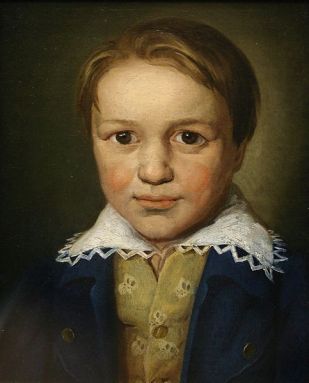
"Ludwig van Beethoven was recognised as a child prodigy. He worked at the age of 13 as organist, pianist/harpsichordist and violist at the court in Bonn, and had published three early piano sonatas. This portrait in oils is the earliest authenticated likeness of Beethoven." Circa 1782 (Wikimedia commons)

“Ludwig van Beethoven was recognised as a child prodigy. He worked at the age of 13 as organist, pianist/harpsichordist and violist at the court in Bonn, and had published three early piano sonatas. This portrait in oils is the earliest authenticated likeness of Beethoven.” Circa 1782 (Wikimedia commons)

At 17 Prince Maximilian sent him to Vienna to meet Mozart, but returned home two weeks later upon hearing that his beloved mother (who he called his best friend) had become severely ill. Heartbroken, he stayed in Bonn for several years. He took over the care of his younger brothers — his father had sunk further into alcoholism and was no longer contributing to the family.

In 1790  he wrote a musical memorial in honor of the death of Emperor Joseph II.

For reasons that remain unclear, Beethoven’s composition was never performed … more than a century later, Johannes Brahms discovered that Beethoven had in fact composed a “beautiful and noble” piece of music entitled Cantata on the Death of Emperor Joseph II. It is now considered his earliest masterpiece. [Biography]

Here’s the Soprano aria with Judith Howarth and the Corydon Orchestra.

He went back to Vienna at 22 and studied with Haydn, Salieri and Albrechtsberger. His skills as a virtuoso pianist helped him win patrons among the Viennese aristocracy. His composing allowed him to highlight his  piano playing skills.  In 1795 he performed and published his Opus number 1, three piano trios.

In April of 1800 “Beethoven debuted his Symphony No. 1 in C major” [Biography]. As he matured as a composer he found fault with the symphony saying “In those days I did not know how to compose.” But when it came out Symphony No. 1 was a hit.  It…

established him as one of Europe’s most celebrated composers. As the new century progressed, Beethoven composed piece after piece that marked him as a masterful composer reaching his musical maturity. [Ibid]

Portrait of Ludwig van Beethoven (1803) by Christian Horneman [Image courtesy: Wikimedia Commons]

Portrait of Ludwig van Beethoven (1803) by Christian Horneman [Image courtesy: Wikimedia Commons]

His Sonata quasis un fantasia (aka Moonlight Sonata) and the ballet The Creatures of Prometheus came next. He was transitioning from Classical world to the Romantic world.

He followed the ballet with his Symphony No. 3, The “Eroica Symphony” which he originally wrote in Napoleon’s honor.

it was his grandest and most original work to date — so unlike anything heard before that through weeks of rehearsal, the musicians could not figure out how to play it. A prominent reviewer proclaimed Eroica, “one of the most original, most sublime, and most profound products that the entire genre of music has ever exhibited.” [Biography]

Here’s the first movement as played by New York Philharmonic, conducted by Leonard Bernstein.

By 26 Beethoven had begun to loose his hearing. He could not hear from the persistent ringing in his ears. He stopped attending social functions and moved to Heiligenstadt, a small town outside of Vienna.

He was  depressed and angry over the fate life had handed him. He confessed in the Helligenstadt Testament that he considered suicide, but …

it was only my art that held me back. Ah, it seemed impossible to leave the world until I had brought forth all that I felt was within me. [Ibid]

Tenaciously he continued to compose, producing “an opera, six symphonies, four solo concerti, five string quartets, six string sonatas, seven piano sonatas, five sets of piano variations, four overtures, four trios, two sextets and seventy-two songs” [Ibid] in his heroic or Middle period.

Beethoven in 1814

Beethoven in 1814 (Photo credit: Wikipedia)

He kept conversation books where friends would writing down what they were talking about to keep him in the loop, and he would respond orally (and sometimes would respond on paper.)  He had about 400 of these books, but only 136 exist today.

Portrait Ludwig van Beethoven when composing t...

Portrait Ludwig van Beethoven when composing the Missa Solemnis (Photo credit: Wikipedia)

His late period includes the Missa Solemnis, String Quartet No. 14 and his infamous Ninth Symphony.

The symphony’s famous choral finale, with four vocal soloists and a chorus singing the words of Friedrich Schiller’s poem “Ode to Joy,” is perhaps the most famous piece of music in history. While connoisseurs delighted in the symphony’s contrapuntal and formal complexity, the masses found inspiration in the anthem-like vigor of the choral finale and the concluding invocation of “all humanity.” [Biography]

Beethoven died on March 26, 1827. He was 56 years old.

Here is the Kyrie Eleison from his Missa Solemnis performed by the London Symphony Orchestra and Chorus,  Sir Colin Davis conducting…


Tycho Brahe 12.14.12 Thought of the Day

“I conclude, therefore, that this star is not some kind of comet or a fiery meteor… but that it is a star shining in the firmament itself one that has never previously been seen before our time, in any age since the beginning of the world.”
–Tycho Brahe

The astronomer Tycho Brahe

The astronomer Tycho Brahe (Photo credit: Wikipedia)

Tycho Ottesen Brahe was born on this day in Knutstrop Castle, Scania, Denmark-Norway in 1546. Today is the 466th anniversary of his birth.

Noble by birth Brahe’s twin brother died before he could be baptized. Tycho’s ode to his dead brother was his first published work. At two his  uncle,  Jorgen Thygesen Brahe,  took him (perhaps kidnapped him) to live at Tosterup Castle, and Tycho became Jorgen’s heir.  At 12 he entered the University of Copenhagen to study philosophy and rhetorics. There was a solar eclipse in 1560 and young Tycho was fascinated by it. He began studying astronomy. When he started at Leipzig he  began to study astronomy without permission…

but was soon forgiven after demonstrating successes. He found that old observations were very inaccurate, and started to design methods and instruments for high-precision measurement of positions of celestial bodies. [TychoBrahe]

From Leipzig he continued his academic pursuits  in  Germany, studying at Wittenberg, Rostock and Basel. In Rostock he had a famous duel with another student to determine who was the best mathematician.

Tycho Brahe

Tycho Brahe (Photo credit: lilspikey)

His nose was cut so badly that  for the rest of his life “he covered the scar with a plate probably made of a silver-copper alloy to imitate the colour of the skin.” [Ibid]

During this period his interest in alchemy and astronomy was aroused, and he bought several astronomical instruments.[The Galileo Project]

He returned to Scania and built a laboratory to study chemistry. In November of 1572 he turned his sights to the heavens again and observed …

a new brilliant star in the constellation of Cassiopeia. Tycho’s measurements showed that it really was a distant star and not any local phenomena. This was very intriguing at that time, since the sphere of the stars was considered to be divine and perfect, hence no changes ought to take place there. Tycho observed its brightness evolve until it faded away the next year. He reported the event in his book “De stella nova”, which made him famous all over Europe. [TychoBrahe]

With his new found fame he could have studied anywhere in Europe, but he chose to return to his beloved Denmark. King Frederick II  granted him the Island of Hven.

Map of Hven from the Blaeu Atlas 1663, based o...

“…There he built his observatory, Uraniburg, which became the finest observatory in Europe.” [The Galileo Project] He designed new instruments and developed a nightly program of observations.

Tycho Brahe's Stjerneborg observatory on the i...

Tycho Brahe’s Stjerneborg observatory on the island of Hven, restored. 2005 (Photo credit: Wikipedia)

The observatory was visited by many scholars, and Tycho trained a generation of young astronomers there in the art of observing. [Ibid]

He left Hven after he had an argument with King Christian IV and, after traveling for several years, wound up in Prague.

Tycho Brahe died 24th October 1601 of a urinary bladder infection. It has long been thought that the cure (a self-induced potion that may have contained lead) was the real culprit. But that has recently been disproved.

English: Signature of Tycho Brahe.

English: Signature of Tycho Brahe. (Photo credit: Wikipedia)

Tycho Brahe ved Knutstorp, Knudstrup

Tycho Brahe ved Knutstorp, Knudstrup (Photo credit: Wikipedia)


Williamsburg (part 3)

Textile 3

[This is part three of my What To Do in Williamsburg Blog for part one go HERE. For part two go HERE. ]

Previous tips included:

  1. Planning your trip in the Fall or Winter to avoid the heat and crowds.
  2. Staying in a Colonial House.
  3. Engaging with the locals.
  4. Visit the Wren Building
  5. Take the Rubbish, Treasures and Colonial Life Tour & the Behind the Scenes Tour
  6. Visit the De Witt Wallace and Abby Aldrich Rockefeller Folk Art Museums

Today we’ll go inside some of Williamsburg’s beautiful houses and get a little spooky after dark.

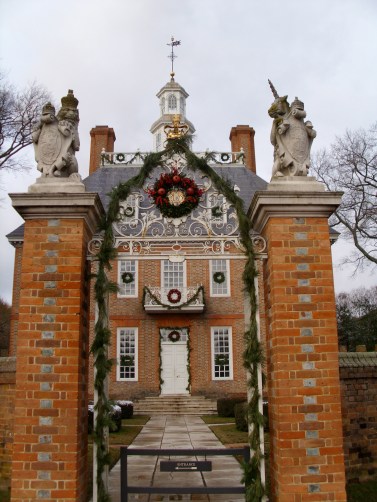
7. Tour the Governor’s Palace. It is the largest and finest residence in Williamsburg and it is meant to awe, inspire and intimidate all who see it. The moment you walk into the entrance hall lined with fire arms and crossed swords you know the power behind the man who lives here. It was home to seven colonial governors and two elected Virginia governors before Thomas Jefferson moved the Capital further west to Richmond in 1780.

Front gate leading to the Palace.

Front gate leading to the Palace.

Tours, which require a separate ticket, will bring you through the public and private portions of the house.

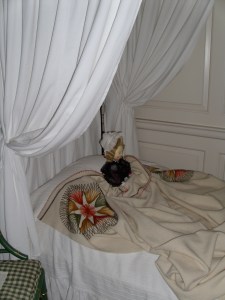
One of the beds in the Palace.

One of the beds in the Palace.

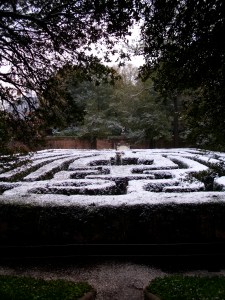
After your tour explore the vast gardens. Don’t miss the box wood maze. And be sure to climb the pyramid over the ice house. I found the gardens more enchanting than the building itself.

View of the box wood maze taken from the top of the pyramid. This was from our 2010 trip, and it had just snowed.

View of the box wood maze taken from the top of the pyramid. This was from our 2010 trip, and it had just snowed.

There were dozens of hidden treasures.

Window through the garden wall looking out to the canal.

Window through the garden wall looking out to the canal.

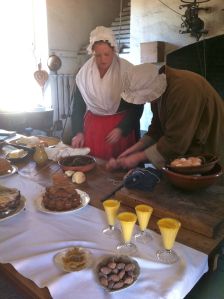
Even if you don’t take a formal Palace tour be sure to stop in to see the cellars and the kitchen. It will give you a fascinating glimpse on how they kept this huge home running. The cook, a man, was one of the highest paid and best regarded people in Williamsurg btw.

They made one big meal for the day. What kept was "left over" for breakfast.

They made one big meal for the day. What kept was “left over” for breakfast.

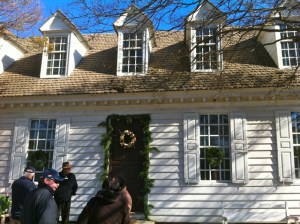
8. Tour the Thomas Everard House. On a prime piece of real estate on the Palace Green is the Thomas Everard House. Everard was an orphan when he arrived in Virginia as an apprentice to Matthew Kemp. Everard trained for seven years as a clerk. Soon after his apprenticeship was finished he was appointed clerk of Elizabeth City County court. Eventually he became the clerk of York county court for 36 years,  Mayor of Williamsburg and held other prestigious post in the city. He purchased the house on the corner of Palace Green and expanded it.

The front of the Everard House faces the Palace Green.

The front of the Everard House faces the Palace Green.

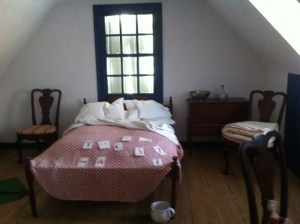
His wife died fairly young but his two daughters, Fanny and Patsy lived with him as they grew up.

One of the girl's bedroom.

One of the girl’s bedroom.

Fanny married Rev. James Horrocks in 1765. He was the rector of Bruton Parish Church and president of Williams and Mary. He was a powerful man in the colony. When Rev. Horrocks died she returned to her father’s house. Sadly she died a year later. Her sister, Patsy lived, there until 1774 when she married.

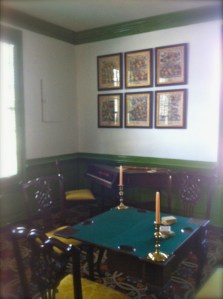
Parlor

The house is in a “U” configuration. On the main floor the parlor and dining room face the front. The Parlor is a public room in the house. This multi use room can be set up for music, games or dancing.

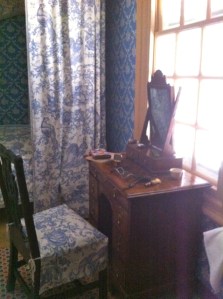
Thomas’ bedroom was accessible through the drawling room.

Everett's bedroom

He  had a quieter prospect  of the yard and garden out his window. A back door allowed for special friends to enter his cozy retreat.

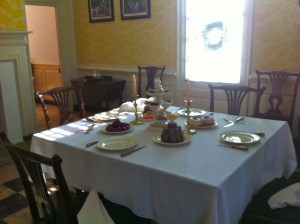
Like the Parlor, the Dinning Room also faces the Palace Green. Dining

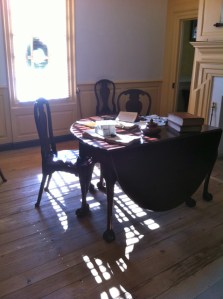
The door in the back of the dining room led to Thomas’ study. This room was also accessible through a rear door.

Evert's study

The Thomas Everard House is open 9-4 Tue, Wed & Friday.

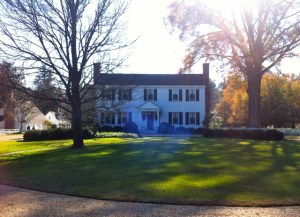
9. Visit Bassett Hall. Williamsburg would not have been possible without the vision of one man and the generosity of another. The first man was Rev. W.A.R. Goodwin, The second was John D. Rockefeller, Jr.. Goodwin convinced Rockefeller to help him rebuild the Revolutionary City to its Colonial glory. Rockefeller and his wife Abby Aldrich Rockefeller.

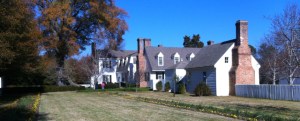
Bassett Hall front

It was their retreat from the outside world. The Rockefellers visited there twice each year. The house and grounds have been restored not to the colonial era, but to the 1930s when the Rockefellers lived there.

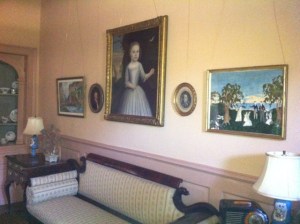
Abby filled the rooms with her folk art finds.

The drawing room at Bassett Hall.

Folk art graces the walls at Bassett Hall.

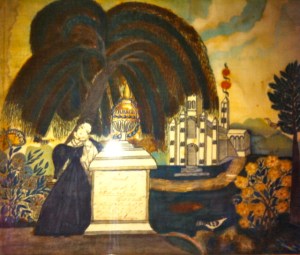
One of her special interest was “School Girl Art.”  A sub set of her Folk Art collection the School Girl Art was literally done by girls who were away at school, usually finishing school in the 19 and 18th centuries.

A sample of School Girl Mourning Art memoralizing some one close to them who has died.

A sample of School Girl Mourning Art. The artist was encouraged to memorialize some one close to them who had died.

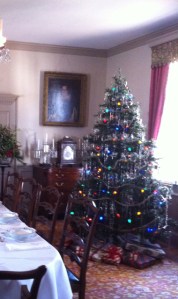
The family entertained  the locals — rich and poor– at their dinner table.

Dining rm

Dining Room decorated to Christmas

During the summer guest were often invited to tea in the Tea Room which was in a building overlooking the garden.

Looking back at the house from the garden.

Looking back at the house from the garden.

Bassett Hall is open Wed-Sun 9-5. Don’t miss the informative movie at the beginning of the tour. You’ll learn a lot about the Rockefellers and the re-making of Williamsburg.

10. Get spooky with it. When you visit a 300 + year old city you expect a lot of history, and probably a few ghosts. So join in the fun and take a Ghost tour. We did the Tavern Ghost tour and it was fun (if not very scary.)  Better still participate in the Cry Witch Program at the Capitol.

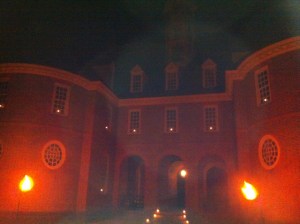
Capital for cry witch

The Capitol Building at night before the Cry Witch program.

You’ll witness the trial of Grace Sherwood with first person interpreters bringing the transcript and court room drama to life. We don’t know what the actual verdict was, those documents have been lost. So the audience in the courtroom gets to weigh the evidence and decide Grace’s fate.

Tomorrow we finish up with Williamsburg and move up the road to Richmond.


Georges Seurat 12.2.12 Thought of the Day

“Some say they see poetry in my paintings; I see only science.”
Georges Seurat

Georges Seurat (1859-1891), photo

Georges Seurat (1859-1891), photo (Photo credit: Wikipedia)

George Seurat was born on this day in Paris, France in 1859. Today is the 153rd anniversary of his birth.

He was born to a wealthy family. His father was distant and taciturn.

At every available opportunity, Antoine-Christophe took leave of his family and disappeared to his villa in the suburbs to grow flowers and say mass in the company of his gardener; he was only at home on Tuesdays. Seurat’s mother was quiet and unassuming, but it was she who gave some warmth and continuity to his childhood. [Renoir Fine Art Inc.]

The family lived on the Boulevarde de Magenta near “Le Parc des Butte-Chaumont” and Georges and his mother often strolled through the park together. He revisited the park in his paintings. Seurat was a quite young man with a gentle voice. He always dressed in a dignified manner. Friends teased him that his tall handsome appearance made him look like a department store model. But he “was serious and intense ­ preferring to spend his money on books rather than on food or drink.” [Ibid]

He went to the Ecole des Beaux-Arts in 1878. He preferred pointillism over the soft brushstrokes of impressionism. He took a scientific approach to painting, working “fixed hours and (using a) meticulous systematization of his technique.” [Ibid]

English: Bathers at Asnières, Georges Seurat, ...

English: Bathers at Asnières, Georges Seurat, 1884. (Photo credit: Wikipedia)

He painted six huge canvas paintings that represent the bulk of his artistic output. The first, painted in 1813 (and taking almost the entire year to complete) was Bathing at Asnieres.

Next came La Grande Jatte. He spent two years on La Grande Jatte, going to the same spot every day for months. There he would sketch in the morning, then in the afternoon he would return to his studio and paint on his giant canvas.

A Sunday on La Grande Jatte

A Sunday on La Grande Jatte (Photo credit: Wikipedia)

Le Grande Jatte “made” Seurat.  He took a studio next to fellow pointillist Signac in Montmartre.

Here he was surrounded by artists ranging from the conservative decorator Puvis de Chavannes, whom he greatly admired, to more progressive contempories ­ including Degas, Gauguin, Van Gogh and Toulouse-Lautrec. He was at the center of artistic debates, but he kept aloof from them. [Renoir Fine Art Inc.]

Likewise he keep aloof about pricing his paintings. He didn’t need to worry about money like some of his fellow artists.

He settled into an annual routine of painting large canvas s in his studio during the winter and doing smaller marine paintings at one of the Normandy Ports in the Summer.

Paris - Musée d'Orsay: Georges Seurat's Le Cirque

Paris – Musée d’Orsay: Georges Seurat’s Le Cirque (Photo credit: wallyg)

His other large canvas paintings include Le Cirque (1890), The Models (1888), La Parade (1889), and Le Chahut (1891).

Le Chahut, 1889–1890, Kröller-Müller Museum, O...

Le Chahut, 1889–1890, Kröller-Müller Museum, Otterlo, Netherlands (Photo credit: Wikipedia)

Seurat died at the age of 31 from meningitis in March of 1891.


Abigail Adams 11.22.12 Thought of the Day

“We have too many high-sounding words, and too few actions that correspond with them.”
— Abigail Adams

Abigail Adams by Benjamin Blythe, 1766

Abigail Adams by Benjamin Blythe, 1766 (Photo credit: Wikipedia)

Abigail Smith was born on this day in Weymouth, Massachusetts, in 1744. Today is the 268th anniversary of her birth.

Abigail  was literally born in a church. Her father, Reverend William Smith was the pastor at the North Parish Congregational Church, her mother, Elizabeth Quincy Smith was first cousins to Dorothy Quincy Hancock (John Hancock’s wife). Reverend Smith believed in reason and morality and he imparted those lessons to  his daughters Mary, Elizabeth and Abigail. Her mother home schooled the girls with the aid of her extended family’s libraries. The girls studied English and French literature, philosophy, history, and the Bible. Abigail
“was a keen political observer, prolific writer…” [abigailadams.org]

Abigail’s third cousin John Adams visited the Smith’s with his friend Richard Cranch. Cranch was engaged to Mary Smith, the eldest Smith sister. Adam’s was just a country lawer, and Abigail’s mother didn’t approve of him as a suitor, but the couple prevailed.

On October 25, 1764 Abigail married John Adams, a Harvard graduate pursuing a law career.  Their marriage was one of mind and heart, producing three sons and two daughters, and lasting for more than half a century. [Ibid]

As a young married couple they lived on the farm John inherited, Braintree. Later they moved to Boston. She stayed in Massachusetts when John went to Philadelphia  to participate in the Continental Congress (1 & 2), travelled abroad as an envoy, and served in elected office.

Abigail struggled alone with wartime shortages, lack of income, and difficult living conditions.  She ran the household, farm, and educated her children.  Abigail’s letters to John were strong, witty and supportive.  The letters, which have been preserved, detail her life during revolutionary times, and describe the many dangers and challenges she faced as our young country fought to become independent.  Most of all, the letters tell of her loneliness without her “dearest friend,” her husband John. [Ibid]

She joined John in Paris in 1784 and travelled with him to England the following year. In 1800 she became the First Lady to preside over the White House as John Adams became the second President of the United States. (The Capitol had recently been moved to Washington DC).

English: "Abigail Smith Adams," oil ...

English: “Abigail Smith Adams,” oil on canvas, by the American artist Gilbert Stuart. Courtesy of the National Gallery of Art, Washington, D. C. (Photo credit: Wikipedia)

When John Adams lost his bid for a second term he and Abigail moved back to Braintree …”and for 17 years enjoyed the companionship that public life had long denied them.” [Ibid]

Abigail Adams died on October 28, 1818. She was a woman …

often ahead of her time with many of her ideas. She opposed slavery, believed in equal education for boys and girls, and practiced what she learned as a child – the duty of the fortunate is to help those who are less fortunate. [Ibid]


Thought of the Day 11.17.12 August Mobius

August Ferdinand Möbius

August Ferdinand Möbius (Photo credit: Wikipedia)

August Ferdinand Mobius was born on this day in Schulpforta, Saxony (Germany) in  1790. Today is the  222nd  anniversary of his birth.

Möbius was an only child whose father died when he was just three years old. Möbius was home schooled until he was 13 when he went to the College of Schulpforta. He went to the University of Leipzig to study Law, but  after about a half a year’s study he switch to his real calling of math, astronomy and physics.

He went on to study astronomy at the Gottingen Observatory in 1813. Then he went to Halle where he cemented his studies in mathematics.

In 1815 Moebius wrote his doctoral these on The occultation of fixed stars and began work on his Habilitation thesis… on Trigonometrical equations …he was appointed to the chair of astronomy and higher mechanics at the University of Leipzig in 1816. [Mac Tutor History — Möbius biography]

He became a full professor in astronomy at Leipzig in 1844 where he held the post of “Observer at the Observatory at Leipzig.” [Ibid]  He supervised the rebuilding of the Observatory and became the director in 1884.

Möbius published several important papers in both astronomy and math. His…

1827 work Der barycentrische Calcul, on analytical geometry, became a classic and includes many of his results on projective and affine geometry. In it … He introduced a configuration now called a Möbius Net, which was to play an important role in the development of projective geometry. [Ibid]

Möbius net [Image courtesy: Thingiverse]

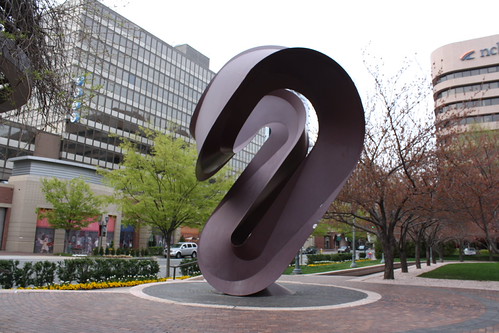
He is best known for the Möbius Strip or Möbius Band — “a two-dimensional surface with only one side. ” [Mac Tutor History — Mobius biography]

Giant Möbius Strips have been used as conveyor belts (to make them last longer, since “each side” gets the same amount of wear) and as continuous-loop recording tapes (to double the playing time). In the 1960’s Sandia Laboratories used Möbius Strips in the design of versatile electronic resistors.[bellevuecollege.edu]

A parametric plot of a Möbius strip

A parametric plot of a Möbius strip (Photo credit: Wikipedia)

Möbius died at age 77 in Leipzig.

08.CaligraphicMoebius.CharlesPerry.CC.VA.10Apr...

08.CaligraphicMoebius.CharlesPerry.CC.VA.10April2011 (Photo credit: Elvert Barnes)


Thought of the Day 11.12.12 Grace Kelly

“Hollywood amuses me. Holier-than-thou for the public and unholier-than-the-devil in reality.”
–Grace Kelly


English: Studio publicity portrait for film Hi...

English: Studio publicity portrait for film High Society (Photo credit: Wikipedia)

Grace Patricia Kelly was born on this day in Philadelphia, Pennsylvania, USA in 1924. Today is the 88th anniversary of her birth.


Third of four children, Grace was born into a wealthy family of Irish and German background. The Kellys were athletic, her father, Jack, won three gold medals in the Olympics and her mother, Margaret, was the first female head of the University of Pennsylvania’s Physical Education Department. Her brother, John, also competed in the Olympics.


But Grace was drawn to acting. She modeled and acted in school plays starting at age 12.


At a young age, Grace decided she wanted to become an actress, and studied acting (primarily theater) at New York City’s American Academy of Dramatic Art and worked as a stage actress and model before moving to Hollywood. When in New York, Grace promoted Old Gold cigarettes and appeared on the covers of magazines such as Cosmopolitan and Redbook. [Grace Kelly Online — Biography]

She worked her way through the American Academy of Dramatic Arts by working as a model  on the side. At 19 she starred as Tracy Lord in the school’s performance of The Philadelphia Story (She reprised the role in High Society, her final film in 1956)


Television and stage gigs followed. Kelly played 39 roles on high brow television theatre shows such as the Kraft Television Theatre, the Philco-Goodyear Television Playhouse, and the Armstrong Circle Theatre. The shows were a hybrid of stage performances and scripted radio drama filmed live in front of a studio audience.


English: Screenshot of Grace Kelly and Clark G...

English: Screenshot of Grace Kelly and Clark Gable from the trailer of the film en:Mogambo (Photo credit: Wikipedia)

After a small role in Fourteen Hours her film career took off when she played the “mousey” Quaker bride” [Ibid] in High Noon in 1952. The following year  she went to Africa to shoot Mogambo with Clark Gable and Ava Gardner. Kelly was nominated for a best supporting actress Academy Award for the film.

1954 brought the first of three movies that Kelly did with director Alfred Hitchcock, Dial M for Murder. Here’s THE clip from the movie. [I think  it proves what a great actress she is… not just any actress can get this much drama out of one word and a pair of scissors.]

<iframe width=”560″ height=”315″ src=”http://www.youtube.com/embed/5QQjSUNVM7o&#8221; frameborder=”0″ allowfullscreen>

Her next movie with Hitch was Rear Window with Jimmy Stewart. There’s plenty of tension and murder here too, but there is also a huge helping of likeability too.  There is a lot of chemistry between Steward and Kelly. It’s dark, but it’s funny and romantic too. And Kelly’s Lisa Carol Fremont is soooo sophisticated and, well, graceful. [Rear Window is my favorite Grace Kelly movie and probably my favorite Hitchcock movie as well.]


Cropped screenshot from the trailer for the fi...

Cropped screenshot from the trailer for the film Rear Window (Photo credit: Wikipedia)

That same year, 1954, she also co-starred with [the always wonderful] William Holden in a Korean War drama, The Bridges at Toko-Ri; the South American emerald mining adventure, Green Fire; and as Bing Crosby’s wife in The Country Girl. Holden was the third leg of a romantic triangle in The Country Girl. Kelly’s performance as a woman torn between a verbally abusive, alcoholic, washed up husband and a charming, kind man who looks like WILLIAM HOLDEN won her an Academy Award.


English: Screenshot of Grace Kelly and Cary Gr...

English: Screenshot of Grace Kelly and Cary Grant from the trailer of the film en:To Catch a Thief (film) (Photo credit: Wikipedia)

In 1955 her last Hitchcock movie came out. In To Catch a Thief she co-starred with Cary Grant.


When a reformed jewel thief is suspected of returning to his former occupation, he must ferret out the real thief in order to prove his innocence. [IMDb]

Again Kelly’s onscreen chemistry with her co-star elevates a good movie to a great one. To Catch a Thief won the Academy Award for best picture that year.


Her next movie was The Swan with Alec Guinness and Louis Jourdan. She plays Princess Alexandra who needs to win the heart of Crown Prince Albert (Guinness) so her family can re enter the inner circle of court life. In real life Kelly was being courted by Prince Rainier III of Monaco whom she had met while attending the Cannes Festival. The engagement ring she wears in the movie is her real ring from Rainier. The studio timed the release of the film to corresponded with the date of the royal wedding.


Kelly’s last feature film was High Society, a musical reboot of The Philadelphia Story. In it Kelly and Crosby sing True Love, a song that went platinum — selling over a million records and and earning a best song Academy Award nod.


 Later that year, she married Prince Rainier Grimaldi III of Monaco to become Her Serene Highness Princess Grace of Monaco. As a princess, she gave up her successful acting career, in which she had made eleven films. She had three children: Princess Caroline, Prince Albert, and Princess Stéphanie. [Grace Kelly Online — Biography]

Wedding dress of Grace Kelly

Wedding dress of Grace Kelly (Photo credit: Wikipedia)

Kelly had a stroke while driving with her daughter Stephanie along the windy mountainside roads of Monaco. The car went off the road and Kelly suffered fatal injuries. She died on September 14th, 1982.