Category Archives: Civil War

Thought of the Day 11.8.12 Margaret Mitchell

“Death and taxes and childbirth! There’s never any convenient time for any of them”
–Margaret Mitchell

Margaret Mitchell all set to launch cruiser af...

Margaret Mitchell all set to launch cruiser after long training as Red Cross launchee / World Telegram & Sun photo by Al Aumuller. (Photo credit: Wikipedia)

Margaret Munnerlyn Mitchell was born on this day in Atlanta, Georgia, USA in 1900. today is the 112th anniversary of her birth.

Mitchell was the younger of two children born to an Atlanta attorney and suffragette. Her father’s family stretched back to colonial Georgia, and he had ancestors who fought in the War of Independence and the War of 1812. Her paternal grandfather was wounded twice in the head at Battle of Antietam, but he survived. After the war he made a fortune selling lumber to an Atlanta eager to rebuild.  Her mother’s people were from Ireland. Her maternal grandfather, Philip Fitzgerald, came over to America and bought a plantation in Georgia. He too fought in the Civil War.

If all of that has the Tara theme of Gone With The Wind playing in your head… well, lets just say Mitchell wrote what she knew, and growing up she was fed a steady diet of Old South stories along with the collard greens and fried chicken that graced every good Georgian table.

As a child Margaret Mitchell was saturated with stories of the Civil War told to her by family members who had lived through it. They indoctrinated her so effectively that Mitchell was ten years old before she learned that the South had lost the war. [Book Rags: Encyclopedia of the World]

Her mother was strict– she was “quick with the hairbrush whenever she thought her daughter was acting spoiled or ill-mannered.”[ReoCities; Margaret Mitchell] — When Mitchell came home from her first day of school frustrated at not being able to do the math and vowing not to go back Maybelle Mitchelle beat the little girl’s bottom with a hairbrush then took her in the carriage on a tour of ruined plantations near Atlanta.

‘ “Fine and wealthy people once lived in those houses,” she told the child, slowing the horses and pointing at the shabby former plantation houses they passed. “Now they are old ruins and some of them have been that way since Sherman marched through. Some fell to pieces when the families in them fell to pieces. …Now, those folk stood as staunchly as their house did. You remember that, child — that the world those people lived in was a secure world, just like yours is now. But theirs exploded right from underneath them. Your world will do that to you one day, too, and God help you, child, if you don’t have some weapon to meet that new world. Education!…People — and especially women — might as well consider they are lost without an education, both classical and practical… You will go back to school tomorrow,” she ended harshly, “and you will conquer arithmetic.” [Ibid]

Mitchell went back to school.

She was an avid reader and story-teller. She would snatch up her older brother’s books when he was finished with them. She loved sharing time with Maybelle as her mother read Mary Johnson’s historical/romance novels to her — they especially liked the ones dealing with the Old South. And she was a life long fan of children’s contemporary fantasy author Edith Nesbit. She told stories to her brother and his friends and made up plays for her school mates. She’d write the stories down and illustrate them. She created her own “publishing company” called “Urchin Publishing Co.” By 13 she’d written a 237 page book of Civil War stories.

When the First World War broke out Mitchell’s older brother joined up. She volunteered at refuge center. Toward the end of the war she met Lieutenant Clifford West Henry. He could

… quote poetry and passages from Shakespeare. Some of Margaret’s friends thought that he was of weak personality, strongly contrasting to Margaret’s, and was unmanly. But Margaret was quite taken by him. Clifford soon gave her a heavy gold family ring. In August, however, Clifford was told he was to be transferred overseas, and that night, he and Margaret secretly got engaged. [Ibid]

Mitchell went off to Smith College and Clifford went to war. At first she didn’t like Smith, which she called ‘a crusty old place,’ but soon enough she grew accustomed to it and the chic,  sophisticated, northern fellow students. They thought ‘Peggy’ cut a very romantic figure with her southern accent and her letters from an overseas lover.  Sadly in October Clifford died from shrapnel wounds he received from air bomb.

Mabelle  was sick too, but the news was kept from Mitchell. Her mother died  in January from the influenza epidemic and Mitchell returned home to take care of the household.

In 1922 she married Berrien Kinnard “Red” Upshaw, “an ex-football player and bootlegger.” [Margaret Mitchell House]  He was  “broad-shouldered, six feet and two inches, had brick-red hair, green eyes, and a cleft chin.”[ReoCities; Margaret Mitchell] so he towered over Mitchell, who was just 5 feet tall. Red was also violent and unpredictable. He physically and verbally abused Mitchell and marriage only lasted a few months.

Finances were not good. Her father had suffered financial setbacks. So, in 1922, Mitchell took a job as a features writer for the Atlanta Journal Sunday Magazine for $25 a week.

In 1925 she found true love with John Marsh. “Marsh was soft-spoken, not as tall as Red, and not extremely attractive. He was stoop-shouldered, wore glasses over his grey brown eyes, and had sandy hair which was receding and flecked with grey.” [Ibid] He’d long been  Red and Mitchell’s friend, and was the best man at their wedding. Whenever Red went too far Marsh was the first phone call Mitchell made. When things finally fell apart he was there to pick up the pieces, and Margaret Mitchell, finally, saw who the “best man” in the scenario really was.

English: Photograph of the Margaret Mitchell H...

English: Photograph of the Margaret Mitchell House in Atlanta, Georgia, USA taken by Jin-Ping Han on January 30th 2006 using a Canon Inc. Powershot S400 digital camera Category:Images of Atlanta, Georgia (Photo credit: Wikipedia)

When Mitchell injured her ankle in a car accident in May of 1926 she was bedridden for several weeks. Marsh dutifully stopped at the library to pick up stacks of novels for her to read. By the time she was able to hobble about on crutches she’d read her way through the library. Mitchell folk-lore has it that the next time he came home it was with a Remington Portable No. 3 typewriter. He gave it to her saying that she could write a better book than the thousands he’d been lugging back and forth.

She had no outline, but her authentic background gave her guidelines and structure. The story would commence with the war and end with Reconstruction, and it would be the story of Atlanta during that time as much as it would be the story of the characters she created. She did not come to the typewriter cold. She knew the story would involve four major characters, two men and two women, and that one of the men would be a romantic dreamer like Clifford Henry; and the other, a charming bounder like Red Upshaw…[Ibid]

For the women she would choose a paragon of Southern virtue for one character and some one  who was strong, hot-headed and “a bit of a hussy.” [Ibid] In other words some one vaguely like her maternal grandmother and herself. At first her heroine was named Pansy O’Hara.

She wrote ferociously 6 to eight hours a day “She kept index-card files for the characters, no matter how minor they were.” [Ibid] but the novel took years to complete.

Gone with the Wind cover

Gone with the Wind cover (Photo credit: Wikipedia)

Gone With the Wind was published in June 1936. Mitchell was awarded the Pulitzer Prize for her sweeping novel the following May.[Margaret Mitchell House]

It was a Book of the Month main selection. Mitchell won the Pulitzer Prize for fiction in 1937 and the book sold eight million copies by the time of her death.   Selznick-International purchased the movie rights for $50,000 shortly after its publication.

It was made into an equally famous motion picture starring Vivien Leigh and Clark Gable. The movie had its world premiere at the Loew’s Grand Theater in Atlanta December 15, 1939. [Ibid]

The film won 10 Academy Awards.

Mitchell “spent the rest of her life shepherding her book through many foreign editions, protecting her financial and copyright interests, and answering her extensive fan mail.” [Book Rags: Encyclopedia of the World]

Margaret Mitchell was killed by a drunk driver while crossing an Atlanta street in August 1949.

Mitchell's grave in Oakland Cemetery in Atlanta

Mitchell’s grave in Oakland Cemetery in Atlanta (Photo credit: Wikipedia)


Chillin’ out in GRAND CAVERNS

Who’d have thought that things that go drip in a cave could be so pretty?

On our way home from a family vacation in Staunton, VA we stopped at Grand Caverns. The cave was discovered in 1804 by a trapper and opened for tours two years later as “The Grottoes of the Shenandoah”. It is the oldest continually operating “show cave” in America and is rated 2nd best “show cave” (after Carlsbad Caverns in New Mexico) by Parade Magazine. In 1926 it was renamed “Grand Caverns” and it was declared a National Natural Landmark in 1973.

Drapery formations hang from the ceiling in the Persian  Palace  (once known as the Tannery).

During the Civil War soldiers from both sides explored the cave. 200 men signed the walls of the cave. Two of the signatures, one from a Northern soldier, one from a Confederate soldier, were left on the same day, only hours apart. A firearm accidentally discharged inside the cave, piercing one of the shield formations. The hole is still visible today.

The rock formations are always growing, albeit at an extremely slow rate. Oil from human hands block that growth, so visitors aren’t allowed to touch any of the rock formations.  However, visitors will inevitably feel a drip or two while taking a tour. Those are called “Cave Kisses” and are supposed to bring good luck.

The Cathedral Hall is the largest chamber in the caverns. An impressive stalagmite, “George Washington’s Ghost” (foreground) stands century at the center of the hall. The white spot on the ceiling is likely a spot where a shield broke off centuries ago.

Naturally occurring colors in the cave are White (from calcite/calcium carbonate), Red (from iron/iron oxide) or Grey (limestone or manganese). Another color  in the cave is Green (from cave algae which is the result of dampness of the cave combined with lint from clothing and heat and light from the light bulbs.) Colored lights enhance the cave formations in certain areas. With out artificial lights the cave would be pitch black, of course.

The Bridal Chamber has a shield formation with drapery that represents a bride’s veil. It is about 17 feet tall.

With over 200 shield formations, Grand Caverns has more cave shield formations than any other cave or cavern in the eastern United States. No one knows how these formations are made, but for some reason they form flat disks rather than columns.  Some notable shield formations in Grand Caverns are  the “Clam Shell”  formation, a triple shield formation in the Lily Room, and the “Bride’s Veil” formation that combines both a shield and drapery.

The Lily Room. A shield with drapery resembles a calla lily and takes center stage in the Lily Room

Another formation in the Lily Room.

Grand Caverns is open daily except Thanksgiving, Dec 24, 25 & Jan 1. Summer Hours (April to Oct 31) are 9-5. Winter Hours (Nov 1-March 31) are 10-4. Tours are given hourly. For pricing and directions click here.

At the lowest part of the cave (as seen on the tour) looking up to the highest part of the cave.


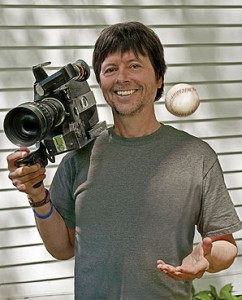
Thought of the Day 7.29.12 Ken Burns

“Good history is a question of survival. Without any past, we will deprive ourselves of the defining impression of our being.”

–Ken Burns

His family, including his brother Ric Burns, who is also a documentary film maker, traveled often through out Europe and the North East US. They settled in Ann Arbor.  Burns enjoyed reading, especially history. For his 17th birthday he got an 8mm movie camera and made his first documentary (it was about a factory in Ann Arbor.)  He attended Hampshire College in Amherst, MA. He Graduated in 1975 and co-founded Florentine Films in 1976 with Roger Sherman, Buddy Squires and Larry Hott.

Burns’ work as a director, writer, producer, cinematographer, and film music director began in earnest in 1977  when he started work on a documentary based on the book The Great Bridge by David McCullough.  The result, Brooklyn Bridge (1981) brought Burns an Academy Award nomination. He followed that success with 23 (and counting) award winning documentaries most of which saw their debut on PBS.

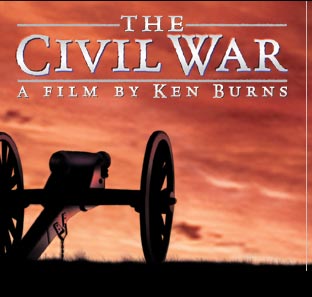
His break out series was the 11 hour  The Civil War which first ran in 1990. Burns used over 16,000 photographs  and archival images. He had first person narratives (mostly letters) read by different actors, giving each historic figure their on personality in the film. He had live interviews with noted historians. And the finishing touch was the music — a mix of Civil War era tunes and the haunting theme song, Jay Unger’s Ashokan Farewell.  The Civil War won two Emmy Awards, two Grammy Awards, a Peabody Award,  a Producers Guild of America Award, a People’s Choice Award and a slew of other accolades.


Films by Ken Burns:

  • The Shakers: Hands to Work, Hearts to God
  • The Statue of Liberty (which also received an Oscar nomination)
  • Huey Long
  • The Congress
  • Thomas Hart Benton
  • The Civil War
  • Empire of the Air: The Men Who Made Radio
  • Baseball
  • The West
  • Thomas Jefferson
  • Lewis & Clark: the Journey of the Corps of Discovery
  • Frank Lloyd Wright
  • Not for Ourselves Alone: Elizabeth Cady Stanton and Susan B. Anthony
  • Jazz
  • Mark Twain
  • Horatio’s Drive: America’s First Road Trip
  • Unforgivable Blackness: The Rise and Fall of Jack Johnson
  • The War
  • The National Parks: America’s Best Idea
  • The 10th Inning
  • Prohibition
  • The Dust Bowl

Films in production include:

  • The Central Park Five
  • The Roosevelts
  • Jackie Robinson
  • Vietnam
  • Country Music
  • Ernest Hemingway

The Baltimore Sun’s Media Critic, David Zurawik, has called Burns “… not only the greatest documentarian of the day, but also the most influential filmmaker period. ”


Thought of the Day 6.14.12

“So much has been said and sung of beautiful young girls, why doesn’t somebody wake up to the beauty of old women”

–Harriet Beecher Stowe

Harriet Beecher Stowe was born this day in 1811, she would be 201 years old today.

Beecher-Stowe 2

Beecher-Stowe 2 (Photo credit: Wikipedia)


Stowe was a social activist and writer.

She wrote over 30 books covering a wide range of genres (from biographies to children’s books and how-to books on homemaking)  but she is best remembered for her best selling Uncle Tom’s Cabin.

Uncle Tom’s Cabin was  originally published in installments in the National Era, a weekly antislavery journal, starting in June of 1851. In 1852 it came out as a book which was published in two volumes. It was internationally well received and has been translated into 60 languages (including, if one is to believe Rogers and Hammerstein, Siamese.)

Visit the Harriet Beecher Stowe Center’s site to learn more.


The Battle of Westminster… Corbit’s Charge

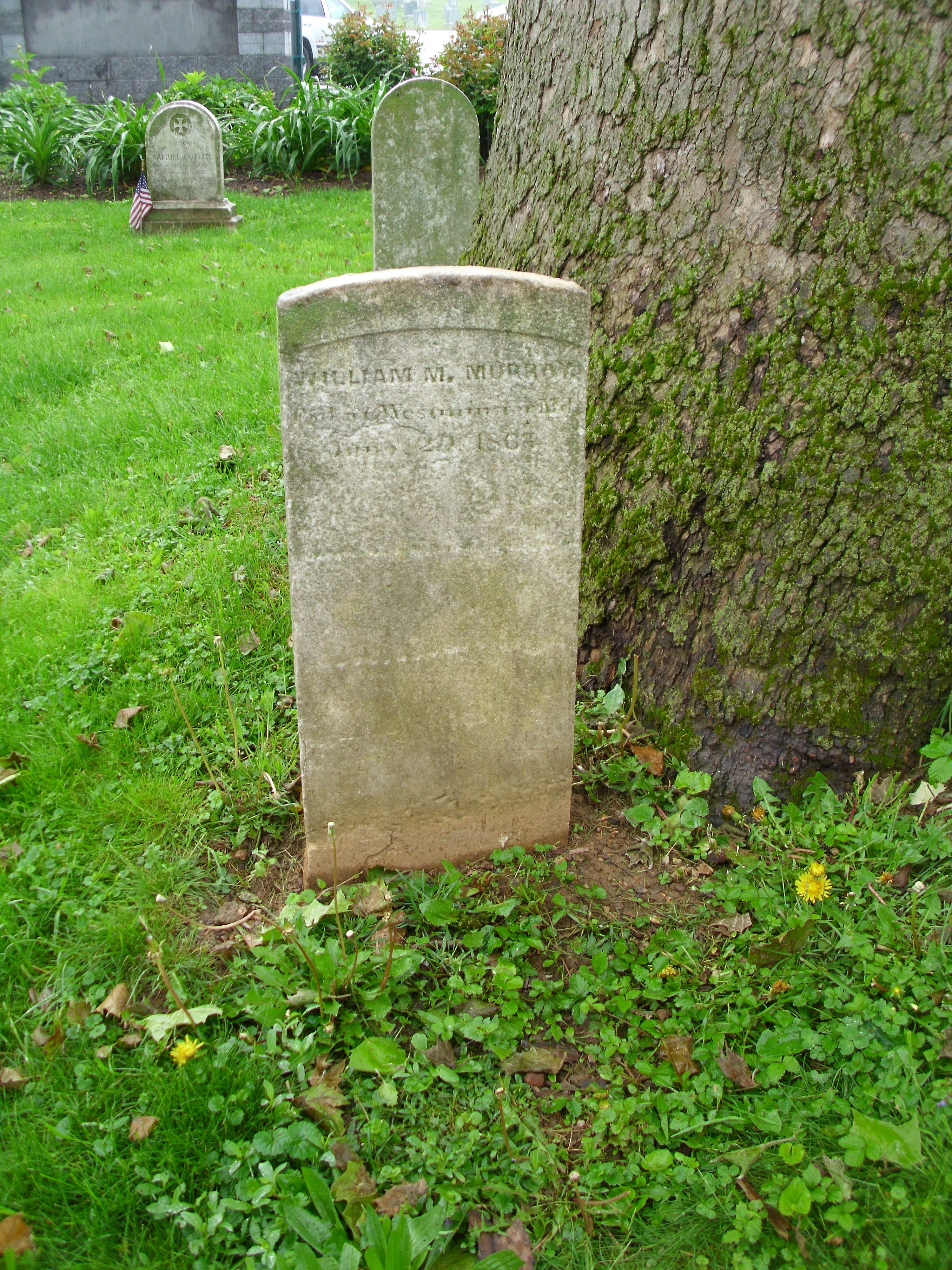
Marker for Lieutenant John William Murray, one of two Virginians who lost their lives in the Battle of Westminster.

I wrote this article for AT HOME IN MARYLAND an on-line  magazine. It was originally published last year, but I have updated it for publication here. Permission to reprint the article was given by the publisher. All photos and content are the original work of ritaLOVEStoWRITE.

____________________

Westminster, Maryland reenacts Corbit’s Charge every year on the last full weekend in June,
this year it will take place June 23 & 24th.

 What started out as a single afternoon in 2003 has grown to a weekend-long celebration that draws over 2,000 people.  The weekend includes a Civil War encampment; military demonstrations; period music; living history interpretations and  artisans, guided tours, speakers and museum displays relating to the Civil War period. A wreath will be laid at the Corbit’s Charge monument.

____________________

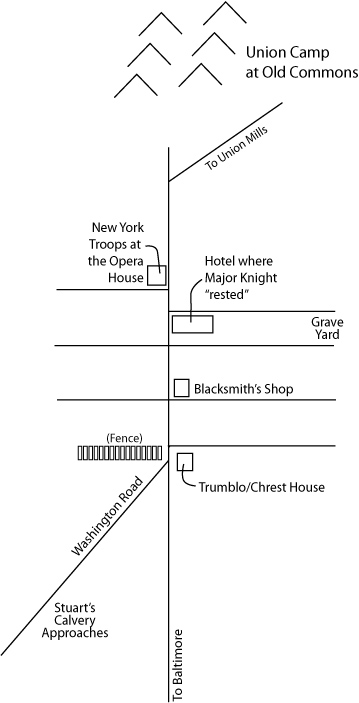
Corbit’s Charge took place June 29, 1863 on the outskirts of Westminster. A group of about 90 men from the C and D companies of the Delaware 1st Cavalry skirmished with the vanguard of Confederate General J.E.B. Stuart‘s cavalry near what is today East Main Street and Washington Road. The skirmish, also known as, “The Battle of Westminster,” resulted in delaying Stuart from getting to Gettysburg, and may have cost the South the battle.

So what was the battle all about?

For two weeks J.E.B. Stuart and his cavalry were busy collecting provisions and information and harassing the Union’s rear echelon in Northern Virginia and Maryland.  He was essentially charged with a surveillance mission but he was just as happy to raid, and he was up to no end of trouble as he made his way up to a rendezvous point with General Jubal Early in York, Pa.  He destroyed a portion of the C&O canal  here… dismantled a telegraph lines there… attacked an 8-mile-long wagon train of Union supplies here… Stuart was a busy guy.

It was clear that the Federals had a column of men heading north through Frederick, and he tried twice to alert Gen. Robert E.  Lee to the advancing troops – He was Lee’s eyes and ears after all — but neither missive made it to Lee.

So Stuart pointed his horses toward the rendezvous in York, and headed the Rebel Calvary toward Westminster.

Unlike their battle hardened Rebel counterparts, the 1st Delaware Calvary had seen light action thus far, serving for the most part in the defense of Baltimore prior to moving northwest to Carroll County. Mustered in January, 1863, the 1st Delaware Calvary couldn’t come up with a full complement of 10 horse companies.  They scraped together seven small companies and those seven were reassembled into four active companies. Under the leadership of Major Napoleon Bonaparte Knight, Companies C and D arrived in Westminster to bolster a small garrison from 150th New York to protect the railroad depot for the Western Maryland Railroad line. They arrived at about 11 a.m on June 28. It was quiet warm Sunday.

They set up camp in the “Commons” on the north side of town, near what is now McDaniel College. The area was on high ground and provided the Union troops with a good view of both the town and the roads leading to it from Taneytown, Uniontown, New Windsor and Gettysburg.  Pickets were placed along the roads leading to town and the Delaware troops settled in, assured that they would be warned of any Rebel movement.

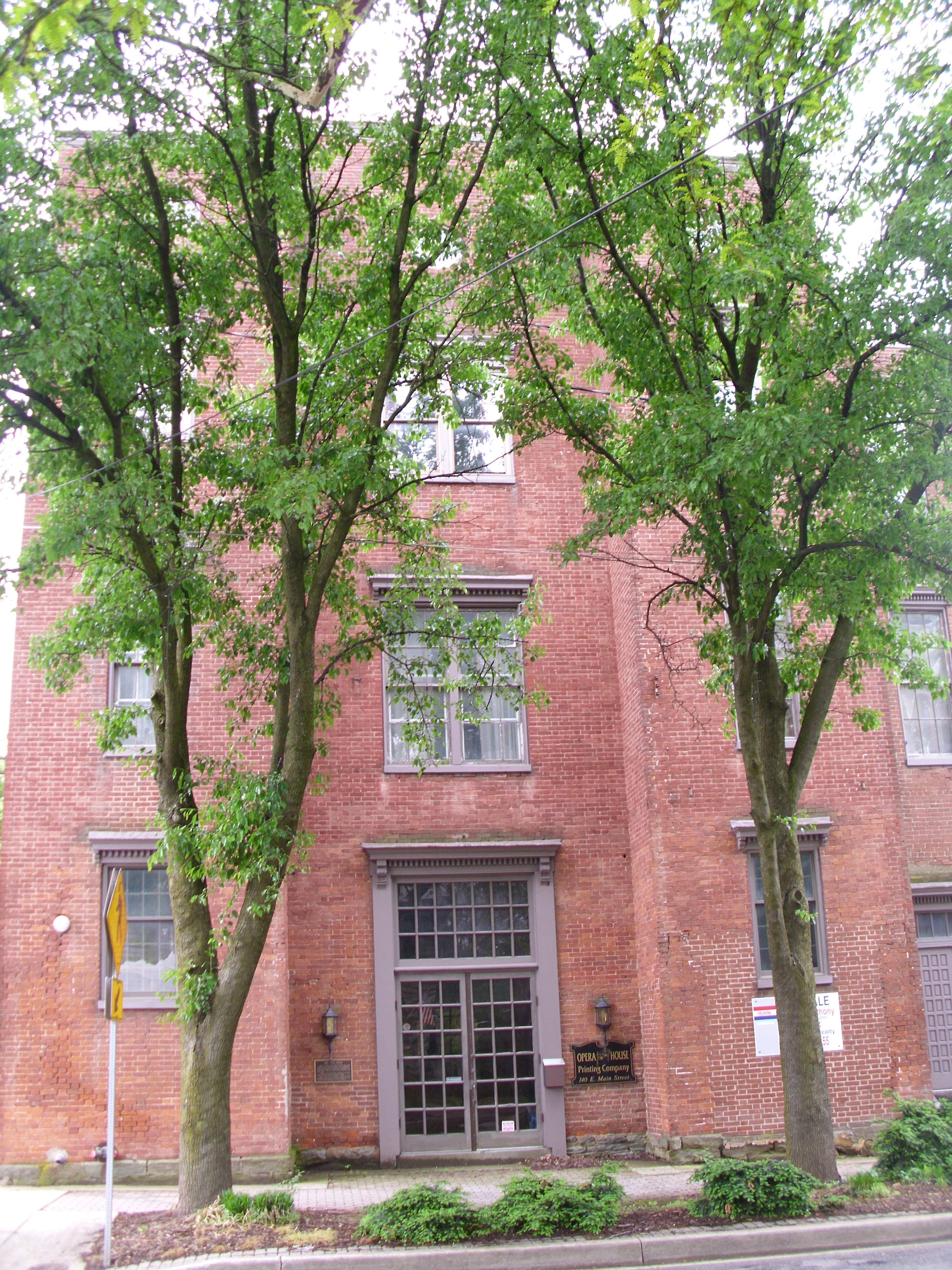
The Opera House was used by Lt. Pulaski Bowman and the New Yorkers as their head quarters.

Lieutenant Pulaski Bowman, who was in charge of the New York Provost Guard reported to Knight that there was no enemy about either in Gettysburg or Hanover. The Major, satisfied that all was secure, retired to the Westminster Hotel and Tavern, his unofficial  headquarters and settled in for some local comfort. There were some disturbances in the night, with reports coming in from the Hampstead and Manchester road pickets that the Southern cavalry was advancing, but investigation failed to turn up any Southerners. The Union troops settled in for the night. With the next day looking equally uneventful, Major Knight ordered the battalion’s blacksmiths to attend to the horses, many of whom had thrown shoes on the rough road from Baltimore.

Stuart needed to travel through Westminster to get to Lee. He knew that the information he had on the Union Army’s whereabouts was vital to the General’s tactical planning. One little bit of the Union Force he was unaware of was the small group of Blue Coats from Delaware in his way. He found out about them just after 4 p.m. when his forces overcame and captured a handful of pickets on the ridge road.

The advance guard of the Confederates under Fitzhugh Lee (General Lee’s nephew) entered the town and captured five of the Delawareans at Michael Baumann’s Blacksmith Shop. Again the Yankees were prevented from alerting their superiors. But  Isaac Pearson, a young lawyer from the town, who saw the Rebel force,  took quick action and reported them to the Yankees. Knight was unaccounted for, whether he was sick, inebriated or just flat out hiding is unclear (he had originally signed up to fight for the South, but deserted to fight for the North early in the War.) So when the warning cry rang out he was spared the glory of leading less than a hundred men against Stuart’s thousands.  That honor fell to Captain Charles Corbit.

Corbit was twenty-five years old, tall, strong, and well liked by his company of 4 officers and 89 enlisted men. Some of those men were out at the pickets, some were left mountless as their horses were being tended to and others had already been captured. He rallied what remained of his subordinates at the top of Main Street and moved east to find the enemy. Corbit sent Lt. D.W.C. Clark ahead with a scouting party of a dozen men.

Lt. Clark went through downtown, passing the blacksmith shop and turning left on Washington Road where they encountered Fitzhugh Lee and the front of Stuart’s force. Clark quickly turned around and rushed back to Corbit to report his findings… There was a LARGE contingent of Southern gentlemen just around the corner!

Instead of retreating Corbit drew his sword. He led his men head on against  the hordes of Confederates.

What little luck Corbit had on his side– besides the loyalty of his troops and his own bravado–was the layout of that area of town.  Washington Road hit Main Street at an odd angle and there was a sturdy fence that squeezed the cavalry men together into a narrower field of battle.

The other Delaware company, Company D, under Lt. Caleb Churchman, heard the gunfire and quickly joined the battle. But the Northerners were still hopelessly outnumbered.

The battle was fierce and short-lived. Corbit and his men fought off two or three countercharges before the sheer overwhelming number of Rebels won the day.

The Southerners pushed the 1st Delaware back up Main Street.

Corbit’s horse was shot out from beneath him and he was captured along with most of his company.

A few of the Yankees, including Major Knight, escaped toward Baltimore on the Reisterstown Road (Baltimore Pike)  a swarm of Confederate riders in hot pursuit. This caused some alarm in the city when the fleeing troops warned that the Confederates were about to invade.

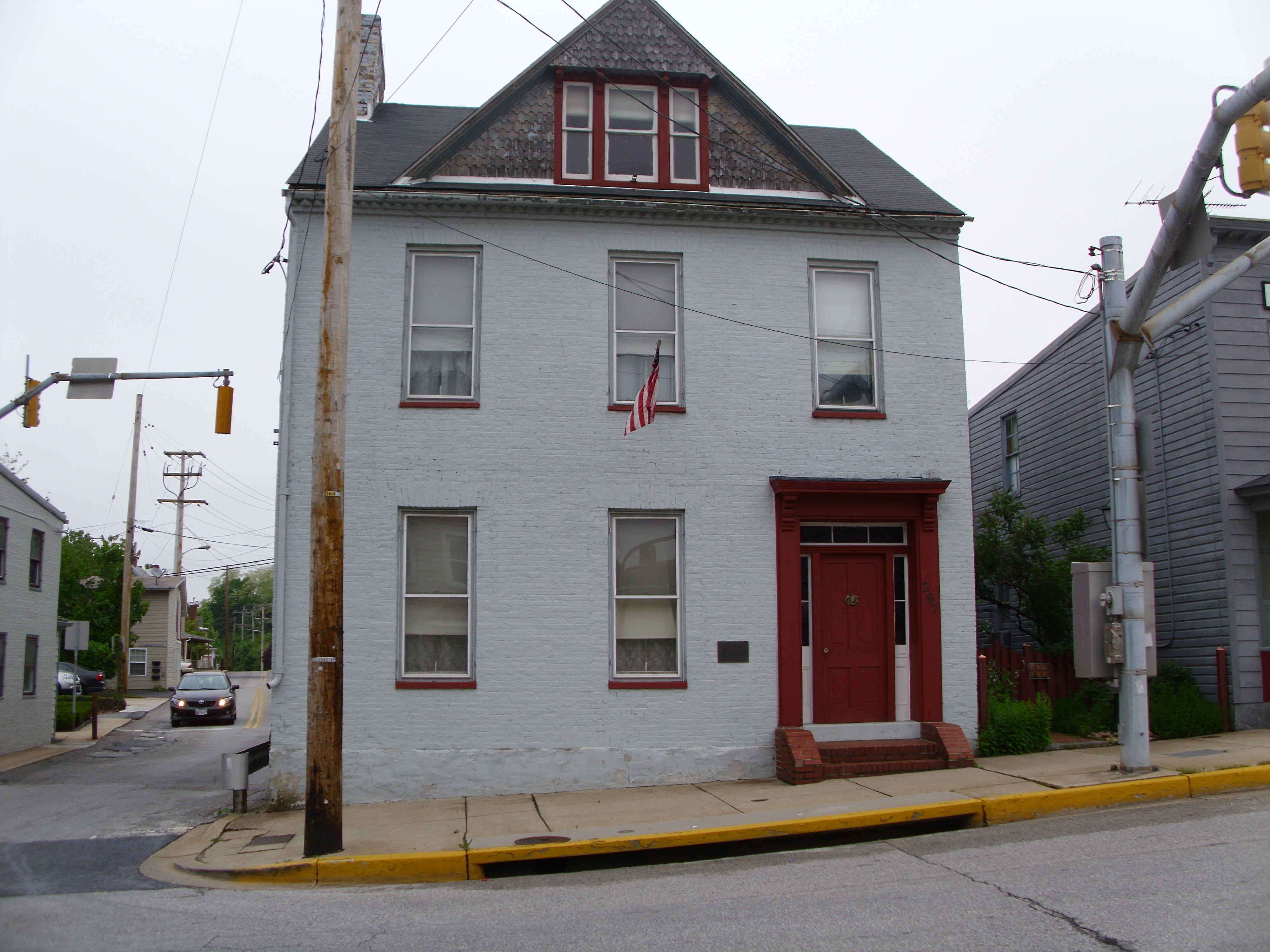
The Trumbo/Chrest House was in the thick of the action. There are still bullet holes in the side of the building.

The more practical outcome of the battle was that two officers from the 4th Virginia Calvary  and two privates from the 1st Delaware lay dead on the dusty streets of Westminster. (One of those Virginians, 1st Lt. John William Murry, Co. E. 4th Virginia Calvary, C.S.A., is buried in the Ascension Episcopal Church cemetery at 23 North Court Street.)  11 men were wounded and almost all the Northerners were taken as Prisoners of War, including Captain Corbit,  Lt. Churchman and Lt. Bowman. The Southerners overtook the camp at the Commons and confiscated supplies, both army issue and private, and intelligence.  The town and the surrounding farms were likewise foraged for supplies.

Then Stuart stopped for the night. For the first time in five days both the men and the horses in Stuart’s column had enough to eat and a chance to rest.

The Confederates continued on to Hanover  the next day, where Stuart paroled Corbit and Chruchman, and continued on to meet up with General Lee in Gettysburg.

But, did The Battle of Westminster delay Stuart from reaching Lee at Gettysburg?  Historian Eric J. Wittenberg thinks so. “That foolhardy charge cost Stuart half a day of critical time on his march. It absolutely had an effect on the time of Stuart’s arrival at Gettysburg,”

Still Wittenberg thinks  “Stuart did everything he reasonably could  to link up with Lee.”

So why does Stuart get so much of the blame for the South’s failure at Gettysburg? “The Calvary’s main job at that point of the Civil War was raiding and scouting,” Says Civil War enthusiast George Baker, III, adding, “Stuart’s lack of communication  basically left Lee blind in enemy territory, so he (Lee) didn’t know exactly where the Army of the Potomac was going prior to Gettysburg. The first day he didn’t know whether he was going up against a division or the entire army. That could have been the game changer of the battle.  Lee never publicly blamed Stuart for the battle’s loss, but When Stuart showed up late at Gettysburg…it was the closest Lee ever came to chewing anyone out.”

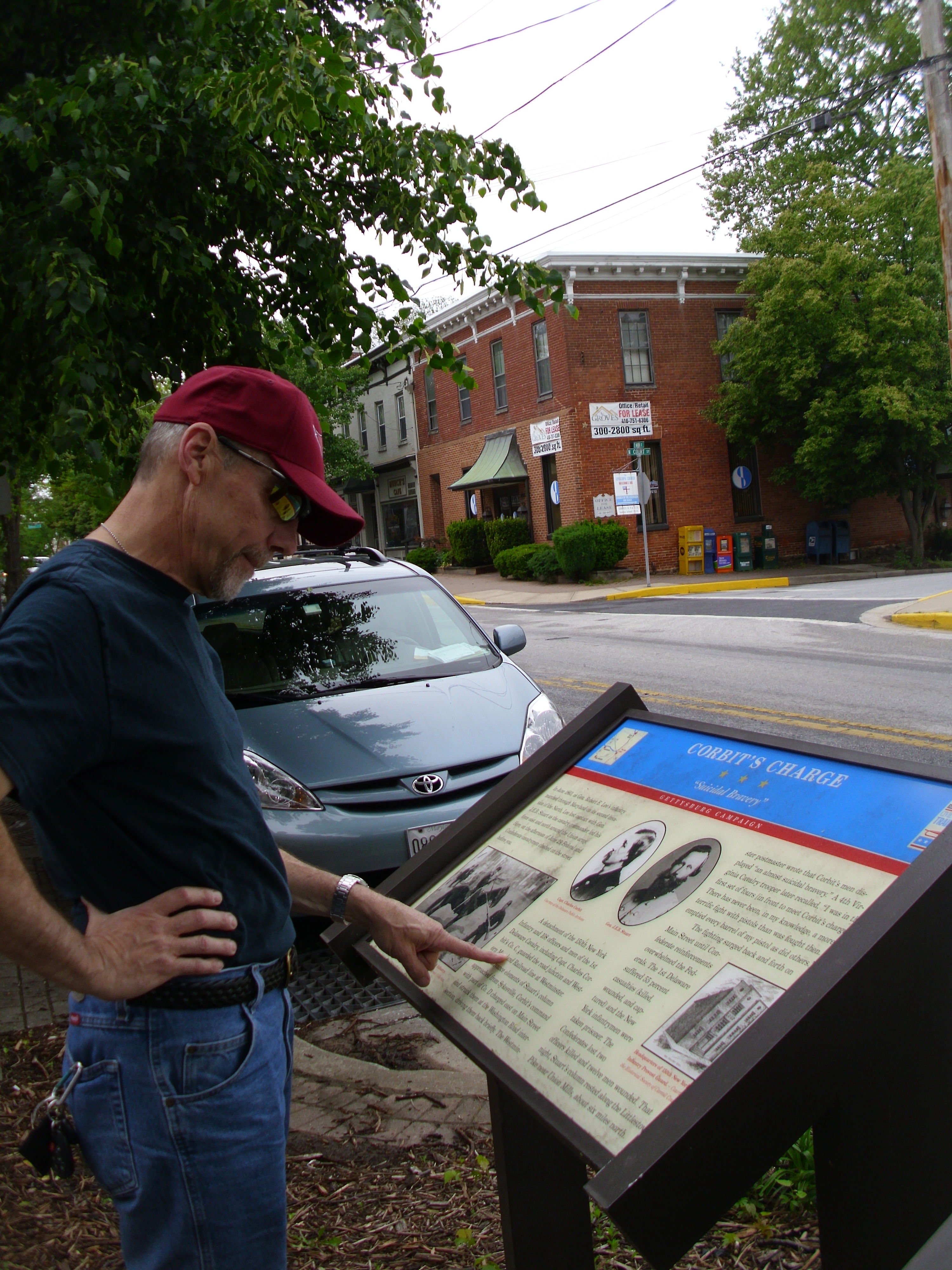
A Civil War history buff reads the Corbit’s Charge marker on Westminster’s Main Street.