Category Archives: American History

Thought of the Day 8.17.12 Davy Crockett

“Since you have chosen to elect a man with a timber toe to succeed me, you may all go to hell and I will go to Texas.”

–Davy Crockett

Davy Crockett

Davy Crockett (Photo credit: Wikipedia)

David Stern Crockett was born on this day near the Nolichucky River in Greene County, Tennessee in 1786. Today is the 226th anniversary of his birth.

Here’s what I THOUGHT I knew about Davy Crockett…

He was born on a mountain top in Tennessee. He wore a coon skin hat. He looked like either Fess Parker or John Wayne. He killed himself a bear when he was only three. He had a riffle named Ole Betsy. He was “King of the Wild Frontier.” He died in the Alamo.

English: Davy Crockett 1967 Issue, 5c

English: Davy Crockett 1967 Issue, 5c (Photo credit: Wikipedia)

Here’s what I LEARNED about Davy Crockett while researching this Thought of the Day segment…

John and Rebecca Crockett had 9 children, Davy was their 5th. His father taught him how to hunt and shoot (when he was 8 — so that bear probably lived another 5 years.) His father put him in school at 13, but Davy had some trouble with a bully and lasted only 4 days. After he “whupped the tar” out of the class bully  he reckoned he was in trouble with both the teacher and his parents so he ran away. He spent three years in the wilderness before coming home. He didn’t learn to read and write until he was 18. He married his first wife Mary Finley when he was 19 going on 20. They  had three children together, but then Mary passed away. Crockett then married Elizabeth Patton and fathered two more children.

Crockett enlisted in the army in 1813 as a scout  and was stationed in Winchester, Tennessee. He took part in the massacre against the Cree at Tallussahatchee on November 3rd, 1813. He left the  US Army in 1815 as a fourth sergeant. He joined the Tennesee Militia and became a lieutenant colonel.

English: Oil on canvas portrait of Davy Crocke...

English: Oil on canvas portrait of Davy Crockett; original size without frame 76.2×63.5 cm. (Photo credit: Wikipedia)

His folksy demeanor and larger than life frontiersman ways gave him a folk legend status. Crockett was elected to the Tennessee State Legislature  and in 1826  ran for US House of Representatives as a supporter of Andrew Jackson. He  was pro squatters rights and he won a second term. But when he opposed Jackson’s Indian Removal Act  he was defeated for his bid for a third consecutive term. He bounced back in 1832, insisting that he would remain independent of Jackson “I bark at no man’s bid. I will never come and go, and fetch and carry, at the whistle of the great man in the White House no matter who he is.”

When he was defeated in 1835 he decided he’d had enough of backstabbing Washington politics and he joined the fight for Texan Independence.

Cover of "The Alamo"

Cover of The Alamo

He arrived at the Alamo on February 8, 1836. He liked his new environment and his new companions. “I would rather be in my present situation” he wrote in a letter to his daughter, “than to be elected to a seat in Congress for life.” General Santa Anna’s Mexican army laid siege to the make shift fort on February 23. He fought at the Alamo with 189 defenders in San Antonio for 13 days against the much larger Mexican Army. On March 6, in a 20 minute final battle, the fort was over run and Crockett was killed.
Thought of the Day 8.15.12 Julia Child

“The only time to eat diet food is while you’re waiting for the steak to cook”

Julia Child

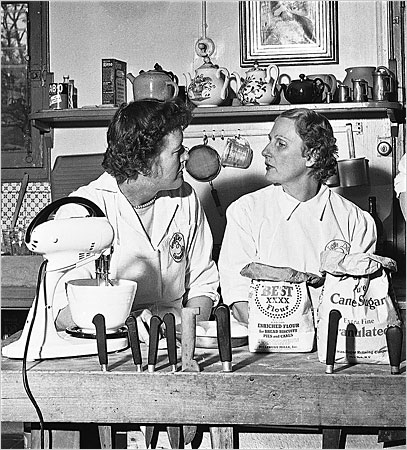
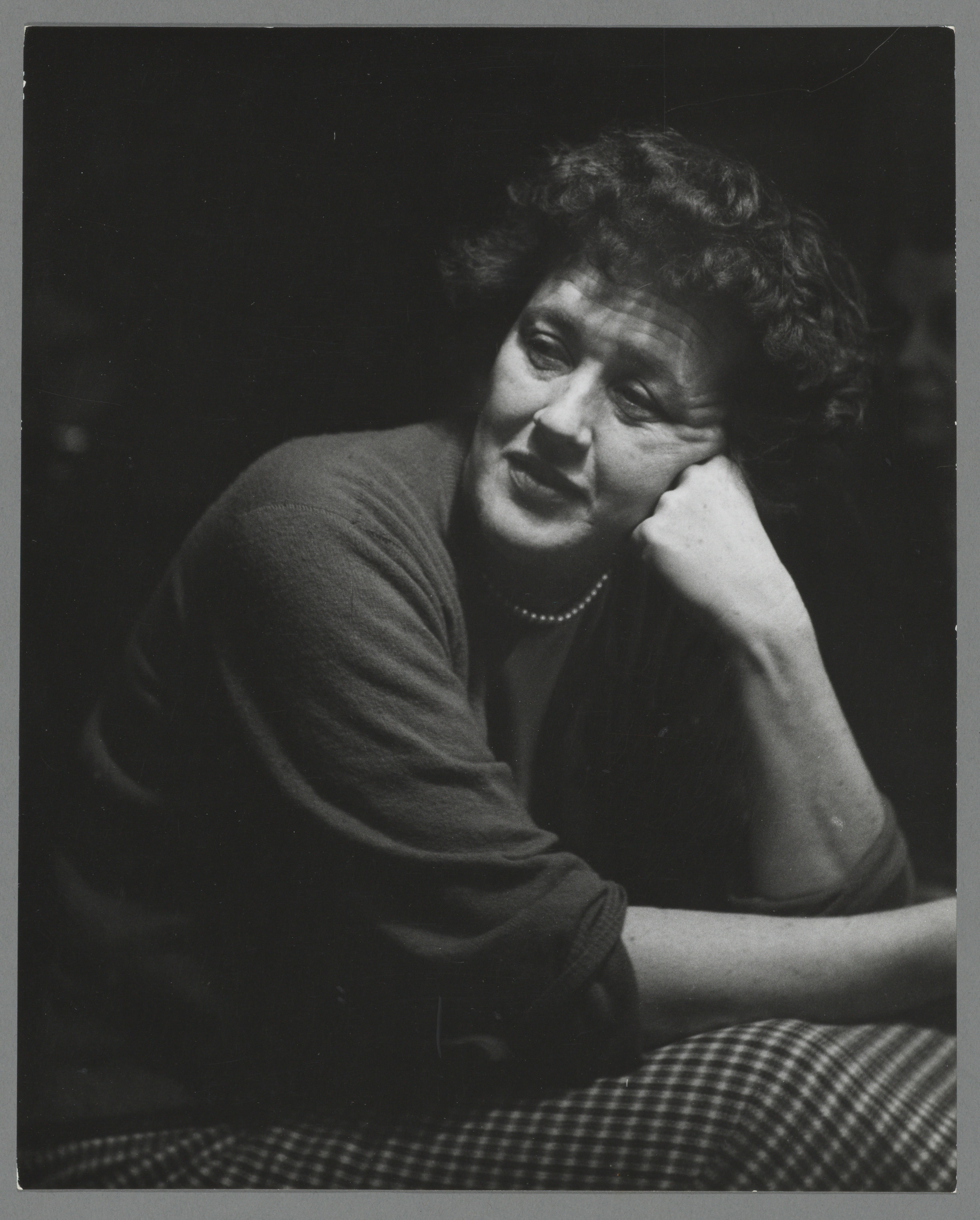
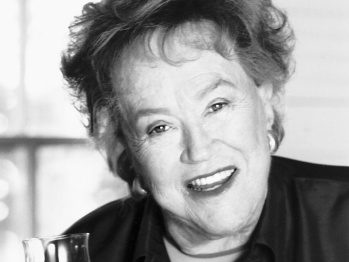
Julia McWilliams was born on this day in Pasadena, California in 1912. Today is the 100th Anniversary of her birth.

“Juju” was the oldest of three children in the McWilliams household. Their father was a real estate magnet, their mother a paper-company heiress and daughter of a lieutenant governor of Massachusetts. Julia was vivacious, athletic (she was 6’2″ by the time she graduated the exclusive Katherine Branson School for Girl’s in San Francisco) and loved a good laugh. She studied writing at Smith College and worked in advertising after graduation.

During WWII Julia tried to join the Woman’s Army Corps, but she was too tall to be a WAC, so she volunteered at the OSS, a government intelligence agency. She started as a typist in Washington but worked her way up to researcher for Top Secret intelligence. She worked overseas in China and Sri Lanka. The SPY Museum in Washington DC included a display on Julia’s time in the OSS as part of their collection. In 2009 they held a special event featuring Child’s Coq au Vin and a talk about the chef’s life as a spy.

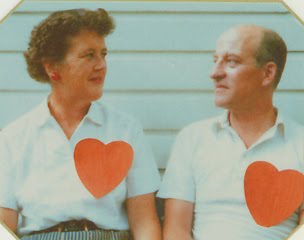
While she was in Sri Lanka on assignment she met fellow OSS employee Paul Child and the two began to date. In 1946 Paul and Julia were married. When Paul, now in the US State Department, was assigned to Paris the couple moved to France.

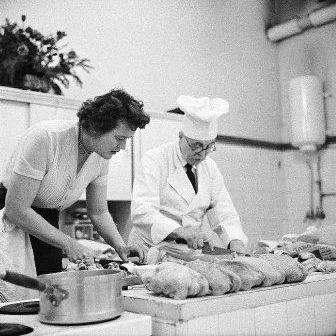
Julia loved food and loved a challenge, so she started to take classes at the Cordon Bleu cooking school. After graduation she worked with her colleagues Simone Beck and Louisette Bertholle to start The School of the Three Gourmands for American women in Paris. The three started to write a cookbook that would translate French cuisine to the American kitchen. After a lot of hard work and many revisions that cookbook became Mastering the Art of French Cooking, a best selling cookbook that changed the way people looked at French cuisine.

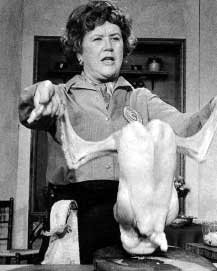
When Julia promoted the book by cooking an omelet on-air  at her local PBS station the response was so good that they offered her  her own cooking show for $50 a pop.  The French Chef premiered on WGBH Boston in 1962. It was the first cooking show on PBS. It ran for 10 years  and was syndicated nation wide. The show won a Peabody and Emmy award (Julia was first educational television personality to receive an Emmy. In her career she was nominated for a total of eight and won three). In 1966 Time Magazine anointed Julia as a culinary goddess by putting her on the cover with the title “Our Lady of the Ladle.” A dozen more TV shows (with bigger budgets) followed. You can still catch reruns of Baking with Julia on PBS. She used 753 pounds of butter during the filming of that series alone.

She wrote sixteen more cookbooks, most  were associated with her television series.

She was awarded the Presidential Medal of Freedom by President Bush in 2003. Her autobiography My Life in France was published posthumously. Her kitchen, designed by her husband Paul, is now installed at the Smithsonian Institute’s National Museum of American History in Washington DC.

Blogger Julie Powell digested the  Mastering the Art of French Cooking, working her way — recipe by recipe– through the  752 page book in one year. She documented the journey in a book, Julie and Julia: 365 Days, 524 Recipes, 1 Tiny Apartment Kitchen (which was then made into a movie, Julie & Julia starring Meryl Streep in 2009.)

“Something came out of Julia on television that was unexpected… it was just magical.  You can’t fake that. You can’t take classes to learn how to be wonderful. Our food culture is the better for it. Our stomaches are the better for it. ” — Julie Powell

This week restaurants are celebrating Julia’s 100th birthday by  featuring some of her most famous recipes.


Thought of the Day 8.5.12 Neil Armstrong

—————————————UPDATE—————————————

Sadly I have to give an update to this post.

One of America’s greatest heros, Neil Armstrong, passed away today due to complications from cardiovascular procedures. He had  heart surgery last month in Cincinnati, Ohio.

“Looking back, we were really very privileged to live in that thin slice of history where we changed how man looks at himself and what he might become and where he might go,” Armstrong said.

—————————————UPDATE—————————————

“I believe every human has a finite number of heartbeats. I don’t intend to waste any of mine”

–Neil Armstrong

Neil A. Armstrong was born on this day in Wapakoneta, Ohio, in 1930. He is 82 years old.

He grew up near the local airport and took flying lessons as a teenager. He got his pilots license before he got his driver’s license.

Armstrong was a naval aviator for three years, flying 78 combat missions during the Korean War,  prior to joining the National Advisory Committee of Aeronautics (NACA) in 1955. (The NACA was the precursor to NASA.) He  logged over 2,400 hours of air time testing experimental aircraft at Edwards Airforce Base.

According to the NASA’s Glenn Research Center web site:

He has flown over 200 different models of aircraft, including jets, rockets, helicopters and gliders.

In 1962 Armstrong became one of the “New Nine” NASA astronauts, the second group of men selected for US space flight to augment the Mercury 7. The Mercury astronauts established orbital space flight, the New Nine would fly in Gemini space capsules and would tackle docking two vehicles in space and space walks.

English: Close-up on orbiting Agena D rocket s...

English: Close-up on orbiting Agena D rocket stage Polski: Zbliżenie orbitującego członu rakietowego Agena D (Photo credit: Wikipedia)

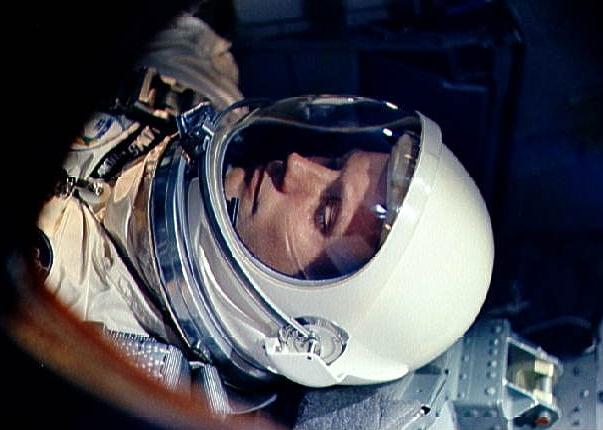
On his historic Gemini 8 mission Armstrong and Dave Scott successfully docked their ship with an unmanned Agena target vehicle. It was an essential first step  towards getting to the moon. Unfortunately about 27 minutes after docking the two ships began to roll and yaw. Assuming the problem was with the Agena, Armstrong undocked, but it was a faulty thruster on the Gemini that was making the capsule spin, and undocking only exacerbated the problem. Armstrong and Scott had to shut down Gemini’s main reaction control system and use the reentry thrusters to zero out yaw and roll on the wildly spinning craft. Armstrong’s masterful flying skills were successful, but they used up 75% of the system’s fuel and Mission Control cut short the flight.

On the Gemini 11 flight he acted as CAPCOM — the person at Ground Control who interfaces with the astronauts in space — and he was the commander of the back-up crew for Apollo 8 (the first human space flight to leave Earth’s orbit, fly to the moon — but not land — and return to Earth.)

Flag of the United States on American astronau...

Flag of the United States on American astronaut Neil Armstrong’s space suit (Photo credit: Wikipedia)

Armstrong was the Commander of Apollo 11, the first manned space craft to land on the Moon. He accompanied by Michael Collins, who stayed aloft in the Command Module, and Edwin “Buzz” Aldrin, Jr. who touched down on the Moon’s surface on July 20, 1969 with with Armstrong. Armstrong descended a lader and took the first steps on the lunar surface. Armstrong and Aldrin had about 2 hours outside the lander, the Eagle,  to take photographs, set up experiments and collect moon rocks. The Eagle blasted off from the Sea of Tranquility and  Armstrong and Aldrin rejoined Collins on the Command Module, Columbia.

The reverse of the Anthony dollar is based upo...

The reverse of the Anthony dollar is based upon the insignia of the Apollo 11 mission, which was also used on the reverse of the Eisenhower dollar that preceded it. (Photo credit: Wikipedia)

He worked for NASA as Deputy Associate Administrator for aeronautics until 1971.

Post NASA he taught and did research as a professor of aerospace engineering at University of Cincinnati and served as the chairman of the board for several privately owned aerospace/defense industries.

Buzz Aldrin walks on the moon, July 20, 1969

Buzz Aldrin walks on the moon, July 20, 1969. The photo was taken by Armstrong. (Photo credit: Wikipedia)

[Please note that I did not say Armstrong was the first man to LAND on the moon. Both Aldrin and Armstrong landed on the Moon at the same time.  … Armstrong was the first man to WALK on the Moon.]


Thought of the Day 8.4.12 Louis Armstrong

“I got a simple rule about everybody. If you don’t treat me right / shame on you!”

–Louis Armstrong

Louis Armstrong

Louis Armstrong (Photo credit: late night movie)

Louis “Satchmo” Armstrong was born this day in New Orleans, Louisiana in 1901. Today would be his 111th birthday.

The grandson of slaves, his family was very poor. His father, William Armstrong, abandoned the family when Louis was a baby. His mother, Mayann often turned to prostitution to make ends meet and she left Louis and his little sister Beatrice with their grandmother Josephine Armstrong. The little boy did what he could to earn money. He worked as a  paper boy. He hauled coal to the red-light district — and lingered around the clubs to listen to the music. In 1907 he sang in a street quartet for change.  He did odd jobs for the Karnofsky family, a Lithuanian-Jewish family who took him in and treated him well. The Karnofskys lent Armstrong the money buy his first cornet.

b/w line drawing of cornet

b/w line drawing of cornet (Photo credit: Wikipedia)

When he was 11 years old he was sent to the New Orleans Home for Colored Waifs, a reform school, for firing his a pistol into the air on New Year’s Eve. While at the home Armstrong really learned to play the cornet (he had been self taught and could play by ear prior to the lessons he had at the home).

He was released from the home at 14. He worked hauling coal and unloading barges during the day and brought out his horn at night. He went to honky tonk clubs like “the Funky Butt Hall” to listen to established musicians and learn from them. Joe “King” Oliver mentored the young man. By 17 he was playing professionally.

By the 1920’s he was playing on riverboats and traveled up to St. Louis. His jazz trumpet solos and vocals became his signature style. In 1922 “King” Oliver invited him to join his Creole Jazz Band in Chicago. The money was good enough that Armstrong no longer had to work the menial labor day jobs to make ends meet. By 1925 he was headlining his own band and playing with artist like Bessie Smith and Ma Rainey. He was billed as “The World’s Greatest Jazz Cornetist” for a gig at the Dreamland Cafe, and cut his debut record with his own group Louis Armstrong and His Hot Five. By the 1930s his act had gone international.

[Portrait of Louis Armstrong, Carnegie Hall, N...

[Portrait of Louis Armstrong, Carnegie Hall, New York, N.Y., ca. Apr. 1947] (LOC) (Photo credit: The Library of Congress)

According to the Louis Armstrong House Museum Site he:

  • developed a way of playing jazz, as an instrumentalist and a vocalist, which has had an impact on all musicians to follow;
  • recorded hit songs for five decades, and his music is still heard today on television and radio and in films;
  • wrote two autobiographies, more than ten magazine articles, hundreds of pages of memoirs, and thousands of letters;
  • appeared in more than thirty films (over twenty were full-length features) as a gifted actor with superb comic timing and an unabashed joy of life;
  • composed dozens of songs that have become jazz standards;
  • performed an average of 300 concerts each year, with his frequent tours to all parts of the world earning him the nickname “Ambassador Satch,” and became one of the first great celebrities of the twentieth century.

Here’s Louis Armstrong (Trumpet), Trummy Young (Trombone), Peanuts Hucko (Clarinet), Billy Kyle (Piano), Mort Herbert (Bass), and Danny Barcelona (Drums) in Stutttgart Germany in 1959.

[note to self: MUST sing more jazz so I can play in a band with some one named Trummy and Peanuts.]


Thought of the Day 8.2.12 L’Enfant

Pierre Charles L'Enfant

Pierre Charles L’Enfant (Photo credit: Wikipedia)

Pierre Charles L’Enfant was born on this day in 1754 at Anet, Eure et Loir, France. Today is the 258th anniversary of his birth.

L’Enfant was educated at the Royal Academy in Paris as an engineer before joining Lafayette  to help the American side during the War of Independence. He arrived in 1777 at the age of 23 and fought as military engineer. He joined George Washington’s staff  after recovering from injuries at the Siege of Savannah. He attainted the rank of Major of Engineers in 1783.

He moved to New York after the war and established a civil engineering firm. In 1788 he redesigned the  New York’s city hall to be the United States’ first capitol building, Federal Hall.  The building was the site of George Washington’s inauguration and where the Bill of Rights was signed.

Federal Hall, Seat of Congress 1790
hand-colored engraving by Amos Doolittle, depicting Washington’s April 30, 1789 inauguration. [Image Courtesy Wikimedia Commons: public domain]

In 1791 the US Congress authorized the building of a capital city on the Potomac River. George Washington appointed his old friend L’Enfant  to design the new city in 1791.

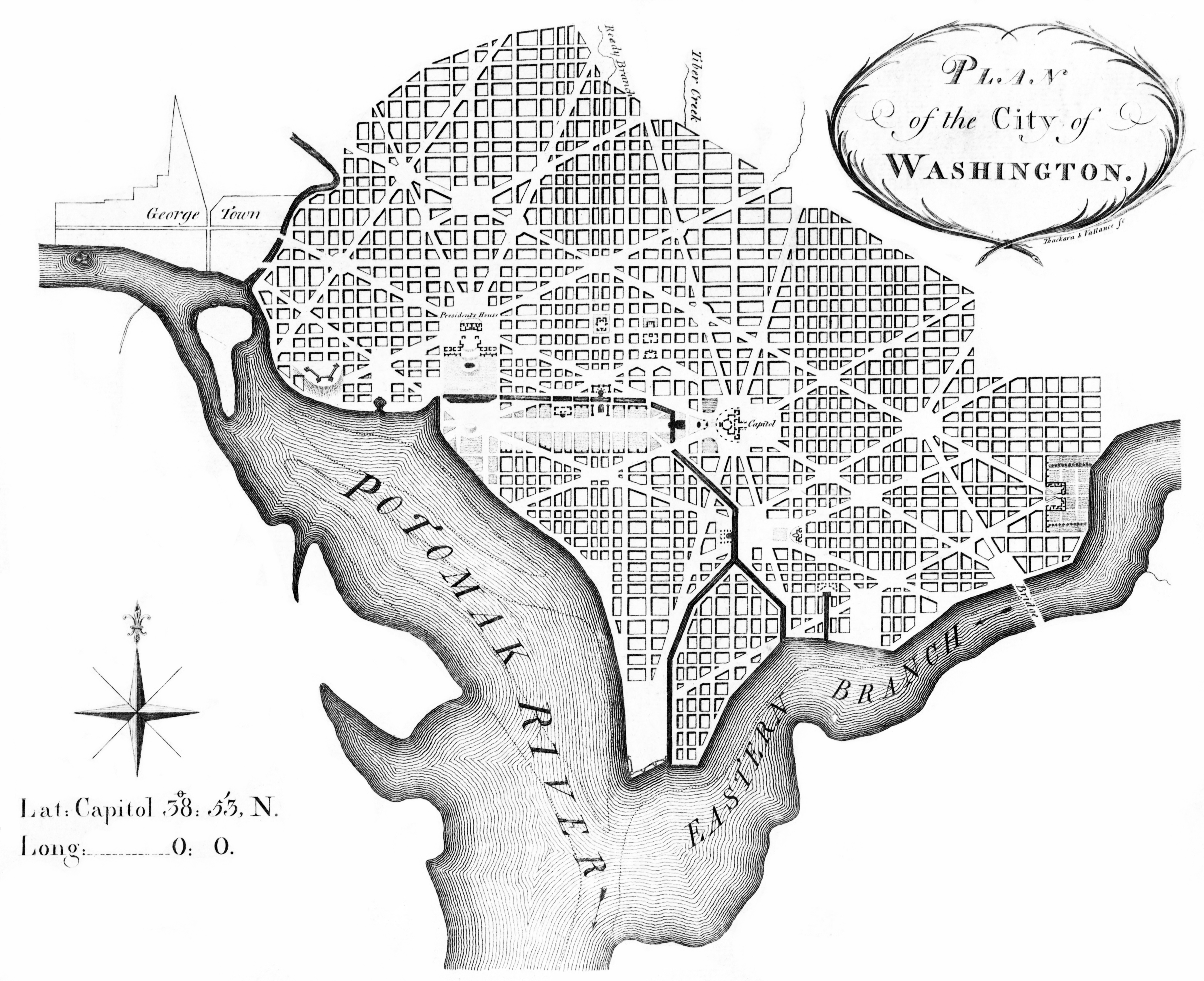
L’Enfant’s “Plan of the city of Washington” March 1792 is at the Library of Congress. [Image courtesy Wikimedia Commons. This image is in the Public Domain.]

“Congress House” (the Capitol) was to be on top a hill, a place of honor overlooking the rest of the city.  The “President’s House” (the White House) was to be a grand mansion fit for the leader of the country. His plan outlined the need for public spaces including a grand public walk (today’s National Mall) ). It would be 1 mile long and 400 feet wide and would stretch from the Capitol to an equestrian statue of Washington (the Washington Monument is now where the statue would have been).

The western front of the United States Capitol...

The western front of the United States Capitol. The Capitol serves as the seat of government for the United States Congress, the legislative branch of the U.S. federal government. It is located in Washington, D.C., on top of Capitol Hill at the east end of the National Mall. The building is marked by its central dome above a rotunda and two wings. It is an exemplar of the Neoclassical architecture style. (Photo credit: Wikipedia)

According to “A Brief History fo Pierre L’Enfant and Washington, D.C.”:

L’Enfant placed Congress on a high point with a commanding view of the Potomac, instead of reserving the grandest spot for the leader’s palace as was customary in Europe. Capitol Hill became the center of the city from which diagonal avenues named after the states radiated, cutting across a grid street system. These wide boulevards allowed for easy transportation across town and offered views of important buildings and common squares from great distances. Public squares and parks were evenly dispersed at intersections.

Wide avenues and public squares would make it “people’s city”, while monuments  and inspiring buildings would give it the stature and importance of world capital.

While he was concerned with the grand vision of the city  his bosses on the Congressional appointed committee were concerned with how much the project was going to cost . They  wanted to keep the wealthy plantation owners in the area happy. L’Enfant “delayed producing a map for the sale of city lots (fearing real estate speculators would buy up land and leave the city vacant).” And he angered the commission when he had a prominent resident’s house torn down because it was in the way of one his boulevards.  When the city’s surveyor went behind his back and produced a lot map L’Enfant resigned. He was never properly paid for the work he did on the Capital.

The city was built, but the design had been greatly altered. Gone were the arrow straight streets and parkways. The Mall between the Capitol and the White House was a tree-covered park of irregular shape. Cows grazed on it.

Visitors ridiculed the city for its idealistic pretensions in a bumpkin setting and there was even talk after the Civil War of moving the capital to Philadelphia or the Midwest.

But in 1901 the McMillan Commission resurrected L’Enfant’s ideas and updated them for a modern city. The Mall was reclaimed, cleared and lined with American Elm trees. Memorials to Lincoln and Jefferson were added, and Museums and government buildings lined the perimeter.

L’Enfant worked on commissions

after the Capital, but non were very successful. His design for Philadelphia millionaire Robert Morris’ mansion was called Morris’ Folly. His final years were spent at the home of his friend William Dudley Digges, near Bladensburg, Maryland. He was buried there, but his body was exhumed and reinterred at Arlington National Cemetery with full military honors. His tomb now overlooks the city he helped design.

Tomb of Pierre Charles L'Enfant, designer of W...

Tomb of Pierre Charles L’Enfant, designer of Washington, D.C.’s original city plan, on the grounds of Arlington House (the Robert E. Lee Memorial) at Arlington National Cemetery in Arlington, Virginia, in the United States. (Photo credit: Wikipedia)


Thought of the Day 8.1.12 Herman Melville

“To the last, I grapple with thee; From Hell’s heart, I stab at thee; For hate’s sake, I spit my last breath at thee”

–Herman Melville


Photo of Herman Melville

Photo of Herman Melville (Photo credit: Wikipedia)

Herman Melvill was born this day on 1819 in New York City. Today is the 193 Anniversary of his birth.

He was the third of eight children. He grew up in Boston and Albany.  His father, Allan Melvill, was a successful merchant and the family lived comfortably for several years until an unsuccessful trading venture led to financial ruin. The elder Melvill sparked Herman’s love for adventure and the sea with stores of seafaring excitement and faraway places. Herman was 12 when his father died and the family moved to Lansingburg on the Hudson. It was then that his mother added the “e” to the end of the family name, and Melvill became Melville.

He got a job on a ship bound from New York to Liverpool as a cabin boy.  After several years as a teacher he heard the call of the sea again. In 1840 he signed on with the Acushnet from Fairhaven, Massachusetts. The ship left port for an 18 month journey in Pacific journey in January of 1841.  The Acushnet was a whaler and much of his material for Moby-Dick came from his time on board the ship. By the time they reached the Marquesas Islands in July of 1842 Melville had had enough of life on the Acushnet.

He deserted the ship and lived among the Typee tribe for three weeks. He then joined the crew of another whaler, this one, an  Australian ship called the Lucy Ann, was bound for Tahiti. Melville participated in a mutiny and landed in jail. Upon his release he signed up with yet another whaler and made it as far as Honolulu where he jumped ship again. He worked as a clerk until he was able to sign on with the USS United States which got him back to Boston in 1844. There Melville began to write about his adventures.

Cover of "Typee (Signet classics)"

Cover of Typee (Signet classics)

Typee is a quasi-autobiographical adventure novel about Tommo’s four month stay on a tropical paradise amidst the “nobel savages” (or cannibals) who may or may not be about to eat him,  and his relationship with the beautiful, and exotic, Faraway. He had trouble fining an American publisher, but the book was an overnight success when it was published in England. Omoo, continued the tale, again roughly following Melville’s adventures in the Pacific. Mardi, and a Voyage Thither showed a more sophisticated writing style. It was not a successful as the straight forward narratives of Typee and Omoo. In 1849 He published Redburn : His First Voyage, the fictionalized account of his first sea journey  as a cabin boy. In 1850 White-Jacket, based on his time as a seaman on the USS United States, was published. Because of its graphic depiction’s of flogging the U.S. Navy banned the punishment.

Sadly at this point the tides seem to have turned in his literary career. His popularity waned. Other books didn’t garner critical or popular acclaim in his lifetime. The Confidence-Man, Pierre, Billy Budd, and even Moby-Dick had to wait until a Melville revival, some 30 years after his death, to get their rightful praise.

Herman Melville: Moby-Dick

Herman Melville: Moby-Dick (Photo credit: wolfgraebel)

Melville went on the lecture circuit to supplement his writing income. He then moved his family to New York City and worked at the New York Custom House. He continued to write, working on both poetry and fiction, until his death.

http://www.online-literature.com/melville/

http://en.wikipedia.org/wiki/Herman_Melville


Thought of the Day 7.24.12

“Never interrupt someone doing what you said couldn’t be done.”

–Amelia Earhart

Famous aviator Amelia Earhart is thought to ha...

Famous aviator Amelia Earhart is thought to have crash landed on Nikumaroro Island when she disappeared in 1937. (Photo credit: Wikipedia)

Amelia Mary Earhart was born on this day in Atchison, Kansas in 1897. Today is the 115th anniversary of her birth.

She was unimpressed with the first plane she saw, a rickety thing of “rusty wire and wood” at the Iowa State Fair. When she was 23 pilot Frank Hawks took her up for her first ride in a plane and she was hooked. “By the time I had got two or three hundred feet off the ground, I knew I had to fly.” (– from Amelia Earhart, the Official Website.)

Earhart was a nurse’s aid at Spadina Military Hospital in Toronto, Ontario, during WWI. She was there when the Spanish Flu broke out in 1918 and she was hospitalized for pneumonia and sinusitis. She suffered from chronic sinusitis for the rest of her life.

She took her first lesson at Kinner Field in Long Beach in 1921. She had to take a bus and then walk four miles to get there. She cropped her hair and bought a leather jacket to ward off the chill morning flights (Amelia slept in the jacket for three nights straight to break it in before she dared to wear it to the field.) On Oct 22, 1922 she broke the altitude record for a female pilot  by flying over 14,000 feet, and on May 15, 1923 she became the 16th woman to earn her pilot’s license.

Family financial problems limited her time in the air as Amelia took jobs as a photographer a teacher and a social worker. But with Lucky Lindy’s solo flight over the Atlantic the hunt was on to find the first woman to fly (either solo or with a crew) over the ocean too. Amelia was chosen to join pilot Wilmer Stultz and copilot/mechanic Louis “Slim” Gordon. They took off from Newfoundland and landed in Wales about 21 hours later. Although her contribution to the flight was minimal — she kept the flight log and later said she that Stultz did all the flying and she was as useful as a “sack of potatoes” — it was a publicity smash. They returned to New York to a ticker-tape parade and were greeted at the White House with a reception by President Calvin Coolidge.

She become romantically involved with George Putnam, who had handled the publicity for the trans-Atlantic flight, and (after Putnam proposed six times) the two married in February of 1932. Amelia saw the marriage as a partnership. Their honeymoon was a lecture/promotional tour.  She also did a number of endorsements for luggage, clothing and cigarettes.  She became an associate editor for Cosmopolitan. And she and Lindbergh promoted commercial air travel, investing in Transcontinental Air Transport (which later became TWA).

In May of 1932, 5 years after Lindberg’s trip, she became the first woman to fly solo across Atlantic (she landed in Ireland.)  She also flew solo from Hawaii to California, from LA to Mexico City and from Mexico City to New York.

Amelia was one of the organizers and the first  president of The Ninety-Nines, an organization that advanced the cause of women in aviation.

In 1936 she started to plan a trip around the world. The first attempt ended in Hawaii when a blown tire (or perhaps pilot error) when the plane ground-looped. The damaged plane and the deflated crew went back to Oakland, CA.  For the second attempt Amelia and Fred Noonan  headed east, to Miami. They made several stops in South America, Africa, India and Southeast Asia. On June 29, 1937 they landed in Lae, New Guinea. The next stop would be Howland Island… but the plane never made it.

An intense air and sea rescue attempt ensued, but after searching a quarter million square miles of ocean the US Government gave up.

Amelia Earhart - GPN-2002-000211


Thought of the Day 7.22.12

“Give me your tired, your poor,
Your huddled masses yearning to breathe free,
The wretched refuse of your teeming shore.
Send these, the homeless, tempest-tost to me,
I lift my lamp beside the golden door!”

Emma Lazarus

Engraving

Engraving (Photo credit: Wikipedia)

Emma Lazarus was born in New York City in 1849. Today is the 163 anniversary of her birth.

She was the middle of seven children born to Moses and Ester Lazarus. The family lived very comfortably in the Union Square neighborhood of the city. They had ties to some of the earliest Jewish American families and were part of the Jewish upper class. She received a classical education and excelled in German and French, she loved to write and translate poems.

As antisemitism began to rise in Europe and America, Lazarus became more and more involved in the fight against it. As the Russian Pogroms caused large numbers of Jews to immigrate to the US she became more outspoken on refugee issues.

She wrote “The New Colossus”  for an auction to help pay for the pedestal for the Statue of Liberty. (France had donated the statue, the US had to come up with the money for the pedestal.) The sonnet perfectly exemplified the Mother of Exiles in the the New York Harbor. The poem was engraved into the Statue of Liberty’s base after Lazarus’ death.


She was an accomplished writer, publishing books of poetry, a novel, a play, and several translations for the American market. She sought out Emerson as her mentor, and the two shared a long friendship.

"I lift my lamp. . .

“I lift my lamp. . . (Photo credit: ckaiserca)


Thought of the Day 7.12.12

“There is no remedy for love but to love more.”

–Henry David Thoreau

Henry David Thoreau was born Concord Massachuset 1817. This is the 195th anniversary of his birth. 

Thoreau was an abolitionist, a naturalist,  a lecturer, a historian, a teacher, a surveyor, a pencil maker  and a writer.  He was inspired by his friend Emerson.. 

Thoreau made most of his money through surveying. He wrote that surveying “seems a noble employment  which brings you within hearing of [the birds].” He also helped to make Thoreau & Co., his family’s pencil making company one of the best in the America when he  developed a way of mixing clay with graphite to make a superior, “smudge-free” pencil. 

Thoreau loved nature. He would take long walks in the woods and he collected specimens of herbs, leaves and flowers, storing along the way. He stored them in his hat until he got home.,  then he or his sister Sophia carefully press them. He carried a notched stick that acted as both walking stick and a measuring stick. He also brought along a copy of Alexander Wilson’s bird anthology to identify the birds in the trees.  In 1845 he built his own cabin near  Walden Pond, on property owned by Emerson,  and lived for two years. His goal was to “live deliberately, to front only the essential facts of life, and see if I could not learn what I had to teach.”   He wrote about his time there in A week on the Concord and Merrimack Rivers (a memorial to his late brother) and, after seven full drafts,  Walden.

His work as an abolitionist  included “Slavery in Massachusetts, and a trio of essays about John Brown. 

English: Portrait drawing of Henry David Thoreau

English: Portrait drawing of Henry David Thoreau (Photo credit: Wikipedia)