Category Archives: American History

George Washington 2.22.13 Thought of the Day

“Labor to keep alive in your breast that little spark of celestial fire, called conscience.”-George Washington

1795 - 1823

1795 – 1823 (Photo credit: Wikipedia)

George Washington was born on this day in Westmoreland County, Virginia, USA in 1732. Today is the 281st anniversary of his birth.

Did you know that if your name is George and you went to Mt. Vernon–Washington’s home south of Alexandria Virginia — today you’d get in at a reduced rate?

So much has been said and written about our first president that that (the “George” Discount) is about the only thing I can bring to the table that is new.

Therefor  I decided that for today’s blog I’d focus on images of Washington.

For an excellent biography of the surveyor, soldier, statesman, farmer and cherry-tree-chopper I refer you to the whitehouse.gov bio. Another terrific bio can be found on the Mount Vernon site at mountvernon.org. Indeed if you are anywhere near the Northern Virginia area I strongly suggest a trip to Mount Vernon where you can not only tour Washington’s house and the grounds of his estate, but can explore Ford Orientation Center and the The Donald W. Reynolds Museum and Education Center. If you have a little extra time you might want to drive over to the Washington Grist Mill and Distillery.

Washington was one of the most successful liquor distributors in the new nation. He built a state-of-the-art distillery at Mt. Vernon, where he made rye whiskey, apple brandy and peach brandy. The distillery has been restored in recent years, and is now open to visitors. [Bio.now]

George Washington dollar

George Washington dollar (Photo credit: Wikipedia)
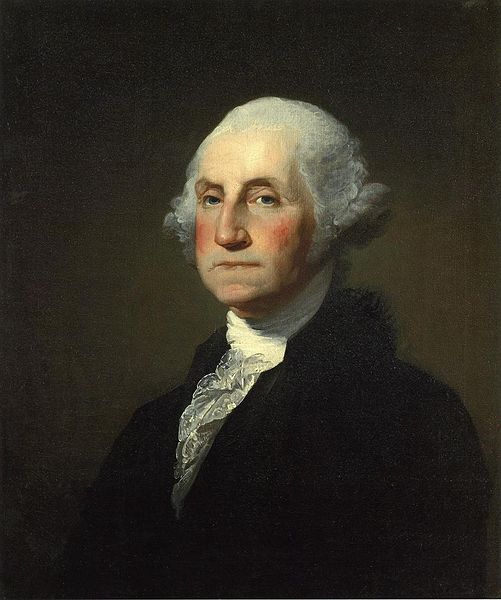
Perhaps the best known image of George Washington is this one done by Gilbert Stuart.

Perhaps the best known image of George Washington is this one done by Gilbert Stuart.

Gilbert Stuart was another artist who was inspired to paint Washington. [Image courtesy: The Library of Congress]

Stuart was inspired by Washington and painted him several times . [Image courtesy: The Library of Congress]

Tompkins H. Matteson's Washington at Valley Forge. [Image courtesy the Pocontico Hills School Washington site]

Tompkins H. Matteson’s Washington at Valley Forge. [Image courtesy the Pocontico Hills School Washington site]

General of the Armies [Image courtesy: the US Military Hall of Fame.]

General of the Armies [Image courtesy: the US Military Hall of Fame.]

A young George Washington [Image courtesy: The History Channel.]

A young George Washington [Image courtesy: The History Channel.]


An etching showing George Washington addressing the troops in 1775 [Image courtesy: The National Archives]
An etching showing George Washington addressing the troops in 1775 [Image courtesy: The National Archives]

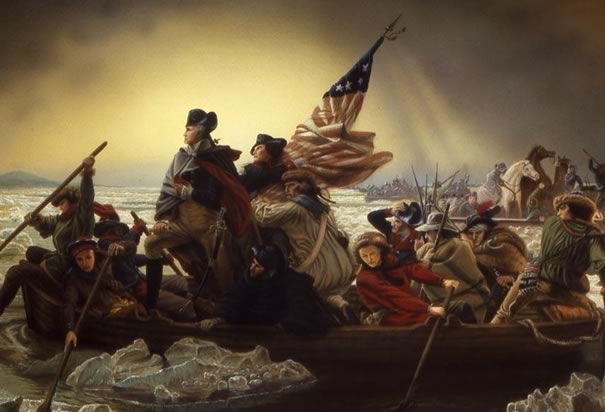
Emanuel Leutze's famous (and highly stylized) version of Washington crossing the Delaware river.

Emanuel Leutze’s famous (and highly stylized) version of Washington crossing the Delaware river.

Washington at Valley Forge. [Image courtesy: the Library of Congress]

Washington at Valley Forge. [Image courtesy: the Library of Congress]

Washington was one of artist John Trumbull's favorite subjects. Here he is  resigning as commander and chief.

Washington was one of artist John Trumbull’s favorite subjects. Here he is resigning as commander and chief.

[Image courtesy Bartleby.com]

[Image courtesy Bartleby.com]

George Washington at Mt. Vernon. George Washin...

George Washington at Mt. Vernon. George Washington seated, half-length, with Martha Washington, and two children. (cropped) (Photo credit: Wikipedia)

An older Washington [Image courtesy: The Independent]

An older Washington [Image courtesy: The Independent]

English: The equestrian sculpture of George Wa...

English: The equestrian sculpture of George Washington at the center of Washington Circle, a traffic circle and public park, located on the boundary of the Foggy Bottom and West End neighborhoods in Washington, D.C. (Photo credit: Wikipedia)

Click HERE to see a forensic model of what George Washington looked like.


Frederick Douglas 2.14.13 Thought of the Day

It is easier to build strong children than to repair broken men.

A sketch of Douglass, from the 1845 edition of...

Frederick Augustus Washington Bailey was born on this day in Talbot County, Maryland, USA in 1818. Today is the 195th anniversary of his birth.

The exact day and year of his birth is unknown, but he decided on February 14th, 1818.  He never met his father, a white man,  and almost never saw his mother.  He lived with his grandparents in their cabin west of the Tuckahoe Creek. In his first autobiography he wrote:

“I do not recollect ever seeing my mother by the light of day. … She would lie down with me, and get me to sleep, but long before I waked she was gone.” [Narrative of the life of Frederick Douglass, an American slave. Written by himself. (1851)

At seven he was sent to Wye House plantation near Easton, in Talbot County, Maryland. Soon he was sent to Hugh Auld a Baltimore carpenter. Auld’s wife, Sophia,  taught him to read until the master (her husband)  stopped her. Hugh Auld thought teaching slaves lead to rebellious slaves. Frederick practiced reading and writing in secret. When he was in Baltimore he heard about Abolition for the first time, and in 1831 he  read an article “on John Quincy Adams’s antislavery petitions in Congress” [Frederick Douglass Timeline]

At 13 he was sent to the shipping town of St. Michael’s, Maryland to work for Thomas Auld. When Auld discovered that Frederick was teaching other slaves to read he rented him out to a brutal slavebreaker, Edward Covey.”The treatment he received was indeed brutal. Whipped daily and barely fed, Douglass was “broken in body, soul, and spirit.” “ [PBS.org]

In 1838 he was back in Baltimore hired out to work as a caulker in a shipyard. He made his escape to freedom by…

Travelling by train, then steamboat, then train, he arrived in New York City the following day. Several weeks later he had settled in New Bedford, Massachusetts, living with his newlywed bride (whom he met in Baltimore and married in New York) under his new name, Frederick Douglass. [Ibid]

Douglass became active in the Abolitionist movement. He became a “licensed preacher for the African Methodist Episcopal Zion Church.” [Frederick Douglass Timeline] In 1841 he spoke at an antislavery meeting in New Bedford about his life in Maryland. The Massachusetts Anti-Slavery Society hired him as a speaker.

English: Portrait of Frederick Douglass as a y...

English: Portrait of Frederick Douglass as a younger man (Photo credit: Wikipedia)

Some people didn’t believe that a former slave could speak so eloquently and assumed Douglass was a fraud. In response to that criticism he wrote Narrative of the Life of Frederick Douglass. In 1845 he toured England and Ireland to raise money to buy his freedom. (Auld  manumitted him for $711.66.) Douglass used the remaining money from the Great Britain tour to buy a printing press and began to publish the North Star, a weekly Abolitionist paper. The paper later became the Frederick Douglass’ Paper and is joined in 1859 by the Douglass’ Monthy.

In 1855 he published his second autobiography, My Bondage and My Freedom. During the American Civil War Douglass was a recruiter for the all African-American 54th Massachusetts Infantry.

After the ratification of the 13th Amendment to the Constitution (which outlaws slavery) Douglass continued to fight for civil rights and woman’s rights. A fringe political party, The Equal Rights Party nominated Douglass as its vice-presidential Nominee in 1872.

The title page of the 1845 edition of Narrativ...

The title page of the 1845 edition of Narrative of the Life of Frederick Douglass, An American Slave (Photo credit: Wikipedia)

In 1881 he published his final autobiography, The Life and Times of Frederick Douglass.

He was appointed to the post of US Marshal of the District of Columbia and the Recorder of Deed of the District of Columbia before becoming Minister Resident and Consul General to the Republic of Haiti in 1889.

Frederick Douglass

Frederick Douglass (Photo credit: Wikipedia)

Frederick Douglass died on February 20th, 1895 of heart failure.

The gravestone of Frederick Douglass located a...


Abraham Lincoln 2.12.13 Thoughts of the Day

President Abraham Lincoln was descended from S...

Abraham Lincoln was born on this day near Hodgenville, Harden Co., Kentucky in 1809. Today is the 204th anniversary of his birth.

I’m going to assume that you are all familiar with the 16th President of United States — the man who grew up in a log cabin, was a simple country lawyer and  went on to become president during this country’s darkest days. [For more information on his life might I suggest the White House.gov biography, Lincoln’s write-up on Biography.com , or the article on History.com ]  Frankly, there is little I can bring to the table that you don’t already know or couldn’t read about on more lofty websites… so instead I thought I’d bring you my favorite Lincoln quotes.

LIncoln logo

  • Better to remain silent and be thought a fool than to speak out and remove all doubt.
  • Sir, my concern is not whether God is on our side; my greatest concern is to be on God’s side, for God is always right.
  • You can fool all the people some of the time, and some of the people all the time, but you cannot fool all the people all the time.
  • In the end, it’s not the years in your life that count. It’s the life in your years.
  • Character is like a tree and reputation like a shadow. The shadow is what we think of it; the tree is the real thing.
  • Give me six hours to chop down a tree and I will spend the first four sharpening the axe.
  • Whatever you are, be a good one.
  • Be sure you put your feet in the right place, then stand firm.
  • The things I want to know are in books; my best friend is the man who’ll get me a book I ain’t read.
  • No man has a good enough memory to be a successful liar.
  • I destroy my enemies when I make them my friends.
  • My great concern is not whether you have failed, but whether you are content with your failure.
  • It has been my experience that folks who have no vices have very few virtues.
  • If I were two-faced, would I be wearing this one?
  • I want it said of me by those who knew me best, that I always plucked a thistle and planted a flower where I thought a flower would grow.
  • The time comes upon every public man when it is best for him to keep his lips closed.
Abraham Lincoln

Abraham Lincoln (Photo credit: George Eastman House)

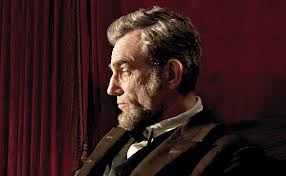
Lastly if you haven’t had a chance to see the Steven Spielberg film LINCOLN with Daniel Day-Lewis as the President, I recommend it. Why not Celebrate Lincoln’s birthday watching this tribute to the man’s indomitable spirit?

——————-

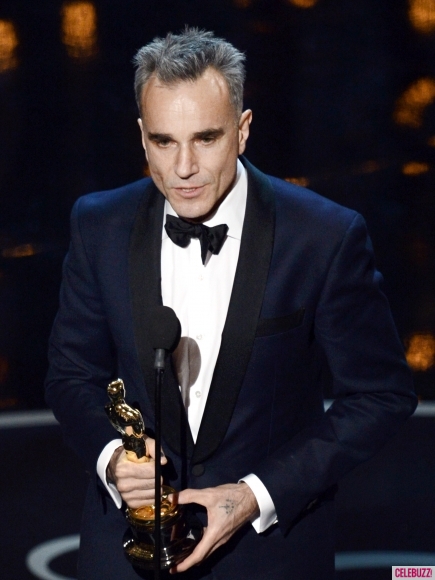
UPDATE: Daniel Day Lewis won the Oscar last night for his amazing portrayal of Lincoln. Well deserved!

Daniel Day Lewis embodied Lincoln in last year's Oscar nominated the Steven Speilberg movie.

Daniel Day Lewis embodied Lincoln in last year’s Oscar nominated the Steven Speilberg movie.

Daniel Day Lewis won the BEST ACTOR OSCAR for his performance of Lincoln.

Daniel Day Lewis won the BEST ACTOR OSCAR for his performance of Lincoln.

Daniel Day Lewis embodied Lincoln in last year's Oscar nominated the Steven Speilberg movie.

Daniel Day Lewis embodied Lincoln in last year’s Oscar nominated the Steven Speilberg movie.


Babe Ruth 2.6.13 Thought of the Day

“Never let the fear of striking out get in your way.” — Babe Ruth

Babe Ruth

Babe Ruth (Photo credit: carloscappaticci)

George Herman Ruth was born on this day in Baltimore, Maryland, USA in 1895. Today is the 118th anniversary of his birth.

He was one of eight children born to George and Kate Ruth. Only he and his sister Mamie survived.  His parents ran a saloon  at 426 West Camden Street, a job that took much of their time. So George, Jr and Mamie were left to their own devices. As an adult Ruth reflected that he ran the streets as a kid, skipped school, chewed tobacco and drank beer while his father wasn’t looking. He was “incorrigible,” and that’s what his parents recorded on his entry documentation to St. Mary’s Industrial School for Boys when he was sent he was just 7 years old.

St. Mary’s was part reformatory, part orphanage, part school and part work house. It was run by the Xavier Brothers and it served boys from ages 5 to 21. Ruth learned to make shirts as well as carpentry skills at the school. He lived there for 12 years. His parents seldom had the time to visit the school.

Ruth (top row, far left) at St Mary's Industri...
Ruth (top row, far left) at St Mary’s Industrial School for Boys, Baltimore, Maryland, c. 1912 (Photo credit: Wikipedia)

Fortunately for Ruth, the prefect of discipline at St. Mary’s, Brother Matthias Boutlier, took him under his wing.

Ruth particularly looked up to a monk named Brother Mathias, who became a father figure to the young boy… Matthias, along with several other monks of the order, introduced Ruth to baseball, a game at which the boy excelled. [Biography.com]

Brother Matthias worked with Ruth to hone his hitting, pitching and fielding abilities. Ruth showed such promise that …

the Brothers invited Jack Dunn, owner of the Baltimore Orioles, to come watch (him)  play. Dunn was obviously impressed, as he offered a contract to (Ruth) in February 1914 after watching him for less than an hour…. Upon seeing (Ruth) for the first time, the Orioles players referred to him as “Jack’s newest babe”…[baberuth.com]

The nickname stuck and he was known as Babe Ruth from then on.

Babe Ruth pitching with Boston Red Sox, Comins...
Babe Ruth pitching with Boston Red Sox, Cominsky Park, 1914 (Photo credit: Wikipedia)

He started as a pitcher. First for Baltimore and then for the Boston Red Sox. By 1915 he was a “permanent fixture in the Red Sox rotation, …accumulating an 18-8 record with an ERA of 2.44.” [Ibid] Both his pitching and hitting game improved over the next few years and “In 1918, Babe Ruth pitched his 29th scoreless inning in a World Series. That record stood for 43 years!” [about.com]

English: American baseball player Babe Ruth in...
English: American baseball player Babe Ruth in 1921 (Photo credit: Wikipedia)

The following year he shifted his focus to his hitting game and earned a new record. This time for a whopping 29 home runs in a single season. Ruth was traded to the Yankees in 1920 and topped his home run tally (coming in at 54 for the year.) In 1921 he broke the record again with 59 home runs.  In 1927 Ruth, as part of the Yankees famous “Murderer’s Row” hit an amazing 60 home runs for the season — a record that stood for 34 years.


Over the course of his career, Ruth went on to break baseball’s most important slugging records, including:

  • most years leading a league in home runs (12);
  • most total bases in a season (457)
  • and highest slugging percentage for a season (.847).

In all he hit 714 home runs, a mark that stood until 1974, when Hank Aaron of the Atlanta Braves surpassed him. [Biography.com]


Baseball player Babe Ruth
Baseball player Babe Ruth (Photo credit: Wikipedia)

Ruth helped the Yankees win seven pennants and four World Series. He wore pinstripes until 1934. He was ready to retire from the active roster and wanted to manage, but his off-field hijinks — he was almost as famous for his love of alcohol, women and food as he was for his ability to swing a bat — made owners think twice about placing him in a supervisory position. He was traded to the Boston Braves for his final season where he hoped to have both playing and assistant-management duties, but he soon realized the “management” part of his job was mostly P.R., public appearances and giving autographs.

Ruth with the Boston Braves in 1935, his last ...
Ruth with the Boston Braves in 1935, his last year as a player (Photo credit: Wikipedia)


On May 25, 1935, an overweight and greatly diminished Babe Ruth reminded fans of his greatness one last time when hit three home runs in a single game at Forbes Field in Pittsburgh, Pennsylvania. The following week, Ruth officially retired. [Biography.com]

The Sultan of Swat, The Bambino, Number “3” (Babe’s number in the Yankee batting line up and eventually the number on the back of his pinstripes) was inaugurated into the Baseball Hall of Fame in 1936.

Babe Ruth
Babe Ruth (Photo credit: Wikipedia)

A decade later doctors discovered a tumor on his neck. Ruth had cancer. He died on August 16, 1948.

Babe still remains the greatest figure in major league baseball, and one of the true icons in American history. The Babe helped save baseball from the ugly Black Sox scandal, and gave hope to millions during The Great Depression. …He continues to be the benchmark by which all other players are measured. Despite last playing nearly 75 years ago, Babe is still widely considered the greatest player in Major League Baseball history. [baberuth.com]


Gehrig_&_Ruth[1]
#4 Gehrig and #3 Ruth were the heart of Murderer’s Row and the Yankees.

—————————————————————————–

Sigh, it kills this Baltimore Orioles girl to write “Y – A – N – K – E – E -S”  so often in a post. Please know I could only do it for the Babe (and for Lou Gehrig when it is his turn). When is Brooks Robinson’s birthday?


Rosa Parks 2.4.13 Thought of the Day

“I have learned over the years that when one’s mind is made up, this diminishes fear; knowing what must be done does away with fear.” –Rosa Parks

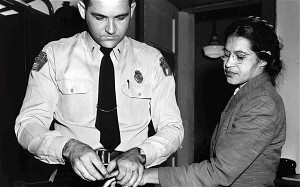
Rosa Parks getting fingerprinted after her arrest.

Rosa Parks getting fingerprinted after her arrest. [Image courtesy  abcnews.go.com]

Rosa Louise McCauley was born on this day in Tuskegee, Alabama in 1913. Today is the 100th anniversary of her birth.

Rosa’s father James was a carpenter and her mother Leona was a teacher. Her parents separated when Rosa was 2, and she moved with her mother a little brother Sylvester to Pine Level, Alabama (just outside the capital, Montgomery) to live with her maternal grandparents. He mother taught her to read. The segregated one room school-house she attended seldom had enough desks  or other supplies. At 11 she went to the Montgomery Industrial School for Girls, an institution a laboratory school set up by the Alabama State Teachers College for Negroes and founded “liberal-minded women from the northern United States. The school’s philosophy of self-worth was …to ‘take advantage of the opportunities, no matter how few they were.'” [Achievement.org] She dropped out of the school to care first for her grandmother then her mother.

At 19 she married Raymond Parks and moved to Montgomery. Raymond encouraged Rosa to finish high school, and she earned her degree in 1933.  The two were active in the National Association for the Advancement of Colored People (Raymond had been an active member when they met.) They worked to raise money to help defend the Scottsboro Boys and were members of the Voter’s League. Mrs. Parks managed to get her voter’s card (it took her three tries because of the Jim Crow laws in Montgomery.)

English: Photograph of Rosa Parks with Dr. Mar...

English: Photograph of Rosa Parks with Dr. Martin Luther King jr. (ca. 1955) Mrs. Rosa Parks altered the negro progress in Montgomery, Alabama, 1955, by the bus boycott she unwillingly began. National Archives record ID: 306-PSD-65-1882 (Box 93). Source: Ebony Magazine Ελληνικά: Φωτογραφία της Rosa Parks με τον Dr. Martin Luther King jr. (περ. 1955.) Español: Fotografía de Rosa Parks con Martin Luther King jr. (aprox. 1955). Français : Photographie Rosa Parks (ca. 1955) (Photo credit: Wikipedia)

Rosa served as the chapter’s youth leader. And in 1944 she became the secretary to NAACP President E.D. Nixon—a post she held until 1957. (She recalls that they needed a secretary, she was the only woman there, and she was too timid to decline.)

“I worked on numerous cases with the NAACP,” Mrs. Parks recalled, “but we did not get the publicity. There were cases of flogging, peonage, murder, and rape. We didn’t seem to have too many successes. It was more a matter of trying to challenge the powers that be, and to let it be known that we did not wish to continue being second-class citizens.” [Rosa Parks quoted on Achievement.org]

On Thursday, December 1, 1955

Rosa Parks boarded the Cleveland Avenue bus for home. She took a seat in the first of several rows designated for “colored” passengers. …As the bus Rosa was riding continued on its route, it began to fill with white passengers. Eventually, the bus was full and the driver noticed that several white passengers were standing in the aisle. He stopped the bus and moved the sign separating the two sections back one row and asked four black passengers to give up their seats. Three complied, but Rosa refused and remained seated. The driver demanded, “Why don’t you stand up?” to which Rosa replied, “I don’t think I should have to stand up.” The driver called the police and had her arrested. …The police arrested Rosa at the scene and charged her with violation of Chapter 6, Section 11, of the Montgomery City Code. She was taken to police headquarters, where, later that night, she was released on bail. [biography.com]

Booking photo of Parks

Booking photo of Parks (Photo credit: Wikipedia)

On the day of her trial the NAACP and the Montgomery Improvement Association (with its new leader Dr. Martin Luther King, Jr.) organized a Bus Boycott.  The

13-month mass protest that ended with the U.S. Supreme Court ruling that segregation on public buses is unconstitutional. …The bus boycott demonstrated the potential for nonviolent mass protest to successfully challenge racial segregation and served as an example for other southern campaigns that followed. In Stride Toward Freedom, King’s 1958 memoir of the boycott, he declared the real meaning of the Montgomery bus boycott to be the power of a growing self-respect to animate the struggle for civil rights. [Stanford.edu]

“At the time I was arrested I had no idea it would turn into this, … It was just a day like any other day. The only thing that made it significant was that the masses of the people joined in.” –Rosa Parks

After her arrest Parks lost her job  as a seamstress in a department store. “her husband was fired after his boss forbade him to talk about his wife or their legal case.” [biography.com] The couple was unable to find work and eventually they moved to Detroit, Michigan with Rosa’s Mother.

In Michigan Rosa Parks worked U.S. House of Representative John Conyer as a secretary and receptionist. In 1987 she helped found the Rosa and Raymond Parks Institute for Self-Development which runs bust tours  to civil rights and Underground Railroad sites for young people.

Rosa Parks receives an award from Bill Clinton.

Rosa Parks receives an award from Bill Clinton. (Photo credit: Wikipedia)

She published a biography, Rosa Parks: My Story and a memoir, Quiet Strength in the 1990s. In 1996 she received the Presidential Medal of Freedom from President Clinton.

Rosa Parks died on October 24, 2005 at the age of 93. She was honored by lying in state at the Capitol Rotunda in Washington, DC.

Today, on the centennial of her birth the US Postal Service is releasing a Forever Stamp with her likeness.

[Image courtesy USPS]

[Image courtesy USPS]

“I would like to be remembered as a person who wanted to be free… and other people would be also free.” –Rosa Parks


Elizabeth Blackwell 2.3.13 Thought of the Day


“If society will not admit of woman’s free development, then society must be remodeled.”
Elizabeth Blackwell

[Image courtesy History.com]

[Image courtesy History.com]

Elizabeth Blackwell was born on this day in Bristol, England in 1821. Today is the 192nd anniversary of her birth.


Elizabeth was the third of nine children born to Samuel and Hannah Blackwell. She had a happy childhood growing up with her large family (four aunts also lived with them.) Her father encouraged all his children in their education. Elizabeth had both a governess and private tutors.


In 1832, when Elizabeth was 11, the Blackwells moved to America. Her father wanted to get the family away from Bristol’s chaotic atmosphere. He also wanted to move to America to help the abolitionist movement. He started a new sugar refinery but this business in New York, but it did not do as well as his Bristol refinery. They moved to Ohio in 1838 to begin again. But soon after the move west Samuel Blackwell died. He left a large family and a good deal of debt.

T909228_08

[Image courtesy Biography.com]


Elizabeth and two of her sisters started a school, The Cincinnati English and French Academy for Young Ladies.


Blackwell later decided to pursue a career in medicine. But the road to becoming a doctor was not an easy one for her. She studied independently with a doctor before getting accepted to the Geneva Medical College in upstate New York in 1847. [Biography.com]

Notwithstanding the opposition of fellow students and the townspeople of Geneva, New York, and despite being keep from attending medical demonstrations that were considered inappropriate for women Elizabeth Blackwell graduated in 1849…


becoming thereby the first woman to graduate from medical school, the first woman doctor of medicine in the modern era. [about.com]

She went to Europe and trained in midwifery at La Maternite in Paris. In England she “worked at St. Bartholomew’s Hospital with Dr. James Paget…and became friends with Florence Nightingale.”[Ibid]


English: u.s. postage stamp of 1974, depicting...

English: u.s. postage stamp of 1974, depicting Elizabeth Blackwell Français : Timbre des Etats-unis de 1974, portrait de Elizabeth Blackwell (Photo credit: Wikipedia)

But on returning to the States she was unable to find a hospital willing to allow her to practice under their roof. She couldn’t get office space, “and she had to purchase a house in which to begin her practice.” [Ibid]


Her sister, Dr. Emily Blackwell, joined her in 1856 and, together with Dr. Marie Zakrzewska, they opened the New York Infirmary for Women and Children at 64 Bleecker Street in 1857. This institution and its medical college for women (opened 1867) provided training and experience for women doctors and medical care for the poor. [NIH.gov]

Health Education and maintaining Sanitary Conditions were core to the school. She helped establish the U.S. Sanitary Commission.


Blackwell returned to England “and served as a lecturer at the London School of Medicine for Women.” [Biography.com]


Cover of "Pioneer Work In Opening The Med...

Cover via Amazon

In 1877 she retired to Hastings, England. She published her biography, Pioneer Work in Opening the Medical Profession to Women in 1895.  On May 31, 1910 she died from complications of a stroke.

Portrait of Elizabeth Blackwell by Joseph Stan...

Portrait of Elizabeth Blackwell by Joseph Stanley Kozlowski, 1905. Syracuse University Medical School collection. (Photo credit: Wikipedia)


Franklin D. Roosevelt 1.30.13 Thought of the Day

“There is nothing to fear but fear itself.”


“The truth is found when men are free to pursue it.”


“Repetition does not transform a lie into a truth”


“Today is a day that will live in infamy.”


— Franklin D. Roosevelt


President Franklin D. Roosevelt faced strong o...


Franklin Delano Roosevelt was born on this day in Hyde Park, New York, USA in 1882. It is the 131st anniversary of his birth.


FDR was born into wealth and luxury. The only child of James Roosevelt and Sara Anne Delano Roosevelt, Franklin was fifth cousins with Teddy Roosevelt.


An athletic child, Franklin enjoyed horseback riding, shooting, rowing, tennis, polo, golf and sailing.  He went to an Episcopal boarding school, the Groton School for boys with other privileged, connected students.  At Groton, under the influence of headmaster Endicott Peabody,  he learned the values of serving his fellow-man, of public service and helping the less fortunate. From Groton he went on to Harvard College where he served as editor-in-chief of the Harvard Crimson.


Franklin D. Roosevelt and Eleanor Roosevelt wi...


He also began to date his fifth cousin Eleanor Roosevelt while he was at Harvard. They married “On St. Patrick’s Day, 1905” [whitehouse.gov] The couple had six children together, Anna Eleanore, James, Franklin Delano, Jr., (who died before he was a year old) Elliot, a second Franklin Delano, Jr. and John  Aspinwall.


He attended Columbia Law School but dropped out when he passed the bar. He worked for the law firm Carter Ledyard & Milburn  focusing in Corporate Law. In 1910 he ran for New York State Senate and won by a landslide. In 1913 he was appointed Assistant US Secretary of the Navy. And by 1920 had risen in the ranks of the Democratic party to such a degree that he was their nominee for Vice President.


Franklin Delano Roosevelt, three-quarter lengt...

Franklin Delano Roosevelt, three-quarter length portrait, seated, facing left as Asst. Sect. of the Navy. (Photo credit: Wikipedia)


Roosevelt was struck by Polio in the summer of 1921.


At first, he refused to accept that he was permanently paralyzed. He tried numerous therapies and even bought the Warm Springs resort in Georgia seeking a cure. Despite his efforts, he never regained the use of his legs. He later established a foundation at Warm Springs to help others, and instituted the March of Dimes program that eventually funded an effective polio vaccine. [Biography]


It took almost a decade but determination and Eleanor’s support he managed to take the stage at the 1924 Democratic National Convention “on crutches to nominate Alfred E. Smith” [whitehouse.gov]  Smith in turn convinced Roosevelt to run for NY Governor  in 1928.


English: Color photo of U.S. President Frankli...

English: Color photo of U.S. President Franklin Delano Roosevelt, “Man of The Year” on the cover of TIME Magazine, January 2, 1933 edition: http://www.time.com/time/magazine/0,9263,7601330102,00.html The file is a cropped, digitally-retouched version of the original large-resolution file at the Google Images/LIFE Magazine archives (see “Original source” link). According to the information posted here, the cover of this edition of the magazine is of public domain. (Photo credit: Wikipedia)


In 1932, as the country struggled in the throes of the Great Depression, Roosevelt was elected  to the first of his four terms as President of the United States.


In his first 100 days, President Franklin Roosevelt proposed sweeping economic reform, calling it the “New Deal.” He ordered the temporary closure on all banks to halt the run on deposits. He formed a “Brain Trust” of economic advisors who designed the alphabet agencies such as the AAA (Agricultural Adjustment Administration) to support farm prices, the CCC (Civilian Conservation Corps) to employ young men, and the NRA (National Recovery Administration), which regulated wages and prices. Other agencies insured bank deposits, regulated the stock market, subsidized mortgages, and provided relief to the unemployed. [Biography]


By mid-decade the country was turning the corner on the depression, Roosevelt’s bold policies had worked. But some wondered if he had gone too far, especially his decision to take the nation off the gold standard.


Roosevelt responded with a new program of reform: Social Security, heavier taxes on the wealthy, new controls over banks and public utilities, and an enormous work relief program for the unemployed. [whitehouse.gov]


As the winds of war blew through Europe and the Pacific he pledged a “good neighbor” policy of mutual action against aggressors. “He also sought through neutrality legislation to keep the United States out of the war in Europe, yet at the same time to strengthen nations threatened or attacked.” [Ibid] After the German’s invaded France and the threat to England became omnipresent Roosevelt “send Great Britain all possible aid short of actual military involvement.” [Ibid]


But after December 7, 1941 there was no hedging America’s involvement in the War.


When the Japanese attacked Pearl Harbor on December 7, 1941, Roosevelt directed organization of the Nation’s manpower and resources for global war. [Ibid]


By 1944 as World War II was beginning wind down, Roosevelt’s health was starting to deteriorate. “hospital tests indicated he had atherosclerosis, coronary artery disease and congestive heart failure.” [Biography] Regardless of the test results Roosevelt ran for a fourth term. this time he choose Missouri Senator Harry S. Truman as his running mate.


He attended the Yalta Conference to discuss post-war Europe with Churchill and Joseph Stalin.


He then returned to the United States and the sanctuary of Warm Springs, Georgia. On the afternoon of April 12, 1945, Roosevelt suffered a massive cerebral hemorrhage and died. [Ibid]


Franklin Delano Roosevelt's funeral procession...

Franklin Delano Roosevelt’s funeral procession with horse-drawn casket, Pennsylvania Ave. (Photo credit: Wikipedia)


Martin Luther King 1.15.13 Thought of the Day

“I had a dream…” Martin Luther King, Jr.


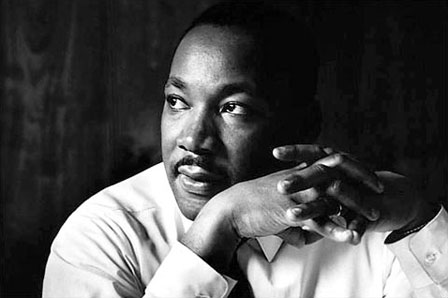
[Image courtesy the Seattle Times

[Image courtesy the Seattle Times

Michael Luther King, Jr. was born on this day in Atlanta, Georgia, USA in 1929. Today is the 84th anniversary of his birth.


Born to into a “preaching” family. Both his father and grandfather were Baptist ministers. His maternal grandfather, A.D. Williams took over the Ebenezer Baptist church in Atlanta when its congregation numbered only 13. Under his leadership that quickly changed.  King’s father married Alberta Williams (A.D.’s only surviving child) in 1926.


Michael King Sr. stepped in as pastor of Ebenezer Baptist Church upon the death of his father-in-law in 1931. He too became a successful minister, and adopted the name Martin Luther King Sr. in honor of the German Protestant religious leader Martin Luther. In due time, Michael Jr. would follow his father’s lead and adopt the name himself. [Biography]


Martin was the middle of three children in the King household. He grew up in Atlanta attending Booker T. Washington High School. He entered Morehouse College at age fifteen. He graduated from Morehouse in 1948 and went on to get his Bachelor of Divinity degree at Crozer Theological Seminary in Chester, PA. and his Doctor of Philosophy from Boston University.


He emerged as a Civil Rights leader with the Montgomery Bus Boycott in December of 1955. In 1957 he worked with Ralph Abernathy and other ministers to create …


the Southern Christian Leadership Conference to harness the moral authority and organizing power of black churches. They would help conduct non-violent protests to promote civil rights reform. [Ibid]


The SCLC organize voter registration drives in the South. In 1959 King traveled to India


The trip affected him in a deeply profound way, increasing his commitment to America’s civil rights struggle. African-American civil rights activist Bayard Rustin, who had studied Gandhi’s teachings, became one of King’s associates and counseled him to dedicate himself to the principles of non-violence. [Ibid]


The “Sit-In” movement began in 1960. By summer 27 sit-ins had successfully ended lunch counter segregation. King joined an Atlanta lunch-counter sit in and was arrested with 36 others.


King was arrested again in 1963 after he organized a demonstration in Birmingham, Alabama. The demonstration, which included families, ended when the


City police turned dogs and fire hoses on demonstrators. Martin Luther King was jailed along with large numbers of his supporters, but the event drew nationwide attention. …However, King was personally criticized by black and white clergy alike for taking risks and endangering the children who attended the demonstration. From the jail in Birmingham, King eloquently spelled out his theory of non-violence: “Nonviolent direct action seeks to create such a crisis and foster such a tension that a community, which has constantly refused to negotiate, is forced to confront the issue.”[Ibid]


On August 28, 1963 King and his supporters marched peacefully to the Lincoln Memorial in Washington DC and he gave his “I Have a Dream” speech.


The Civil Rights Act passed 1964. The same year King received the Nobel Peace Prize. King continued to advocate for civil rights. He saw the passage of the Voting Rights Act in 1965 and worked to bring the Civil Rights Movement to larger cities.


President Lyndon B. Johnson and Rev. Dr. Marti...

President Lyndon B. Johnson and Rev. Dr. Martin Luther King, Jr. meet at the White House, 1966 (Photo credit: Wikipedia)


He also added his voice to the chorus of protesters against the Vietnam War.


He felt that America’s involvement in Vietnam was politically untenable and the government’s conduct of the war discriminatory to the poor…[Ibid]


In the spring of 1968 King went to Memphis, Tennessee to support sanitation workers who were on strike.


On April 3, in what proved to be an eerily prophetic speech, he told supporters, “I’ve seen the promised land. I may not get there with you. But I want you to know tonight that we, as a people, will get to the promised land.” The next day, while standing on a balcony outside his room at the Lorraine Motel, Martin Luther King Jr. was struck by a sniper’s bullet. [Ibid]


Alexander Hamilton 1.11.13 Thought of the Day

“Those who stand for nothing fall for anything.”
Alexander Hamilton

Oil on canvas portrait of Alexander Hamilton b...

Oil on canvas portrait of Alexander Hamilton by John Trumbull (Photo credit: Wikipedia)

Alexander Hamilton was born on this day in Charlestown, Nevis, British  West Indies in 1755 (or 1757). It is the 258th (255th) anniversary of his birth.

Hamilton was born to humble beginnings. He was conceived during an extramarital affair between Rachel Fawcett Lavine and James Hamilton. When Lavine’s husband threw mother and son out of the house she moved in with James Hamilton. But he abandoned the little family  to return to Scotland for financial reasons. Lavine relied on the kindness of family members and friends to help raise the boy.

English: Source: http://alexanderhamiltonexhib...

English: Source: http://alexanderhamiltonexhibition.com/timeline/timeline1.html, original source stated as Library of congress (Photo credit: Wikipedia)

Because he was illegitimate he was not allowed to enroll at the Church of England school, however he was given some tutoring and private lessons, and had the family library at his disposal  to read both Greek and Latin.

Around the age of ten the family moved to the nearby island of St. Croix where his mother died soon after. Friends and relatives took an interest in the future of the young Hamilton by encouraging him to work as a mercantile clerk and to read and write, activities at which he excelled despite his lack of proper schooling. [Brandywide Battlefield Historic Site — Alexander Hamilton]

He wrote an essay about a hurricane that had hit the island in the summer 1772 for the local paper. Influential readers of the paper were so impressed with the essay that the started a fund to send Hamilton to America for formal education. By late 1773 he was enrolled in King’s College (now Columbia) in New York City. While at King’s College he wrote his first political essays.

With war pending, Hamilton immersed himself in the study of artillery tactics and military maneuvers. In March of 1776, he joined the New York Artillery, and was recommended for an officer’s commission by General Alexander McDougall. He was thereby given the title “Captain of the Provincial Company of Artillery.” [Ibid]

He proved “a conscientious and business-like leader.” After distinguishing himself at the Battle of Trenton Hamilton was appointed as an aide to George Washington. He was a close advisor to the general for the rest of the war.

He wrote Washington’s critical letters, and composed numerous reports on the strategic reform and restructuring of the Continental Army….While serving as an adviser for George Washington, Hamilton had come to realize Congress’ weaknesses, including jealousy and resentment between states, which, Hamilton believed, stemmed from the Articles of Confederation. … Hamilton left his adviser post in 1782, convinced that establishing a strong central government was the key to achieving America’s independence… [Biography.com]

English: US Postage stamp: Alexander Hamilton,...

English: US Postage stamp: Alexander Hamilton, issue of 1956, $5, black (Photo credit: Wikipedia)

Hamilton worked as part of the New York delegation to fix the Articles of Confederation. Among other things, he was a strong advocate for a central source of revenue. Although he didn’t help write the Constitution he did help get it ratified. He wrote 51 of the 85 Federalist Paper.

He was appointed Secretary of the Treasury  when George Washington was elected President. Hamilton served in that post from 1789-1795.

Hamilton was fatally wounded in a duel with Aaron Burr  on July 11, 1804. He died the next day in New York City.

An artistic rendering of the July 11, 1804 due...

An artistic rendering of the July 11, 1804 duel between Aaron Burr and Alexander Hamilton by J. Mund. (Photo credit: Wikipedia)