Monthly Archives: August 2012

Thought of the Day 8.4.12 Louis Armstrong

“I got a simple rule about everybody. If you don’t treat me right / shame on you!”

–Louis Armstrong

Louis Armstrong

Louis Armstrong (Photo credit: late night movie)

Louis “Satchmo” Armstrong was born this day in New Orleans, Louisiana in 1901. Today would be his 111th birthday.

The grandson of slaves, his family was very poor. His father, William Armstrong, abandoned the family when Louis was a baby. His mother, Mayann often turned to prostitution to make ends meet and she left Louis and his little sister Beatrice with their grandmother Josephine Armstrong. The little boy did what he could to earn money. He worked as a  paper boy. He hauled coal to the red-light district — and lingered around the clubs to listen to the music. In 1907 he sang in a street quartet for change.  He did odd jobs for the Karnofsky family, a Lithuanian-Jewish family who took him in and treated him well. The Karnofskys lent Armstrong the money buy his first cornet.

b/w line drawing of cornet

b/w line drawing of cornet (Photo credit: Wikipedia)

When he was 11 years old he was sent to the New Orleans Home for Colored Waifs, a reform school, for firing his a pistol into the air on New Year’s Eve. While at the home Armstrong really learned to play the cornet (he had been self taught and could play by ear prior to the lessons he had at the home).

He was released from the home at 14. He worked hauling coal and unloading barges during the day and brought out his horn at night. He went to honky tonk clubs like “the Funky Butt Hall” to listen to established musicians and learn from them. Joe “King” Oliver mentored the young man. By 17 he was playing professionally.

By the 1920’s he was playing on riverboats and traveled up to St. Louis. His jazz trumpet solos and vocals became his signature style. In 1922 “King” Oliver invited him to join his Creole Jazz Band in Chicago. The money was good enough that Armstrong no longer had to work the menial labor day jobs to make ends meet. By 1925 he was headlining his own band and playing with artist like Bessie Smith and Ma Rainey. He was billed as “The World’s Greatest Jazz Cornetist” for a gig at the Dreamland Cafe, and cut his debut record with his own group Louis Armstrong and His Hot Five. By the 1930s his act had gone international.

[Portrait of Louis Armstrong, Carnegie Hall, N...

[Portrait of Louis Armstrong, Carnegie Hall, New York, N.Y., ca. Apr. 1947] (LOC) (Photo credit: The Library of Congress)

According to the Louis Armstrong House Museum Site he:

  • developed a way of playing jazz, as an instrumentalist and a vocalist, which has had an impact on all musicians to follow;
  • recorded hit songs for five decades, and his music is still heard today on television and radio and in films;
  • wrote two autobiographies, more than ten magazine articles, hundreds of pages of memoirs, and thousands of letters;
  • appeared in more than thirty films (over twenty were full-length features) as a gifted actor with superb comic timing and an unabashed joy of life;
  • composed dozens of songs that have become jazz standards;
  • performed an average of 300 concerts each year, with his frequent tours to all parts of the world earning him the nickname “Ambassador Satch,” and became one of the first great celebrities of the twentieth century.

Here’s Louis Armstrong (Trumpet), Trummy Young (Trombone), Peanuts Hucko (Clarinet), Billy Kyle (Piano), Mort Herbert (Bass), and Danny Barcelona (Drums) in Stutttgart Germany in 1959.

http://youtu.be/6GuDExkBmnU?t=15s

[note to self: MUST sing more jazz so I can play in a band with some one named Trummy and Peanuts.]


Thought of the Day 8.3.12 Leon Uris

“Often we have no time for our friends but all the time in the world for our enemies.”

–Leon Uris

Leon Marcus Uris was born on this day in Baltimore, Maryland in 1924. This is the 88th anniversary of his birth.

Son of Polish and Russian Jewish immigrants Leon went to schools in Baltimore, Norfolk and Philadelphia. He failed English three times, but he loved History and Literature. He allegedly wrote an operetta about the death of his dog when he was only six years old.

When the Japanese attacked Pearl Harbor on December 7, 1941 Uris dropped out of high school and enlisted in the Marine Corps. He served from 1942 to 1945 in the South Pacific. He  was a radio operator  and saw combat at Guadalcanal and Tarawa. When he contracted malaria he was sent to San Francisco to recuperate. There he met his first wife Marine sergeant Betty Beck.

1st edition cover Pages: 694 pp (Mass Market P...

1st edition cover Pages: 694 pp (Mass Market Paperback) (G.P. Putnam’s Sons) (Photo credit: Wikipedia)

After his discharge from the service he worked  for the San Francisco Call-Bulletin and wrote fiction in his spare time. His first book, Battle Cry,  retold his war experiences. Published in 1953 ,and made into a movie by Warner Brothers with Uris as screen writer, the film did well at the box office.

His second novel also took place during WWII, but this time in the European Theatre. The Angry Hills is about Greek resistance fighters.  It too was made into a movie, this one starring Robert Mitchum.

Research Uris did for The Angry Hills and his time  as a war correspondent during Arab-Israeli fighting in 1956  lead to most his most successful novel, Exodus. Published in 1958 the book is the result of  thousands of interviews. Uris traveled 12,000 miles in Israel and read hundreds of books on Jewish history. Doubleday bought the book which out sold Gone with the Wind, becoming the biggest bestseller in the United States. It was translated into 50  languages. A blockbuster movie starring Paul Newman came out in 1960.

Mila 18 is about Jewish resistance fighters during the Warsaw uprising. Armageddon: A Novel of Berlin is about the complications of the Cold War during and after and the Berlin Airlift. Topaz, a spy story, has the Cuban Missile Crisis and the Cold War in its cross hairs. Alfred Hitchcock  directed it for the big screen.  QBVII  is a courtroom drama about a doctor who was pressed into service in a Nazi concentration camp.  It was made into a mini series starring Anthony Hopkins in 1974.

In Trinity Uris tacked the troubles in Ireland, following the lives of several families from the potato famine to the Easter Uprising. Redemption, written two decades later follows up on the Irish story.

The Haj delves again into the troubled Middle East. The Milta Pass is about the Suez Crisis.

A God in Runs takes on the American political scene when Quinn Patrick O’Connell runs for president. His last novel, O’Hara’s Choice, was published posthumously, and was not well received.

Non fiction works include: Ireland: A terrible Beauty and Jerusalem: Song of Songs both include photographs by his with Jill Uris.

More on Leon Uris try this site: http://www.kirjasto.sci.fi/uris.htm


Thought of the Day 8.2.12 L’Enfant

Pierre Charles L'Enfant

Pierre Charles L’Enfant (Photo credit: Wikipedia)

Pierre Charles L’Enfant was born on this day in 1754 at Anet, Eure et Loir, France. Today is the 258th anniversary of his birth.

L’Enfant was educated at the Royal Academy in Paris as an engineer before joining Lafayette  to help the American side during the War of Independence. He arrived in 1777 at the age of 23 and fought as military engineer. He joined George Washington’s staff  after recovering from injuries at the Siege of Savannah. He attainted the rank of Major of Engineers in 1783.

He moved to New York after the war and established a civil engineering firm. In 1788 he redesigned the  New York’s city hall to be the United States’ first capitol building, Federal Hall.  The building was the site of George Washington’s inauguration and where the Bill of Rights was signed.

Federal Hall, Seat of Congress 1790
hand-colored engraving by Amos Doolittle, depicting Washington’s April 30, 1789 inauguration. [Image Courtesy Wikimedia Commons: public domain]

In 1791 the US Congress authorized the building of a capital city on the Potomac River. George Washington appointed his old friend L’Enfant  to design the new city in 1791.

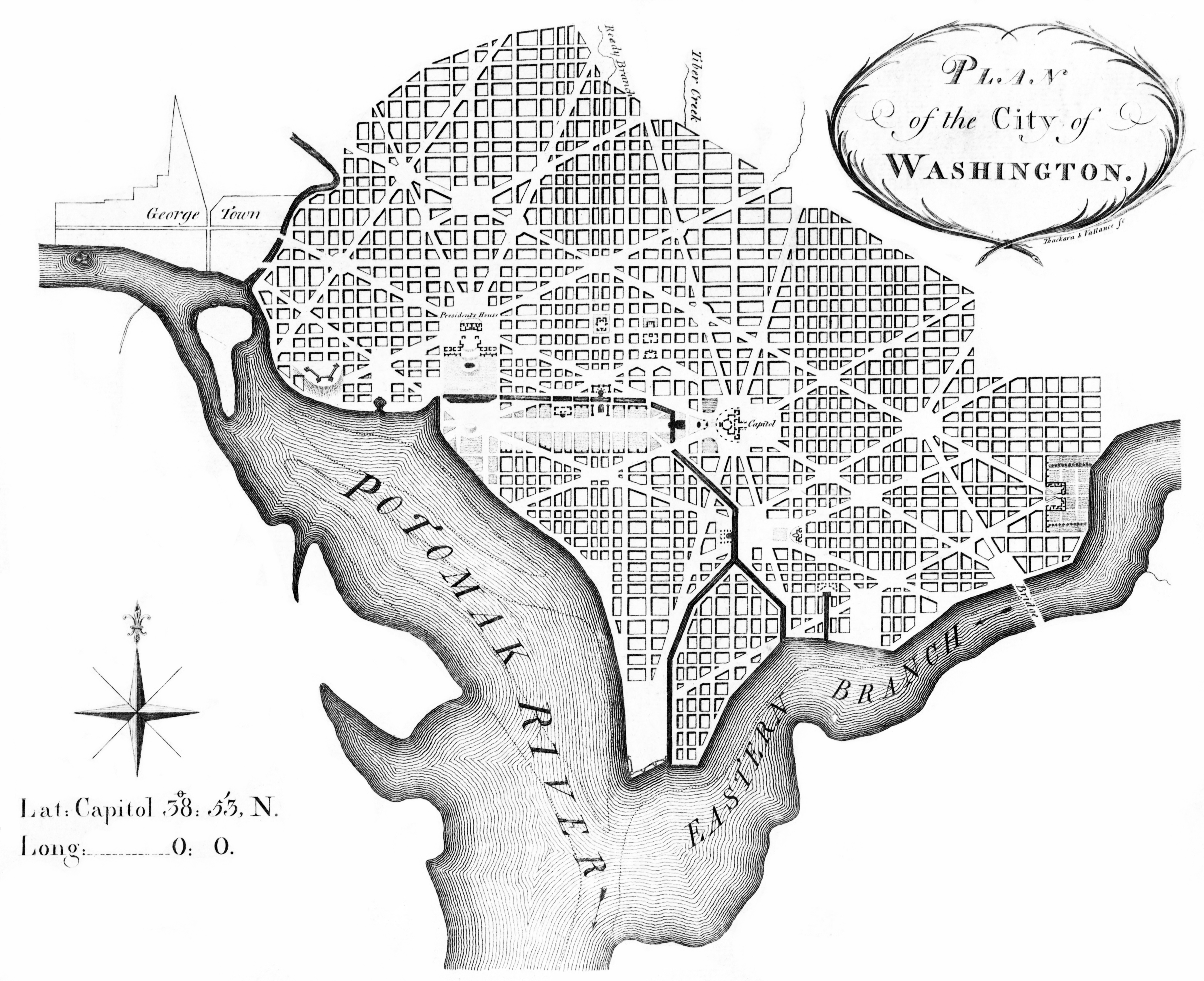
L’Enfant’s “Plan of the city of Washington” March 1792 is at the Library of Congress. [Image courtesy Wikimedia Commons. This image is in the Public Domain.]

“Congress House” (the Capitol) was to be on top a hill, a place of honor overlooking the rest of the city.  The “President’s House” (the White House) was to be a grand mansion fit for the leader of the country. His plan outlined the need for public spaces including a grand public walk (today’s National Mall) ). It would be 1 mile long and 400 feet wide and would stretch from the Capitol to an equestrian statue of Washington (the Washington Monument is now where the statue would have been).

The western front of the United States Capitol...

The western front of the United States Capitol. The Capitol serves as the seat of government for the United States Congress, the legislative branch of the U.S. federal government. It is located in Washington, D.C., on top of Capitol Hill at the east end of the National Mall. The building is marked by its central dome above a rotunda and two wings. It is an exemplar of the Neoclassical architecture style. (Photo credit: Wikipedia)

According to “A Brief History fo Pierre L’Enfant and Washington, D.C.”:

L’Enfant placed Congress on a high point with a commanding view of the Potomac, instead of reserving the grandest spot for the leader’s palace as was customary in Europe. Capitol Hill became the center of the city from which diagonal avenues named after the states radiated, cutting across a grid street system. These wide boulevards allowed for easy transportation across town and offered views of important buildings and common squares from great distances. Public squares and parks were evenly dispersed at intersections.

Wide avenues and public squares would make it “people’s city”, while monuments  and inspiring buildings would give it the stature and importance of world capital.

While he was concerned with the grand vision of the city  his bosses on the Congressional appointed committee were concerned with how much the project was going to cost . They  wanted to keep the wealthy plantation owners in the area happy. L’Enfant “delayed producing a map for the sale of city lots (fearing real estate speculators would buy up land and leave the city vacant).” And he angered the commission when he had a prominent resident’s house torn down because it was in the way of one his boulevards.  When the city’s surveyor went behind his back and produced a lot map L’Enfant resigned. He was never properly paid for the work he did on the Capital.

The city was built, but the design had been greatly altered. Gone were the arrow straight streets and parkways. The Mall between the Capitol and the White House was a tree-covered park of irregular shape. Cows grazed on it.

Visitors ridiculed the city for its idealistic pretensions in a bumpkin setting and there was even talk after the Civil War of moving the capital to Philadelphia or the Midwest.

But in 1901 the McMillan Commission resurrected L’Enfant’s ideas and updated them for a modern city. The Mall was reclaimed, cleared and lined with American Elm trees. Memorials to Lincoln and Jefferson were added, and Museums and government buildings lined the perimeter.

L’Enfant worked on commissions

after the Capital, but non were very successful. His design for Philadelphia millionaire Robert Morris’ mansion was called Morris’ Folly. His final years were spent at the home of his friend William Dudley Digges, near Bladensburg, Maryland. He was buried there, but his body was exhumed and reinterred at Arlington National Cemetery with full military honors. His tomb now overlooks the city he helped design.

Tomb of Pierre Charles L'Enfant, designer of W...

Tomb of Pierre Charles L’Enfant, designer of Washington, D.C.’s original city plan, on the grounds of Arlington House (the Robert E. Lee Memorial) at Arlington National Cemetery in Arlington, Virginia, in the United States. (Photo credit: Wikipedia)


Thought of the Day 8.1.12 Herman Melville

“To the last, I grapple with thee; From Hell’s heart, I stab at thee; For hate’s sake, I spit my last breath at thee”

–Herman Melville


Photo of Herman Melville

Photo of Herman Melville (Photo credit: Wikipedia)

Herman Melvill was born this day on 1819 in New York City. Today is the 193 Anniversary of his birth.

He was the third of eight children. He grew up in Boston and Albany.  His father, Allan Melvill, was a successful merchant and the family lived comfortably for several years until an unsuccessful trading venture led to financial ruin. The elder Melvill sparked Herman’s love for adventure and the sea with stores of seafaring excitement and faraway places. Herman was 12 when his father died and the family moved to Lansingburg on the Hudson. It was then that his mother added the “e” to the end of the family name, and Melvill became Melville.

He got a job on a ship bound from New York to Liverpool as a cabin boy.  After several years as a teacher he heard the call of the sea again. In 1840 he signed on with the Acushnet from Fairhaven, Massachusetts. The ship left port for an 18 month journey in Pacific journey in January of 1841.  The Acushnet was a whaler and much of his material for Moby-Dick came from his time on board the ship. By the time they reached the Marquesas Islands in July of 1842 Melville had had enough of life on the Acushnet.

He deserted the ship and lived among the Typee tribe for three weeks. He then joined the crew of another whaler, this one, an  Australian ship called the Lucy Ann, was bound for Tahiti. Melville participated in a mutiny and landed in jail. Upon his release he signed up with yet another whaler and made it as far as Honolulu where he jumped ship again. He worked as a clerk until he was able to sign on with the USS United States which got him back to Boston in 1844. There Melville began to write about his adventures.

Cover of "Typee (Signet classics)"

Cover of Typee (Signet classics)

Typee is a quasi-autobiographical adventure novel about Tommo’s four month stay on a tropical paradise amidst the “nobel savages” (or cannibals) who may or may not be about to eat him,  and his relationship with the beautiful, and exotic, Faraway. He had trouble fining an American publisher, but the book was an overnight success when it was published in England. Omoo, continued the tale, again roughly following Melville’s adventures in the Pacific. Mardi, and a Voyage Thither showed a more sophisticated writing style. It was not a successful as the straight forward narratives of Typee and Omoo. In 1849 He published Redburn : His First Voyage, the fictionalized account of his first sea journey  as a cabin boy. In 1850 White-Jacket, based on his time as a seaman on the USS United States, was published. Because of its graphic depiction’s of flogging the U.S. Navy banned the punishment.

Sadly at this point the tides seem to have turned in his literary career. His popularity waned. Other books didn’t garner critical or popular acclaim in his lifetime. The Confidence-Man, Pierre, Billy Budd, and even Moby-Dick had to wait until a Melville revival, some 30 years after his death, to get their rightful praise.

Herman Melville: Moby-Dick

Herman Melville: Moby-Dick (Photo credit: wolfgraebel)

Melville went on the lecture circuit to supplement his writing income. He then moved his family to New York City and worked at the New York Custom House. He continued to write, working on both poetry and fiction, until his death.

http://www.online-literature.com/melville/

http://en.wikipedia.org/wiki/Herman_Melville