Monthly Archives: June 2012

Thought of the Day 6.13.12

“When you are old and gray and full of sleep, and nodding by the fire, take down this book and slowly read, and dream of the soft look your eyes had once, and of their shadows deep.”

William Butler Yeats

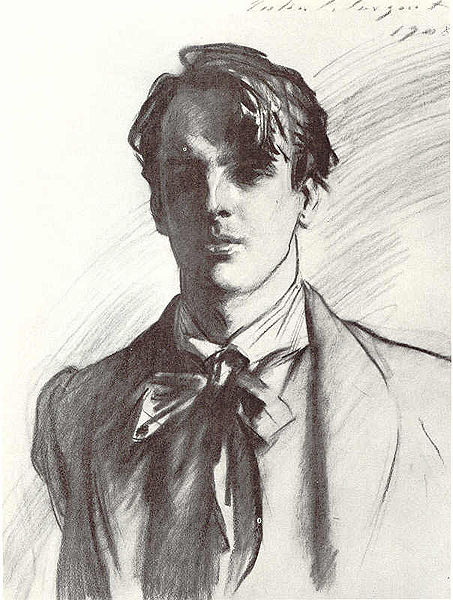
W.B. Yeats was born this day in Sandymount, County Dublin, Ireland, in 1865. He would have been 147 years old.

Yeats is one of Ireland’s greatest writers. A Symbolist poet, he used imagery to enhance the meaning of his verse. He won the Nobel Prize in Literature in 1923. And when Ireland achieved statehood Yeats was appointed as Senator.

He died in Menton, France on January 28, 1939. The epitaph on his headstone is from one of his poems:

Cast a cold Eye
On Life, on Death.
Horseman, pass by!

John Singer Sargent’s 1908 pencil sketch of W. B. Yeats.

Public domain
This media file is in the public domain in the United States. This applies to U.S. works where the copyright has expired, often because its first publication occurred prior to January 1, 1923

The Battle of Westminster… Corbit’s Charge

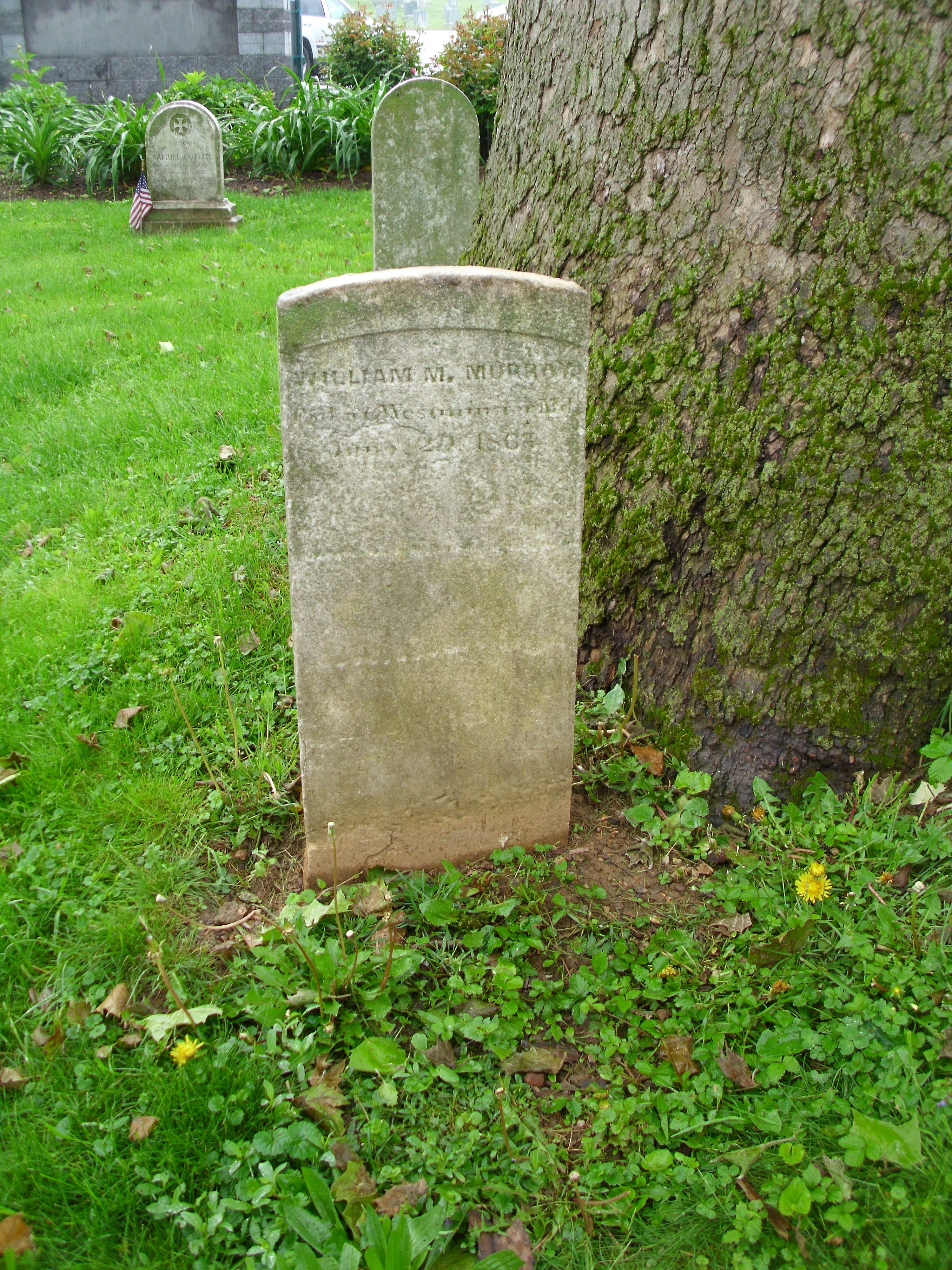
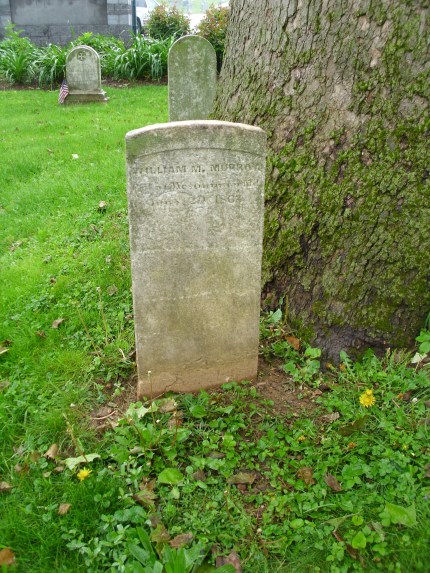
Marker for Lieutenant John William Murray, one of two Virginians who lost their lives in the Battle of Westminster.

I wrote this article for AT HOME IN MARYLAND an on-line  magazine. It was originally published last year, but I have updated it for publication here. Permission to reprint the article was given by the publisher. All photos and content are the original work of ritaLOVEStoWRITE.

____________________

Westminster, Maryland reenacts Corbit’s Charge every year on the last full weekend in June,
this year it will take place June 23 & 24th.

 What started out as a single afternoon in 2003 has grown to a weekend-long celebration that draws over 2,000 people.  The weekend includes a Civil War encampment; military demonstrations; period music; living history interpretations and  artisans, guided tours, speakers and museum displays relating to the Civil War period. A wreath will be laid at the Corbit’s Charge monument.

____________________

Corbit’s Charge took place June 29, 1863 on the outskirts of Westminster. A group of about 90 men from the C and D companies of the Delaware 1st Cavalry skirmished with the vanguard of Confederate General J.E.B. Stuart‘s cavalry near what is today East Main Street and Washington Road. The skirmish, also known as, “The Battle of Westminster,” resulted in delaying Stuart from getting to Gettysburg, and may have cost the South the battle.

So what was the battle all about?

For two weeks J.E.B. Stuart and his cavalry were busy collecting provisions and information and harassing the Union’s rear echelon in Northern Virginia and Maryland.  He was essentially charged with a surveillance mission but he was just as happy to raid, and he was up to no end of trouble as he made his way up to a rendezvous point with General Jubal Early in York, Pa.  He destroyed a portion of the C&O canal  here… dismantled a telegraph lines there… attacked an 8-mile-long wagon train of Union supplies here… Stuart was a busy guy.

It was clear that the Federals had a column of men heading north through Frederick, and he tried twice to alert Gen. Robert E.  Lee to the advancing troops – He was Lee’s eyes and ears after all — but neither missive made it to Lee.

So Stuart pointed his horses toward the rendezvous in York, and headed the Rebel Calvary toward Westminster.

Unlike their battle hardened Rebel counterparts, the 1st Delaware Calvary had seen light action thus far, serving for the most part in the defense of Baltimore prior to moving northwest to Carroll County. Mustered in January, 1863, the 1st Delaware Calvary couldn’t come up with a full complement of 10 horse companies.  They scraped together seven small companies and those seven were reassembled into four active companies. Under the leadership of Major Napoleon Bonaparte Knight, Companies C and D arrived in Westminster to bolster a small garrison from 150th New York to protect the railroad depot for the Western Maryland Railroad line. They arrived at about 11 a.m on June 28. It was quiet warm Sunday.

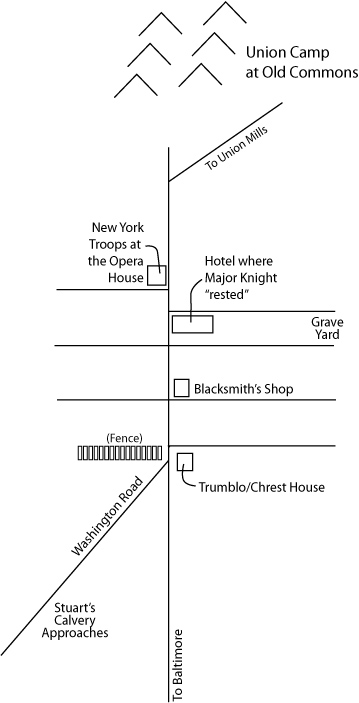
They set up camp in the “Commons” on the north side of town, near what is now McDaniel College. The area was on high ground and provided the Union troops with a good view of both the town and the roads leading to it from Taneytown, Uniontown, New Windsor and Gettysburg.  Pickets were placed along the roads leading to town and the Delaware troops settled in, assured that they would be warned of any Rebel movement.
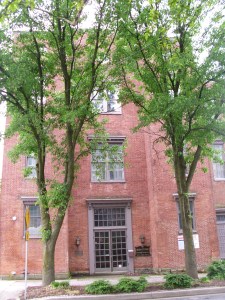
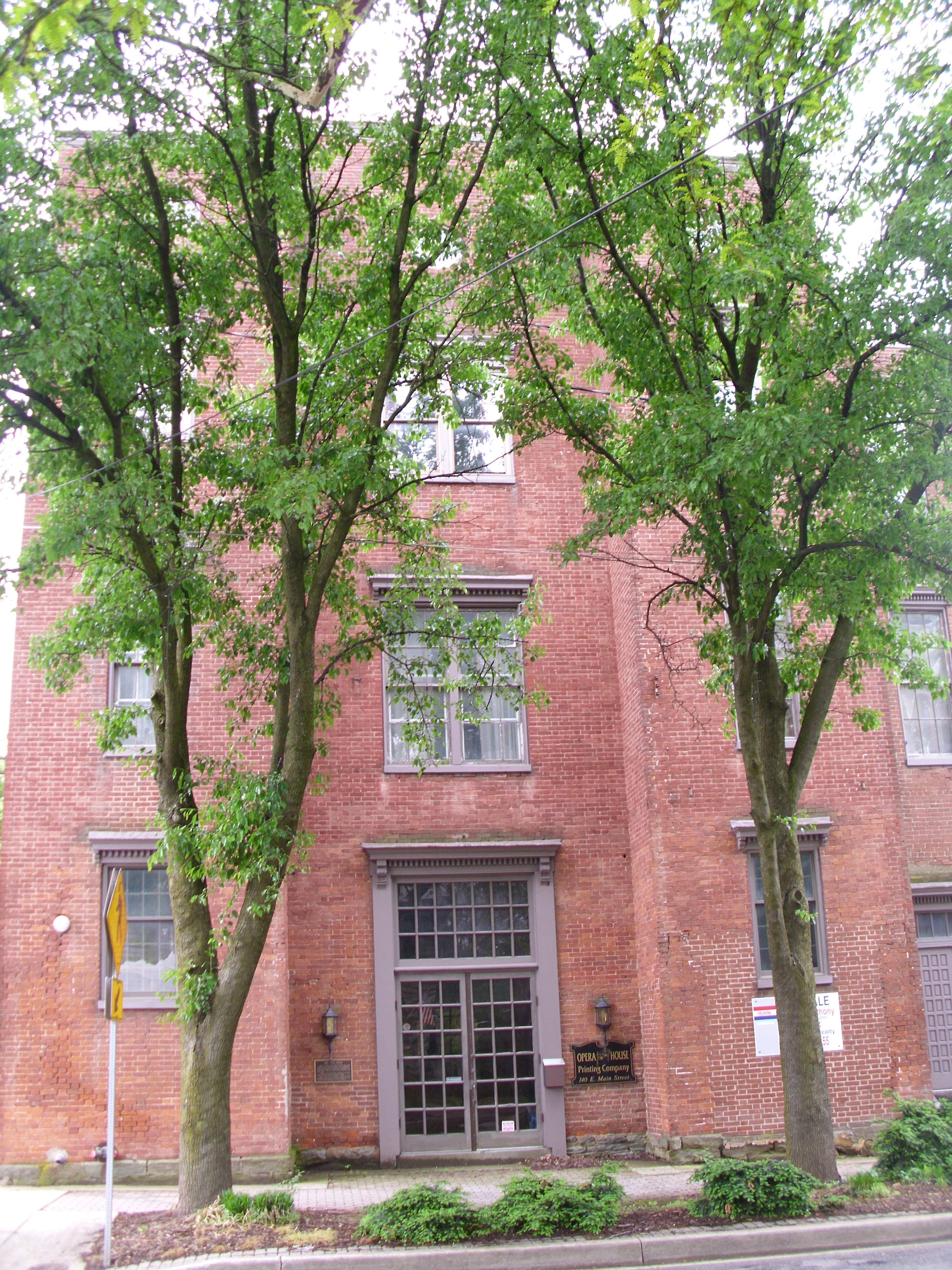
The Opera House was used by Lt. Pulaski Bowman and the New Yorkers as their head quarters.

Lieutenant Pulaski Bowman, who was in charge of the New York Provost Guard reported to Knight that there was no enemy about either in Gettysburg or Hanover. The Major, satisfied that all was secure, retired to the Westminster Hotel and Tavern, his unofficial  headquarters and settled in for some local comfort. There were some disturbances in the night, with reports coming in from the Hampstead and Manchester road pickets that the Southern cavalry was advancing, but investigation failed to turn up any Southerners. The Union troops settled in for the night. With the next day looking equally uneventful, Major Knight ordered the battalion’s blacksmiths to attend to the horses, many of whom had thrown shoes on the rough road from Baltimore.

Stuart needed to travel through Westminster to get to Lee. He knew that the information he had on the Union Army’s whereabouts was vital to the General’s tactical planning. One little bit of the Union Force he was unaware of was the small group of Blue Coats from Delaware in his way. He found out about them just after 4 p.m. when his forces overcame and captured a handful of pickets on the ridge road.

The advance guard of the Confederates under Fitzhugh Lee (General Lee’s nephew) entered the town and captured five of the Delawareans at Michael Baumann’s Blacksmith Shop. Again the Yankees were prevented from alerting their superiors. But  Isaac Pearson, a young lawyer from the town, who saw the Rebel force,  took quick action and reported them to the Yankees. Knight was unaccounted for, whether he was sick, inebriated or just flat out hiding is unclear (he had originally signed up to fight for the South, but deserted to fight for the North early in the War.) So when the warning cry rang out he was spared the glory of leading less than a hundred men against Stuart’s thousands.  That honor fell to Captain Charles Corbit.

Corbit was twenty-five years old, tall, strong, and well liked by his company of 4 officers and 89 enlisted men. Some of those men were out at the pickets, some were left mountless as their horses were being tended to and others had already been captured. He rallied what remained of his subordinates at the top of Main Street and moved east to find the enemy. Corbit sent Lt. D.W.C. Clark ahead with a scouting party of a dozen men.

Lt. Clark went through downtown, passing the blacksmith shop and turning left on Washington Road where they encountered Fitzhugh Lee and the front of Stuart’s force. Clark quickly turned around and rushed back to Corbit to report his findings… There was a LARGE contingent of Southern gentlemen just around the corner!

Instead of retreating Corbit drew his sword. He led his men head on against  the hordes of Confederates.
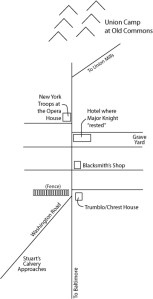
What little luck Corbit had on his side– besides the loyalty of his troops and his own bravado–was the layout of that area of town.  Washington Road hit Main Street at an odd angle and there was a sturdy fence that squeezed the cavalry men together into a narrower field of battle.

The other Delaware company, Company D, under Lt. Caleb Churchman, heard the gunfire and quickly joined the battle. But the Northerners were still hopelessly outnumbered.

The battle was fierce and short-lived. Corbit and his men fought off two or three countercharges before the sheer overwhelming number of Rebels won the day.

The Southerners pushed the 1st Delaware back up Main Street.

Corbit’s horse was shot out from beneath him and he was captured along with most of his company.

A few of the Yankees, including Major Knight, escaped toward Baltimore on the Reisterstown Road (Baltimore Pike)  a swarm of Confederate riders in hot pursuit. This caused some alarm in the city when the fleeing troops warned that the Confederates were about to invade.
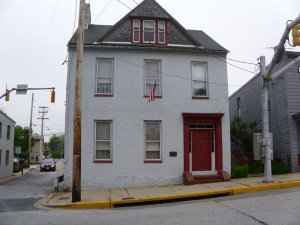
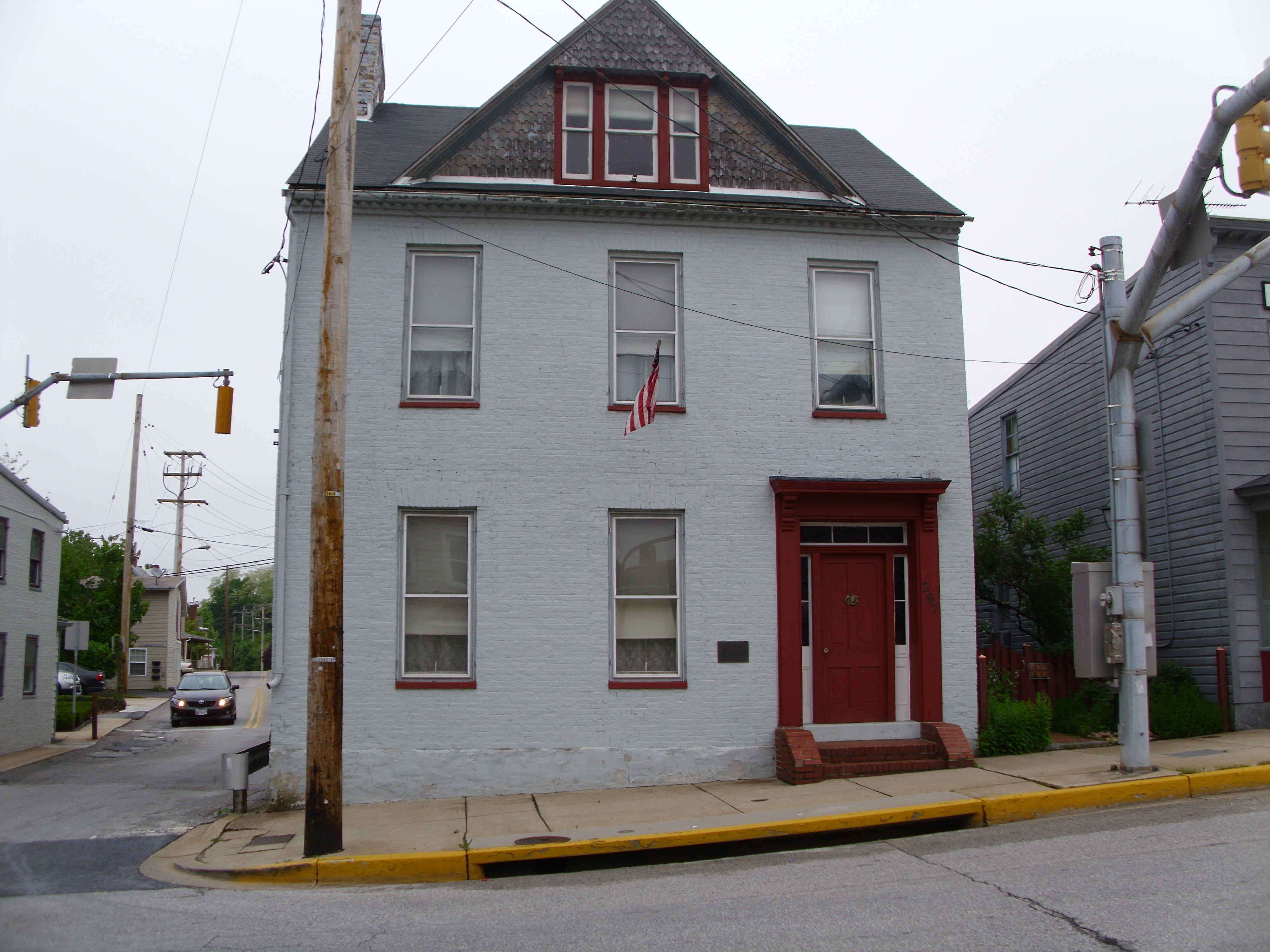
The Trumbo/Chrest House was in the thick of the action. There are still bullet holes in the side of the building.

The more practical outcome of the battle was that two officers from the 4th Virginia Calvary  and two privates from the 1st Delaware lay dead on the dusty streets of Westminster. (One of those Virginians, 1st Lt. John William Murry, Co. E. 4th Virginia Calvary, C.S.A., is buried in the Ascension Episcopal Church cemetery at 23 North Court Street.)  11 men were wounded and almost all the Northerners were taken as Prisoners of War, including Captain Corbit,  Lt. Churchman and Lt. Bowman. The Southerners overtook the camp at the Commons and confiscated supplies, both army issue and private, and intelligence.  The town and the surrounding farms were likewise foraged for supplies.

Then Stuart stopped for the night. For the first time in five days both the men and the horses in Stuart’s column had enough to eat and a chance to rest.

The Confederates continued on to Hanover  the next day, where Stuart paroled Corbit and Chruchman, and continued on to meet up with General Lee in Gettysburg.

But, did The Battle of Westminster delay Stuart from reaching Lee at Gettysburg?  Historian Eric J. Wittenberg thinks so. “That foolhardy charge cost Stuart half a day of critical time on his march. It absolutely had an effect on the time of Stuart’s arrival at Gettysburg,”

Still Wittenberg thinks  “Stuart did everything he reasonably could  to link up with Lee.”

So why does Stuart get so much of the blame for the South’s failure at Gettysburg? “The Calvary’s main job at that point of the Civil War was raiding and scouting,” Says Civil War enthusiast George Baker, III, adding, “Stuart’s lack of communication  basically left Lee blind in enemy territory, so he (Lee) didn’t know exactly where the Army of the Potomac was going prior to Gettysburg. The first day he didn’t know whether he was going up against a division or the entire army. That could have been the game changer of the battle.  Lee never publicly blamed Stuart for the battle’s loss, but When Stuart showed up late at Gettysburg…it was the closest Lee ever came to chewing anyone out.”
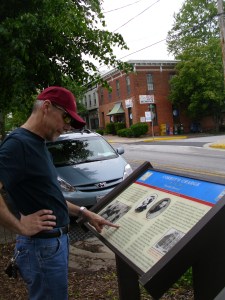
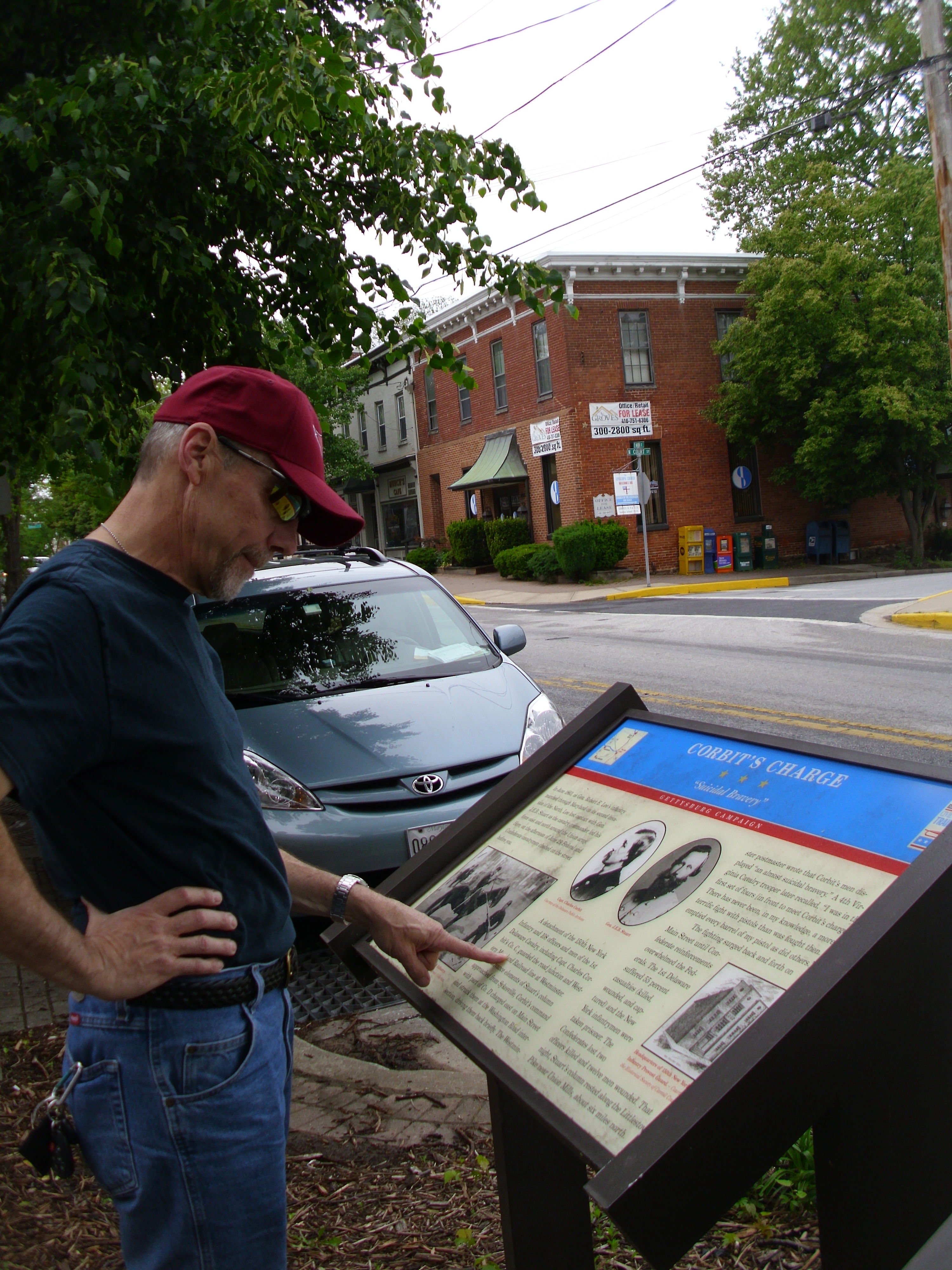
A Civil War history buff reads the Corbit’s Charge marker on Westminster’s Main Street.

Thought of the Day 6.12.12

“How wonderful it is that nobody need wait a single moment before starting to improve the world.”

–Anne Frank

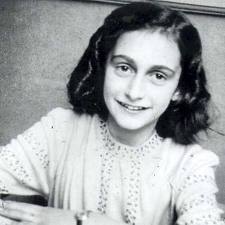
Anne Frank was born on this day in 1929. She would have been 83.

Anne, of course, was one of the millions of victims of the Holocaust in Europe in the 1930s and 40s. She and her family hid in the secret annex of a business her father once owned (and later managed) in Amsterdam.  Anne kept a diary detailing their time in hiding. On August 4th, 1944, after 2 years in hiding, the eight people living in the Annex were arrested and taken to concentration camps. Otto, her father, was the only one who survived. He returned to the Annex and eventually was able to get Anne’s diary published.

As her world started to close in on her Anne struggled with anger and resentment at what was happening, but the pages of her diary reflect an incredibly optimistic young lady. As she notes…
“in spite of everything I still believe that people are really good at heart.”

The diary has been published as book, made into a Pulitzer and Tony Award winning play, movie and television drama.

Here is a nice page by the Anne Frank Museum where you can learn more about Anne’s story.


FLLW Pope-Leighey House

In the 1920s and 1930s Frank Lloyd Wright (FLLW) began to look seriously at the way the common man lived. He wanted to design a series of affordable houses that were beautiful, streamlined, suited for their site and used local materials.  What he came up with was the USONIAN.

USONIAN houses were typically built as a single level dwelling. The houses had two wings. The public wing had a living and dining room. There was a  hearth wall that separated this formal area form the work area of the kitchen, “service core” of the house.  Then the house would bear off to a private wing for the bedrooms. FLLW’s goal was to build a USONIAN for $5,000 including the Architect’s fee, but, as with most  of his projects they tended to come in over budget. According the Wright foundation only 60 USONIAN homes were built.

One of those houses is the Pope-Leighy House in Virginia.

Loren Pope was a writer and copy editor for the Washington Evening Star when he approached Wright about building the house in 1938. He was  making $50 a week at the newspaper when he began to dream about owning a USONIAN home. Pope had a love for architecture and had read Wright’s Wasmuth Portfolio (a two-volume set of Wright lithographs with line drawings and schematics of his early buildings). He met Wright  at a DC event and convinced the architect to design him a USONIAN by writing him a letter.  He appealed to Wright’s desire to bring his artistic aesthetic to the common man (AND appealed to his ego) “There are certain things a man wants during life, and, of life. Material things and things of the spirit. The writer has one fervent wish that includes both. It is for a house created by you…. Will you create a house for us? Will you?” Wright’s answer was magnanimous “”Dear Loren Pope: Of course I am ready to give you a house.” 1

The Evening Star financed a loan of $5,700 for the 1200 foot house. (Down from Wright’s original proposal of 1800 ft.)

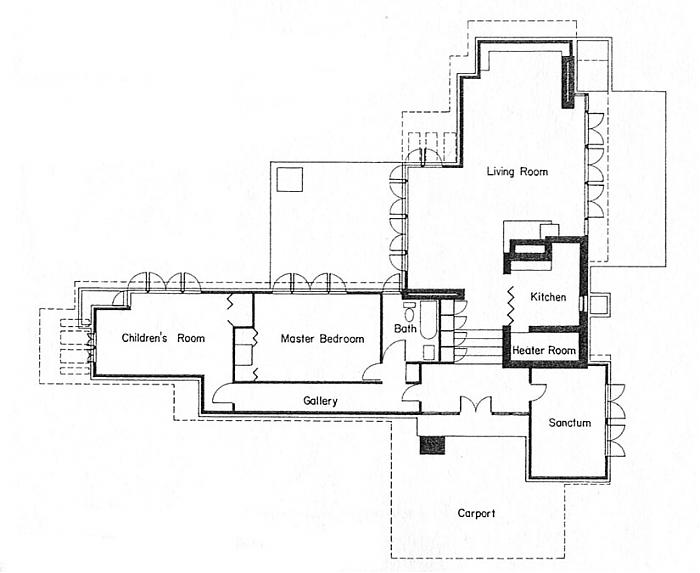
Floor plan of the Pope-Leighy house

Some of FLLW’s houses were build on octagons, but the Pope house was based on a 2 x 4 foot rectangular grid. There is radiant heating in the floor which was made of concrete and painted Cherokee Red (a favorite color of FLLW.)  Other favorite Wright materials are used as well, Tidewater red cypress, brick and glass. The exterior vertical mortar on the brick work was tinted red to match the red of the brick, while the horizontal mortar was left natural cream. That gave a strong horizontal feeling to the walls, and made the house look longer that it really was.

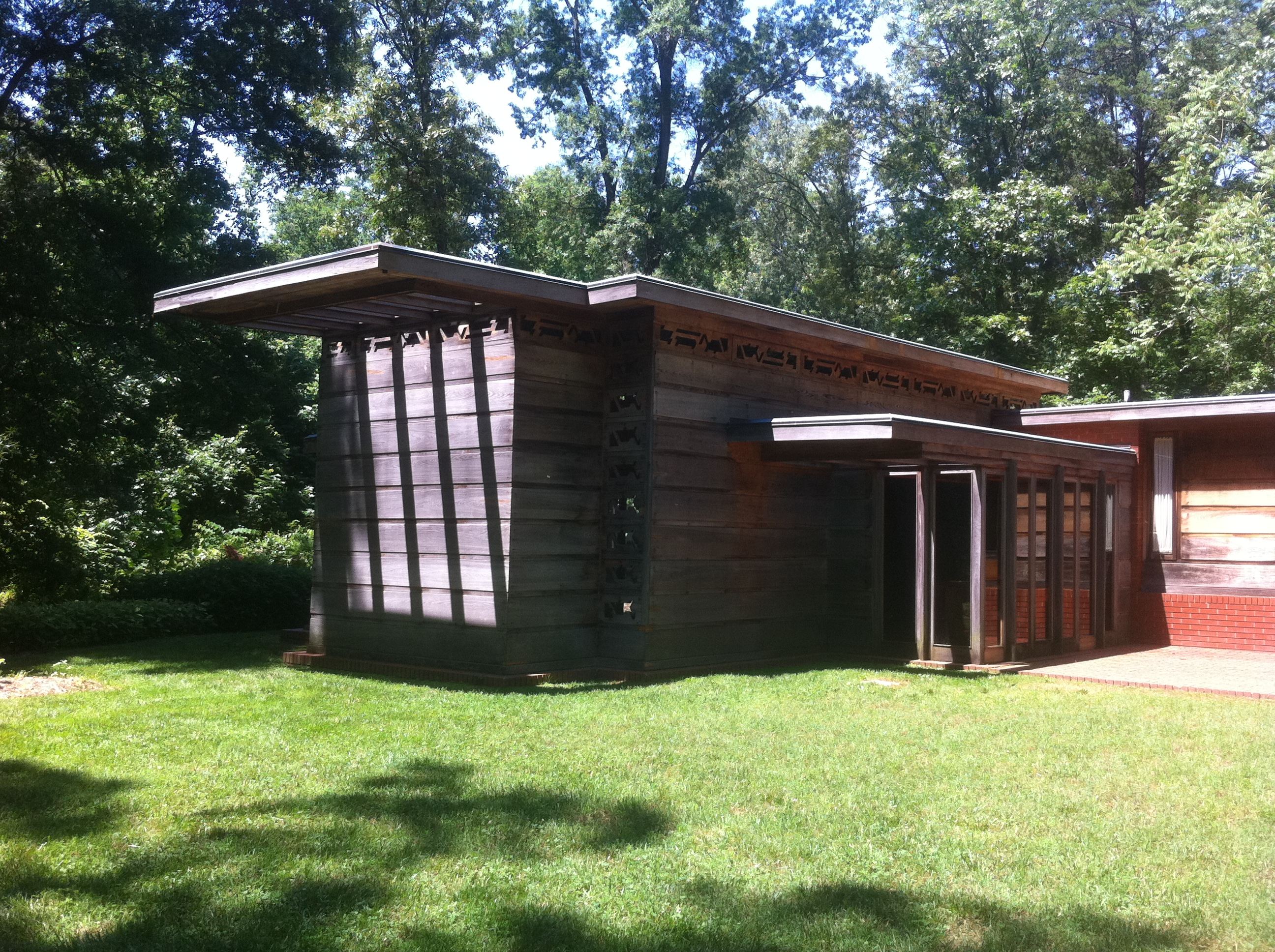
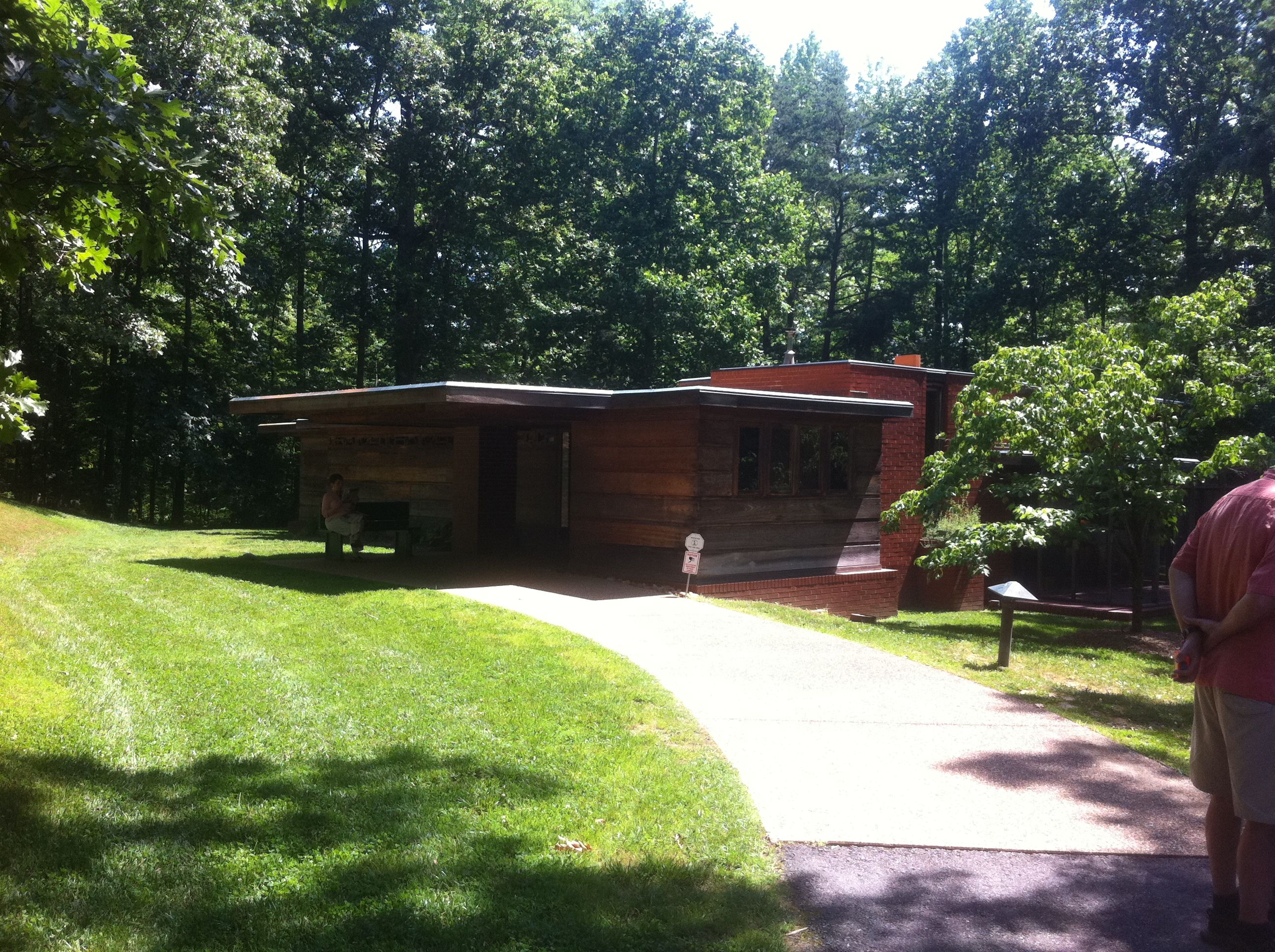
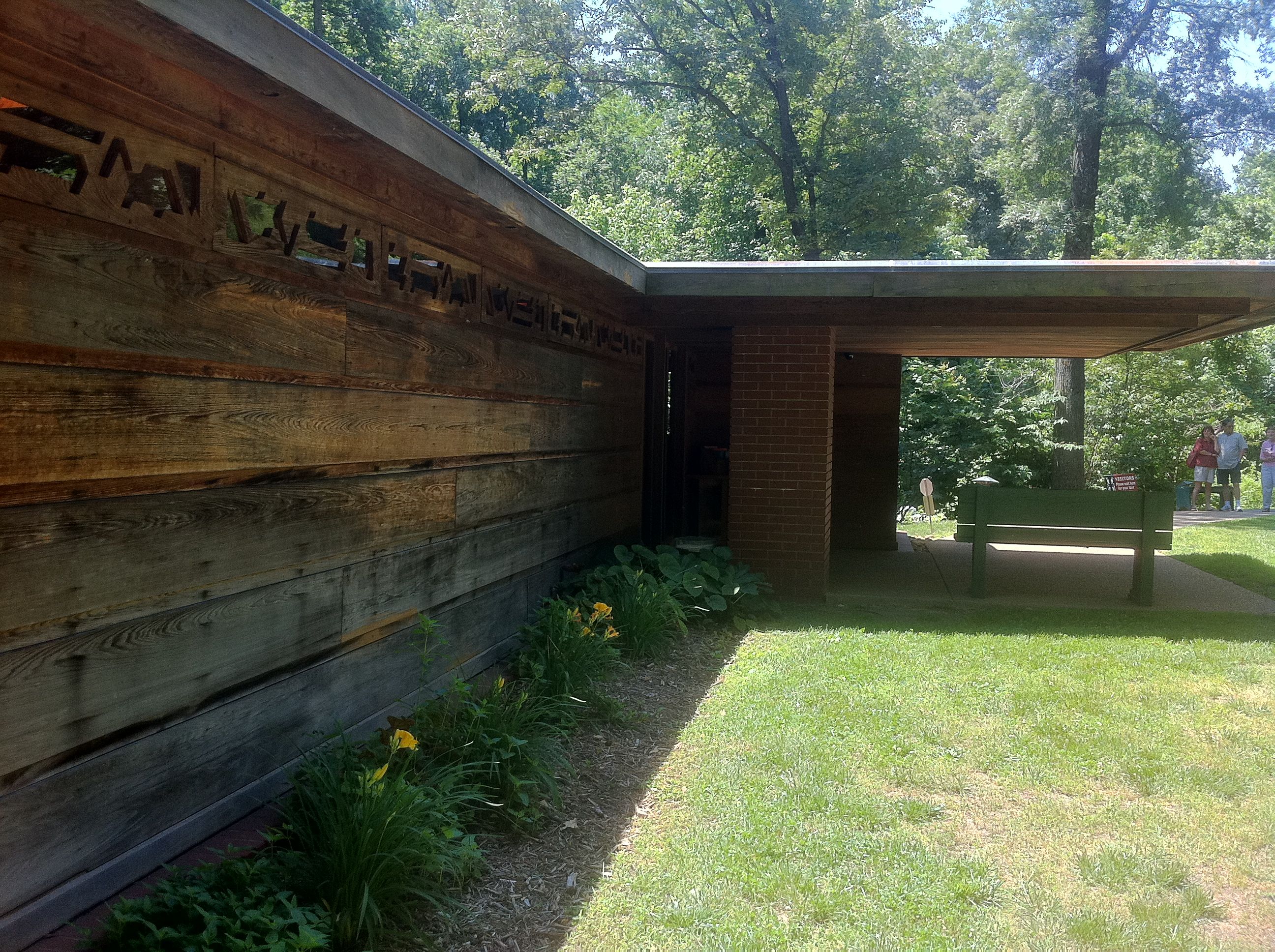
You approach the house from a shady cantilevered carport. This is the “Public” side of the  house Most of the walls on this side lack windows, except for a clerestory at the top. This allowed the family privacy. Wright created a unique clerestory design each house.

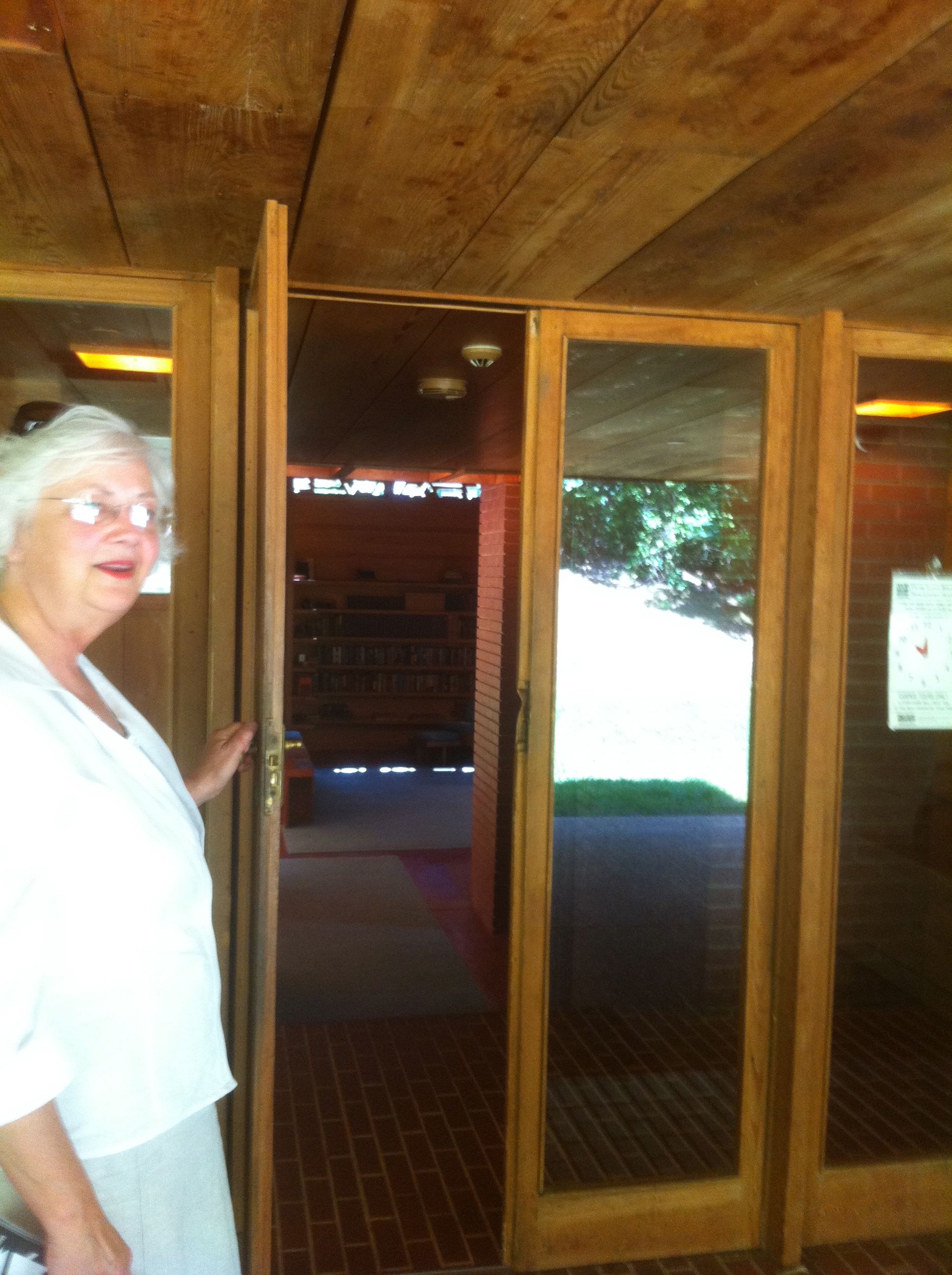
Our tour guide opens the front door to the Pope-Leighey house for us.

The ceiling of the carport and the entrance hall are low, but it doesn’t feel claustrophobic. You can see the living room directly opposite the front door and Wright used a sense of compression and release to encourage visitors to go through the entrance into the more important area of the house. The LIVING room was for living, after all. He brings you down a short set of stairs while keeping the ceiling line constant and suddenly the space feels massive. The ceiling height here is 12 feet.

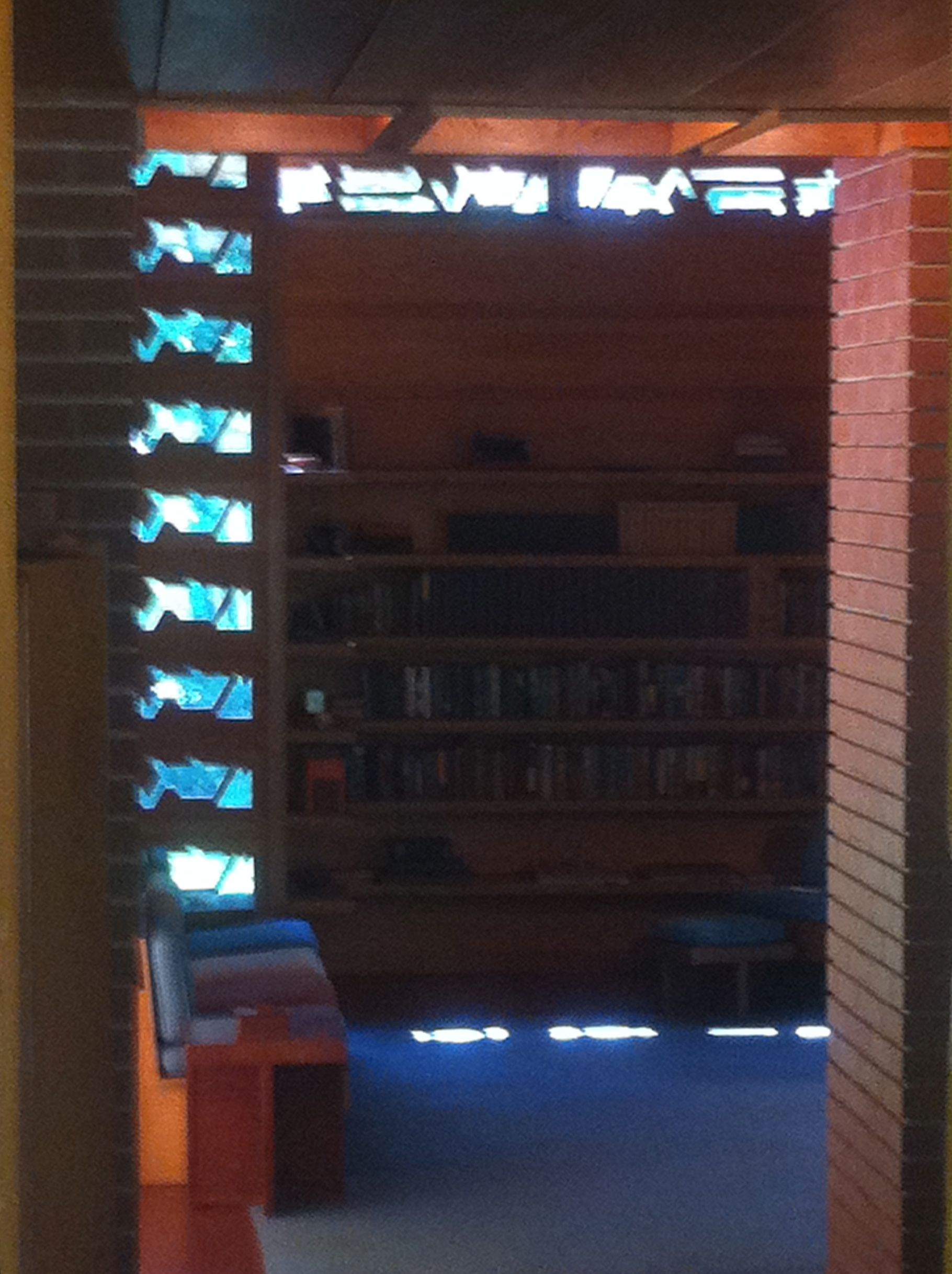
Living room as seen from the entrance.

The living room is warm and lush. The wood, which has been allowed to weather (as FLLW intended) to a stately silver on the outside is waxed to a wonderful rich orange inside. The light from the clerestory windows, the dining room nook to the left, and a screened in porch to the right wash this peaceful room with calm. The room is furnished by period pieces designed by Wright  some of which are original to the house (as well as a few reproduction chairs that visitors are allowed to sit on.)

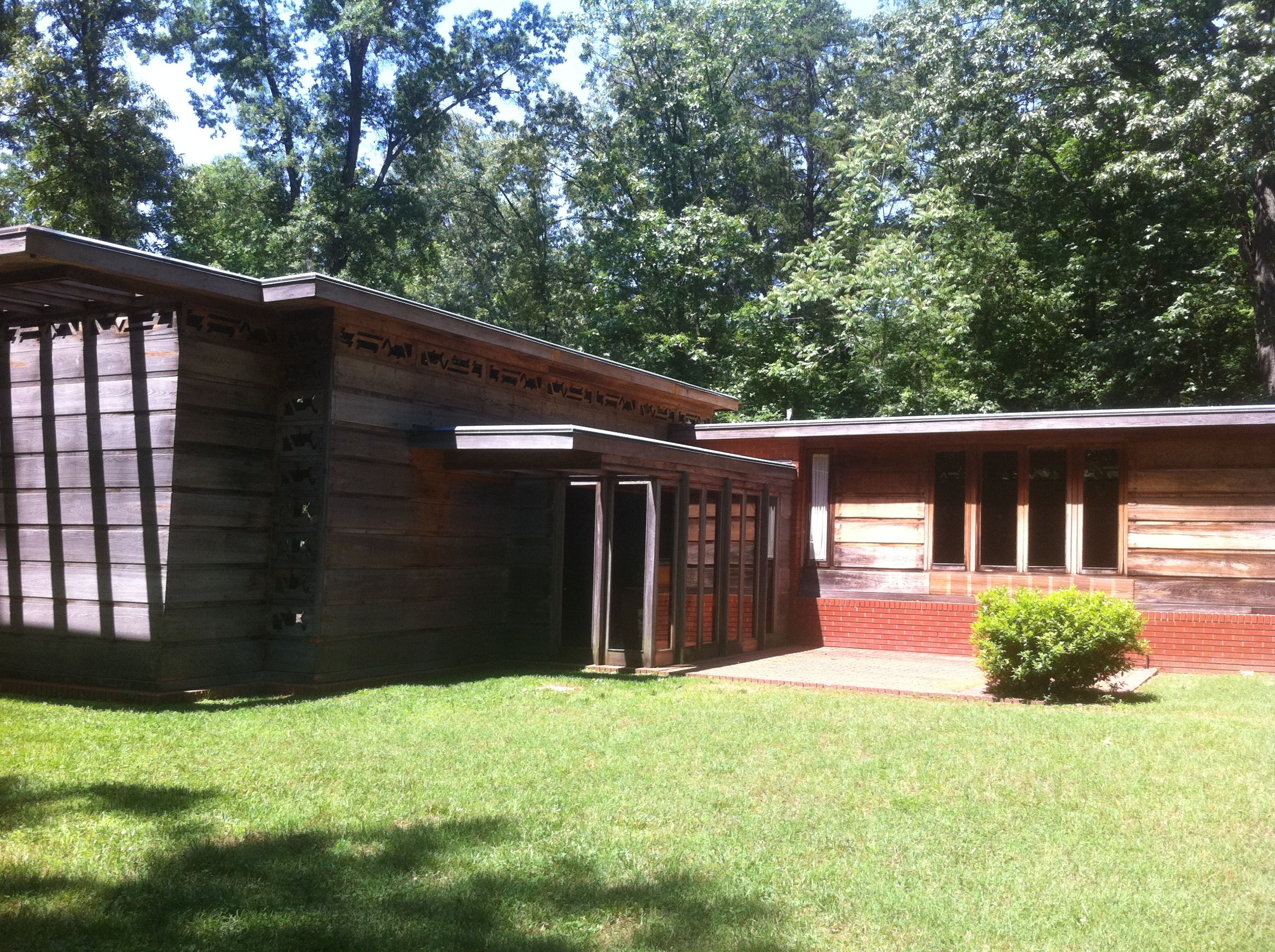
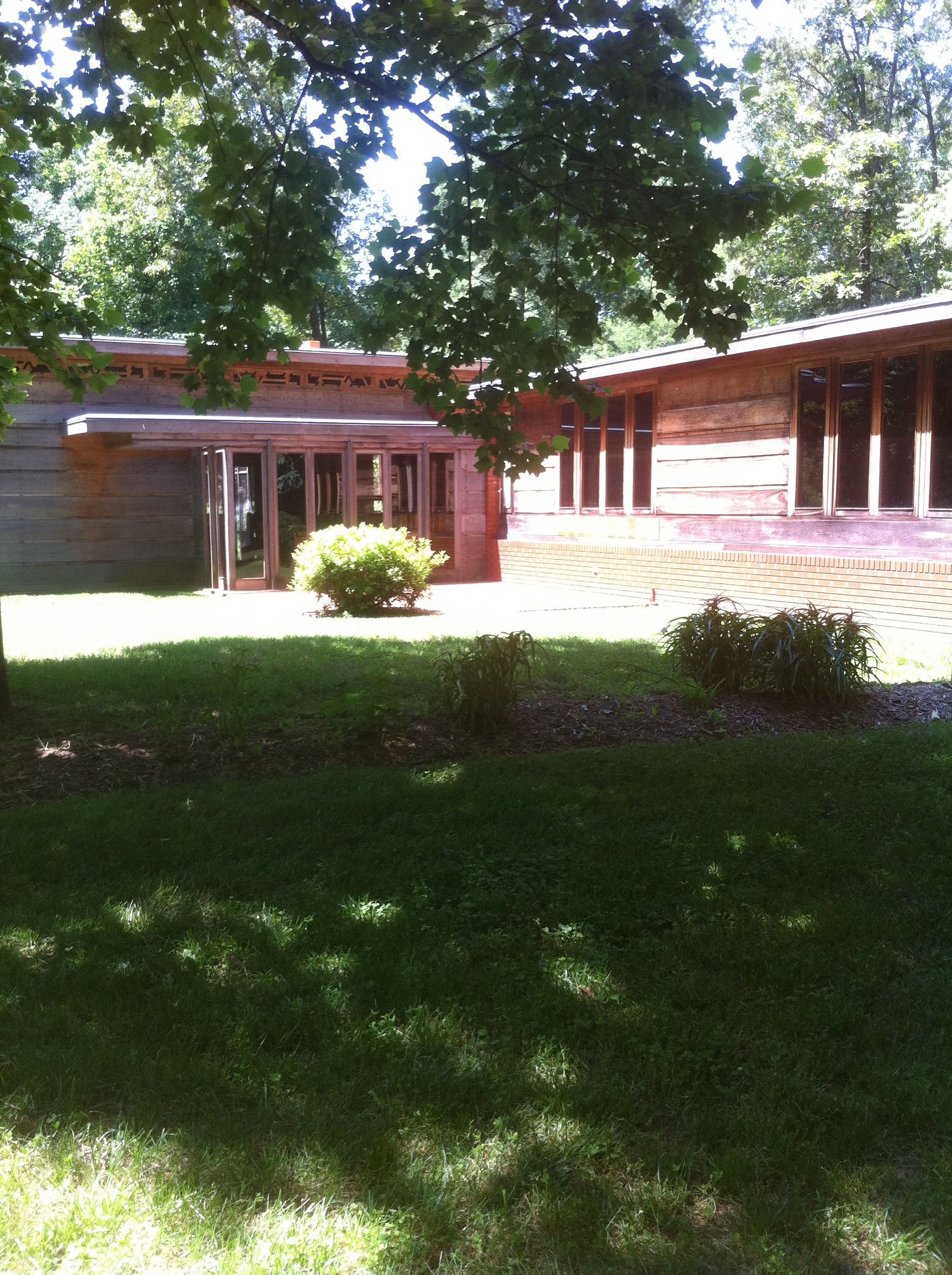
The house from the garden. The dining nook comes right out into the garden area blurring the line between indoor and outdoor space.

FLLW strived to blur the line between the inside and the outside. When the floor to ceiling windows of the dining room are open he accomplishes the goal. Diners are both in the dining room and in the garden at the same time. The corner window opens completely — with no center sash — to give an uninterrupted view (A concept he borrowed from Fallingwater.)

The kitchen is small according to modern standards, but it was typical for the time. The tall ceilings make the room feel a little larger than it really is. There is a long skinny window  at the end of the kitchen, and FLLW created an herb planter just outside. All Mrs. Pope had to do was open the window and reach out to pluck a few herbs to add to what ever she was cooking. There is also a small utility room off the kitchen.

Exterior of the bedroom wing looking to the front of the house. This public side of the house offers a lot of privacy to the inhabitants, with only clerestory windows (above eye level) for light and air.

Looking from the end of the bedroom wing to the crux of the building and the dining nook. The garden side of the bedroom wing has large, hip to ceiling windows.

Back up the stairs and to the right is a door that leads to the bedroom wing of the house. A long, very narrow hall with a run of clerestory windows  leads first to a small bathroom (the only one in the house), to the master bedroom and to the children’s bedroom. The hall is very skinny –about as wide as a passage way in a Pullman railway car — so large furniture had to be brought in through the windows.  The children’s bedroom is especially light. With a wrap around window and two additional clerestory inspired at the far wall. Built-ins, like a child’s desk and cantilevered bookshelves make this room a delight.

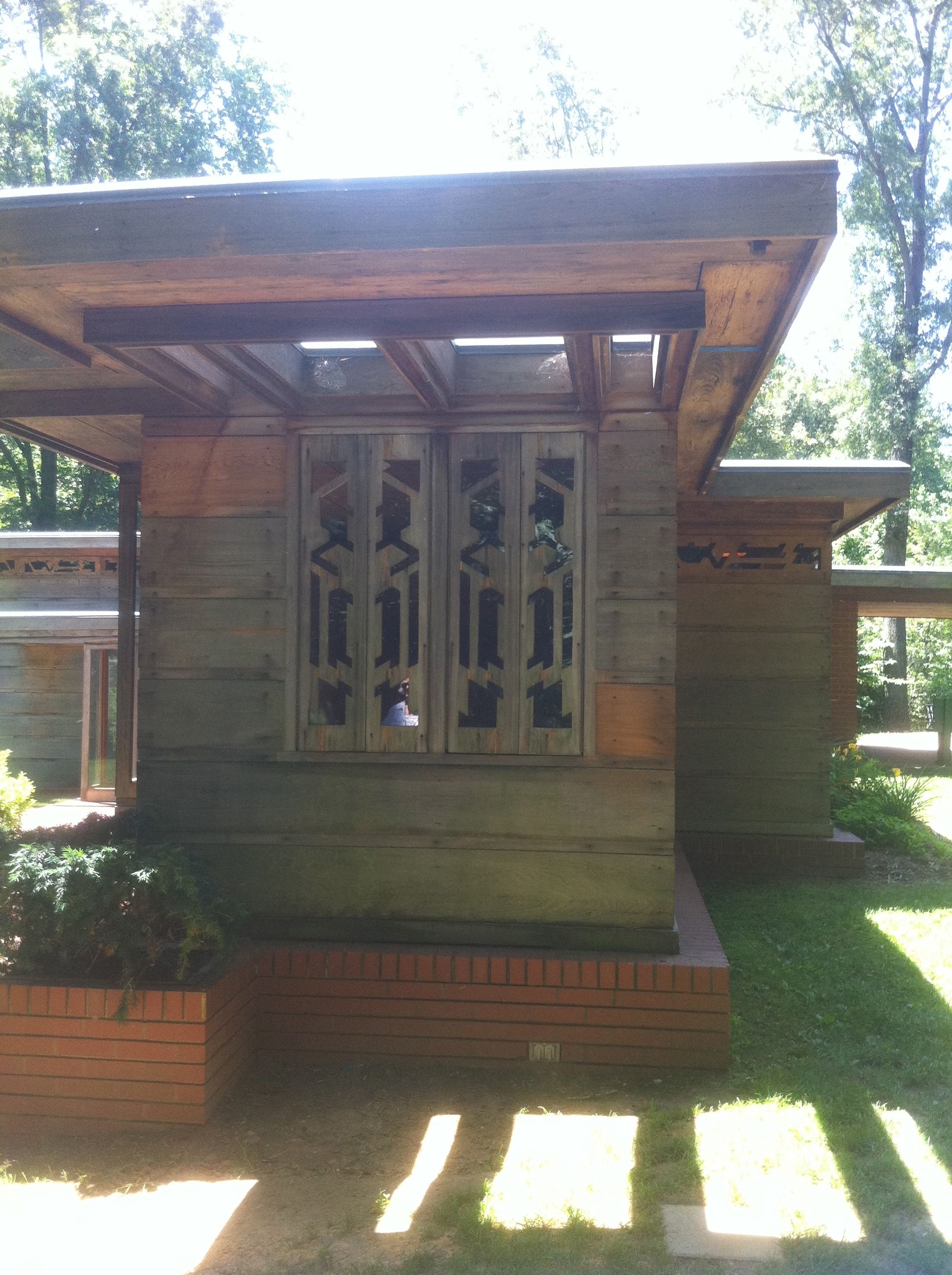
At the far end of the bedroom wing the children’s bedroom has it’s own cantilevered roof and special windows.

A room to the right of the entrance, opposite the bedroom wing was Mr. Pope’s Sanctum, his study, until the growing family converted it into a nursery for their child.

Loren Pope wrote an article about the design and construction process on the house and it was this article that inspired other middle income families in the mid 20th Century to turn to FLLW and seek out a USONION. The Popes had hopes that FLLW would build them a new, large home, but by the time the could afford one Wright was in the middle of building the Guggenheim. They only lived in the house for 6 years.

In 1947 The Leighey’s bought the home. They lived there happily until 1961 when they received notice that expansion of Interstate 66 would be going right though the property. The house would need to be moved or it would be torn down. After Mr. Leighey’s death in 1963 Mrs. Marjorie Leighey made a deal with the Trust for Historic Preservation and the house was moved to the grounds of Woodlawn Plantation by flat bed truck. (The masonry and concrete foundation are not original, as those could not be moved and were lost when I-66 was expanded.)  Mrs. Leighey continued to live in the house at it’s new location and gave tours on the weekend.  This first relocation proved to be troublesome as the house had been placed on an unstable marine clay foundation. So it had to be relocated a second time in 1995. Although this second relocation site is only 30 feet from the first is much more stable.

Now the house is situated on a piece of land that is very similar to the original plot. It faces almost the same site lines so the sun peaks through the windows just as it did when the Popes and Leigheys lived there.

Wright was delighted with the house. He thought it truly embodied this ideals of USONIAN design.

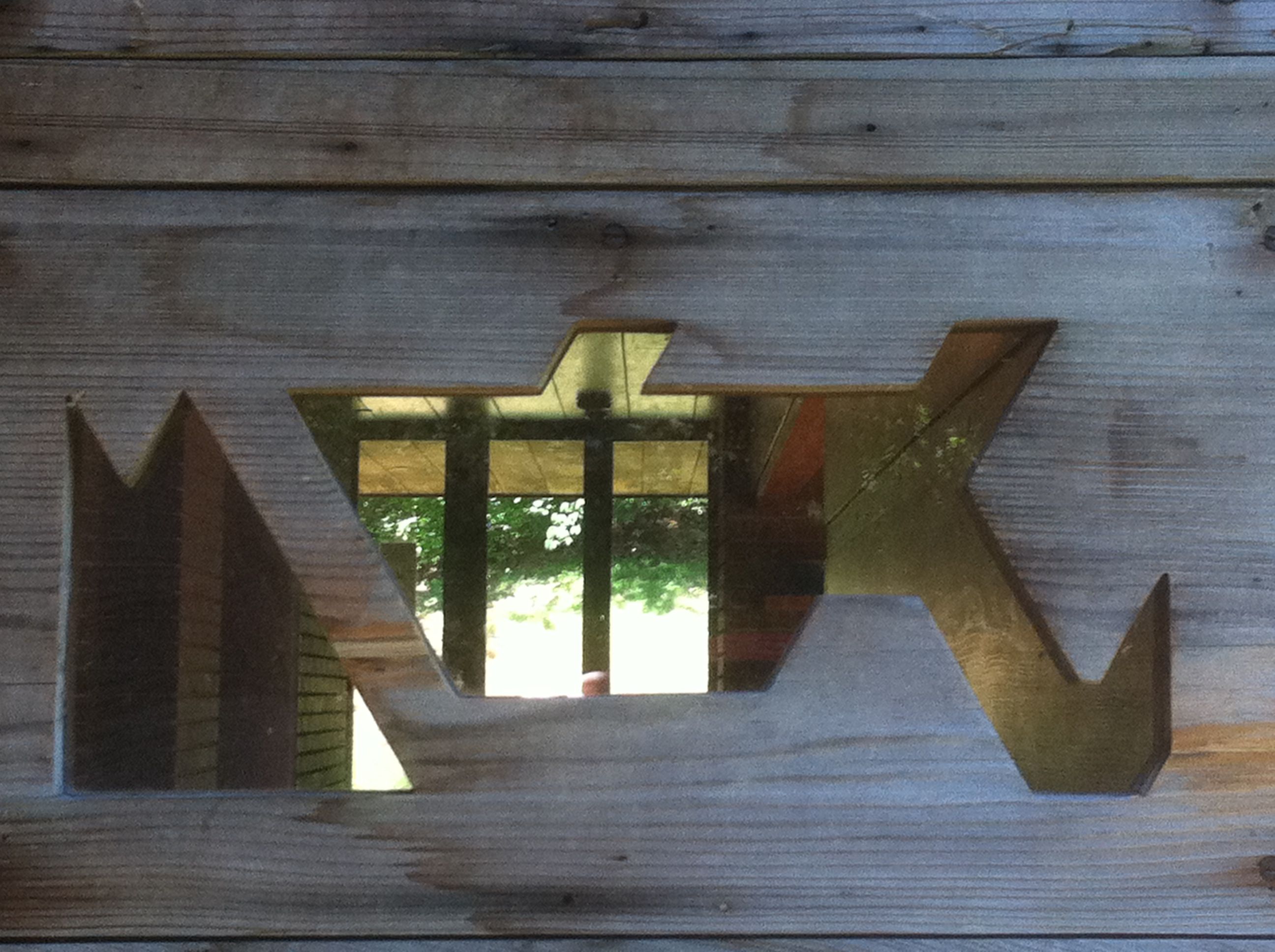
Motif detail for the Pope-Leighey’s clerestory. Looking from outside the living room toward the front door.

The house is open for tours Thursday, Friday, Saturday, Sunday and Monday (closed Tuesday and Wednesday) from 10-5pm. Tours are limited to 16 people at a time and cost $8.50 for adults. If you are visiting Mount Vernon the Pope-Leighey House is a short drive away and well worth the addition to your plans. (See the National Trust link below for more information)

Other pages you’ll like on the Pope-Leighy House:

•The National Trust Historic Site  Frank Lloyd Wright’s Pope-Leighy House page

• Peter Beers’s Pope Leighey House, 2003: Mount Vernon, Virginia page. This page has some wonderful interior photos, something we were not “allowed” to take on our visit. All my interior shots are taken from open doors and windows.

1 Pope and Wright correspondence, 1939, reprinted in The Pope-Leigh[e]y House (Washington DC: National Trust for Historic Preservation, 1969), pp. 12-15.


Thought of the Day 6.11.12

“The best way to observe a fish is to become a fish.”

Jacques Cousteau

Jacques Cousteau was born this day in Saint-Andre-de-Cubzac, France in 1910, he would be 102 years old.

Cousteau was a famous researchers and conservationist who brought the wonders of the “Undersea World” to life to millions through his books, movies and television shows in the 1950s and 60s.

He co-developed the Aqua-lung and was the captain of the Calypso  research vessel.

Picture of Jacques-Yves Cousteau.

Picture of Jacques-Yves Cousteau. (Photo credit: Wikipedia)


Thought of the Day 6.10.12

“Be a first rate version of yourself, not a second rate version of someone else.”

Judy Garland

Judy Garland was born today in 1922 , she would have been 90.

She starred in dozens of movies from 1929 to 1963, most for MGM.  She won an Academy Award for her Dorothy in “The Wizard of Oz” and a nomination for the award for her roles  in “A Star Is Born” and “Judgement at Nuremberg“. Other Garland favorites include “Meet Me In St. Louis“, “The Harvey Girls” and “Easter Parade.”


re-cropped screenshot of Judy Garland from the...

re-cropped screenshot of Judy Garland from the trailer for the film A Star Is Born. (Photo credit: Wikipedia)


Thought of the Day 6.9.12 Cole Porter

“Birds do it, bees do it, even educated fleas do it. Let’s do it, let’s fall in love.”

–Cole Porter

[“Let’s Do It”]


It is Cole Porter’s Birthday he would have been 119 years.

Porter was an icon of the Great White Way, and wrote both the lyrics and music for hundreds of songs including “Night and Day”, “Begin the Beguine”, “De-Lovely”, “You Do Something to Me”, “I’ve Got You Under My Skin”, “My Heart Belongs to Daddy”  “In the Still of the Night”,  “I get a Kick out of You,” and “You’re the Top”. His musicals include Anything goes and Kiss Me Kate (a take on Taming of the Shrew.)  Are you singing yet?

Cole porter smiling

Cole porter smiling (Photo credit: Lord Mariser)


Thought of the Day 6.8.12 Frank Lloyd Wright

“I’m all in favor of keeping dangerous weapons out of the hands of fools.
Let’s start with typewriters.”

–Frank Lloyd Wright

Today is Frank Lloyd Wright’s birthday, he would have been 145 years old.English: Frank Lloyd Wright, American architec...

English: Frank Lloyd Wright, American architect, portrait, head and shoulders, facing right. (Photo credit: Wikipedia)

[As a writer all I can say to that quote is “ouch.”]


Thought of the Day 6. 7.12 Nikki Giovanni

Nikki Giovanni

Nikki Giovanni (Photo credit: Tulane Public Relations)

I’m starting to post the Thought of the Day in the main section of the Blog (as opposed to as a Widget). What do you think?

“I really don’t think life is about the I-could-have-beens. Life is only about the I-tried-to-do.I don’t mind the failure but I can’t imagine that I’d forgive myself if I didn’t try.”

Nikki Giovanni
(Today is poet Nikki Giovanni’s birthday)